Paradigm: A policy and legal wrapper guide for creating daOs

Paradigm: How to package a DAO by law?
Source: Old Yuppie
This article is from wechat official account:Old yuppie
An important feature of Web3 is that blockchain-based technology enables individuals to organize in new forms, making the problem-solving process more creative, efficient and public. DAO is a classic example. Compared to the industrial companies of the 20th century, which relied on the separation of shareholder ownership and centralized control by managers and directors, the DAO offers a completely different template for organizational engagement: ownership and control can be combined through smart contracts, fluid membership, and transparent transaction channels.

However, setting up daOs involves more than code; It also requires skilled legal engineering to enable daOs to operate in the real world and to protect builders and contributors. However, the scope and complexity of the DAO's legal structure may stun the best engineers (and their lawyers). So, in this article, we summarize the scope of what DAO covers, which provides founders (and policy makers) with the first comprehensive overview of legal wrappers and pair it with a framework for understanding how these legal elements interact with popular DAO applications and interactions.
This paper focuses on:
Strategic considerations
The scope of the DAO's operation
The degree of decentralized governance adopted
membership
Activities related to the United States
The DAO of resources
Legal packaging
A non-corporate general partnership
The company
Limited liability company
Non-profit option
United Nations Association
Cooperation organization
Ownerless foundation
Special purpose trust
The pool of potential DAO wrappers is wider than many founders might think. It cuts across legal entities and forms normally associated with business associations, as well as registered and unregistered non-profit organizations. However, even in this diversity, we expect that most founders will have to engage in a similar process of reasoning when choosing legal packaging.
Key considerations will include the following:
- Scope and purpose of DAO operation.
- Legal risks and tax liabilities related to the operation of the DAO.
- Size and persistence of DAO members.
- The extent of decentralized governance adopted; As well as
- DAO resources.
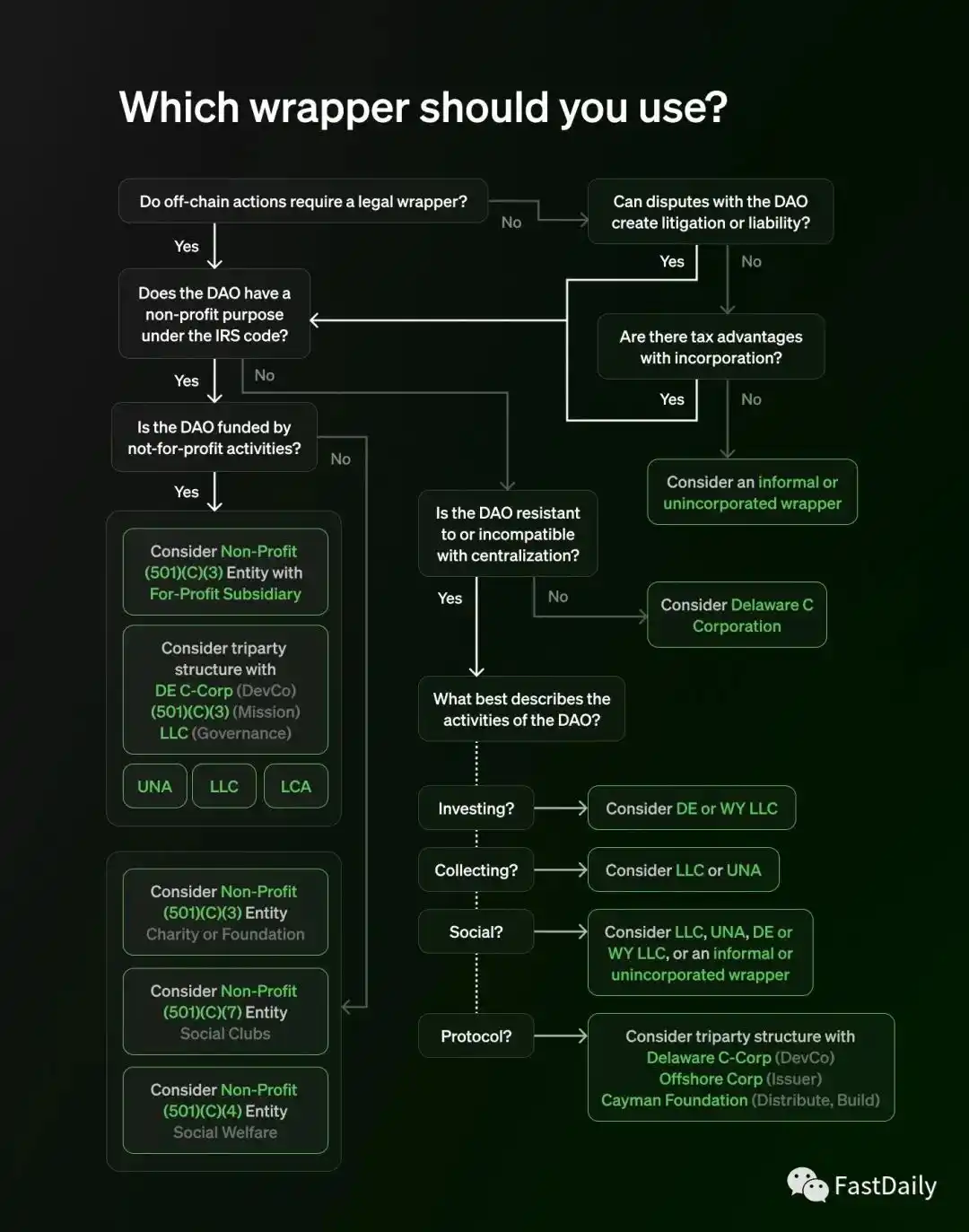
The scope of the DAO
The need for legal packaging depends largely on whether the DAO's sponsors intend the DAO to interact with the real world, and whether the DAO's activities create potential legal and tax liabilities for its members. While the informal approach brings huge benefits to DAOs in terms of speed and cost, off-chain business transactions often operate on legal tracks. From opening bank accounts and hiring lawyers and accountants to hosting IRL events, formal legal status is often necessary. The SPONSORS and founders of the DAO must specifically consider the scope of the DAO's business, not only on the chain, but also off the chain, and evaluate whether legal wrappers are needed for pure practicality.
The core of legal packaging is also a risk mitigation tool. Informality gives members little legal protection if daOs or DAO members are sued for negligence or other errors. Founders must assess these risks -- considering whether their DAO or the activities of the proposed DAO create potential liability scenarios that extend to risks for DAO members and participants. While no one can predict the future, the potential liability of a Tok-only dialogue channel DAO is fundamentally different from the potential liability of a DAO that controls a multi-billion dollar TVL protocol.
Sponsors of more ambitious projects will have to consider additional whether the ACTIVITIES of the DAO will create any tax liability that, if not prepared, could undermine or even threaten the financial health of the project. If income generated by a DAO is likely to be treated as taxable income -- including, for example, from Token sales, financial diversification, or pledging -- founders should analyze who might be liable for tax on that income and whether forming a legal entity could lead to a clearer understanding of who is liable and potentially allow for better tax treatment.
The degree to which decentralized governance has been adopted
Each type of legal packaging involves some centralization and reliance on external actors. Daos should consider to what extent their business can and will adapt to centralization, and in what ways. It is important to note that legal packaging offers a wide range of options to the extent that governance is evenly distributed among owners, members, and investors. DAO and its advisers must conduct a careful internal assessment of its objectives and carefully analyze the extent to which legal packaging can accommodate the actions of DAO Token holders to direct or influence anyone operating legal packaging without raising the risk of legal entities being ignored by the courts or controlling tax or other liabilities.
membership
A DAO's membership, both its size and its liquidity, will determine the available and appropriate legal packaging. Early on, daOs will have to assess the long-term arc of their business. Due to federal laws and regulations, many legal wrappers can accommodate a limited number of members, often far smaller than the number of members of some of the most famous DAOs. However, DAOs with large numbers of members can still take advantage of other types of legal wrappers and even use traditional structures as "island" entities designed to isolate specific responsibilities or for other purposes.
The fluidity of members joining and exiting daOs is also a consideration, which will influence which legal wrappers are most advantageous. Many legal entities require their shareholders or members to enforce contracts and reveal their identities in order to legally join the entity, which may not be appropriate for DAOs that seek to have a large, decentralized and anonymous membership base, which is determined by freeform Token ownership. However, there are some legal wrappings that can accommodate more mobile members and other "ownerless" entities, such as foundations or special purpose trusts, that can serve specific purposes, such as as vehicles for future giving. However, such packaging may be novel, and there is more legal ambiguity about how it works in practice.
Activities related to the United States
The extent of THE DAO's membership and activities in the United States also affects the extent of legal wrappers available. Some offshore legal wrappers, such as ownerless foundations or special purpose trusts, may be unusable or tax inefficient for projects with significant U.S. connections. Conversely, projects without significant U.S. ties may want to avoid relying on U.S. legal wrappings to reduce U.S. tax and liability risk. Therefore, DAOs should design governance mechanisms that control their legal packaging to ensure that they do not inadvertently impede the effectiveness of their legal structures.
The DAO of resources
From a practical point of view, DAOs should consider how much resources they want to invest in the legal structure. As mentioned above, there is no perfect solution, and complex DAOs may need a custom structure to be effective -- which can quickly become expensive. One potential option is to start with a simple structure that will evolve as the scope of DAO activities increases and more resources are available.
Legal wrapper
Once the founders understand the strategic considerations that apply to their DAO, the next step is to analyze which legal wrappers might be most appropriate. We have an in-depth analysis of these wrappers in our white paper, but here is a quick, very broad overview.
A non-corporate general partnership
One of the risks of operating a DAO without a legal entity is that the DAO is treated as an unincorporated general partnership. While this theory has not been proven in court and has faced some criticism, it has the potential to make DAO members liable for other members' responsibilities or DAO's responsibilities.
The company
The most common type of traditional legal entity helps insulate the TAX and legal liabilities of the DAO project, but there are some limitations in its structure (for example, it requires centralized governance in the form of a board of directors, etc.), membership, and the DAO is also subject to U.S. taxes. They have been used as leverage for DevCos or as isolated entities attached to DAOs designed to block specific responsibilities or other special purposes (such as subDAOs).
Limited liability company
Limited liability companies are also widely used in traditional contexts, but offer more structural flexibility in their governance than corporations. Limited liability companies can be managed by members and allow members to waive fiduciary responsibilities to each other, making them better at decentralized governance. Some states have even passed specific DAO LIMITED liability company laws designed to facilitate the operation of DAO. However, DAOs with very large or volatile membership will be limited in their ability to use LLCS, and even member-managed LLCS will have certain points of concentration (for example, tax representation).
Non-profit option
The DAO, which has a charitable mission, could also seek to form a nonprofit entity and designate it as a tax-exempt entity in the United States. This approach provides the DAO with corporate status and significant tax benefits, but limits the SCOPE of the DAO's activities and its ability to distribute profits to its members. Some programs use multi-entity structures that combine for-profit and nonprofit entities.
United Nations Association
A nonprofit association that is not a corporation is equivalent to a general partnership that is not a corporation, but may provide limited liability to its members in some states and may file a tax claim with the IRS as a corporation. It is also possible for unAs to provide a more flexible framework to facilitate membership mobility. Although United Nations associations are limited in their distribution of profits to their members, they may engage in some for-profit activities (however, this may cause them to lose their tax-exempt status). One disadvantage of UN associations is that their implementing regulations can vary widely from state to state, and there is little case law, making potential outcomes difficult to determine.
Cooperation organization
Co-operatives, a form of legal packaging with a long history in the United States, offer an alternative to the traditional corporate model, which separates ownership and control and typically requires all members to be both owners and direct contributors to the cooperative. Certain states have adopted more modern co-op frameworks that allow variations in investor membership and the one-member, one-vote standard, which has led some DAOs to experiment with this entity type.
Ownerless foundation
An ownerless foundation is a form of legal wrapper available in certain offshore jurisdictions that acts like a trust, controlled by a board of directors or governors, which in turn can be guided by a DAO's vote. The foundation can be used to provide grants to further the development of the agreement. However, DAO members will not become owners of the foundation or be "wrapped" by the entity.
To maintain tax advantages and other liability protections, U.S. programs have some restrictions on how offshore foundations can be controlled.
Special purpose trust
This legal wrapper is a trust available in some offshore jurisdictions that can be created by transferring assets to a set of trustees, who in turn can act on the voting instructions of the DAO's token holders. Fiduciaries are overseen by executors and can Sue if they misbehave. It is similar to an ownerless foundation in that it can serve as a vehicle for keeping and distributing assets, as well as entering into legal agreements. One obvious advantage of this structure is that it does not require any government filing, as it is purely a collaboration between those who contribute assets and those who will act as stewards of them.
The original link
Welcome to join the official BlockBeats community:
Telegram Subscription Group: https://t.me/theblockbeats
Telegram Discussion Group: https://t.me/BlockBeats_App
Official Twitter Account: https://twitter.com/BlockBeatsAsia
 Related Articles