Coinbase: The rise of cryptocurrencies in higher education
The Rise of Crypto in Higher Education
Original source: Coinbase
Tan.Z/Vivi, H. Frost Ventures
With the development of blockchain internationalization, blockchain education is getting more and more attention. Although there are few blockchain-related courses in China, universities around the world have started to conduct blockchain-related education and future development.
Regular docking with students and universities across the country is part of Coinbase's recruiting effort. We've partnered with Qriously and asked students directly what they think about cryptocurrencies and blockchain -- in this report, we outline the growth of the roster of cryptocurrencies and blockchain courses as student interest steadily rises.
Main Findings
Of the world's top 50 universities, 42% now offer at least one course on cryptocurrencies or blockchain.
Students from different majors are interested in cryptocurrency and blockchain courses, so universities are adding courses that cover multiple departments.
Coinbase's original research included a Qriously survey of 675 U.S. students, a comprehensive review of courses at 50 international universities, and interviews with professors and students.
When David Yermark, chair of the finance department at NYU's Stern School of Business, first offered his blockchain and financial services course in 2014, 35 students signed up, eight fewer than the school's typical elective. But in the spring of 2018, stern was forced to move the class to its largest auditorium as enrollment climbed to 230 students. To cater to students' interest, Jermak will offer blockchain courses over two semesters this academic year.
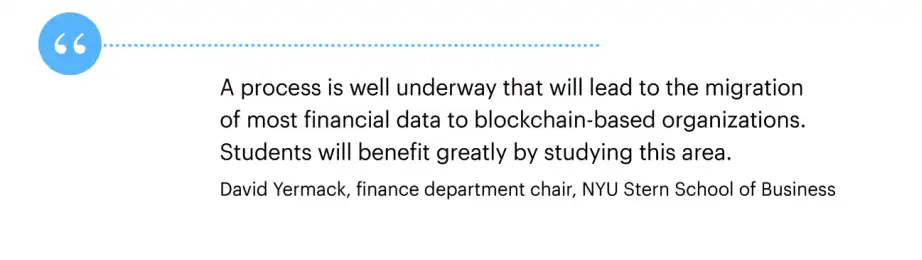
Mr. Jermak said he developed the course out of a burgeoning interest in bitcoin and cryptocurrencies. But other reasons quickly emerged, notably the need for people who understand cryptocurrency-related issues. Now, he sees his classes as a way to give students the skills they need for future jobs. "A process is well underway that will result in the migration of most financial data to blockchain-based organizations." "Students will benefit from studying this area."
Similar scenes are playing out at top universities around the world. Students are flocking to courses on cryptocurrencies and blockchain -- "distributed ledger" technology that makes decentralized financial systems work -- partly because graduates trained in these fields are in high demand in the job market. Universities are setting up research centers and adding more cryptocurrency-related courses in response, partly to meet the growing demand, but also because they now see cryptocurrencies as an area worthy of serious academic study. Coinbase reviewed course catalogs at the top 50 universities and found cryptocurrency courses spread across departments, including anthropology and finance -- not just computer science. In fact, the increase in courses in all subjects reflects student interest. According to a survey conducted by Coinbase in collaboration with Qriously, students of all majors said they wanted to take a cryptocurrency class. Nearly half of all social science majors expressed interest in taking a cryptocurrency course.
One possible reason for the diversity of interest in blockchain is its potential impact on society in many areas. "Blockchain combines theory and practice and can lead to fundamental breakthroughs in many areas of research," said Dawn Song, a computer science professor at the University of California, Berkeley. "It can have a really deep and broad impact on society in many different industries." To assess the current state of cryptocurrencies in higher education, Coinbase analyzed courses at the top 50 universities in US News & World Report. Our research focuses on undergraduate courses offered during the fall 2018 semester or the most recent semester for which online information is available.
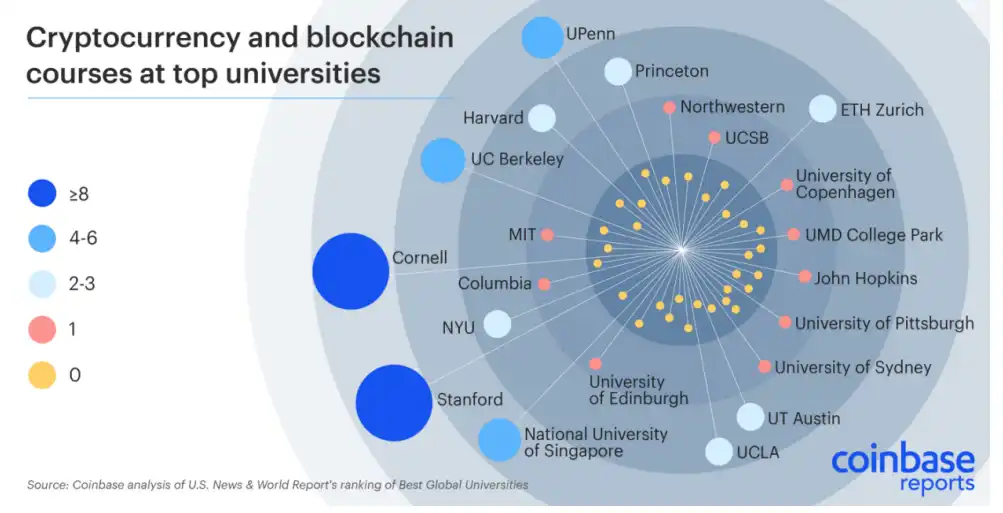
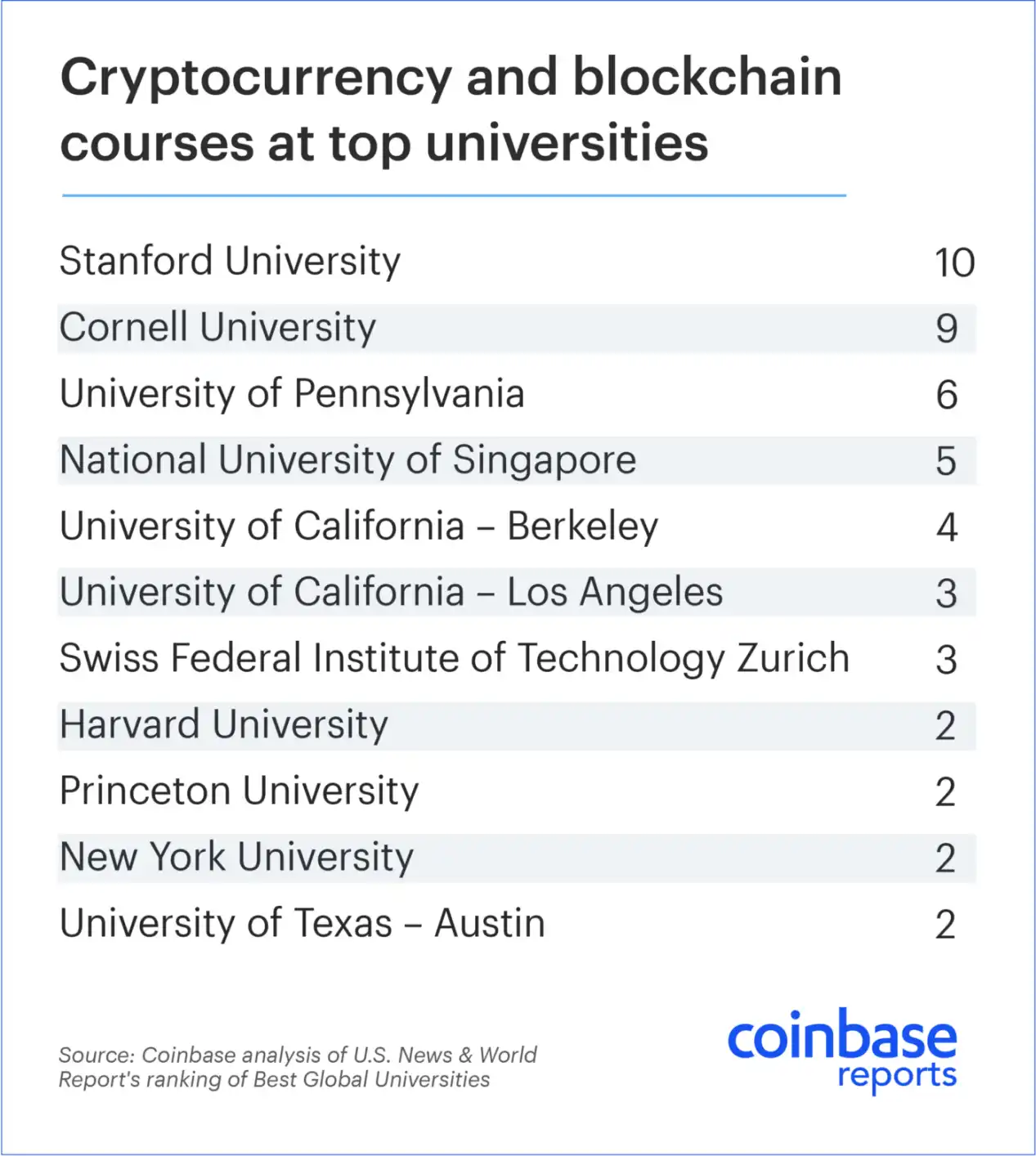
The study found that 42 percent of the top 50 universities offer at least one course on blockchain or cryptocurrencies, and 22 percent offer more than one. Expanding the scope of research to include long-term foundation courses related to cryptography, 70% of universities offer at least one course related to cryptocurrencies. Blockchain and cryptocurrency courses are particularly prominent in the United States. Of the 18 international universities on the list, only five, or 27%, offer at least one course on blockchain or cryptocurrencies. And only two -- the Swiss Federal Institute of Technology in Zurich and the National University of Singapore -- offer more than one course.
To meet the rising demand
Johns Hopkins university offers a business course on blockchain, and the school's syllabus shows that students can learn about the security features of blockchain and "the potential strengths and weaknesses of blockchain infrastructure as it applies to businesses and organizations." At Princeton, students can take an information security course that focuses on secure computing systems, cryptocurrencies, blockchains, and related economic, ethical, and legal issues. Cornell offers the largest number of courses covering cryptography, cryptocurrencies or blockchain. The 28 courses include "The Anthropology of Money" and "Introduction to Blockchains, Cryptocurrencies, and Smart Contracts," which deals with the cryptocurrency Bitcoin and "the technological phenomena it inspires and catalyzes," according to the course description. More than half of the research universities offer at least one course on cryptography, the study of creating and solving cryptographic information that is the key technical underpinning of blockchains and cryptocurrencies.
The technology used in blockchain is not necessarily new, song said, as it borrows from fields such as cryptography, game theory and distributed systems. Research and even education in these areas has been around for a long time.
Stanford University launched the Blockchain Research Center this summer, bringing together students and faculty from across the university's departments to research various aspects of cryptocurrencies and blockchain. Dan Bonnet, a professor of computer science and electrical engineering at Stanford university and co-director of the center, says that every time he speaks with a new team at the research center, he finds himself leaving with three new research ideas. Blockchain projects raise new technical questions that we wouldn't otherwise study, he says.
Other top-tier universities known for their strong engineering programs are also adding blockchain-centric courses and programs, such as the University of Waterloo, Georgetown University, and the University of Illinois at Urbana-Champaign.
Cross-departmental development
At Berkeley, Song taught a course on "blockchain, the economics of cryptography, and the future of technology, business, and law" in the spring 2018 semester. It is run jointly by the school's schools of Computing, business and law and enrolls an equal number of students from each school. Song said the course was so popular that the instructors had to turn away more than 200 students because their classroom could only accommodate 70 students.
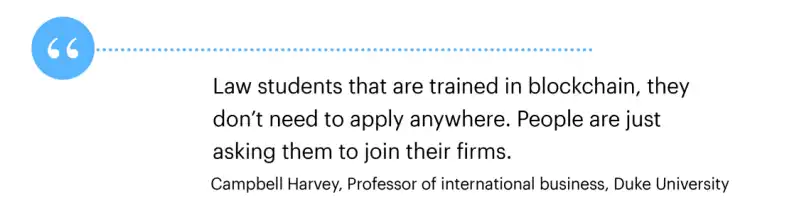
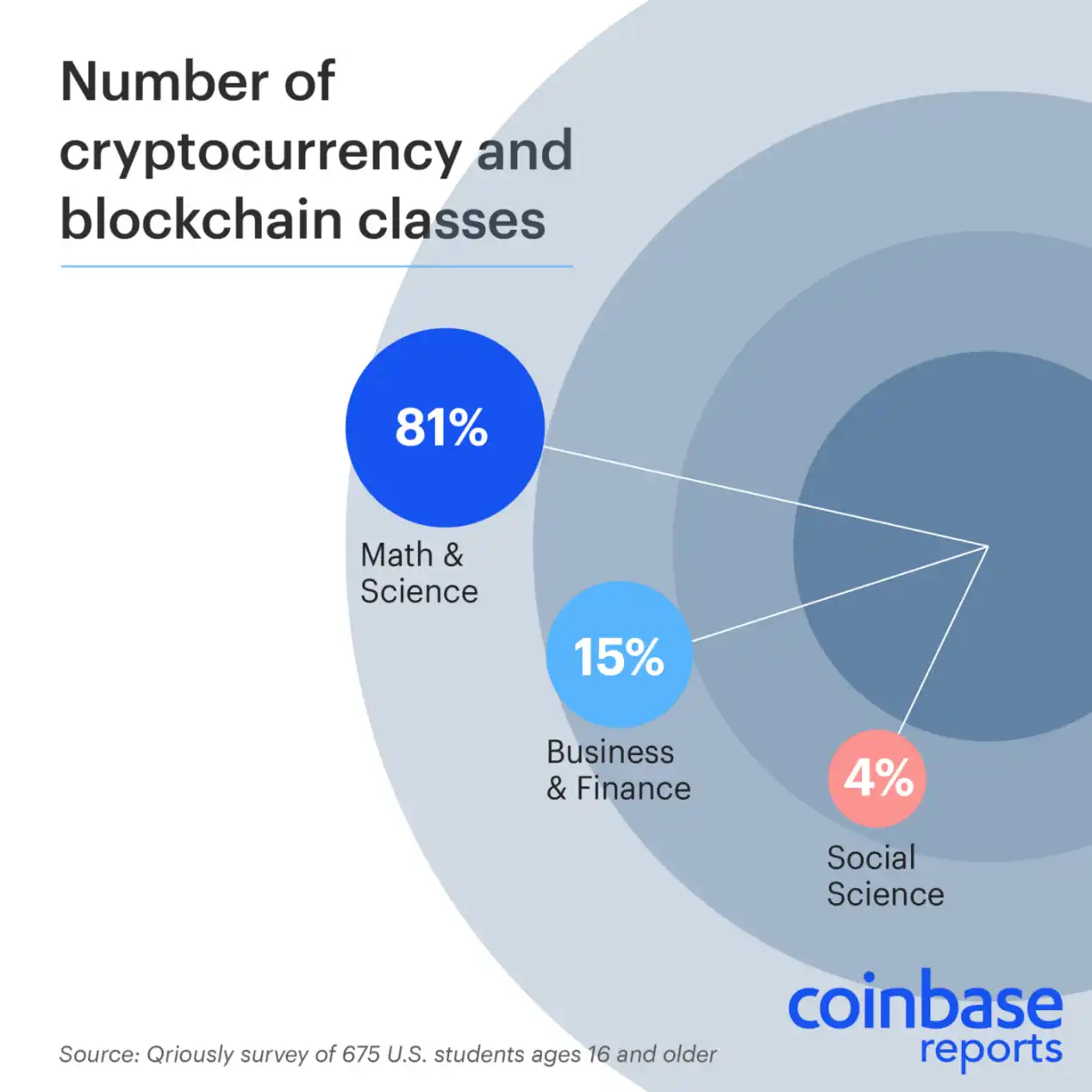
Given the number of departments currently offering courses on the subject, this cross-school approach could become a hallmark of cryptocurrency and blockchain education. Coinbase's analysis found that of the 172 courses listed by the top 50 universities, 15 percent were offered by the faculty of Business, Economics, finance and law, and 4 percent were offered by the social sciences, such as anthropology, history and political science. Harvey says students recognize how much this kind of knowledge is in demand now. If you graduate from law school, it's a tough job market right now, "Harvey said. However, law students trained in blockchain don't have to apply anywhere for people to ask them to join the company.
Students from all fields of study are interested in cryptocurrencies and blockchain. In fact, according to a Qriously survey of 675 U.S. students commissioned by Coinbase, 47% of social science majors said they were interested in learning about cryptocurrency, compared to just 34% of computer science and engineering majors.
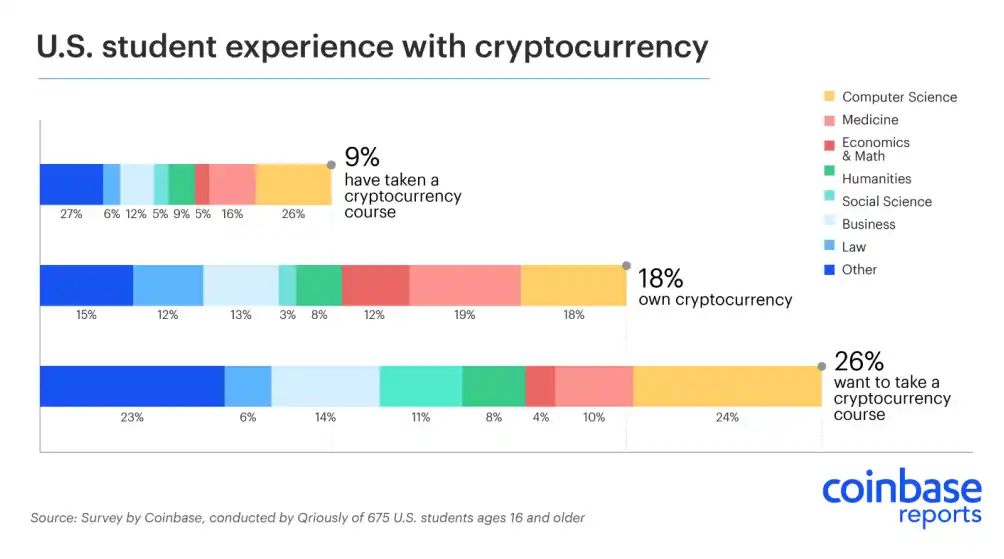
The survey found that 17 percent of computer science and engineering students have taken courses focusing on cryptocurrencies and blockchains, as have 15 percent of economics and math majors and 11 percent of business majors. Only 5 percent of social science students took such courses, the survey found.
Students view
Of all students surveyed, 17% said they thought their knowledge of cryptocurrencies and blockchain was good, compared with 9% of the general population surveyed at the same time. Similarly, 18% of students said they owned (or had owned) cryptocurrencies, double the share of cryptocurrency owners in the general population. A quarter of students said they would definitely or probably take a course focused on cryptocurrencies or blockchain.
Benedicte Bunz, a doctoral student at Stanford university who focuses on cryptocurrencies, says students are now eager to learn about the subject.
A cryptography class bunz took while studying for his master's degree in artificial intelligence sparked his interest in cryptocurrencies and gave him direction for his PhD. He says people often approach Bunz to ask if he can recommend someone with knowledge of cryptocurrencies for a job, but high demand means every candidate he knows already has a position. "If you're an expert in cryptocurrencies and cryptography, it's hard not to get a job," he said recently.
Forward-looking vision
People who are not currently studying cryptocurrencies in university have multiple sources to learn about them. Online learning sites like Udemy, Coursera, edX, and Udacity offer hundreds of courses, ranging from general courses like basic cryptography to more specialized courses on blockchains and cryptocurrencies.
The courses draw on the advice of a wide range of experts, including professors from the world's top 50 universities and practitioners in the field. Coinbase CTO Balaji Srinivasan, for example, is one of the industry experts in Udacity's nanodegree program called Becoming a blockchain developer. The programme consists of two three-month semesters focusing on "hands-on acquisition of job-appropriate skills"
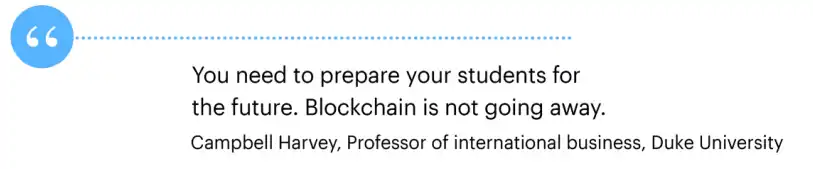
Academia is not known for its rapid development. But the maturity of blockchains and cryptocurrencies and their use by businesses and other groups over the past few years have shown that this is an area that has the potential to have a broad impact, professors say. And that is forcing universities to confront it. "You need to prepare your students for the future," says Duke's Harvey. "Blockchain is not going away."
A description of research methods
Coinbase analyzed the courses currently offered by the world's top 50 universities, as ranked by US News & World Report. Best Global Universities of 2018. Our research focuses on undergraduate courses offered during the fall 2018 semester or the most recent semester for which online information is available. The study excluded graduate students-only courses, leaving courses open to both undergraduate and graduate students, or not explicitly marked graduate students-only. The search term crypto is excluded from the list of statistics and course descriptions if the result is clearly not related to cryptocurrencies or the underlying mathematics of the technology.
To gauge students' perceptions of cryptocurrency, Coinbase also commissioned Qriously to conduct a study of 675 US students aged 16 and over. The general population survey included 6,011 respondents over the age of 16.
Translator's Note:
The blockchain industry is still in its initial stage, and is extremely short of relevant professional and technical talents. Therefore, the establishment of university courses can not only strengthen the belief of global blockchain, but also inject a steady stream of power into the industry.
The original link
Welcome to join the official BlockBeats community:
Telegram Subscription Group: https://t.me/theblockbeats
Telegram Discussion Group: https://t.me/BlockBeats_App
Official Twitter Account: https://twitter.com/BlockBeatsAsia

 Related Articles