When DAO scales up, how to deal with the seemingly "boring" practical problems?
Original title: "It's time for DAOs to get a little more boring"
Original author: Samantha
Original compilation: wonder @DAOrayaki .org, DoraFactory
DAO has always been synonymous with freedom, decentralization, borderless... . It seems that everything is so human. But in order to gain wider adoption, DAOs need to become boring.
Boring is not a derogatory term, but when facing human nature self-discipline and restraint.
For the DAO to grow, it needs to be very, very boring, as boring as the HR department . How much volatility, uncertainty, or excitement can DAO contributors tolerate?
Together with the DAOrayaki community to understand what is boring in DAO:
DAO needs to think deeply about all aspects of work, which is boring in the eyes of most DAO builders today, but in fact But it is critical to attracting more diverse contributors from all walks of life.
This includes liability, taxes, health insurance, paid time off, parental leave.
For example, U.S. citizens do not get health insurance through the government. So, if US-based contributors were to become full-time contributors to the DAO, they would have to make some tough decisions about how to get health insurance. For people with chronic illnesses, or even just wearing glasses, health insurance is essential. I believe health care issues are what prevent many US contributors from taking this step.
But there are many other factors that prevent contributors from taking action - responsibilities, time off Factors such as uncertainty about taxes, taxes, and retirement plans make it more difficult for contributors to join a DAO.
In order to provide some of these benefits to contributors, the DAO needs a legal wrapper. Sure, that sounds scary. But DAOs can start small—perhaps by introducing a day-off policy, or reaching an agreement on how to handle parental leave.

DAOs don't need to go all in on all the "boring stuff". They can start small, see what works, experiment and iterate, and build from there. If DAOs accept the boring side of the job—namely, all the legal work, compliance, and contributor benefits—they will open their arms to different contributors.
Let’s talk about a few important aspects of the boring side of DAOs so more people can Join the full-time DAO.
Break time: Paid time off and parental leave
Discussing breaks in a DAO might sound like an odd topic, since everyone theoretically works when it's best for them. But what about contributors who may not have that much savings in their wallets? What about those who need time off but can't stop working?
They need paid time off (PTO).
According to CNBC, 64% of Americans live paycheck to paycheck. That means 64% of Americans would not be able to work for a DAO if they were working non-stop. Globally, more than 684 million people live in poverty, and this does not include those above the poverty line who are struggling to make ends meet. DAOs weren't built for this massive group — in fact, DAOs are now built against them.
Imagine you are a young mother about to have a second child. You are considering joining a DAO. But you may not be able to take that step due to lack of parental leave, health insurance and time off.

From zakk .eth tweet
How DAOs can introduce paid time off, especially when some DAOs have Thousands of people and no clear path to profitability?
First, the DAO can designate who are the core contributors - perhaps they are full time in the DAO Contributors to work. This will shrink the number of people who accept PTO and make it more feasible for DAOs to offer PTO. A DAO could start small, perhaps with a two-week PTO per year for each contributor considered a core member.
This is just one way the DAO is starting to look into contributor benefits. Of course, for many DAOs, PTO is more of a long-term addition - they are not yet profitable, so they may not be able to offer it. But when it comes to the mental health of contributors and the overall success of a DAO, it can be of great help to start thinking about these finer details.
Medical Insurance Services
Contributors from countries that don't offer universal health care get in trouble when they work in jobs that don't offer health coverage. If you're young enough to use your parents' health insurance, or you have a spouse who can provide health insurance, that's fine. But with a large number of potential DAO contributors who do not fall into this category, DAOs are not a viable option.
Some contributors may obtain health coverage by purchasing health insurance from their state, but this is often very expensive. And this will be even more difficult for people with chronic diseases. Overall, the best way to get good health care at an affordable price is from your employer.
Opolis, a digital job sharing platform, is one possible solution. It offers health insurance plans, retirement plans, and other "corporate" benefits to individual contributors.
However, these plans can be more expensive than plans that receive coverage directly from an employer , and difficult to set up and use. Many contributors don't want to voluntarily form an LLC or pay the extra costs that come with non-employer-provided health insurance. Opolis is a great option, but it's very different from getting an all-in-one healthcare solution from your employer.
DAO is nowhere near capable of providing something like health care. However, they can take steps to help contributors find the best solution. They can guide new contributors through the Opolis process. Or, they could add Medicare to their long-term roadmap and look at steps they can take, such as creating a legal wrapper.
In the early days of a DAO, small steps are still important.
Retirement Plan
In the United States, many employers provide 401k retirement benefit plans (Translator's Note: 401(k) plans are set up by employers of laborers. Employees contribute a certain amount of salary to their retirement account every month. A financial institution's individual retirement account (IRA) or a new company's 401(k) account.), which means they put the same percentage of money into a retirement savings account as you do. While a 401k plan may not seem like a good deal to crypto earners accustomed to sky-high annualized prices, for non-native crypto earners who are uncomfortable with the highs and lows of the volatile crypto market, a 401k is necessary.
Due to the volatility of cryptocurrencies, if you put your entire retirement savings in it, it would be a dangerous place. But DAOs operate in the cryptocurrency space. Providing a retirement plan can be very difficult unless the DAO is completely on the ledger, which means they open bank accounts and use annual salary summary sheets for contributors to keep track of.
Will contributors get used to not having access to the wide range of benefits they are accustomed to in their normal jobs? Could there be generational shifts in what your employer does and doesn't offer? Or, will the lack of perks make it difficult for DAOs to gain near-mainstream adoption?
Alternatively, could the DAO provide some kind of crypto-native retirement plan? Given the events of mid-May 2022 (Translator's Note: Stablecoin UST Collapse Event), I daresay people will avoid stablecoins for a while.
Again, there are more questions than answers. Many DAO contributors today are young, so they may not be thinking about retirement planning. But since youth is the best time to start saving for retirement, this seems like a hole for future full-time DAO jobs.
DAO helps contributors build their own retirement plans independent of their employers. Maybe an advisor can come in and support a DAO contributor who needs help getting started with an IRA. Retirement savings solutions look like the wrong choice for DAO contributors right now, but I hope there will be crypto-native solutions in the near future.
Responsibility
Many DAO contributors want DAOs to fly under the radar, independent of any taxation, run as autonomous state-like entities, and bypass any regulation. Unfortunately, the opposite is true.
Marta Belcher is a guest on the podcast DAOn the Rabbithole where she talks about "Laws of the Earth," or The laws of the traditional, non-crypto world still apply to DAOs, even if we don’t want them to. Even if DAOs want to be above and separate from the law, they actually need to function in the "real world" legal arena in order to survive without the wrath of the legal system.
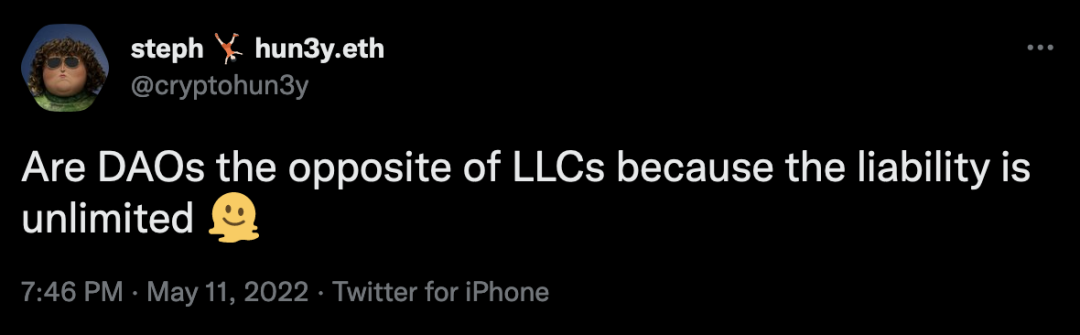
Tweet from Steph sharing his thoughts on being in a What legal protections DAOs feel
Today, DAOs are still trying to circumvent the legal system. But ultimately it means that all contributors in a DAO are responsible for the actions of the DAO, just like in a general partnership. According to Investopedia, "In a general partnership, the partners agree to unlimited liability, which means there is no upper limit to liability and can be met through forfeiture of the owners' assets."
This is the reality of DAOs today: Contributor assets may be confiscated.
If you haven't learned this yet, you need to be quite aware of your fellow contributors Big trust that they won't do anything that will get your DAO sued. Even if you trust your peers, getting sued is not something you can plan or predict.
What are the options for DAO?
They can be in crypto-friendly places like the Cayman Islands or the Marshall Islands Jurisdiction of Incorporation. Alternatively, they can go the Wyoming or Tennessee LLC route. They can set up a separate legal entity, such as a Swiss association, to handle contracts and agreements for them.
These choices can be complicated, but when it comes to protecting your DAO the responsibility of the contributors , they are necessary. Before making any legal choices for your DAO, I recommend reading a16z's Legal Framework for DAOs.
Taxes
In Taxes in DAOs have been a topic of discussion since before there were DAOs - just look at this Reddit thread from seven years ago. But when it comes to taxes, real world truths start to creep in.
The tax conversation is related to the legal packaging conversation: no one wants to get involved, but for the sake of contributors and their Asset security, this is necessary.
Today, many DAOs fly under the radar, or out of legal paperwork. But some DAOs have begun to explore corporatization and legal packaging — MakerDAO, for example, has had discussions around how to create a legal entity to sign contracts and interact with other external entities.

Chapman's tweet about DAO tax uncertainty
If a DAO does become " Legal", how will their contributors be taxed? These contributors may be outsourced, which means they must file taxes with a 1099. Contributors will pay 100% of the tax instead of the 50% they would have paid as W-2 employees (the annual work form the employer sends the employee). This is another thing that keeps contributors away from DAOs — outsourcing pays more taxes than employees at traditional companies. If your DAO becomes an LLC but considers all contributors "outsourced", the tax implications for those contributors are significant.
However, if the DAO starts issuing W-2s to all US employees, things will change very quickly very complicated. When a DAO has contributors from all over the world, how will they handle taxation and compliance without completely draining their treasury? What about contributors who work on multiple DAOs? And, if the DAO were to accommodate people from all over the world, where would they choose to be based?
Things are a mess - there are no easy answers. But the sooner you plan your DAO's legal framework, the better it will be for your contributors. It might be easier to start a legal framework with a small group of contributors than to go backwards and do it with a giant DAO.
What would be the most boring DAO but [probably] with top contributors
This DAO has a legal wrapper. It pays taxes and does all funding "on the books", so contributors are never unsure of where they stand in the DAO or if they are safe.
This DAO may not have a token to avoid securities issuance issues. or it may have Token , but distributed on a more limited, secure basis. Instead, it might have NFT voting or have a whitelist of addresses that can vote (e.g. members of a DAO).
This most boring DAO will help their contributors build Opolis or some other healthcare system. It will host conferences to help young contributors build their IRAs, or perhaps start exploring crypto-native solutions.
This "boring" DAO may also have the top contributors in the ecosystem. It hosts different contributors, not just those who can take financial and legal risks.
Being bored pays off, right?
No one wants to be bored until they need to
Builders in the web3 space often don't want to look at the boring parts of DAOs. But in order to attract more diverse contributors with unique skill sets, they're going to have to dig into all the boring stuff. And once regulation steps in (probably sooner than we think), the boring side will be absolutely necessary.
A source of information on the boring side of DAO
A Legal Framework for Decentralized Autonomous Organizations (pdf) by a16z
Legal Issues in DAOs, DAOn the Rabbithole podcast episode
Legal Entity Solutions for DAOs, Decentralized Law interview with Adam Miller
Original Source
Welcome to join the official BlockBeats community:
Telegram Subscription Group: https://t.me/theblockbeats
Telegram Discussion Group: https://t.me/BlockBeats_App
Official Twitter Account: https://twitter.com/BlockBeatsAsia
 Related Articles