Tools that DAO governance contributors should know about
DAO Governance Contributor Toolkit & NBSP;
Original author : Raphael Spannocchi
Tian zhi xuan @DAOrayaki.org, DoraFactory
DAO governance can be scary. We all know that. Some of our suggestions were applauded and some were vehemently opposed, but one thing is for sure, there is nothing better than the depth of DAO governance to directly influence the direction our field is going.
So, dear reader, if you are on the fence about whether to jump in and contribute to DAO governance, let us warmly encourage you: "LFG!"
This article will introduce the tools of the industry and how to use them well. As a professional governance team, we have been involved in more than a dozen DAOs. Governance contributions are our daily routine. This article represents our best practices and is intended to provide a starting point for new contributors and a place for experienced experts to discuss them. Let's start at the beginning. If you already have experience with DAOs, skip chapter 1.
What is DAO governance?
DAO governance is the process of guiding a decentralized autonomous organization. Because of its decentralized nature, the DAO should not have central leadership (at least in theory). In practice, the founders and most active members determine much of the agenda and thus what needs to be done. Especially in the early startup phase, the founder will be responsible for doing everything.
As the DAO grew, more and more contributors took on the task and began to shape the overall operation. Daos are more mobile than traditional companies, and influence is easier to gain but also easier to lose. One major difference from traditional organizations is that we cannot force other members or sub-units to perform certain tasks.
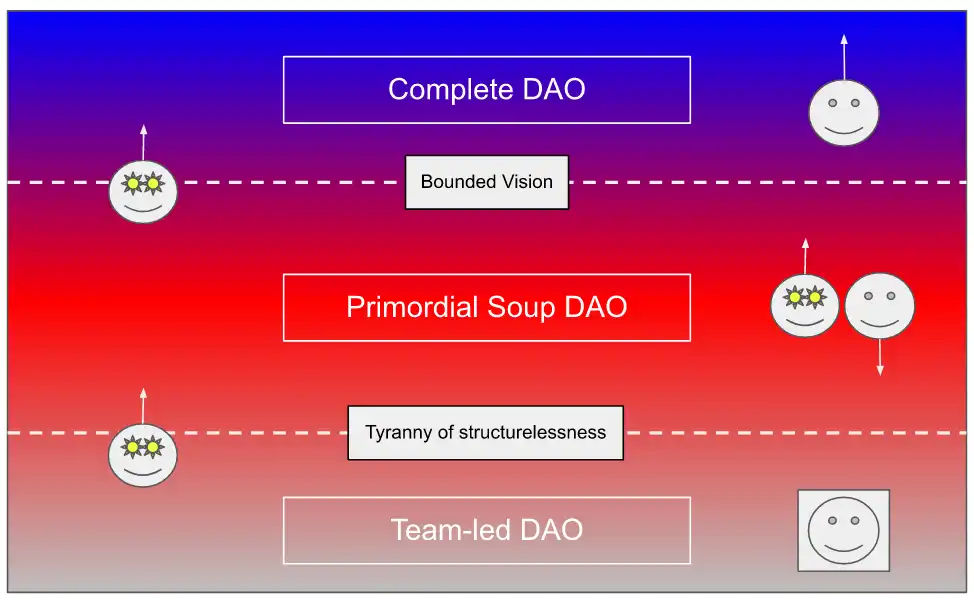
The DAO's check and balance mechanism differs from that of traditional organizations. It does not have any command structure other than the smart contract that makes up the DAO on the chain. There is no executive who orders people around. In contrast, good, well-reasoned advice persuades others to take action.
DAO governance wants to create and support a thriving network to fulfill its mission. How the network achieves its goals, and how its governance works, can vary greatly from DAO to DAO. If you compare SushiSwap to MakerDAO, you can see two very different modes of operation, but they are two very successful projects.
Should you participate in DAO governance?
Since we work in DAO governance, we can only emphasize "should!" . DAO governance is an exciting, diverse, and influential profession that allows contributors to expand their networks, be at the forefront of development, and make a name for themselves.
However, the overall pace of actual activity and governance is not for everyone. A better question then is: "Who should participate in DAO governance?"
When recruiting contributors for Flipside, we look for these qualities:
Strong communication skills, both written and verbal
Quick grasp of situations and ability to act under pressure and great uncertainty
Quick learners with a deep understanding of ecosystems
Some background in history, philosophy or behavioral sciences
Governance, especially in the later stages of DAOs, covers a huge range of topics, and contributors sometimes need to vote on each issue. While "abstaining" is a valid vote, it's even better if you have an opinion to express. It is important to be able to grasp an issue quickly and then do the necessary research and draw conclusions. Good communication skills require being honest about what you know and what you don't know. In this way, your opinion will be understood in an accurate context.
A lot of governance is about relationships, and human relationships with other humans are based on trust and respect. Some contributors use anonymous accounts and publish great work, while others post under their real names. Assuming you want to remain anonymous, great. But please don't use your anonymity to crush people with cynicism and hatred. This is a negative factor in Web3, don't be that person.
Good, transparent communication that reveals one's strengths and weaknesses helps build trust and provides plenty of conversational touchpoints. We cannot emphasize the importance of this quality too much. The concept of honest, clear and well-meaning communication is simple but difficult to maintain, especially in the face of adversity or criticism. The ideal contributor is "based" on something, which means she or he has a solid sense of self-worth and won't easily feel attacked.
Tools recommended
We'll look at the tools we use every day to communicate our ideas, find the best topics to cut into, and how we can create engaging posts to ensure we have the most impact.
Communication Tools - How do you get your point across
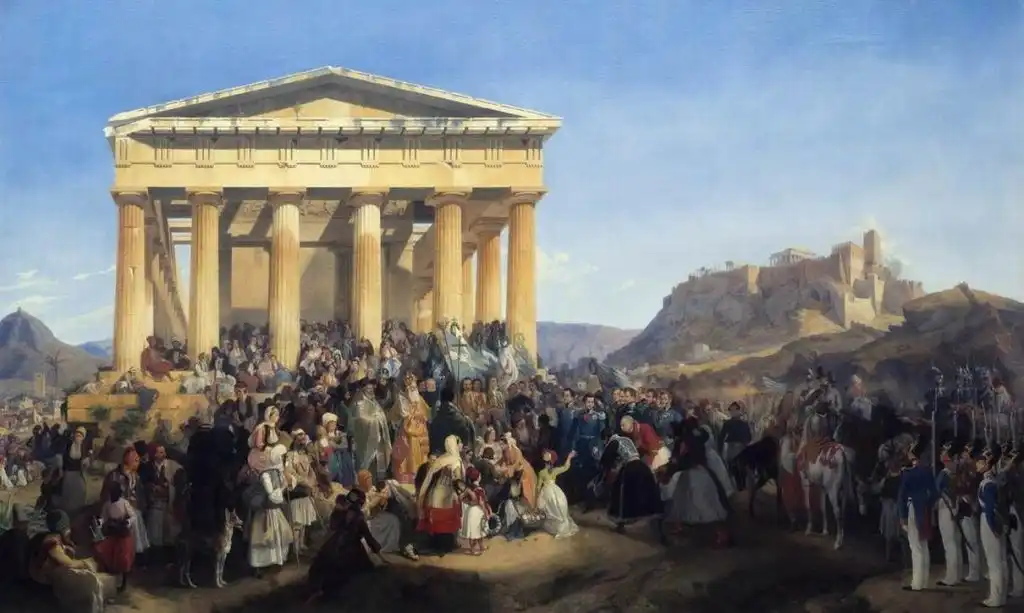
The two main tools for contributors are Discord and Discourse. Discord is the de facto standard for THE DAO's group chatter, and Discourse is the DAO's place to discuss what is going on. DAO called their Discourse website "forum", which was inspired by the word Agora in ancient Greece and translated as forum. Agora was a place where nobles gathered to discuss the fate of their country.
Discord is a place for informal conversation. It's the place to get a sense of the overall atmosphere of the DAO and the easiest way to make friends and make connections. The forum is a place where proposals are presented, dissected, discussed, amended, and then put to a vote. We'll talk more about the voting later. I just want to say that the actual voting takes place outside of Discourse in most cases.
At the end of this chapter, we'll discuss the most useful aggregator sites to help you find the hottest topics in your favorite DAO.
Research Tools - How to find the hottest topics
Messari Governor is a great tool because it can track many DAOs and flag interesting proposals. If the DAO you want to participate in is covered by this tool, you will have a real payoff.
Then there's Tally.xyz, an operating tool that calls itself DAO, where you can keep track of important votes and initiatives. This list would not be complete without proposal monitoring systems Boardroom and Sybil.
Boardroom sends notifications to your email when there is a new proposal to vote on at your targeted DAO. Sybil doesn't support many DAOs yet, but it does have Uniswap, Radicle, and ENS, where the most interesting ones are. Sybil allows you to follow the activity information of the representatives of individual DAOs, which is quite nice.
Tips and tricks
How to browse forums and chat rooms
When you join a new Discord server or scour the DAO forum for messages, the sheer number of channels and parallel conversations can get overwhelming. Don't worry. We'll take care of you.
Flipside's Francis 'Fig' Gowen likes to check what's happening every day to make sure he stays on top of developments. He looked at subjects that remained at the top of a category. These are the topics with the highest engagement and the potential to have the biggest impact. At times, he also focuses on the activities of key contributors. It's like asking a local to guide you through an urban maze you're just getting to know.
His colleague Ian 'D0bby' Dobbins uses the 'Since you last visited' feature to keep him informed of new issues on the forum. Then he visits the symbolic affairs and governance categories, because that's where he feels drawn to and where he wants to make the most impact. Forum posts usually have tags that you can search for. But checking the categories themselves helps catch interesting but mistargeted proposals.
In Discord, the best thing to do is follow the chats on the channels you're attracted to, then make the jump and write a reply or post directly. On most servers, people are warm and friendly. Daos thrive when they can attract and retain new contributors and talent. There is an inherent incentive for members to be friendly to newcomers. You can think of it as talent development.

Figg and Ian track participation in their posts. Figg kept a Google chart of likes for his responses and suggestions to see what was working and what wasn't, while Ian looked at likes in his Discourse discussion notifications.
Make your posts shine
This chapter will give you a quick overview to ensure your posts stand out from the competition. As Discourse and Discord are two very different animals, we will divide this chapter into two sections. This chapter is the most practical and hands-on in this blog. We encourage you to put it into practice immediately and become active in your DAO of choice.
Become excellent in Discourse
The most endearing quality of a post is good writing that is original and concise. You don't need to be Shakespeare to get noticed. Basic spell checking, writing and rereading forum posts before Posting, as well as having clear, positive intentions, all go a long way.
Fig'Gowen uses Google Docs to create proposals or longer responses because he can use Google spell check and Grammarly there. Ian Dobbins entered his response directly into the post editor of Discourse and made full use of the preview function on the right. Grammarly can also be used in Discourse without spelling mistakes.
But the most important question to ask yourself is: "What am I trying to accomplish with this post? What am I actually saying?" Well, those are two questions, but they're closely related.

Above is a screenshot of the Discourse editor. Grammarly's icon, which you can see in the bottom right corner of the editor, tells me that my blog as a whole feels neutral and that I have a grammatical error (underlined in red) where a comma is missing after "right ".
You can use basic HTML tags such as your text here or use Markdown language to format your Discourse post. This blog has all the details you want.
The Markdown code we use most often is:
## stands for H2 heading. One # for H1, three for H3,.... Next thing you know.
** indicates bold **, and * indicates italic *.
A line that begins with a hyphen - becomes a list of dots
Select a paragraph from another post and click "Quote" to insert part of another post for reference
[Link Description](https://hyperlink.here) Insert descriptive links in the post
Good structure helps break down long proposals into chunks that are easier to digest and understand.
Concise, expressive writing is a skill that needs to be honed and developed, and it's what separates the best from the great contributors. A well-structured, goal-oriented proposal with a positive character is much more likely to pass than random chatter. It definitely pays to give your proposal all your love and give it the best chance to succeed. One of the best examples of this is a very well written essay by TJ Ragsdale of MakerDAO that shows his deep research.
A lot of likes isn't always the best measure of a great proposal. Sometimes inconvenient truths have to be expressed. It's unlikely to get a lot of likes, but it can have a huge impact.
Glitter in Discord
Discord, by contrast, is a looser, faster medium. Spell checking is done instantly by Discord, and we need to keep an eye on that. Of course, spell check also flags up lots of interesting spoken words like "HODL "or "jeez".
The most important thing is to ask yourself what you want to say and what you want to achieve in the interaction. We just said that, but it's worth repeating. Everyone receives hundreds of notifications and messages to read. Make it worth their time to read.
Make it about them, not you
Discord allows users to change basic font parameters such as bold or italic text, square quotes and single lines of code, as well as green, red or blue text colors. This blog has all the details. The main features we use:
* Your text * makes the text italic
** Your text ** makes the text bold.
> You insert a block quotation mark into your text, and finally,
'Your text' formats text into code
One very handy tool is the Discord timestamp generator, like this one. Since the DAO contributors are in different time zones, using timestamps makes everyone's life easier. The timestamp is displayed in local time for everyone reading the message, which means no UTC calculation is required.
For example. The message contains a timestamp that looks like this:

Formatting in Discord can be useful when submitting detailed replies. Otherwise, a solid grasp of emojis, memos and GIFs will help you stand out from the crowd.
Moving forward -- How proposals pass (or don't)
If you followed the instructions in the last section, you should be familiar with how to navigate the channels. Let's talk about getting things done. In order for the DAO to do something, a proposal must be made and accepted by the community. Only in this way can the necessary resources be made available.
Proposals often surface first in Discord, often in the form of informal "temperature checks" to gauge the group's mood. If emotions are overwhelmingly negative, those concerns must be addressed first. In this case, putting forward a proposal would only lead to negative comments and would certainly not pass.
You can jump into these conversations and start bootstringing daOs. Being humble and open about your knowledge gaps will help avoid awkward situations and will ensure that your questions are answered. It really is that simple to start governance.
If the authors of the proposal feel they are getting positive feedback on their idea, they will take it to another level. Before a proposal is put to a vote, it sometimes performs a formal 'temperature check' on DAO's Discourse forum. These are called "temperature checks" or signal requests. At this stage, the proposal has a degree of completeness and development. Registered users can vote yes, no or sometimes abstain. Some forums require users to participate for a certain period of time before they are allowed to vote, to avoid bots and other nefarious activities.
在发出信号请求后,下一步是对提案进行正式投票。有时投票在 Discourse 中进行,或在采用 Token 加权投票时,在自定义网站上进行。偶尔也会在 Discord 中借助聊天机器人举行投票。其用于投票的工具有 Snapshot 和用于分发奖励的 Coordinape。后两者在链外工作,所以在那里的活动不会产生交易费用,使持有少数的 Token 的持有者可以参与。
Let's take a closer look at Snapshot and then quickly look at Coordinape.
Learn more about Snapshot and Coordinape
Snapshot 允许用户用他们的 Token 进行投票。要参与投票,用户需要在他的钱包里持有 Token ,也就是 MetaMask、Coinbase Wallet、Portis 以及其他所有支持 WalletConnect 的钱包。
如果你没有持有任何 Token ,你就不能投票。这是特别设计的机制,因为大多数 DAO 认为,只有那些受投票影响的人才能够参与。
Here's a screenshot of a slightly controversial vote on BanklessDAO. We can see that one of the core contributors and developers of Icecool. Eth, BanklessDAO, is the moderator, and a user with the Discord Handle Links# 7868 supports the proposal.
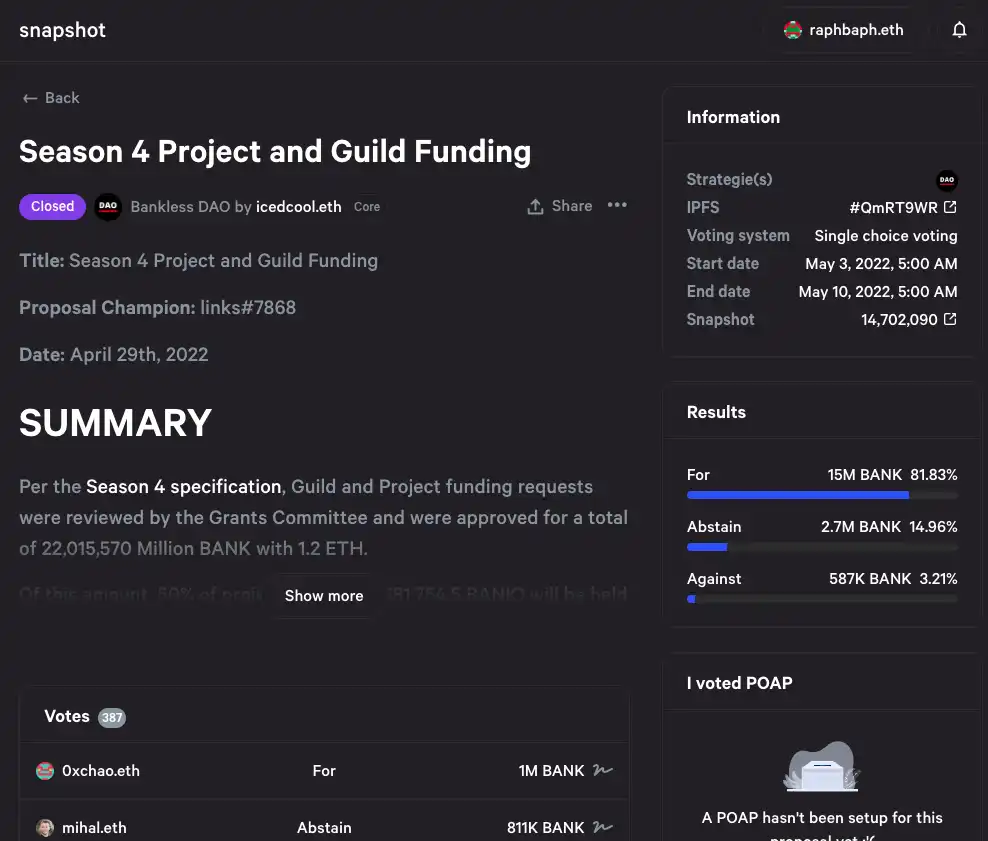
The proposal calls for funding so that BanklessDAO in the fourth quarter can receive funding for this discussion.
The actual discussion that led to the proposal was already taking place on Discord and the forums. Snapshot is just a polling station. Voting took place over a week, and if you look at the timing, it was centered on Eastern Standard Time. The authors are voting at Greenwich Mean Time (GMT +5) from 12:00 am EDT May 3, 2022 to 12:00 am EDT May 10, 2022.
The final vote was written to the Ethereum blockchain with a block height of 14,702,090. Snapshot does not store votes on the Ethereum blockchain as storage there is very expensive.
Instead, it will vote, i.e., information signed by the respective users' wallets, stored in the interstellar file system, a decentralized cloud service.
我们可以看到,投票通过了,~82% 的 Token 被委托给赞成票,~15% 的 Token 被委托给弃权票,3% 的 Token 被委托给反对票。如果投票允许, Token 持有人有时可以对多个选项进行投票。然后,持有人可以将其 Token 的一定比例分别分配给他们赞成的选项。
Yes, no, and abstention votes usually limit only one option.
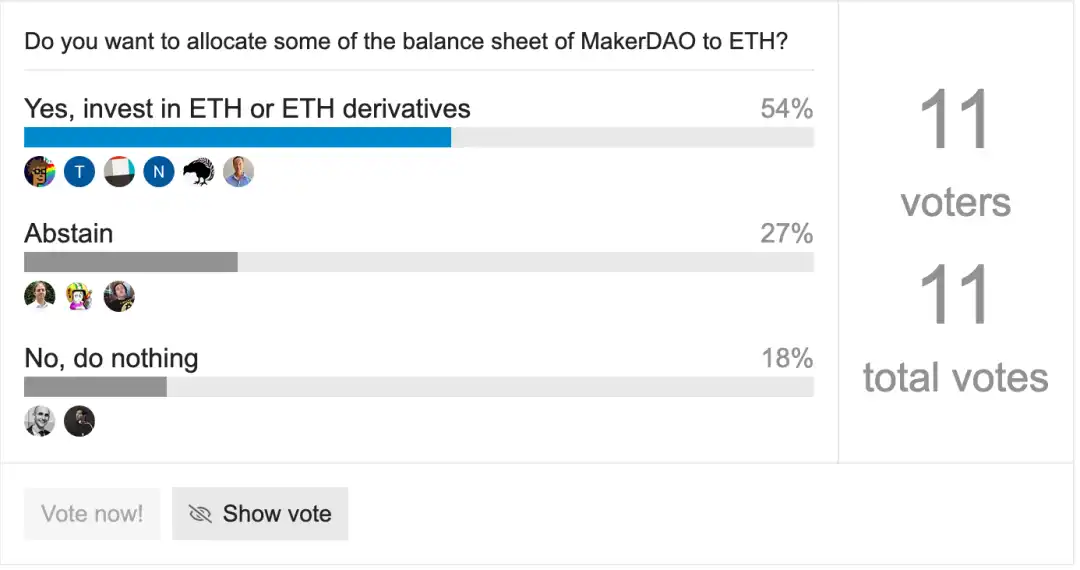
一些 DAO 有自己的前端,用于链上投票。通常需要持有 Token 才能参与, Token 的权重被纳入,以决定结果。下面是 MakerDAOs 投票页面的截图来作为一个例子:
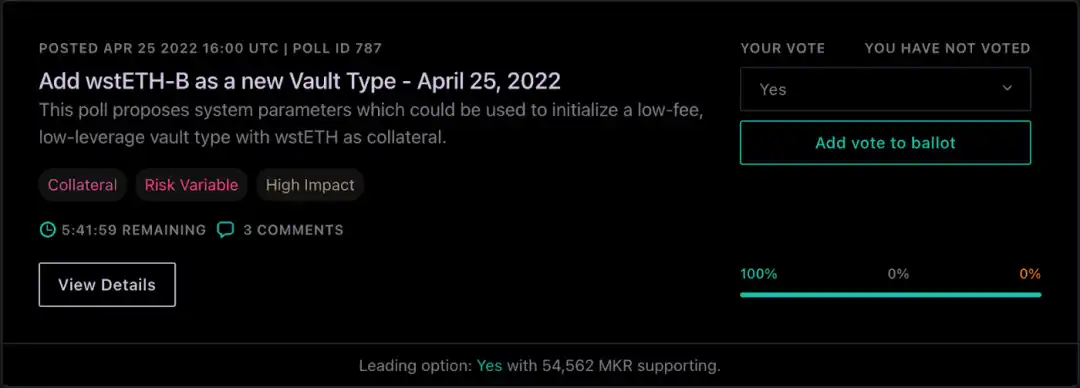
We would like to mention that some DAO proposals must be in the form of smart contracts in order for automated proposal execution to proceed smoothly, which is the closest thing to a true definition of an autonomous organization whose execution is not dependent on any one member or group. Voting can occur without a human being by invoking the appropriate smart contract, and some DAOs require this level of technical expertise.
Coordinape 在严格意义上不是投票工具,而是让社区成员以一种很酷、很有趣的方式向贡献者分发奖励或报酬的工具。它有一个很好的用户体验,成员可以选择其他人,并决定他们想分配给其他人多少份额。Coordinape 是一个有趣的游戏理论实验:成员决定是否尽可能地分散他们的 Token ,以最大限度自身的接触点和宣传自己,或将他们的 Token 分配给少数提供了最多价值的关键成员。我们不想在这里讨论更多细节。如果你有兴趣,这篇部落格有更多的深度探讨。让我们用一个完毕的 Coordinape 轮次的截图来结束这一部分。线代表着分配。圆圈代表着贡献者。

What makes a contributor great
The measure of a good contributor is their impact on the DAO. Ian Dobbins suggests prioritizing having a presence in the community, showing up, and coming up with good ideas, and not being afraid to disagree. Being a "nice guy" who keeps hitting on people won't make you many friends or make an impact. Paying attention to issues and having an opinion is crucial.
Following the voting requirements is another marker to ensure your participation is up to par. Some DAOs measure engagement, and regular contributors are rewarded for their efforts. Put voting events on your calendar and stay active on the forums, because sometimes missing a vote means you're giving up that month's prize.
'Fig' Gowen believes that a good understanding of the wider ecology is a hallmark of being a good contributor. Many primitive forms are propagated across multiple ecosystems, which helps to understand the interaction between daOs and protocols. For example, knowing the dynamics of Curve and Convex helps to understand what happened to Saber and Sunny on Solana. Contributors with this basic understanding can point to best practices and can show what similar experiments have been done and what results have been achieved.
Fig and Ian agree that being able to organize your ideas and express them in concise words is one of the most important skills for contributors. Having a unique voice makes posts approachable and recognizable.
In general, DAO governance is primarily a community activity. Likeable contributors who can add value through leadership and research are always influential, especially if they are able to articulate their opinions well.
conclusion
We hope this blog has given you the tools and understanding you need to navigate this area. DAO governance is a great place to meet smart people and influence the development and direction of projects you care about.
Gaining influence in a traditional company means being hired into a full-time position of influence. DAO lowers the barrier to entry. Even new contributors can have an impact when they submit well-researched and well-written proposals that provide solutions to current problems.

The original link
Welcome to join the official BlockBeats community:
Telegram Subscription Group: https://t.me/theblockbeats
Telegram Discussion Group: https://t.me/BlockBeats_App
Official Twitter Account: https://twitter.com/BlockBeatsAsia
 Related Articles