Identifying the new scarcity of Web3: Open source developers
Web3 Competitive Advantage: Winning in Open and Decentralized Ecosystems
Original author: Sangeet Paul Choudary
Skyhigh Feng @daorayaki.org, DoraFactory
How do you compete when users have zero conversion costs and all code is forked?
Competition is the art of acquiring and managing scarce resources to create an advantage. Technological change alters the scarcity of resources and thus the basis of competition. The "new competitor" looks different from the "old competitor" in large part because scarce resources are not the same as scarce resources used to be.
Openness adds an interesting dimension to competition. Open organizations can discover potential capabilities, enrich them, and transform their scarcity. Similarly, opening up a previously scarce resource into a commodity changes the basis of competition.
With the rise of web3, we are entering a new era of competitive advantage. Scarcity is changing again, as is the basis of competition. This article (part of our upcoming Web3 walkthrough) offers some initial ideas around this new scarcity and how companies will compete in this new era.
Competition comes with scarcity
To understand where the new scarcity lies, we need to better understand how companies acquire and manage scarce resources.
Competition based on resources
In the industrial age, firms competed on the basis of access to scarce resources. Scarce resources include access to special sources of supply (such as oilfields and mines) or unique intellectual property (such as the formula for Coca-Cola).
For companies in the digital age, much of this translates into competitive advantage. Google's search algorithms continue to be protected as trade secrets, a key resource that gives them a competitive advantage.
When Airbnb succeeded in taking over Craigslist and bringing Craigslist's user base to its own, Craigslist lost its scarce resource -- listings created by sellers -- to Airbnb. In response, Craigslist began sending cease-and-desist letters to all startups trying to emulate Airbnb's integration.
Resource-based competition centers on access to and management of scarce resources. Access to scarce resources may involve access to new sources of supply or access to the best innovators who can create unique intellectual property. Therefore, managing these scarce resources requires building the necessary moat (both structural and legal) to prevent others from gaining access to these resources and using these scarce resources for competitive advantage.
Web2: data as the new scarcity
With the rise of social networking, companies have found a new basis for competition: user data. Scarcity shifts from merely capturing and managing internal resources to capturing and managing user data.
Data collection - Web2 advocates are trying to capture user data - so the company developed new ways for users to submit data (remember LinkedIn's profile completion bar?). It has also developed a whole back-end industry for exchanging and processing data.
It is extremely uncomfortable to compare farming to data collection, which may be collected when users "sow" their attention. So the competition for data is really a competition for attention. Companies invest in behavioural design to "hook" users and get them to cycle through increased data consumption. Dark user experiences are stealthily extracting data. Corporate consolidation ensued. While industrial-age companies acquire competitors with similar or complementary scarce resources, digital-age companies are busy acquiring similar or complementary user attention and data resources. Facebook bought Instagram and WhatsApp, And Google bought Waze, all in an effort to hoard more scarce resources.
To manage this scarce resource, companies initially invested heavily in big data processing technologies (2008-2013), then shifted their focus to creating value using ARTIFICIAL intelligence and machine learning (2010 and beyond).
Centralised platforms, empowered by a lax regulatory regime on data protection, compete on this new scarcity. But that is changing. The rise of GDPR and other data protection regimes has made it increasingly difficult to extract data. Similarly, the rise of web3 heralds a new era in which ecosystems can be organized without centralization and extraction.
Scarcity is changing again!
Web3: Tracking the new scarcity
The rise of Web3 has changed many assumptions about scarcity. Data is portable and no longer the basis of competition. Users can easily switch services, and users' attention and data may no longer be accessed, collected, and managed in the same way as in the Web2 world.
The open ecosystem of Web3 also erodes the vertical integration advantages that the Web2 platform benefits from. For example, competition for user interfaces (and for user attention) will intensify in Web3 as the user interface is separated from the underlying platform. Web2 market platform is vertically integrated into the search interface, which ensures the monopoly of both. The Web3 protocol that manages market transactions may support many search agents, as I explained earlier.
For example, marketplaces like Ebay integrate seller presence, seller analytics, buyer presence, buyer decision support, search capabilities; Can be tied to the trading infrastructure. All of these components will be split in the web3 world.
So we moved from a central market-maker architecture to a decentralized agency-based architecture, all through one. Shared common protocols to coordinate. It's like a Hollywood-style job market, minus the guanxi checks.
So where will the new scarcity appear?
Developer participation will be the new scarcity in the era of open ecosystems.
As I explain in Split and Split, developer participation is the core value driver of the Web3 ecosystem, as the market infrastructure is no longer built by the central platform business, but by ecosystem developers building modules that complement the core protocols. Developer participation is the primary source of value in the infrastructure layer of the Web3 ecosystem. For developers, this requires an investment of time, resources, capabilities, and so on.
There is another reason for the scarcity of developers. Developer involvement and resource commitment involve high multi-hosting costs (the cost developers pay to build multiple platforms at the same time). By building and investing resources for a particular ecosystem, developers implicitly choose not to invest their limited time and resources in other (competing and non-competing) ecosystems.
Not all developer ecosystems are created equal
Managing the developer ecosystem is also an important consideration for web2 platforms. So how has Web3 changed?
To understand how the web3 developer ecosystem is different, we need to revisit the building blocks argument I made in an earlier newsletter.
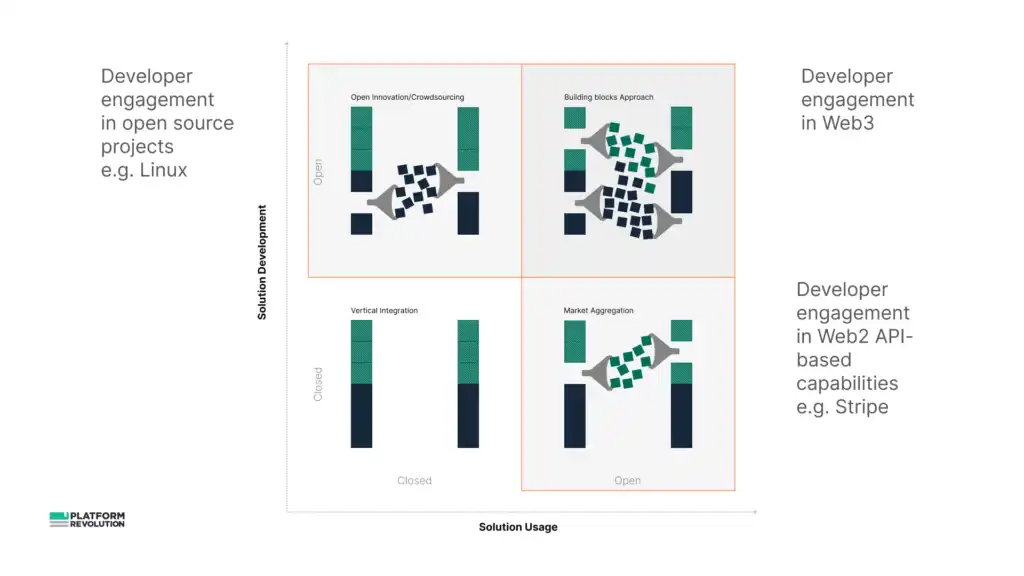
In any developer ecosystem, developers perform two key categories of activities: they may contribute to solution development (value creation), or they may create different integrations that drive the use of the solution (value allocation).
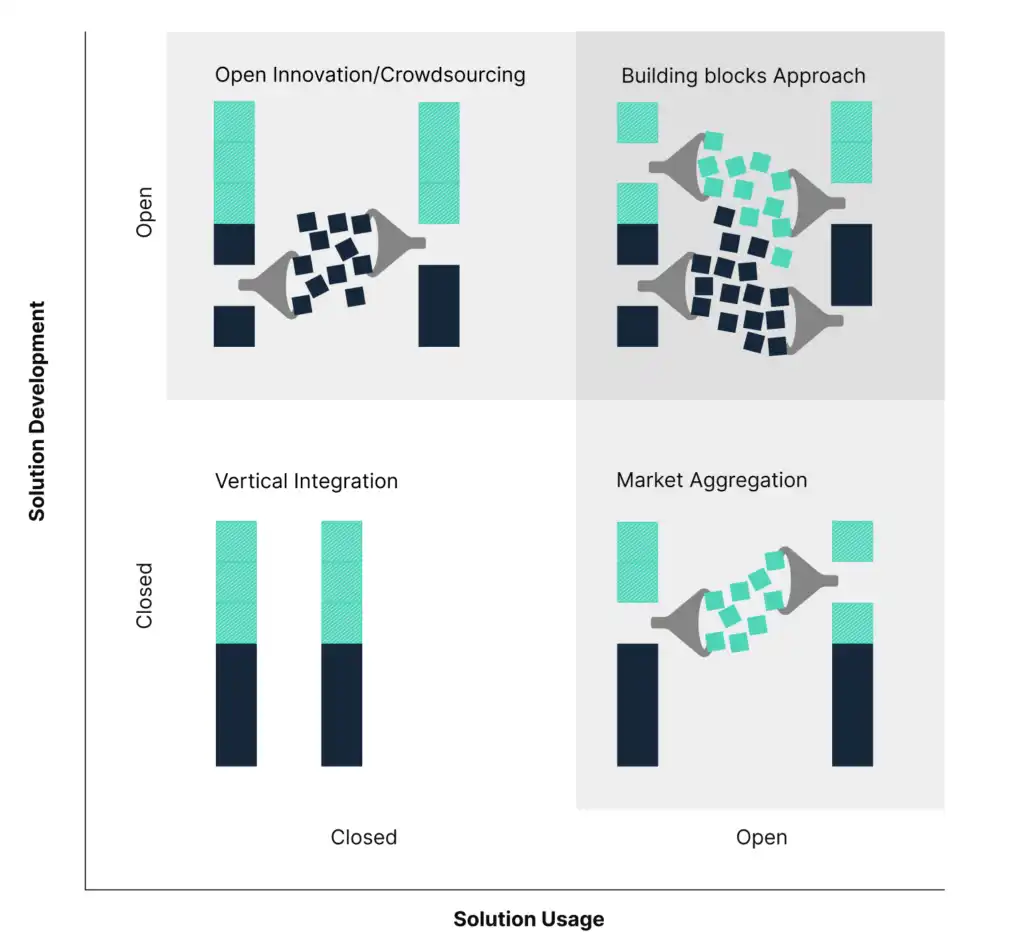
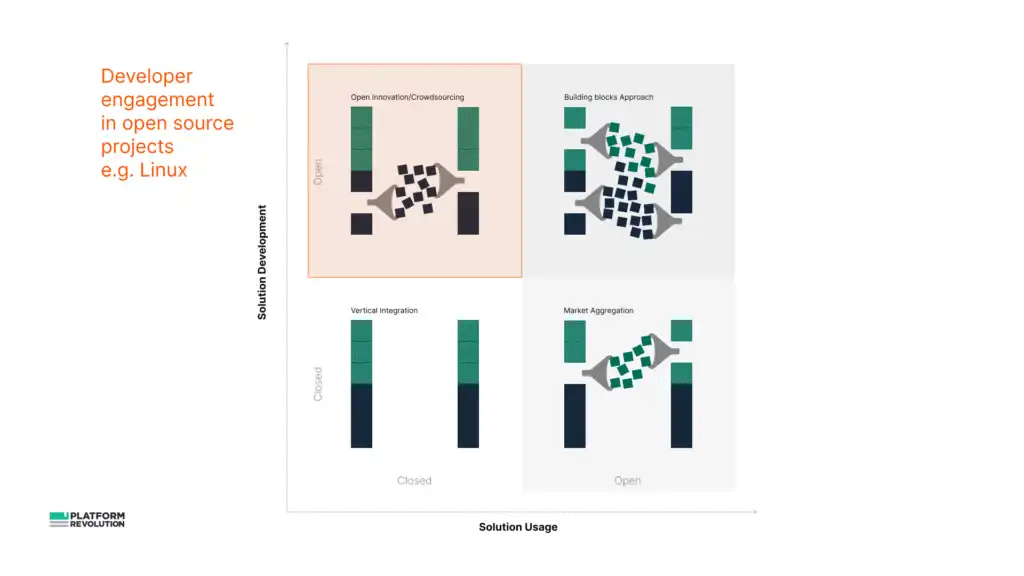
Open source projects rely primarily on an ecosystem of developers for solution development. Software is then packaged, delivered, and supported through traditional company-owned channels, such as Redhat's relationship with Linux. This is shown in the upper left quadrant.
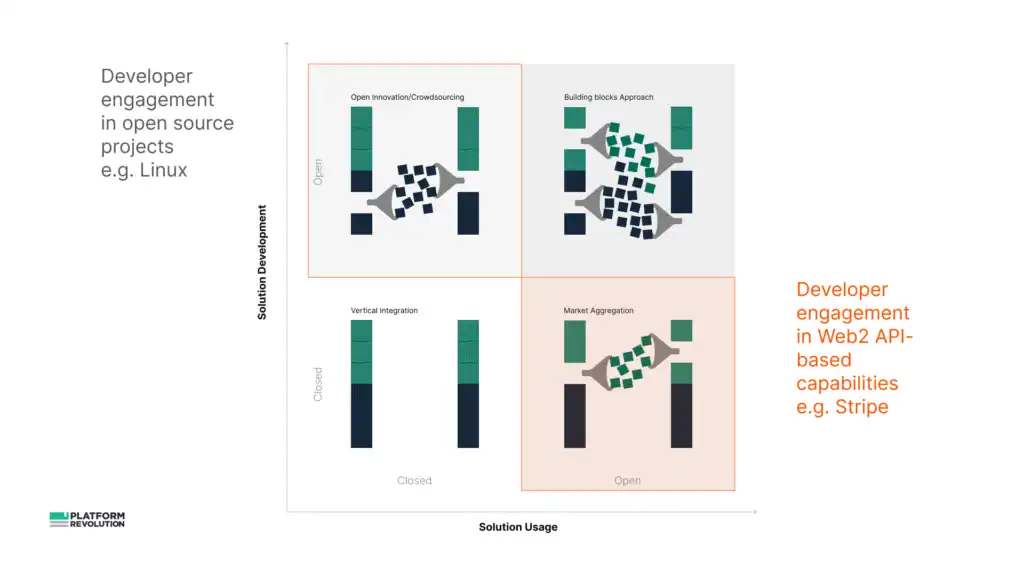
Many Web2 platforms are tied to developer ecosystems. However, the core platform of the value proposition is built and delivered by in-house developers. Most Web2 platforms rely on developer ecosystems, either to create additions to core platform technologies, or to build integration and drive platform usage. The latter is particularly evident in companies like Stripe and Twilio, which offer API-based functionality (as a service). These companies invest heavily in the developer ecosystem, but mostly to drive adoption of solutions (value distribution). This is shown in the lower right quadrant.
What is unique about Web3 ecosystems (and for that matter, any ecosystem that follows the Building Blocks Thesis) is that they engage developers in value creation, solution development, and value distribution by promoting the use of solutions. This is shown in the upper right quadrant.
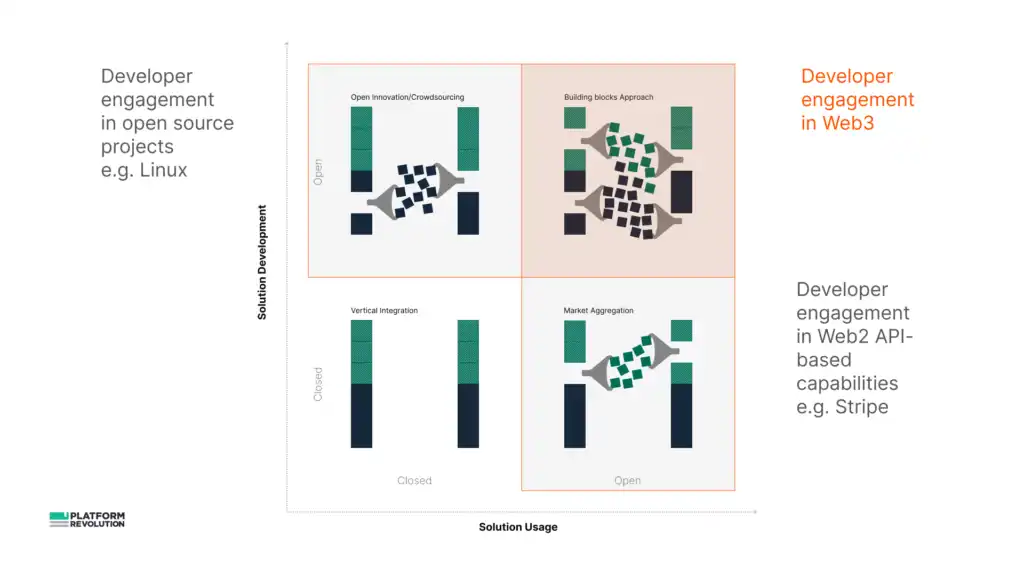
For example, Lens Protocol's developer involvement cuts across solution development and usage. Similarly, the Boson Protocol's bug Bounty program development platform utilizes developer participation in solution and security development, while Boson's Roadmap to V2 extends developer participation in solution development and solution usage.
The value and defense of the Web3 ecosystem
As mentioned above, the web3 ecosystem is unique and value creation across the value chain is driven by the developer ecosystem.
Web3 项目需要建立针对解决方案开发的开发人员参与程序,以便为其 Token 标记积累价值。随着解决方案变得更加全面, Token 的价值也会增加。
Equally important, web3 projects need to establish developer engagement programs that encourage the use of solutions through integration. As the solution is integrated into more projects, the defensibility of the solution increases. New competitors sharing the code base may replicate the code base, but it is difficult to replicate the numerous integrations built through developer involvement in projects that drive the use of solutions.
That's why web3's competitive advantage will revolve around its ability to attract developers.
Thriving developer ecosystems serve two transformative functions.
1、它们增加了 Token 价值 (增加了项目的吸引力),并在一个自我强化的循环中吸引了更多的开发人员。
2. They increase defensibility (making it harder to replace related items).
The original link
Welcome to join the official BlockBeats community:
Telegram Subscription Group: https://t.me/theblockbeats
Telegram Discussion Group: https://t.me/BlockBeats_App
Official Twitter Account: https://twitter.com/BlockBeatsAsia
 Related Articles