Understanding the source of Web3: a brief history of open source evolution
Original title: "Please answer Web3: A brief history of open source evolution that must be said"
Original author: weiduan.eth
Everyone has tons of questions about early waves like Web3. And I found that the most worthy of "open source" has rarely caused heated discussions. If we say that the birth of Web3 originated from cryptocurrency; the birth of cryptocurrency originated from the holy grail of open source.
How does understanding open source help understanding Web3? In fact, I have only been in the industry for 3 months. However, after communicating with many Web3 OGs, they are all surprised by the contrast between my short time in the circle and my deeper understanding.
Looking back, it’s not really how fast I learned, it’s just that the open source community I’ve been immersed in for many years is already very similar to the core of Web3 One of the domains: DAO. The open source community is somewhat similar to an intermediate transitional form between a company and a DAO. It is a compromise solution based on legal currency to "create higher productivity/software that meets update needs" before the birth of cryptocurrency.
To understand the open source culture and its spirit, it is not as difficult to understand as blockchain, encryption algorithm, and Byzantine problem; It is one of the important underlying pillars of technological evolution in our new information age. I want to share these cognitions with you through this article, hoping to help you.
The first question, what is open source? You can say that open source is public welfare, open source is dedication and altruism, you can also say that open source is a brand-new productivity organization method, human collaboration standard, or even open source is a religion and a belief. Each statement and each perspective has its own rationality. I mainly focus on the analysis from the perspective of "creating software with higher productivity/meeting update needs".
By 2022, regardless of the open source behavior of Web2 at home and abroad, mature business models have been incubated. Especially as cloud computing has passed the early stage as an immature infrastructure and entered a period of rapid development that promotes the overall digitalization of human society, the open source Infra has flourished in the past two years and has blossomed all over the world. In China, as of the end of last year, all related start-up companies have emerged, and the amount of financing is staggering (source: 2021 China Open Source Annual Report):
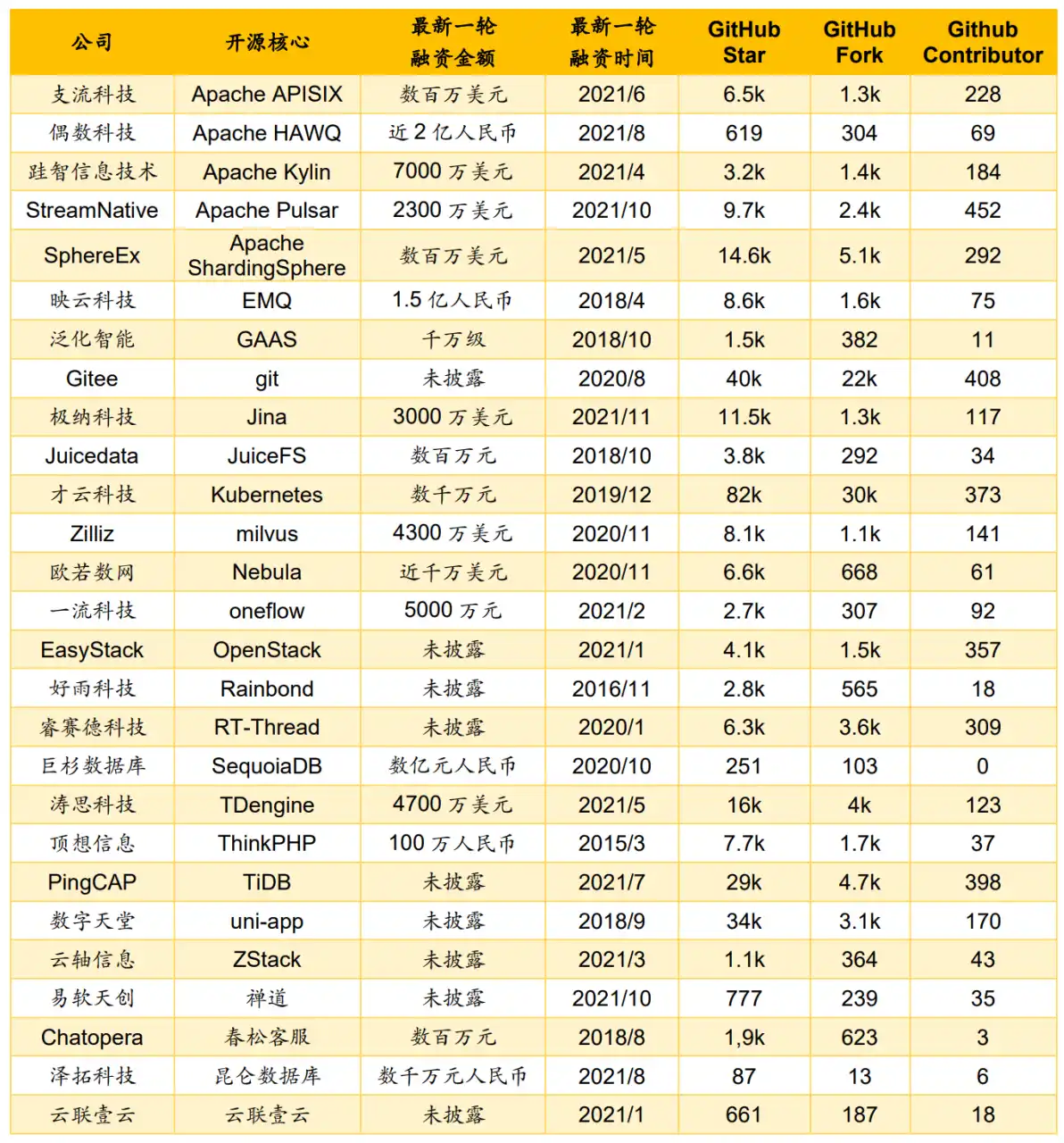
You can see, from database, middleware to AI, cloud native fields, the financing of open source projects The amount and frequency are constantly breaking records. The world-class open source companies that are ahead of a domestic development status are either listed or acquired, and the cycle of capital exit is getting shorter and shorter. One of the notable representatives, the cloud DevOps platform HashiCorp, will be listed on Nasdaq on December 9, 2021, with an IPO market value of approximately US$15.3 billion:

Obviously, the current mainstream open source behavior has become a qualified track and capital game. Take a look at the picture below, and you will find out how prosperous the open source ecosystem has reached:

In the whole process from birth to listing, investors of open source start-up companies (GGV is a typical representative of capital) injected a lot of capital and time, the founding team has gone through many difficulties and hair-loss meetings, and the open source contributors from the community have paid countless PRs and "PRs". Behind this is a line of code, a page Pages of documents and word of mouth.
In the end, the investors made a lot of money and left the market in style; the founding team became famous and bought cars and houses; T-shirts, Hoodie and stickers, feel a "sense of participation" in open source, and continue to happily knock on the next bug. So the paradox is that the vast majority of actual contributors to the open source community have been talking about "power generation for love", and they have not obtained continuous and reasonable economic returns from participating in open source.
Next is the second question: Now that the open source of Web2 is maturing, what is the necessity for us to improve it with the Web3 model? Because the current open source collaboration method based on Web 2 (legal currency) has come to an end in terms of "creating software with higher productivity/meeting update requirements", it is difficult to shorten the product maturity cycle of several years or even decades. To demonstrate this proposition, we must briefly review the history of open source development and how the three generations of open source business models have evolved.
If we really want to go back to the origin, we can go all the way back to the 1950s, an open source project like Arpanet ( ARPANET). The first wave of Iconic open source figures were Richard Stallman (RMS for short) who founded the Open Source Initiative OSI and promoted the free software movement (free software). I won’t expand on the various aspects, but you may have heard of Emacs, the open source “God” editor of RMS. Whoever uses it will know the torture of using experience.
When the open source movement in the 1970s and 1980s took root in the hearts of the people, the second wave of Iconic who contributed to the truly widespread popularization of open source must mention Linus Torvalds in the 1990s. That's right, it's that weird guy who often puts his middle finger up and has a hot temper. He single-handedly contributed to the dominant Linux in the field of server systems, which can be said to be indisputable. It was also from this time that commercial software began to gradually lose ground in the confrontation with open source software that "creates higher productivity/software that meets update needs".
Published as a book in 1999, the open source Bible "The Cathedral and the Bazaar" says it all:

There are many aspects mentioned in this book, and the core is to make an in-depth comparison between the two models of "commercial software-cathedral" and "open source software-bazaar". The former is closed, vertical, and centralized; the latter is parallel, point-to-point, and dynamic multi-person collaboration.
They have their own advantages and disadvantages. The closed-source commercial cathedral model, unified arrangement and partial execution, high efficiency of centralized collaboration, but it is difficult to come up with innovative ideas. The open source and open bazaar model can gather the smartest brains in the world and is easy to innovate, but the efficiency of distributed collaboration is not high.
So what helped open source overcome its shortcomings in one fell swoop? Also have to look at the Killer Feature released by Linus: Git. The original programming is basically a standardized product, only related to logic. The main reason for the low efficiency of collaboration is that the codes between different participants cannot be communicated and merged smoothly and efficiently. The emergence of Git has cured the disease in one fell swoop, Little Penguin Linux is very happy, and open source is no longer lame. Later, the emergence of platforms such as Git-based GitHub brought the efficiency of collaboration between programmers a step closer, and with the addition of mechanisms such as issue and PR review, it became even more powerful.


In order to break the monopoly of commercial and closed-source Windows systems, Red Hat has taken a new approach and adopted a novel strategy such as open source. Red Hat's open source is a license authorization model. Linux-based open source provides a variety of customized solutions, which are sold in a commercial authorization model to generate revenue. Therefore, they did not create their own open source projects to create higher productivity. /Software that satisfies update requirements". In 2018, Red Hat was acquired by the blue giant IBM for $34 billion, marking the end of the pioneering era of this pioneer.
The second generation of open source companies is much more interesting. There are regular troops who truly believe in open source and know how to do business: database MongoDB, data search Elasticsearch, data set Companies like Cloudera. The proposition of this generation of open source is closely related to "creating software with higher productivity/meeting update needs".
In 2007, 10gen, the predecessor of MongoDB's parent company, was established. The database field has always been dominated by relational databases. However, with the advent of the era of big data, all kinds of new needs are soaring, and traditional relational databases are becoming more and more exhausted. Non-relational databases represented by MongoDB fill the vacancy, that is, "creating software that meets update requirements" to meet new requirements such as document databases, KV key-value pair databases, and graph databases.
However, the second generation of open source companies also encountered the grievances of the times: the rising cloud computing vendors, especially AWS (Amazon Cloud Computing) launched a sniper attack, wantonly "Bring" the open source project to fork, and then combine to sell money, but do not contribute to the open source project. It is quite funny and ironic to say that the wave of cloud computing is booming thanks to the open source of container technology Docker (hardware virtualization) and container orchestration technology Kubernetes, which allows cloud computing vendors to buy and sell cloud services through virtual elastic resource units , instead of continuing the IBM-style cloud service model of selling physical servers that was difficult to scale in the early days.
From a moral point of view, this kind of behavior of AWS makes open source people very disgusted. In 2015, Shay Banon, CEO of Elasticsearch, publicly criticized AWS for calling it a vampire. Call it an explosion. MongoDB and Elasticsearch have modified the licenses of open source codes, restricting AWS from freely copying open source codes for personal use in terms of IP property rights.

There are no permanent enemies in business, only temporary enemies and eternal friends. The conflict between the second generation of open source companies and cloud computing companies is vivid. Is there a way for everyone to make money together? A third-generation open source company that has developed a cloud-hosted SaaS approach. The HashiCorp mentioned above is one of the best. It buys IaaS resources from cloud computing vendors to customize a cloud platform and share them with each other. Or open source vendors simply host their own open source software on cloud computing vendors and sell it as an integrated service, such as the cooperation between domestic messaging middleware StreamNative and Tencent Cloud.
To sum up, we can sort out the context of open source business development. The first generation of open source, I sell open source, whoever loves open source can do it by himself. The second generation of open source, I love the open source community and love open source projects, but some people don’t give money for nothing; the third generation of open source, I love the open source community and love open source projects, VC venture capital is my upstream, cloud computing vendors are me Downstream, everyone makes money together, so sweet.
The above brief history is only a small part of the history of open source. If there are any mistakes, corrections and discussions are welcome. In the future, I will continue to publish articles to discuss: what are the similarities between open source and DAO. Has Web3, which has been shouting that the community is king, evolved from the spirit of the open source community? Does the common project fork "Fork" in open source projects help us understand the earth-shattering fork movements of BTC and ETH from time to time?
Original link
Welcome to join the official BlockBeats community:
Telegram Subscription Group: https://t.me/theblockbeats
Telegram Discussion Group: https://t.me/BlockBeats_App
Official Twitter Account: https://twitter.com/BlockBeatsAsia

 Related Articles