Practitioners teach you how to cold start a DAO
Original title: "Building a DAO to Learn in Web3"
Original author: paradise
Original compilation: shaun@DAOrayaki.org, DoraFactory
< /p>
Introduction
About DAO cold start The problem has always been a problem that everyone pays attention to. We often see various articles introducing the mechanism, culture, tools, etc. of DAO, but the nuances of how to cold start and start and run DAO are still relatively missing. Therefore, the DAOrayaki community put together this article. This is not a guide article, but a summary of all the things the author has learned and experienced in the past few months. We use a narrative method to describe how to cold start a DAO, with a list of DAO tools. Again, this article does not constitute financial, tax or legal advice of any kind.
How it all started of?
I started trading cryptocurrencies in 2017 - watched my portfolio plummet and then back to life. After letting it go and forgetting about it for a year or two, my interest really started to peak again during the pandemic. By the middle of 2020, I was back in trading and trying to digest new information, but stayed away from nfts for a few reasons.
That quickly changed.
By September 2021, I've built a reputation as a web3 nerd among friends and family (whether that's good or bad). I even convinced our fantasy football league to put our money in cryptocurrency.
Last December, I bought my first NFT and added several I like the community (Floor & Shiny) that is still active today.
By February 2022, I feel like I've been in this field for a year, but There is still a lot to learn.
Then, I suddenly had an urge to create something.

"Always anxious" is the only word to describe our state last year
Fast forward to March 2022 and we can safely say that our fantasy football pot is doing great. The market is going up, and I'm happy to give advice on cryptocurrencies and NFTs to my wonderfully curious friends who work primarily in the Web2 world.
But what am I going to create?
I think hard and try to create my own NFT community. However, as some of you know, expectations are high and project delivery is insufficient, especially as people in the industry are becoming more and more wobbly. WGMInterface's farewell letter hit me hard, I didn't want the experience of creating a project to go from having fun to being full of anxiety.
Is there anything that is influential but low-risk and can create a good learning atmosphere What about the chance?
I do have some friends who throw at me questions involving encryption, NFT and An olive branch in the field of web3. They are already very successful in their careers and in their lives. What if we formed a group among us to learn together, invest together, and eventually create something together? What if we started by creating a DAO?
This is not a novel Ideas, but the key I've built a few things for myself - keeping it small and expanding our circle only when necessary (a minimal viable community).
I'm already working on NFTs.
I have explained NFTs to friends and family.
I've been following my friends and their businesses in the Web2 space and trying to see if there Worth developing web3 applications.
Creating a DAO seems to be to get friends more involved in Web3, learn about managing products in Web3 The best way to learn the ins and outs, make money along the way, and look forward to building great things with 14 other super-brained friends.
So, it started...
< /p>
How does DAO work? What are the rules of operation?
Each project/DAO needs to know what they want to achieve before they can be created. For us, we want to be a Web3 learning and investing community, ready to act on our knowledge and seize opportunities when the time comes.
With this foundation, we were able to create the basic DAO charter. We chose completeness and simplicity over perfection. We have a high level of trust in each other, so we leverage that to avoid paralysis or over-complication in the creation process.
Deposit
< /p>
Everyone has about a month to make a deposit
min = 1 ETH, max = 10 ETH (to make sure no one mass-produces immediately Control DAO)
1 ETH = 10,000 DUCK Token
After the deposit deadline, no withdrawal within 6 months (to ensure some stability of DAO)
Governance
< /p>
Based on DAO's Token ownership, 1 Token= 1 vote
A majority vote to pass the proposal (<50% & =50% is not passed)
Proposals/polls last for 24 hours
If the number of votes is >50%, the proposal can be implemented (controlled within 24 hours to ensure that we can act quickly if needed)
p>Vote on matters: new members, investment, business changes and administrative changes
Meeting
Meeting
We choose to meet weekly. The purpose is to have a medium through which we can discuss what is happening in the NFT space, bring concerns to the table, talk about current and future investments, and relay any important information to each other.
In-person interaction is of course best, followed by video or IRL. Either way, it's important to us to create a safe space built on trust.
Random Trivia
Many newcomers are hesitant to deposit large sums of ETH. This is to be expected, so I allow deposits after 7 days of the first investment - and usually, depositing after raising a round of funding is a big no-no, but isn't it worth some experimentation in order to win?
Although this creates dilution, I initially chose the trade-off because it helps We go further. Our first investment was Moonbird mint for 2.5 ETH (the current floor price is about 25 ETH). You can imagine how exciting this is for us, and how enticing it is for DAOs.

I have collected a lot of screenshots of common problems, I hope everyone can get started quickly
Great, now you have a very basic architecture, so how do you go about setting them up next?
How do we do it?
Because many people come from the world of Web2 and know almost nothing about the field of Web3, we Realize that it needs to start with as little friction as possible. As much as I would like everything to be on-chain and fully decentralized, I realize that this may be a high barrier to entry for beginners, so gradual decentralization is the most sensible course of action.
The following are our basic requirements:
- Start with a single touch (one app) as much as possible
- Need to choose the right mobile device
- Differentiate, not compete with other communities
- Cost to upgrade/switch apps is lower
- Legally compliant
With the above in mind, we set out to explore tools for DAOs and ways to build DAOs so that it scales well.
We focus on:
- Communication
- DAO Creation
- DAO Governance
- Documentation
- Funds Management
- Contributor Compensation and Reimbursement
- Accounting and Taxes
And get to work on a lot of the details.
Communication
< /p>
We first ruled out iMessage and WhatsApp. The former is too limited and doesn't bode well for us Android users. The latter doesn't have great bot integration.
The real debate for us is between Discord and Telegram. Both have their merits - Discord is the most adopted integration already in the web3 world. Telegram is a smoother experience and is friendly to group chats.
Advantages of Discord
The Web3 community uses Discord extensively, and the behavior habits of Web3 friends who join Spicy Duck will not change.
The integration is rich. Most communities are built here, so we should be able to run a community with many bots out of the box.
Easy to expand. Channel segmentation is a specialty of Discord.
Discord Disadvantages
Compete for user's attention in one period among many other chat servers.
At only 15 members, Discord feels like overkill - do we really have enough small talk topics to get the full power of Discord?
Discord crashes frequently (although probably not often enough for us to care).
Advantages of Telegram
No competition for user attention. You know it’s a message from Spicy Duck and you just open Telegram for a DAO chat.
Local voting. There will be more on this in DAO governance, but a lightweight DAO voting method is important.
A group chat with 15 members will make the atmosphere feel more alive. It's the right vibe, not overkill.
Security seems to be better, more Web3 scams happen on Discord, simply because more people use Discord.
Disadvantages of Telegram
Telegram has less Web3 integration/bot features compared to Discord.
In the future, expansion beyond 15 members may become difficult. Channel segmentation is not a native feature of Telegram.
If we were to build more things for Telegram, it might be annoying/cumbersome when switching costs to scale.
At the end of the day, we really value low friction + a tighter community feel. Discord feels like overkill (redundant) for 15 people, although not having that many integrations and extensions could be an issue in the future. We all know what it's like trying to use Discord for the first time, and it's hard to describe.
Telegram provides us with 80%-90% of the functions , and a better small community/group chat feel that we wanted. For members already active in Web3 and becoming more active, it is important that we are not competing for attention among hundreds of other communities. When we open Telegram, we know what the information is for, and attention is high.
We think the potential cost of moving 15 people is annoying if we need to move away from Telegram, But not unbearable.
DAO Enabler
The field is still in its infancy and underdeveloped, so the rules are constantly changing. The need to digest information quickly is critical. While we care a lot about the DAO platform, it's all relatively even. We explored things like Upstream Collective, Colony, and Syndicate. For simplicity and clarity, we spend most of our time discussing these three issues.
While it is true that Upstream and Colony are more powerful and offer a larger feature set - we We ended up launching our DAO with Syndicate for three main reasons:
- Customer Service/Response
- General Legal Protections
- Non-Accredited Investors Can Legally Participate
In this rapidly changing space where things are often broken and markets can be volatile - we want to rely on a service that is responsive. Frankly, Syndicate goes way beyond that. Their Discord is well managed, with multiple team members always there to answer questions, focus on issues, and iron out bugs in a timely manner. This is a huge advantage.
Also, Syndicate helps ordinary people legally set up DAOs. The idea of counting on other services to put people on full legal counsel is daunting. We need more services like Syndicate that can take into account the legal implications for ordinary people and be able to last until mass adoption. The idea that everyone can shell out tons of cash to create a legal structure for a DAO is foolish.
Syndicate helps you create a legal entity, just a few clicks of Doola, and they Will give you a great template for creating an operating agreement and other documents that need to be prepared, such as subscription agreements.

Creation of joint management dashboards and legal documents
Once everyone is a legal entity Part of it, and the best part, is that Syndicate is structured as an "investment club" according to SEC guidelines. This is an important distinction if you're thinking long-term and want to be able to legally continue to operate after more regulation is introduced.
As an investment club, there are four important things to remember:
You cannot invest in securities (as a non-accredited investor), which means only cryptocurrencies and NFTs ( with few exceptions).
Your membership limit is 99 members.
Every member must participate in decision-making in some capacity.
You cannot publicly provide registration information into your club (only a private link to join).
That's fine. It gives us the guardrails we need to abide by, and it also gives our non-accredited investors an avenue to be able to participate legally. For mass adoption of DAOs, either regulations need to change, or services need to be built around clear legal guardrails. Also, similar to our DAO, most of the world is made up of non-accredited investors. Syndicate handles this nicely.
Note--Colony is a little late in our sights, but looks like a magical The product. It's just that we haven't done as much research comparing it as we have done with Syndicate and Upstream Collective.
DAO Governance
This is an area of DAOs that can quickly become more complex. We evaluated a few on-chain options, but ultimately narrowed down to two off-chain tools - Snapshot and Telegram Polls.
While I want governance and voting to be on-chain, I want to optimize participation -- Make it as simple as possible. Many of the voting options suck on mobile, and there is no way to connect to a mobile wallet without going through a lot of complicated steps or multiple clicks. I realize that most members of our DAO will be mobile-first because they are very busy. I want them to discuss quickly and vote easily.
Unfortunately, we feel that Snapshot is too heavy for the desktop. For this reason, we chose Telegram Polls. This is a native feature of our instant messaging application and provides us with a quick and transparent way to submit proposals for voting
< /p>
But, the truth is – Telegram Polls are the most non-Web3 thing you can do...
< /p>
Of course I know this, but I just want to emphasize again that we first choose the way that it is easier to participate + learn other Web3 concepts. As members become more and more comfortable, we will slowly migrate to the chain .
Documentation
< /p>
We need a single location where all documents for research, proposals, data, meeting minutes and links can be accessed and stored.
It was easy - we chose Notion. We think it's better than Google Docs and gives us a great way to collaborate on research and proposals.

Our first proposal was Moonbirds - an amazing first win
Vaults, vaults and hot wallets
This is another one we made Simple decision. We need a multi-signature wallet for trust and security of our assets/vault, and a hot wallet to be able to mint, buy and sell assets as needed. This has been implemented many times in other DAOs and the common solution works well for us.
We have therefore implemented the following measures:
< /p>
Gnosis Safe for our vaults/vaults
Provides MetaMask hot wallets for each user -- only for DAO purposes, not for personal use (more on this later)
Contributor payment and Reimbursement
We have found three effective ways to implement contributor compensation and reimbursement:< /p>
Utopia Labs
Parcel
Coinshift
Coinshift
p>
We like all three for different reasons. In a sense, all three methods allow for funds/expense management, and the basic functions of all three methods are relatively similar. The difference lies in their customer service/responsiveness and their product direction.
We want it to be billed in multiple wallets, Handle payments to contributors, and have decent customer service, because dealing with finances can get messy, and when things get messy, it's important to us to have a person we can directly contact.
While we like the user experience of Parcel and Coinshift, they do not support multiple wallets account function. This is a pain for us - I don't want to have to manually monitor and add these transactions.
What started as a tweet ended up scheduling a demo with Pryce.
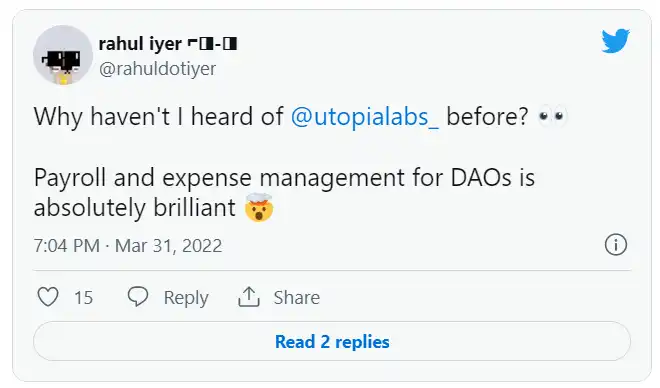
In case it wasn't already clear, we chose Utopia Labs because the team was responsive, aligned with our future plans, and had some of the largest The DAOs are experimenting with them (FWB, PleasrDAO, SquiggleDAO). I have so much love for this team and it's great to see what they continue to build.
Bookkeeping, Accounting and Taxation
While there are plenty of personal accounting and bookkeeping tools for Web3, there aren't any that are really suitable for businesses/DAOs yet. Most are in early development and cost more than what they can offer.
Having said that, we don't actually have a super complex system yet, nor do we have many transactions, so we opted to use Koinly (annotating transactions where necessary) while waiting for Utopia Lab's bookkeeping solution to launch in June.
We evaluated Coinbooks and liked what they did, but ultimately, we wanted to put All spending, payments and billing on one service for less hassle. The cost of Coinbooks (at this time) also doesn't make sense to us. The short-term pain of using Koinly and later migrating to Utopia Labs seems like a good tradeoff.
We also have an accountant on hand to help us, which helps make us feel good about our decisions rest assured.
How far have we developed today?
We've made some investments and started building around what we think is meaningful for our future form an argument.
Some notable investments include:
Moonbirds
Moonbirds Oddities
Chromie Squiggles
Floor NFTs
Tokenproof
Our total asset value has increased from 42.2ETH to 66.63ETH ( 57.89%). This is mostly due to Moonbirds, but we are very excited to continue learning and growing our assets in this space.
What else did we encounter?
As we continue to gradually decentralize, our questions and learnings continue to grow. Below are some of the top issues we may need to address in the near future to scale and fully go on-chain.
01 Exit Mechanism
Problem to be solved: How can we allow investors to have strong liquidity and not violate the correct exit under the securities regulations for non-accredited investors?
Currently, when you invest in illiquid assets like NFTs, there is no good way to Leave the DAO. The existing practice is that you have to sell the assets on hand to ensure that people can come and go as they please, which makes DAO unstable. Dividing assets can create problems for non-accredited investors. Syndicate is working on this.
02 Increase treasury funds for DAO
The problem to be solved: How do we increase the funding of the DAO without diluting existing shareholders?
We have 15 members with a starting value of 42.2 ETH. That's great, but it's trivial compared to a large DAO. We'd love to be there, but we don't necessarily think inviting more people to participate is the best way to do it.
Some ideas that may come to mind:
- create art/generate a mint, we share profits with artists (or ourselves)
- available in our area of expertise Consulting (similar to CPG)
- Building our tools to monetize the DAO
- Creating POP to CPG (although this involves having a clear value delivery and a mature brand )
Increase/motivate participation
The question at hand is: how do we increase and incentivize participation?
Although we have 15 members, encouraging more people to participate has never been a bad thing. We're looking for ways to empower everyone to contribute to the community in ways that matter most to them.
Learning together as a DAO
The question at hand is: how do we get everyone to actually have access to the same tools and learn together?
We set out to create this DAO for the purpose of learning together. It allows us to invest in assets, reach out to diverse communities, and apply those learnings to future investments and the things we build. In theory, this makes a lot of sense. In practice, we encountered some problems.
Not everyone has access to the same Discords/Communities to learn and feel what is going on . This leads to a person going into these communities and then relaying a message that is not the same as seeing/hearing/reading one's own.
Dilution of early believers
We are exploring how we can bring in more people and new members without diluting our existing The schema of the member. What is the best way? How do we do this and still comply with the law? Or the best way is to let the dilution happen?
Business Wallet and Spend Management
The question at hand is: how can we get everyone to be able to make purchases on behalf of the DAO, and properly operate our accounting system and pay taxes?
Now, the wallet architecture of Web3 is not friendly to the real world. We must each have separate hot wallets or make sure we mark business transactions on our personal wallets separately. Otherwise, we run into accounting and tax issues.
Rain is one of the few Web3 native startups working on this problem. I'm looking forward to seeing their results.
Cynics don’t like anything
< /p>
As you read this, there is a section to address some common grievances and questions that may arise for you. Our purpose is to learn about Web3, NFTs, cryptocurrencies and DAOs. For a new group of people, implementing everything at once is overkill and not the right solution. Our intention is to gradually decentralize, and over time we'll get more and more comfortable and move things on-chain.
There are many that have not been considered to the DAO tool. This list is not exhaustive.
I know. I wish I had time to go through everything, but sometimes it's better to build and tweak than spend a lot of time digesting the nuances. We will gradually decentralize, and time and effort will tell if this is the right decision.
Why DAO? If you're just investing, collecting, and learning, it's inefficient.
While we are working hard to improve efficiency, this is not what we are optimizing for. We want to learn and really believe that DAOs are going to be structures worth really understanding in the future. I rarely take advice from people who haven't experienced it firsthand - learn by doing > learn by reading, watching, listening, etc.
DAO Tools
Here are all the tools mentioned in this article, plus some other great tools we came across later in the process. This is not an exhaustive list, but should help anyone get started.
Communication Tools
Telegram: https://telegram.org/
Discord: https://discord.com/
DAO Creation Tool
Syndicate : https://syndicate.io/
Upstream: https://upstreamapp.com/
Colony: https://colony.io/
Prysm: https://www.prysm.xyz/
Gardens: https://gardens.1hive.org/
DAO Governance Tools
Snapshot: https://snapshot .org
Tally: https://www.tally.xyz/
Boardroom: https://www.boardroom.info/
Documentation Tools
Notion: https://notion.so/
Google Docs: http://docs.google.com/
Mirror: https://mirror.xyz/
Clarity: https://www.clarity.so/
Financial Management Tools
Gnosis Safe: https://gnosis-safe.io/
Parcel: https ://parcel.money/
Coinshift: https://coinshift.xyz/
Payment and reimbursement tools for contributors
Utopia Labs: https://www.utopialabs .com/
Parcel: https://parcel.money/
Coinshift: https://coinshift.xyz/
Coordinape: https:// coordinape.com/
Bookkeeping, Accounting & Tax Tools
Coinbooks: https://www.coinbooks.xyz/
Koinly: https://koinly.io/
Token Issuing Tools
< /p>
Collab.Land: https://collab.land/
Guild: https://guild.xyz/
< p>Vulcan: https://www.vulcanbot.io/Original link
Welcome to join the official BlockBeats community:
Telegram Subscription Group: https://t.me/theblockbeats
Telegram Discussion Group: https://t.me/BlockBeats_App
Official Twitter Account: https://twitter.com/BlockBeatsAsia
 Related Articles