Opinion: Why is the world's most efficient market run on blockchain
The world's most efficient market runs on blockchain
TradingStrategy
Block unicorn
The nature of the innovation that blockchain technology brings is often lost in the public debate, which focuses on negative perceptions of blockchain. We looked at where and why blockchain is challenging competition to traditional financial services.
As an example, we show Uniswap's decentralized trading platform and compare it to traditional trading platforms, including crypto and stock trading platforms. Uniswap can offer consumers costs 20 times lower than traditional competitors, thanks to the improved efficiency of the new smart contract business model. Uniswap's openness and transparency also ensures a fairer market and reduces the scope for harmful business practices.
background
Recently, there has been talk of blockchains not solving any real problems. Recently, renowned computer scientist David S. H. Rosenthal gave a speech in which he criticized blockchains and explained why he didn't believe they could create value. This view has been adopted by many influential technologists, such as Mark Russinovich, chief technology officer of Microsoft's cloud computing services, and while some of the criticisms raised are valid, they focus on areas of weakness in blockchain technology and are built solely on the history of cryptocurrencies. These smart people are experts in their field, but they may not study the latest engineering achievements or the current state of cryptography, consensus, and fintech solutions.
These arguments may have been true repetitive arguments a few years ago, but are debunked today:
1. Energy consumption: Only one of the top 20 tokens by market cap uses energy-sensitive proof of work consensus (the Ethereum merger will transition the chain to proof of equity by summer 2022).
2. Terrorists and criminal uses: Based on facts and figures, this is a politically overstated issue, as seen in the 2022 National Risk Assessment of Cryptocurrency Crime and State Money Laundering.
3. Speculative risk in cryptocurrency investments: Not unlike the nasdaq volatility, with tech stocks down 75% from their all-time highs, stabocoins are a vehicle for value transfer in any case.
These arguments fail to take into account the use case that blockchain creates value for users, and it is irrational to dismiss blockchain technology entirely. Fundamental value is created in ways that are difficult to replicate in traditional business models, and we've seen what measurable tangible benefits blockchains provide to their users.
Efficiency of market operation
Markets reportedly operate efficiently when participants are able to execute transactions and obtain services at prices comparable to the actual cost of providing them. When transaction costs fall, an economy becomes more efficient and more capital and labor are freed up to create wealth.
Transaction costs, or general fees in this case, have nothing to do with the asset itself that you pay for on the trading platform. This principle applies to both liquid markets (stocks, cryptocurrencies) and illiquid, irreplaceable markets (real estate, NFT).
Expenses can be defined as:
Spread - The difference between the best offers.
Fees charged to market makers (usually related to the above).
Fees charged by trading platform operators (commissions).
Fees paid to infrastructure providers.
Other fees and non-transaction fees, such as withdrawal fees and account opening fees.
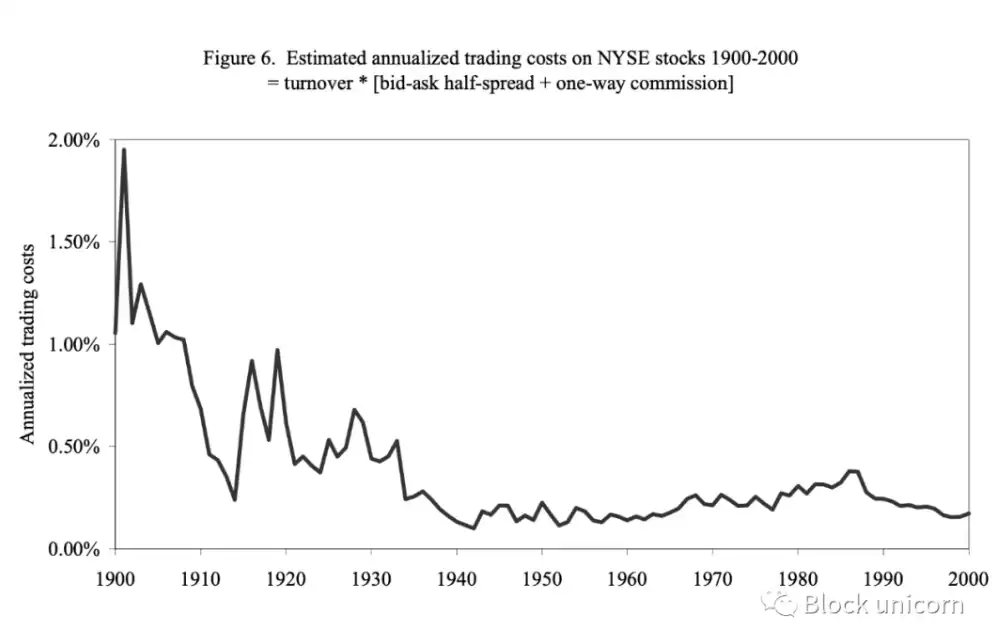
Historical transaction costs of the New York Stock Exchange
In addition to fees, we also have a price impact, which is the result of available liquidity. The more liquidity there is, the less it affects prices. Price impact has nothing to do with expense -- it is more a result of market size than operational efficiency per se.
Fees in liquid markets are usually measured in basis points (BPS). One basis point is 0.5 per cent. While each order can have a fixed price, in liquid markets the transaction price is usually just its BPS fee. For example, a £3 handling charge on a £500 transaction is equivalent to 500*0.0003= £0.15.
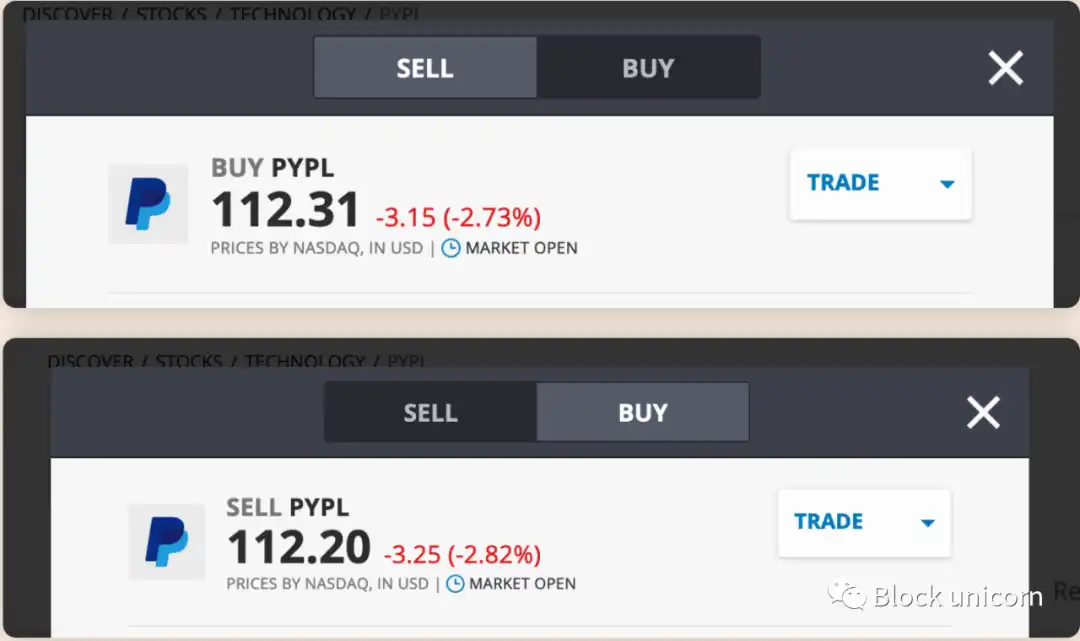
Two screenshots of PayPal's online stock broker. You can see that brokers are giving you different buy and sell prices. The difference is the difference. The price difference of PYPL is 1 -(112.20/112.31)* 10,000 = ~9.8 BPS. Even if the transaction is a "0% commission", users still end up paying for participation in the form of a spread loss. If you are buying or selling, you need to pay 5 basis points above the theoretical midpoint.
Uniswap: The most efficient market in the world
Uniswap V3 is the third version of automated market maker and now offers centralized (range-of-range) liquidity provision. Uniswap is available on public blockchains based on Ethernet Virtual Machine (EVM), including Ethernet main network, Arirum, Polygon, optimismPBC.
Unlike decentralized, order-based bidding, Uniswap introduces the concept of range liquidity, also known as pooled liquidity. In a range-wide liquidity model, liquidity providers (equivalent to market makers) provide the assets of both buyers and sellers. The following is ETH-USDC & NBSP; Scope map of 5BPS market:
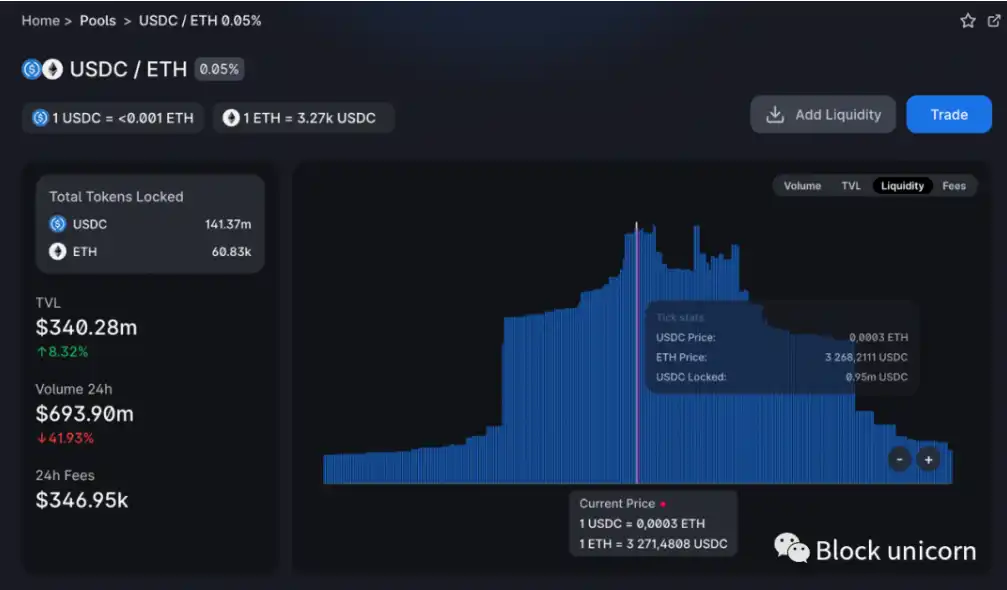
Ethereum mainnet & NBSP; Flow distribution of USDC-ETH on Uniswap V3
在区间流动性模型中,交易或所谓的「掉期」利差为零,这笔交易的任何费用都直接流向流动性提供者。虽然对交易平台本身收取佣金是可能的,但 Uniswap 还没有这样做。Uniswap 最接近的竞争对手 Sushiswap 对其 Token 持有者收取 16% 的流动性供应商加价。
最初 Uniswap v3 支持 5、30、100 BPS 的费用市场。在推出后,维权投资者 Alex Kroeger 和 Getty Hill 提出了 1 个基点市场的建议,作为使用 Token 的去中心化协议治理的成功示范。目前,1 个基点市场仅适用于稳定币对等非波动性资产,与传统金融外汇市场类似。尽管如此,它们的存在本身就表明,一场逐底的成本竞赛正在进行。
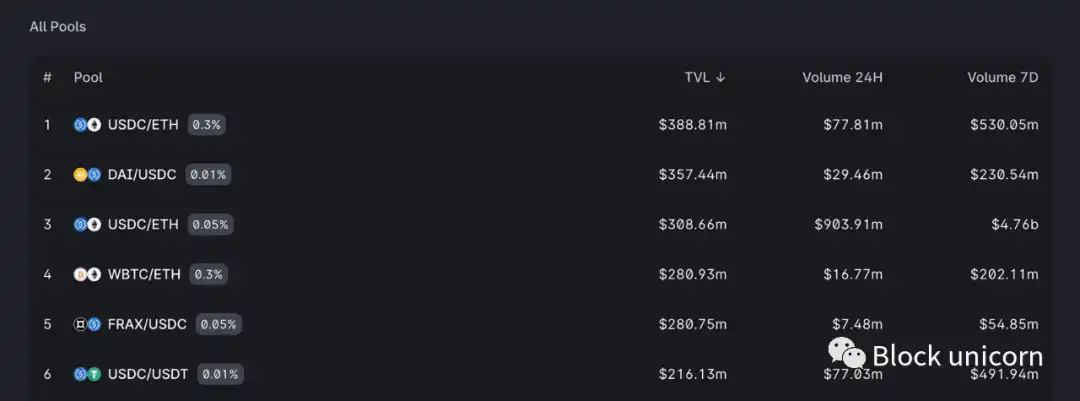
Top level Uniswap V3 pool, 1 BPS, 3 5 BPS and 30 BPS pools can be found
Method of comparison
To demonstrate Uniswap's market operation efficiency, we compared Uniswap with the most advanced trading platforms and brokers. Far from being a scientific study, we illustrate our point by comparing prices over a 24-hour period.
We compared the Uniswap: ETH-USDC trading pair market with Binance and Coinbase, the world's leading centralized cryptocurrency trading platforms. We also compared it to eToro, CFDS, the "free" online broker on the New York Stock Exchange's stock market. We also compare it to traditional small broker Nordnet and its nasdaq Helsinki-listed brokerage business.
No discount was given or accepted
The comparison is made from the point of view of a "retail" trader - assuming a $1,000 trade in which the price is unaffected. We do not consider all discounts, rebates and other benefits for large dealers or dealers with direct seats on securities trading platforms. We also consider withdrawal fees and we also assume market order (take order) types as this is typical for retail investors.
Stock market comparison
Nordnet and eToro measured the spread at 16:33 local time by selecting samples of the best inquiries and bids from their respective web user interfaces. We have also included euro/DOLLAR conversion fees charged by online brokers for deposits and withdrawals. In the cryptocurrency market, the corresponding fee would be the cost of euro /USDC transactions on any order book.
为了进一步比较,我们纳入了 Nordnet 的「非上市股票」价格,然后从 Uniswap 列表中随机选取一个小市值 Token ,以更好地理解低流动性资产的 AMM 定价。但对于流动性较低的资产,价格影响是主导因素,与此相比,交易费用不显著。
Below is a screenshot of the Coingecko ETH-USDC marketing page from March 11, 2022, which we use as one of our data sources.

We also measure the spread of eToro's ETH - dollar pair. EToro (Europe) Limited is an EU financial services company authorized and regulated by the Securities and Exchange Commission of Cyprus (CySEC). EToro is not a cryptocurrency trading platform, but it still offers cryptocurrency brokerage services. EToro spreads are 200 basis points, or 2 per cent. On this EU-regulated "zero-fee" broker, you end up paying 20 times more than on a decentralized trading platform, and about four times more than on Coinbase, its US rival.
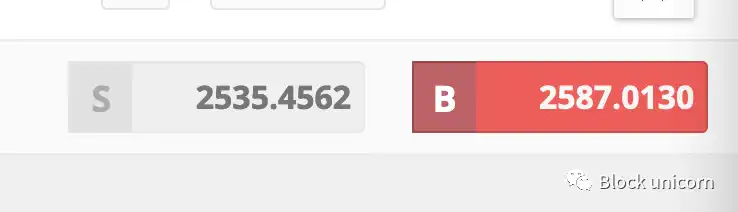
EToro snapshot obtained from the eToro user interface
Blockchain transaction costs
For blockchain transactions, the cost is paid to the block producer (known as a "Gas fee" in ethereum negotiations). Since there is no good service to compare transaction costs across the blockchain, we got data for the lowest transaction fees from l2fees.info. Note that this does not reflect the current proof-of-work transaction costs of the Ethereum main network, but presents the most easily verifiable on-chain costs. Popular tier 1 chains such as Avalanche and Polygon cost the same as ZKSync gas. Non-evm blockchains like Solana could further reduce costs by a factor of 10.
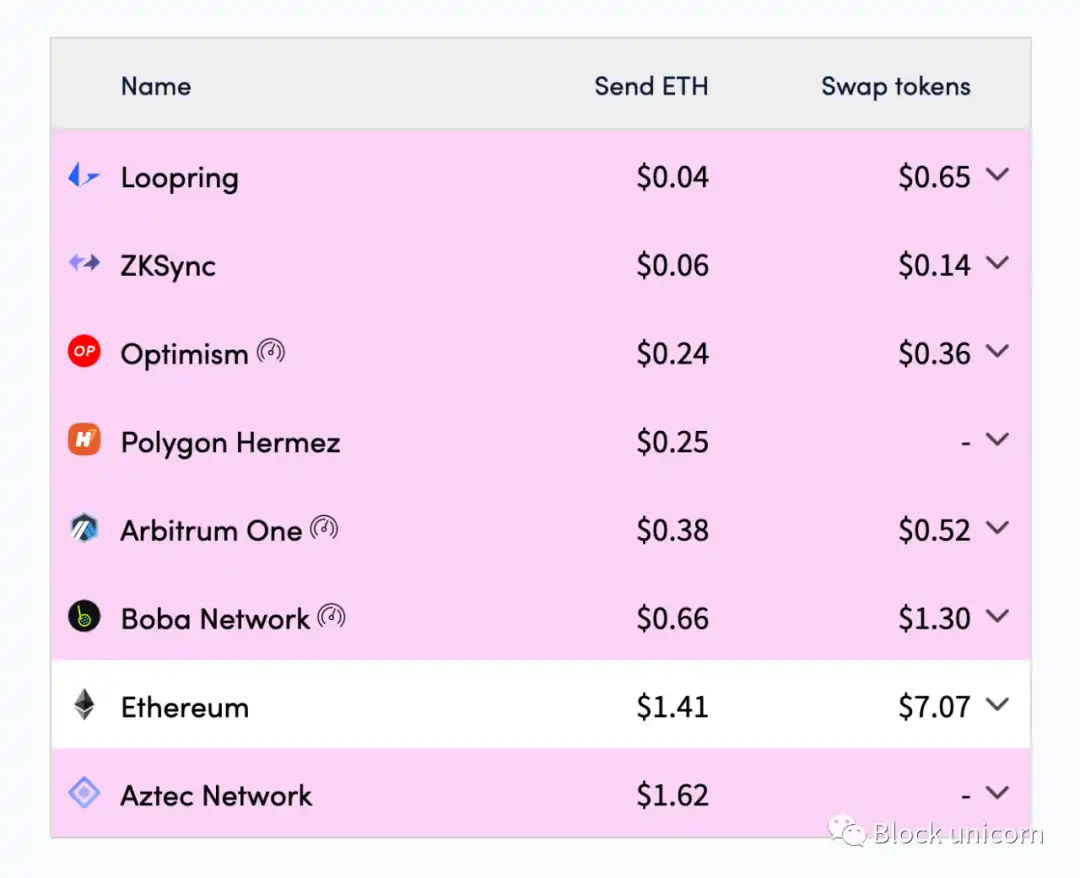
Ethereum L2 transaction costs
Sources of cost
For comparison purposes, we have collected the following information on the source of expenses:
Coinbase Pro cost
Binance cost
Etoro cost
Nordnet Cost & have spent
Nordnet spread
l2fees.info
Result of comparison
Assuming free access to USDC/USD fiat currency via Circle or Coinbase, Uniswap is the most cost-effective ETH USD market for retail traders.
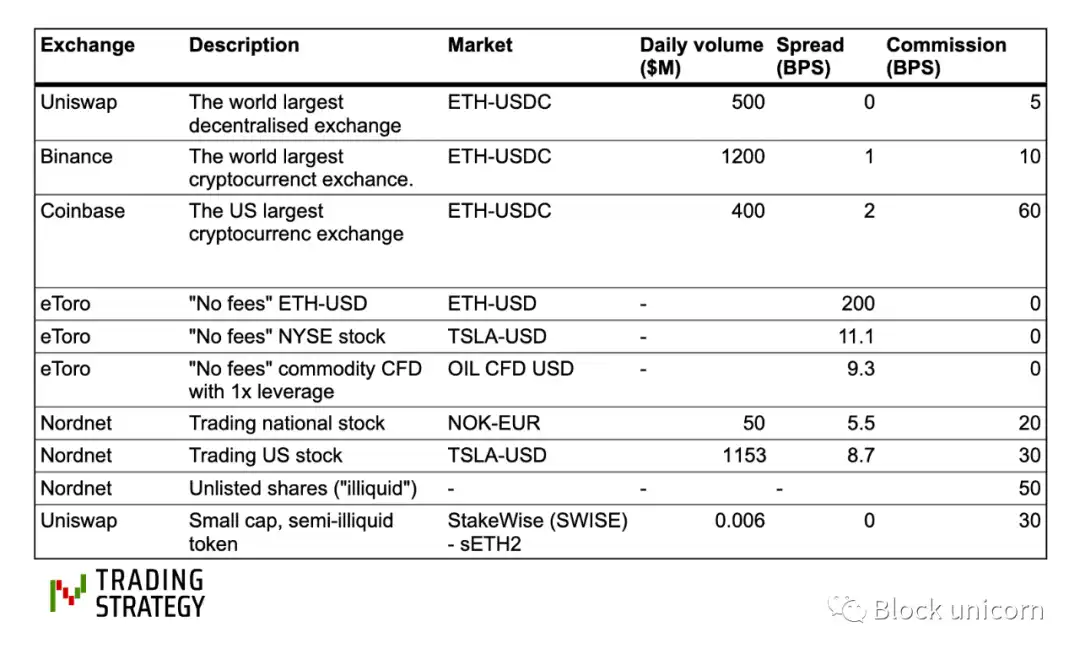
Uniswap ETH-USDC beat the best cryptocurrency trading platforms with transaction costs of around 5 BPS, also in line with online stock brokers. From the screenshot above on Coingecko, we can see that Uniswap has the second highest transaction volume and is 50% of the highest comparable pair ETH/USDT. So it can be said that the market has woken up to the efficiency of decentralised markets.
Uniswap's total charge of 5 basis points is comparable to the spread trade of 10 basis points on eToro's "no-cost" liquid shares. Uniswap has no withdrawal and deposit fees, so its total transaction costs are probably lower by now.
We also added some other costs because they are not immediately visible in spread or trading commissions.
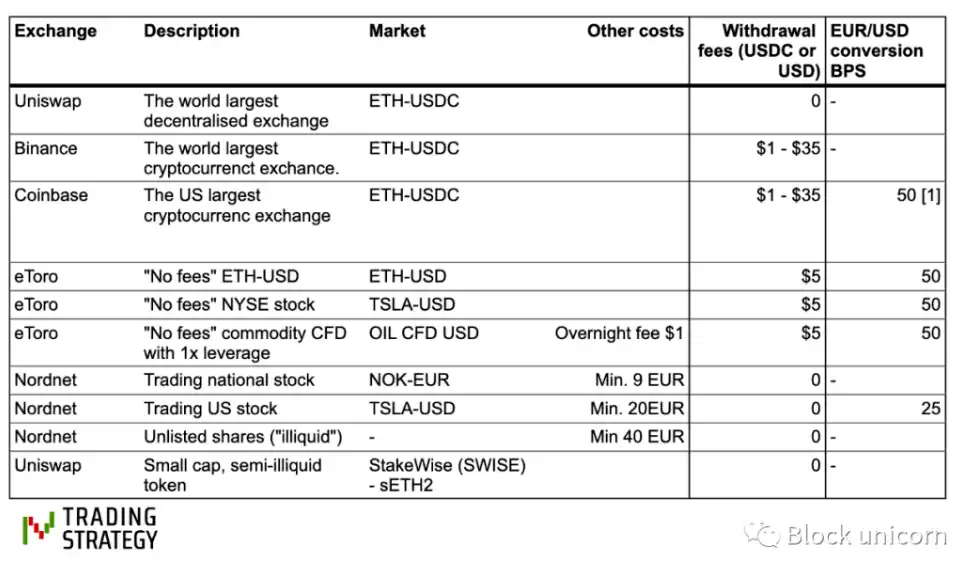
Efficiency factors beyond transaction costs
In addition, because Uniswap runs on a public blockchain, there are efficiencies that centralized markets cannot match.
- No counterparty risk.
- No withdrawal or deposit service charges.
- Direct to investors or no brokerage fees.
- The market is open all day.
- Due to the use of a public blockchain, everyone can access data for free at the same time, making the market fairer and there is no hidden cost to delayed market data.
- The software running the trading platform is open source, allowing anyone to audit errors such as fee structures. Because market participants can self-audit their premises, less regulatory intervention is required.
- 没有供应商锁定。如果您对这项服务不满意,您可以将您的 Token 带到任何其他交易平台,几乎没有费用,也没有麻烦。
- The listing process is automated. For asset issuers, the cost of going public is essentially zero, both in cost and time.
- Fewer staff needed: As activities are governed by smart contracts, there is less need for front, middle or back office staff (finance).
Why are public blockchains more effective at solving transactions?
Uniswap is an improved centralized proprietary solution and is a good example of blockchain technology, and it is important to ask the question "Why is this possible?"
Opponents of blockchain technology often argue that anything implemented on blockchain can be implemented more efficiently on private servers, such as Microsoft Azure clouds. Maybe - if you only count the electricity for one server. In practice, the cost of electricity is not a significant cost for any software-as-a-service business, and business costs are created elsewhere.
We believe that blockchain technology has inherent advantages that proprietary solutions and business models cannot match over the long term.
Creating efficiency through openness and transparency, public blockchains rely on three cornerstones:
1. Open source: Blockchain and decentralized finance protocols are open source.
2. Open data: Everyone has free access to data.
3. Open networks: Trade without barriers to entry.
We looked at how these ideas have historically worked individually, and then concluded why combining them would yield new benefits.
Benefits of Open Source
The open source software movement began in the 1980s as an offshoot of the free software movement. The key promise of open source is that software can be created more cost-effectively due to collaboration and reusability. Compared to proprietary software development, open source promises no vendor lock-in costs, a larger talent pool, better career paths, better developer motivation, easier adoption, fewer licensing hassles, guaranteed software continuity, and more.
The sweet spot of open source and its more generic counterpart open innovation is that smes can innovate and collaborate together to compete with larger companies.

A16z on open source why to devour traditional financial software
The best-known open source success story is the Linux kernel, which began with the hacking movement in 1991 and evolved into a mainstream server-side operating system in the early 2000s. It's an uphill battle: big companies like Microsoft dismissive, perfunctory and muddy the waters with Linux. This may buy some time, but in the end, it's futile. First, Linux bankrupted all commercial Unix systems (HP, Sun, IBM AIX). Finally, Linux lets Microsoft off the hook in the mobile operating system market. Handset manufacturers trust open source Android over Windows Phone because they have more control over the ecosystem. In the end, Microsoft wrote off the $7 billion handset business, a pretty big win for communist thieves.
Linux as the foundation of the software business led to the creation of Google, Android, and Tesla. Today, Linux powers billions of devices. But more importantly, Linux is a core component of thousands of products and businesses. Because of the nature of open source, these companies can collaborate on innovations they otherwise wouldn't be able to do.
Benefits of open data
While data has existed since the age of writing, the accessibility of data provided by the Internet has increased the impact of open data by several orders of magnitude.
Data sharing is an interoperable software and hardware platform that aggregates (or orchestrates) data, data infrastructure, and data generation and management applications to better allow a community of users to manage, analyze, and share data with others on both short-term and long-term timelines (Wikipedia).
Open data drives innovation and, as we discussed earlier, proprietary data leads to market inefficiencies and oligopolistic profits.
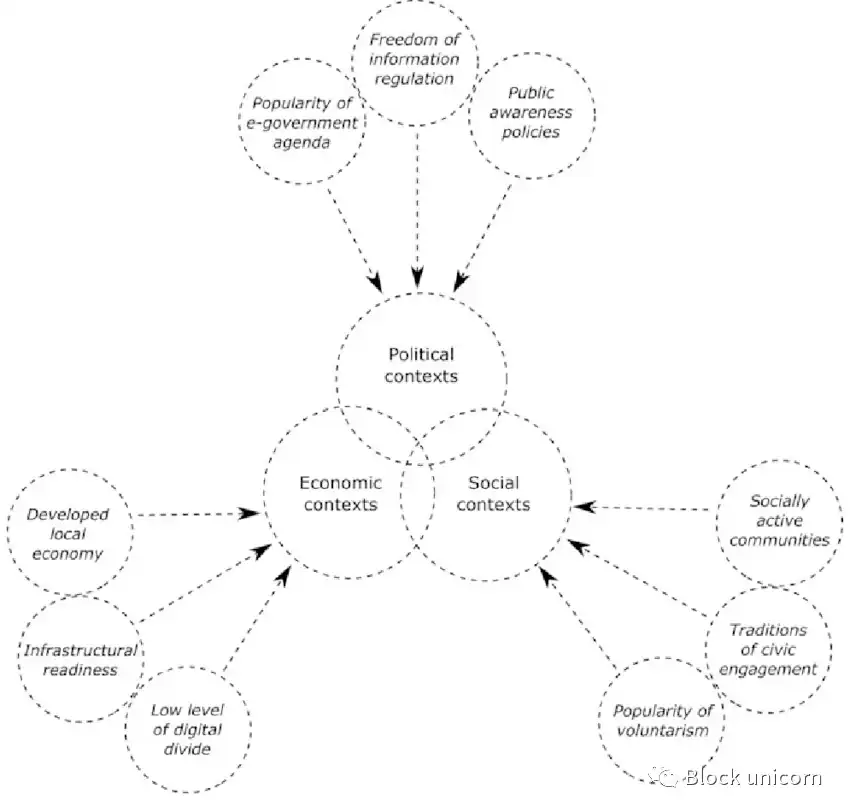
Maxat Kassen is the main political and socio-economic driver of the Open data movement
Blockchain takes this to another level using anonymous addresses and public key encryption, with innovations that separate real-world identity from ownership and authorization. Without this separation, data can become a liability and subject to complex or impossible licensing arrangements. Because there is no such liability, parties can trade with each other more easily because they don't have to worry about what happens to their private information.
Benefits of open networks
In the early 1990s, hypertext Transfer Protocol (HTTP) kick-started a boom in the Internet's "information superhighway", which subsequently led to the creation of e-commerce, online banking, social media and telecommuting industries. The main driver of Internet adoption is its openness - anyone is free to set up their own web server, home page or online store without asking permission. While some of the same original ingredients had existed in the 1990s on licensing networks such as Microsoft Networks, the Internet quickly took over. Public blockchains bring the permitless model of the Internet to financial services, making the barriers to entry very low.
To transact with a public blockchain, you pay a fee in the form of transaction costs, which is roughly equal to the actual cost of the transaction contained in the ledger, or units of account consumed by the blockchain nodes. The experience is frictionless: no software licenses to buy, no business negotiations to negotiate, no paper agreements to E-mail back and forth, no API keys to generate, and no marketing spam to receive. This makes transactions on a public blockchain an improvement on the ultimate process in finance.
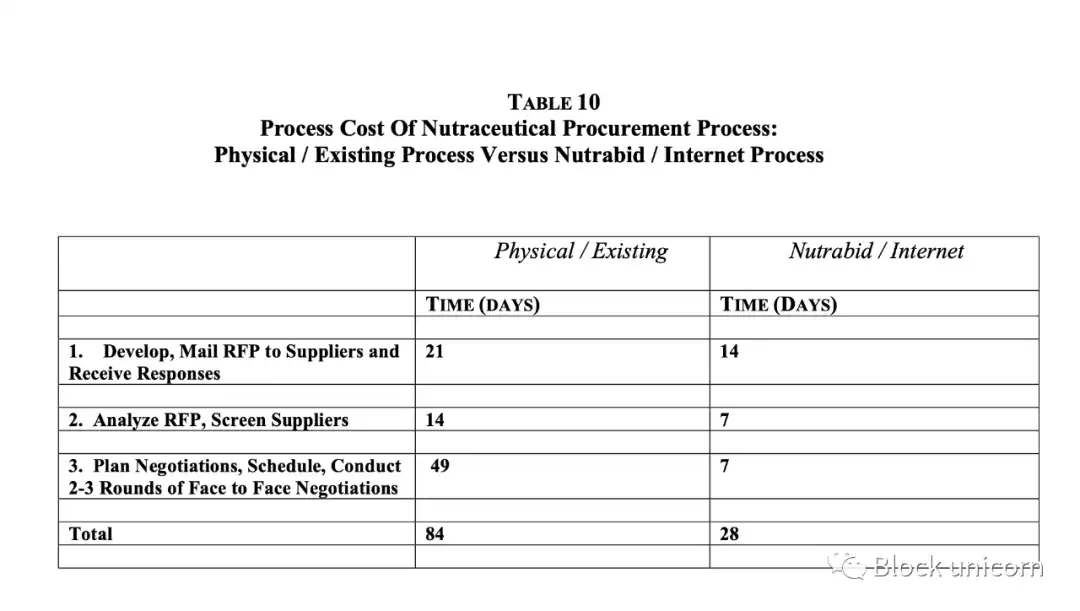
The table shows the process efficiency of paper/physical car sales versus Internet sales, one of the early studies on the impact of the Internet on business. In a similar way, public blockchains further improve efficiency by streamlining processes by encrypting transactions, common ledgers, and reducing software and organizational costs.
In theory, traditional financial systems could become open networks and match the pattern of a public blockchain setup. But in reality, they can't. Traditional finance is built on networks of high levels of trust because:
control: Make sure profits stay in a closed circle and fear competition.
Lack of system flexibility:Malicious actors can compromise the system.
For example, direct API access to the stock market order book is carefully cultivated to be available only to certain members of the stock trading platform, with everyone else needing access through brokers who act as middlemen. This is due to the tradition of trading orders still being settled through a network of tiered middlemen, but also because stock exchanges can make more money by retaining access to certain participants.
Another example is the EU's PSD2 directive. Banks have a huge moat because they hold people's money, but the only way to access it is the way the banks tell you - through their (often terrifying) online portals. There were no apis, and you couldn't create an app to spend money or trade from your bank account. It is about controlling and managing competition for banks: they fear that others will create better products and turn banks into useless conduits.
The EU likes competition, arguing that banks' moat of customer engagement hampers innovation. The EU then tried to enforce the "API access must be provided" principle through the Payment Service Directive 2, hoping to stimulate some competition. But the law has not produced effective software -- implementation is fragile, subject to conflict and challenges. The implementation itself is not open -- TPPs(third party providers) still need permission to access any incompatible apis. Or to put it bluntly: the PSD2 model is a bit of a contradiction, and you need to sign a contract with a third party to get API access to your own bank account. PSD2 has not been a huge success, nor has it stimulated the fintech innovation touted by its political boosters.
Who is being decentralized?
New technologies like public blockchains are disruptive innovations. The benefits they promise come from "disintermediation" -- removing middlemen from the process and replacing them with software and automation. So, in the case of decentralized markets, who is being replaced?
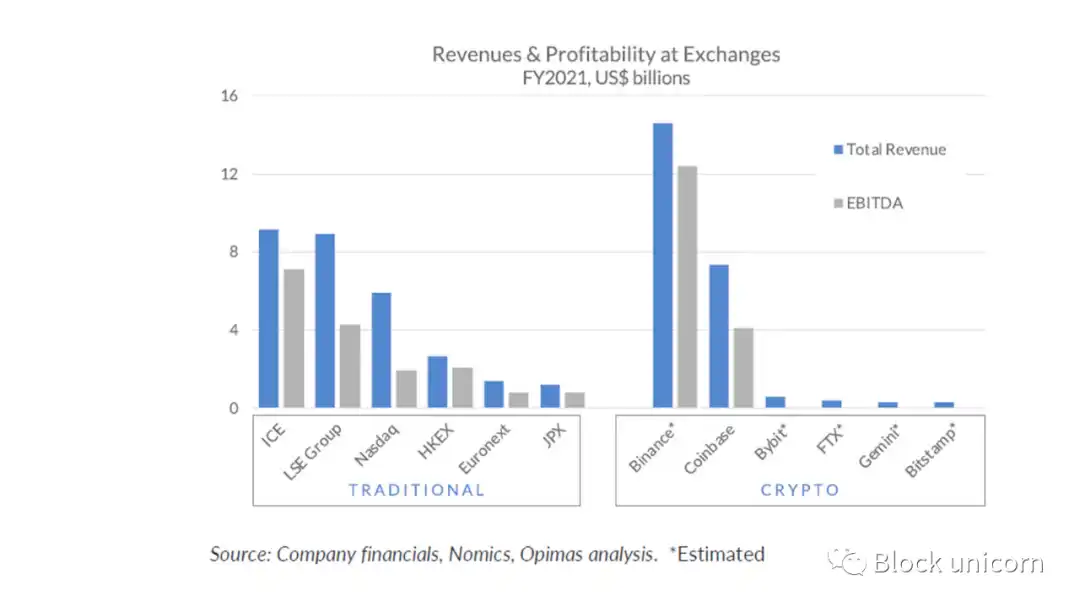
Revenue and profitability of stocks and crypto trading platforms on MarketWatch
If we look at the trading platform fees we discussed earlier, we can see that trading platforms are charging commissions in the form of spreads and fees. These funds are then further allocated to the trading platform itself (Coinbase, Binance) and its market makers (internal, third party), often in the form of rebates paid through opaque arrangements. A market-maker arrangement is based on trust or volume - an ordinary layman could never get the same deal as a "designated market maker". Perhaps the most dubious form of these trades comes from the public stock market, from free online broker Robin Hood and his Order Flow payments (PFOF), as brokers make more money (on the spread, not the fees) while "saving clients trading fees".
Such shenanigans do not exist in decentralized markets. Anyone can be a market maker on Uniswap, or they are called liquidity providers. Everyone has the same terms of entry to the market. If there are special proposals between people, they need to be voted on by public governance, and they will be visible on the chain. This has forced the market to become fairer and more competitive. In addition, compared with the traditional financial world, direct to investor trading platforms eliminate the need for brokers, and self-custody eliminates the need for custodians and reduces the need for custodians.
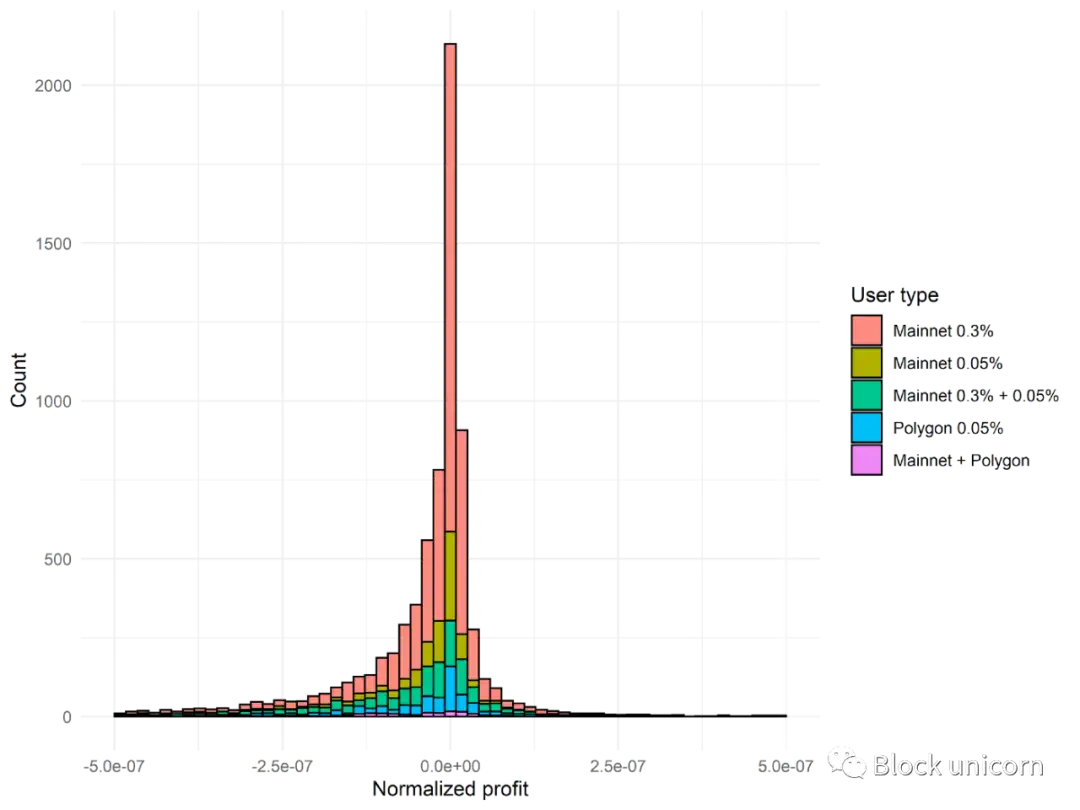
Uniswap Liquidity Provider profitability research
Cryptocurrency trading platforms enjoy fat margins in 2021. But that is changing as the share of decentralized trading platforms grows. Naturally, market makers are sceptical of this development. While Uniswap's remote liquidity model is new and yet to be tested, with data still being collected, market makers appear to be able to remain profitable, but at lower margins. That ultimately means less profit for trading platforms and market makers, which translates directly into lower fees for consumers.
Decentralization of financial issues
Financial decentralization didn't really begin until the summer of 2020, the so-called DeFi summer. Prior to this, blockchain technology was primitive. It took several years for ethereum's software development tools to reach the level of maturity needed to create protocols like Uniswap that we see today. This is similar to Web 2: Facebook spent 15 years developing a Web browser before launching it.
We are dealing with a very young phenomenon and it is not without its problems. The biggest problem is that it takes some time for users to learn new technologies. While there are some new concepts to learn, such as wallets, and the user experience may never be the same as centralized online services, Internet users have gone through similar transitions before: learn email, learn smartphones, learn social media.
Because users are still somewhat ignorant about blockchain technology, they are vulnerable to fraud, both in terms of technology and investment. However, as users continue to learn, this phase will gradually pass.
conclusion
It took Linux 10 years to go from academic adoption to mainstream operating system, and then another decade to become the king of operating systems. This meant disruption to existing industry players (Microsoft, IBM, Sun), but ultimately, it led to better services for consumers (Android phones, cloud servers).
A decade after Bitcoin's launch, a similar revolution is taking place as open source makes its way into financial services. Public blockchains and decentralized trading platforms are at the heart of this movement. There is no fundamental reason why they won't succeed. Regulators and the public are concerned; This is due both to genuine concern, sometimes to lack of information and misunderstanding, and sometimes simply to natural resistance to new phenomena.
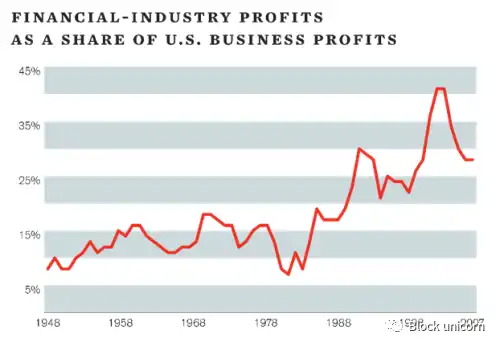
Competition does not seem to be eating into the industry's huge profits, and indeed there is some evidence that consolidation in finance is leading to more fees and worse customer service.
But the change is necessary. While offering transaction services is a race to the bottom, the competition can have unintended consequences for service users. It is better to create an ecosystem where service users have a greater say in transactions and even the smallest participants can easily collaborate. Promoting a movement that emphasizes transparency and fairness would do well to offset these concerns and reduce regulatory interference to keep the game fair. In the long run, this is exactly what decentralised finance will do.
The original link
Welcome to join the official BlockBeats community:
Telegram Subscription Group: https://t.me/theblockbeats
Telegram Discussion Group: https://t.me/BlockBeats_App
Official Twitter Account: https://twitter.com/BlockBeatsAsia

 Related Articles