Foresight Ventures: Crypto enters new life amidst collapse and fusion
Original title: "Foresight Ventures: Crypto enters new life amidst collapse and fusion"
Original author: msfew, Foresight Research
Crypto is dead.Long live crypto.
AC believes that: Crypto is following the old path of monetary policy in the early years, repeating the same mistakes, before recommitting monetary policy Mistakes made. Dragon slayers may be slowly turning into dragons. Wave after wave of Crypto has iterated into another shape, we can't remember why we started. Crypto culture kills the spirit of Crypto.< /p>
Indeed, as if it were. Instead of prioritizing core values (decentralization, security, privacy, ownership, innovation), we focus on Stimulation brought about by short-term greed (acquisition, hype, bloodshed due to fanaticism). This kind of status quo is quite sad.

These are just some of the dark sides, but:
More and more public chains love stable coins, stable coins are Ponziized, and the mechanism is too simple and crude (this article was written in April 22, when Terra did not crash). The theoretical TPS is extremely high, but TPS per second Lower than Ethereum.
Most DeFi projects are more and more fond of embracing supervision, which violates the original intention of less intermediaries and no permission.
Most GameFi is not fun at all, The end of the unsolvable economic system is always a death spiral.
Most of the NFTs are turned into dogs, and the useless or basically useless community concepts are fried. The more expensive the more artistic, the airdropped Token is also the air that feeds Ponzi, and it cannot be landed. It is just for nesting dolls to continue the story.
< p>Most DAOs are prostitutes, and a slogan can make people recharge with confidence. Everyone has added no less than ten DAOs. There are more DAOs than people, and their work efficiency is amazing Low.
Tokens of most projects are useless. Although they are said to have governance effects, is the process of staking really for voting? Does the vote of the blockbeats really let users own part of the agreement?

Decentralization
Centralization is equal to low price, and decentralization is equal to value. The high gas you pay represents the value addition of decentralization. Blockchain has many angles and levels of development Centralization: decentralization of computing power, decentralization of governance, decentralization of tokens, decentralization of applications, decentralization of storage......
As a blockchain or Crypto project, the general practice of the project is to establish a centralized attitude first, and then gradually decentralize all aspects in the implementation of the roadmap. But although the future is very good, but If there is any project that is completely decentralized, there is really no one, but complete decentralization is not the best state.
No one really Therefore, if you really want to build a truly decentralized agreement, you must make a vow of decentralization from the very beginning, otherwise you will only continue to compromise in the long process until you lose the right Direction.
We will start from the decentralization of Bitcoin development to discuss Crypto's vision of decentralization and the necessity of decentralization in certain areas.
1.Whose Law is Code?
One that is often mentioned in the Web3 era The point of view is that code is law, and code refers to the code of network protocols, smart contracts, or "recommended systems". The essence of code is law is actually the social consensus of the new world (the terrible kind), and we mainly focus on it here Discusses issues of code and development decentralization, and the role of users who don't know code in the world of cryptography and computing.
Web3 natives and "the law" There are a lot of direct interactions. Compared with the actual law, Web3 aborigines also understand and are more familiar with Code Law. But just like the law, code modification, governance and promotion are also very difficult and more centralized.
a) Bitcoin's P2SH battle
Bitcoin The first battle of Bitcoin code changes was recorded on Magazine: P2SH dispute. This is the first network upgrade after Satoshi Nakamoto left.

In the few years when Satoshi Nakamoto appeared, under his leadership, Bitcoin carried out a lot without extensive discussion The second protocol change. Of course, this is a relatively centralized manifestation, but Satoshi Nakamoto himself did a very decentralized thing later, that is, he disappeared, but also the decentralization of the development level we discussed The problem was created.
Bitcoin core contributor Andresen became the leader appointed by Satoshi Nakamoto. He promoted the OP_EVAL involved in P2SH Opcode, and hope to go online as soon as possible to realize the function. However, the introduction of OP_EVAL will cause some problems, and the developers are divided into several factions. One group thinks to release it quickly, and the other group thinks to delay the release, or use other alternatives. So the developers decided Let the miners vote with computing power, but the problem is that if the miner client does not upgrade, it will vote for it by default. Developers of various factions have had countless debates afterwards.
< /p>
This kind of undercurrent has been constantly happening in the development of the network, but as ordinary users, we do not see these conflicts and differences. How should a decentralized digital currency be developed? How to make a decision, how to decide the direction?
b) The debate keeps going on
< br>
Behind the scenes, the asymmetry between users and developers also leads to the fact that users usually only listen to the loudest opinions. For example, many people may not know that Bitcoin was in 2262 (right) It will activate the BIP-42 soft fork. I don’t know that Bitcoin was discussing using SNARK to scale in 2013. These are very interesting from the perspective of the story, but if you think about it carefully, these things are used by ordinary users or Miners seem to be unable to participate in Code Law. The characters in the story are all core developers and people who understand technology.
An event similar to P2SH happened recently .A developer pushed an update without reaching a consensus with other developers, and did not go through the update process of Bitcoin Core (Taproot update also had such an event, but everyone trusted that developer, so they did not He fired). Such a change is considered by some developers as an attack on the Bitcoin network, just like the BCH one.
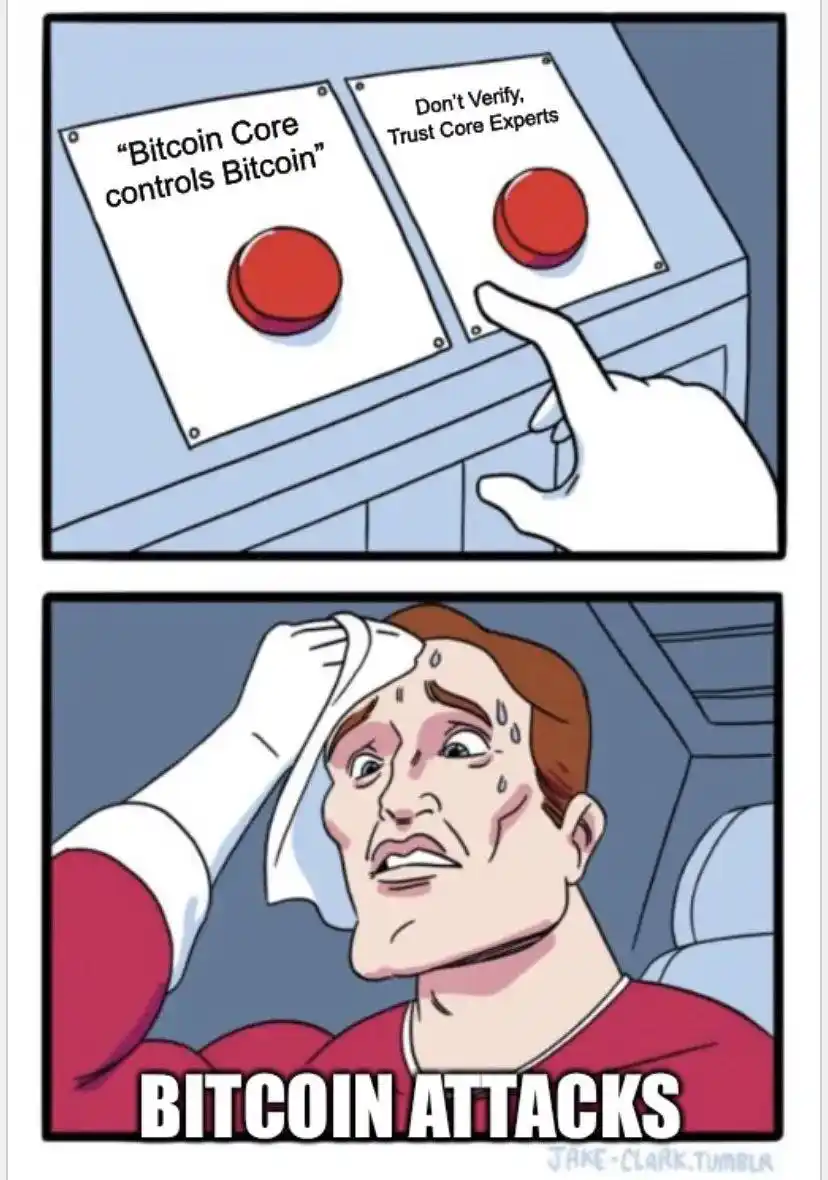
c) Who controls Bitcoin?
< br>
Bitcoin Core is not the Bitcoin network, not the command and control point of the Bitcoin network, but the focus of Bitcoin, nothing more. The Bitcoin network is not controlled by Bitcoin Core, nor In fact, the centralization of development and the lack of strict processes will not directly affect Bitcoin.
But Bitcoin Core may be controlled by these people: GitHub internal employees (secretly tampered with), and the keys of several developers (not the developers themselves). Among them, the developers have experienced quitting due to public opinion, or being kicked out by others. When the developer's When the push is not approved, they may come directly to fork.
We need to focus more on Bitcoin Core or other development Team, to ensure that at least the focus of the Bitcoin network is correct.
d) Law in the face of Code
< /p>
There are more than a dozen versions of Bitcoin nodes, all of which are caused by various development differences. The currently dominant version is Bitcoin Core , because Core code usually means the best performance, safest, best.
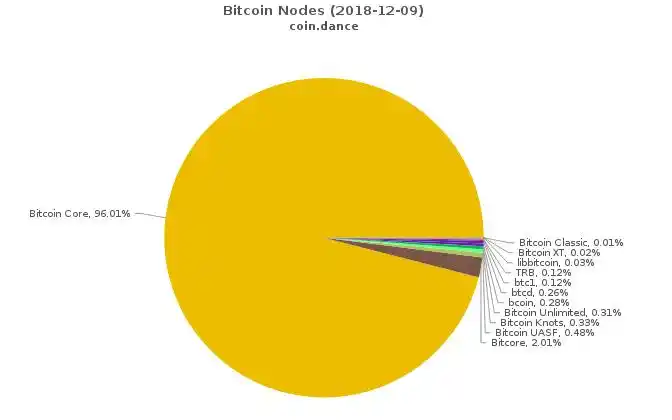
The status of Bitcoin Core is not important, it does not speak for itself. In fact, it does not matter who controls Bitcoin Core, because everything is a consensus in the end. Node operators or users mostly hand over power to Given to developers, this is their consensus, that is, their choice. Under such circumstances, the centralization of Bitcoin Core development may not be too important, because no one forces nodes and users to run Bitcoin Core, Your Node Your Code. Of course, any code changes need to go through strict review to ensure that it is the best solution.
Bitcoin does not actually need to "vote", Does not require ordinary users to participate in the development process, does not require democratic domination, and does not require pure decentralization of development. Bitcoin is anarchic, but requires rules, governed, defined, and enforced by the nodes of the network from top to bottom .
Decentralization is not as effective as centralization at some levels. For example, decentralization at the development level is needed for the team, but for the network Say, maybe decentralization of development doesn't matter...?
e) Code is Law is violated
We spent a long time talking about why we can trust the development team of Bitcoin Core if we want to, but although Bitcoin Core is our consensus, but They must be right?
The overflow bug in 2010 caused a fork, violating the longest chain principle, and 53 blocks were rolled back (DAO 0 blocks in the event were rolled back).
The problems involved in BIP-50 resulted in at least one double-spending transaction, which slapped PoW.< /p>
The problem fixed by BIP-42 is that Bitcoin will have an infinite supply due to overflow. The white paper is Law, Code is not.
These are all because of the fault of the development team, which violates the concept of Code is Law and network decentralization. It is not that the code and Law cannot be changed (just discuss Bitcoin, without any insinuation), but Some development teams are sometimes able to speak out and let the whole network remedy their mistakes. With Bitcoin Core, we choose to forgive them time and time again.

Is Bitcoin still the imagined decentralized currency?
2. No need for trust?
Continuing with the topic of consensus, although Bitcoin Core is everyone’s consensus, everyone must believe in the consensus, or obey the majority Do you have an opinion?
There have been many fresh examples recently, and the project is like this:
Our funds are managed by a particularly secure multi-signature wallet.
We are temporarily based on a centralized service with better performance.
Our contract code may be careless Or a deliberate bug.
Everyone rushed in after seeing the first few words of the first article, instead of DYOR, this is a common feature of trustless Misunderstood. If you don’t understand code, don’t understand technology, and don’t understand finance, then you need to be cautious, blockchain is a terrible dark forest...Anyone who abandons judgment and obeys “authority” may lead to miserable Consequences (just talking about the blockchain, without any insinuation).

For things in the blockchain or network world, we must treat every day as April Fool's Day, think about whether this thing is true or false
3. No permission required
While most people don't want to, some users are very It is necessary and necessary to run your own node. The configuration requirements of many blockchain networks are directly dissuaded. The real ultimate decentralized network is to allow ordinary users to run on home devices.
< br>
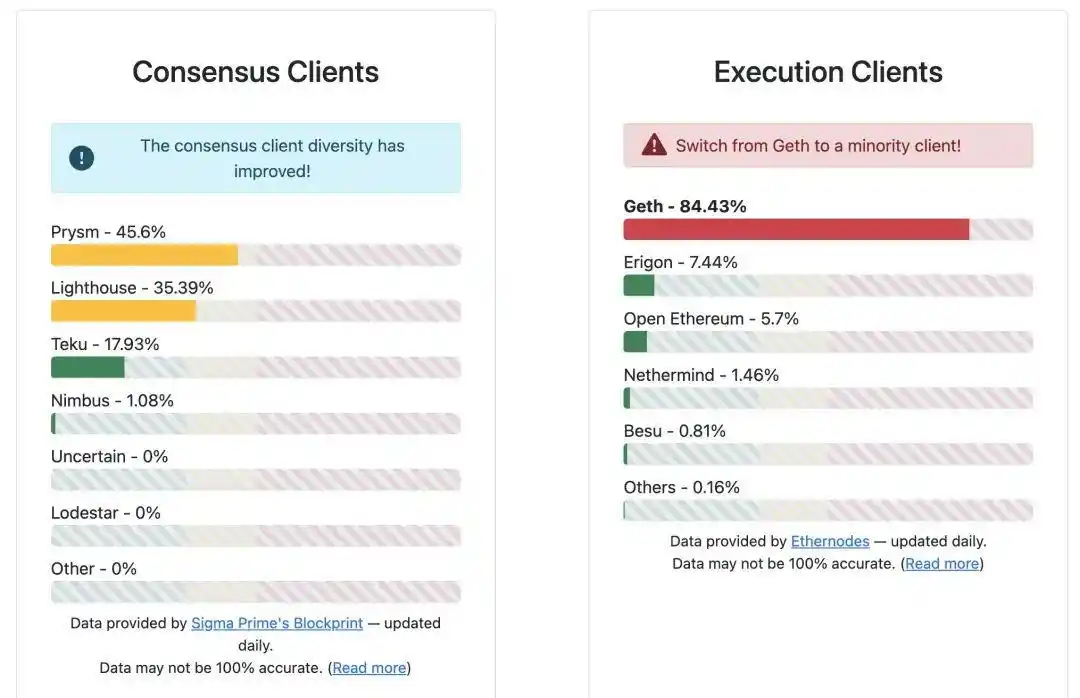
Do you remember the section that you don’t need to trust? Users can run a node or service by themselves. Many additional assumptions that may be risky on the network are removed (such as a more centralized Sequencer). In any case, allowing users to join the network is beneficial to the diversity of the network as a whole, as well as to the security and privacy of users themselves In terms of use, it is an extremely large bonus. This is very typical for Solana. When the node is down and restarts, it may actively review to remove "suspected malicious transactions". In contrast, Ethereum's Danksharding The plan is very user-friendly. Mina is also very good, and can even run in the browser.
For client diversity, even Ethereum It’s also not doing very well. Of course, taking the browser as an example, breaking Chrome’s monopoly is also very difficult, and it will take a long time.
Users also need to run their own application front-end. In many cases, the protocol is decentralized and neutral, but the application front-end is mixed with a lot of other content (Tornado.cash, Uniswap, dYdX, some Bitcoin wallets), leading to blocking and censorship. While it may indeed have a positive effect, this has an impact on the decentralization of the application. The application needs to provide a decentralized open source front end that allows Users or communities host themselves, so as to ensure the anti-censorship, neutrality, and decentralization of the application. We need Arweave.
For For a free and open Web3, any redundant permissions need to be removed, otherwise it is not decentralized.
Privacy and Ownership
< p>Web3 = Read + Write + Own. To have real ownership, we must find a balance between privacy and openness.
In real life, ownership represents house ownership, which means property rights, that is, the ability to refuse others to use. In the Web era, from Web1 to Web3, all items, that is, data, are based on sharing and dissemination to increase value. We use NFT to find a balance between publicity and ownership.

Web2 era , our data is "sold" to Internet companies and directly creates value for them. In the Web3 era, the data we own creates value for ourselves. We hope that these data (Meme, NFT, large-scale transactions) will be more widely disseminated, and These data can represent our own identity. But these transmissions make our privacy exposure risk greater.
We need cryptography to guarantee our privacy, while making the value creation process of our ownership more secure. Cryptography is the only way to enter the Web3 world and truly bring privacy.
Innovation
Innovation
The thriving development of blockchain and Web3 is based on innovation, innovation includes: open source 2.0, composability, decentralization, ownership. Innovation is necessary for success in any new field Conditions.
Higher stablecoin APY (halved next week) and higher TPS after careful "calculation" (the actual use of the main network is low (for Ethereum) is not innovation, but a fight to the death in a meaningless direction.

The essence of innovation is to solve problems that others have not solved, and of course create new ones at the same time
1. Solve problems that others have not solved
Really outstanding innovation can be described in one sentence, the following are a few typical public chains:
Avalanche: the earliest easy-to-use low gas EVM Chain.
Arweave: A Persistent Storage Network Without Any Censorship.
BSC: And Fast and cheap centralized public chain.
Solana: super throughput, contracts can be written in Rust.
Cosmos: a new blockchain network structure.
Arbitrum: cheap, and can borrow the security of Ethereum at the same time.
Luna: The first chain that prints money by 20% APY (this article was written in April 22, when Terra did not crash).
In this process, if these problems are solved by others, then innovation may lose its meaning. For example, Polkadot and Near are both working on the roadmap of the previous version of ETH2, and ETH2 A brand new solution has been proposed for the next-generation Rollup universe (it seems that only the stability and popularity of Bitcoin and Ethereum can support Layer 2). They are all good innovations, but as time goes by, they are a bit outdated. It is indeed creation, but not so new.
2. Creating new problems that cannot be solved at present
Each innovative branch may bring more problems after solving one problem. After the blockchain is created, problems such as expansion, consensus, and security will gradually emerge. There is a process of collapse and fusion. Computers were created to build better computers. It is difficult to explain why an innovation works, but when an innovation creates more problems, we know that at least we will gain later More progress.
Every day-to-day thing that is taken for granted is an innovation optimized by previous generations. At present, Web3 is the best place for innovation, We need to cherish every potential paradigm innovation and ignore meaningless innovation on paper.
Whether the goal is really high-quality innovation can actually be condensed into two questions.
Is the primary purpose is to improve technology/model/industry? (Barely can be a moderate Ponzi structure, but not a Ponzi scheme.)
Is it a good new Meme? (New Kind of Money, Rely on Math not Validators, The Internet of Blockchain)
Key research dimensions
1. Next-generation infrastructure
Every year is the year of Web3 infrastructure construction. This is a good thing, which means that we realize that the foundation of the industry needs to be stronger. Infrastructure will inspire new applications, and applications will inspire new infrastructure. But to Note that infrastructure that does not solve the problem and cannot be developed into an application is still meaningless.

Infrastructure Contains countless directions:
- New chain: The chain is the network layer of the application and the basis for the application to run.
< p>- New Bridges: Bridges are necessary to connect networks.
- Developer Resources: Next Generation Developers, more researchers.
- Facilities for developers: better development tools, more readable data, faster and more meaningful
- User-oriented facilities: better wallets, better applications, especially for Web2 users, which will represent Crypto as a whole Expansion.
- Public goods: providing value for Web3 and the world at large.
Infrastructure
2. The next generation of innovative technologies
We need to look for innovations at the surgical level, not at the level of medicines and plasters. The typical next-generation innovative technology that I personally think of is zero-knowledge proof.
The first era of Crypto is Bitcoin, the second era is Ethereum and smart contracts, and the third era will be zero-knowledge proof.
Web3 will Due to the popularization of zero-knowledge proof technology, a more standardized, more efficient and comprehensive development method has been innovated.

Zero-knowledge proof will satisfy all decentralization (mining in the browser), trustless (extra trust assumption is mathematics), innovation (alien technology combined with cryptography), privacy (zero-knowledge is privacy), Meme (Cryptography and mathematics are the largest "Meme" created in human history) and other features that Web3 should have.
In addition, I am also very much looking forward to the integration of mature technologies of Web2 and Web3 to create a new generation of innovative technologies, such as the true integration of machine learning and Web3, and hardware innovations to allow technologies such as zero-knowledge proof to exert greater capabilities.
< p>3. Next-generation business model
DAO: In the future, more exploration of the DAO model is needed. What is it for? What is it suitable for? How should it be done? DAO is the core of Web3 and Crypto space, closely surrounding the community and users. We will continue to study the improvement of DAO to the traditional system, as well as the evolution of DAO itself.
Creator economy: The creator economy is very similar to DAO. It is a concept that everyone is very familiar with, but it has not run out of real value. Art creators have their own community through NFT Group and economy, but creators in music, video and other fields seem to have a rejection reaction after countless integrations with NFT, unable to truly integrate and innovate. The real realization of the creator economy may require more Web3 social and NFT Co-innovation.
Guild 2.0: The guild has been evolving with the appearance of the game, and the emergence of the Play-to-earn mode has given the guild a new life. Guild The role in the Crypto Gaming field is becoming more and more important, playing the role of management, operation, and integration. I believe this model will become more mainstream in the future, making the Crypto game industry more mature.
NFT 2.0: We all like PFP, but it may be just a consumer product (for now). What role should NFT be? Everyone has always had some hazy ideas in their hearts, and it is Pass , is it Link, is it Art, or is it Meme?
Summary
Remember the beginning of AC Thoughts? Even so, we have entered a new era, and we are a new generation that can do better. Blockchain may have stepped into the wasteland for a while, there are not so many "easy" innovations, but the foundation of Crypto is not Instead of turning into profit-seeking greed, it may have shifted from trustless to partly trust-based. Still, we're on the right track.

We should not be a decentralized Maxi, the existence of these core values is not black and white, we just need to always take them as the first consideration factors. For example, in terms of development and governance at the beginning of the project, these less necessary decentralization can get some concessions, so that the entire Crypto and Web3 fields can really be built and developed rapidly.

Optimistic view: Web3 is already very good. There are countless young and talented people migrating into Web3, use and build, brings free mobility. We're on the fast hype train, and overall it's a very good thing. This is the new land of opportunity, you can build the future, you can own it , Integrate digital identity, realize open finance, combine open source Lego, and have a new generation of global work mode.
Technically:
< br>
Looking pessimistically: Sometimes, you have to let it break. Although Web3 is so ridiculous now, it will experience collapse and integration, and then enter a new life. In a rapidly changing Web3 world, the largest The biggest risk is not to take any risks, we need to recognize the real value in the chaos.
Even if you don't care about how to make Crypto go in the right direction, at least Some people care...

Original link
Welcome to join the official BlockBeats community:
Telegram Subscription Group: https://t.me/theblockbeats
Telegram Discussion Group: https://t.me/BlockBeats_App
Official Twitter Account: https://twitter.com/BlockBeatsAsia

 Related Articles