The encryption market dreams back to 2018, stick to it or leave?
Original Title: "Foresight Ventures: Please Answer 2018"
Original Source: Hippy, Foresight Research
Rhythm Note : This article was originally published in January 2022, when Bitcoin fell from a high to around $30,000, which once aroused market concerns. At that time, LUNA had not yet collapsed and even the price was still rising. Back in May 2022, LUNA did not seem to have escaped the curse of the death spiral, plummeting 99% from a high of $110 in just one day, and has currently fallen below $0.4. The 24-hour decline of most Altcoins in the market exceeded 30%, and the entire encryption market was shrouded in panic.
So for users who just came into contact with Crypto last year, maybe this is the first time you feel The vagaries of the encryption market; for users who have experienced bulls and bears in the battlefield, there will also be moments of confusion. In the end is to stick or leave? After reading this article, you may have your own judgment in your heart.
The following is the original text
“I don’t understand the bull market , but I understand the bear market too well."
——Said the little leek who entered the market at the 18-year high
Written in the front
Recently, many old friends talked to me about "Dream Back to 2018", and many old leeks began to write "Bear Market Survival Guide" , more new friends entering the market in this round of bull market are eager to know what will happen to the market. Seeing the eager eyes of these new friends reminded me of myself who listened to the bragging of the old leek in 2018. I was full of confidence in the future market, but I didn't know that what was waiting for me was a long bear that lasted for 3 years.
Of course, writing this article does not mean that we judge that the future market is about to enter a bear market. We just simply recall what the digital currency market looked like in 2018, and together Think about how to live long and prosper in the ups and downs of the cycle as a participant in the digital currency market.
Market overview - the era of mixed fish and dragons and strange forces

The apex of the secondary market appeared in January 2018, the entire figure The market capitalization of the currency market is more than 800 billion US dollars, which is about one-third of the ATH in 2021. At that time, the market was full of altcoins, and the proportion of Bitcoin reached a minimum of 33.39% on the day when the market capitalization was high, and the market was still immersed in ICO to make wealth In the mythical bubble. Looking back at the top 20 currencies by market value at that time, all of them were various public chain tokens and BTC imitations, but now only 6 currencies remain on the list, and the newly emerged currencies are 11.
Public chain/protocol
First of all, the public chain/protocol market washes In 2017-2018, the market is still mainly in the development stage of infrastructure. The public chain and the protocol layer are the focus of the market. Fragmentation, DAG, BFT and various Proof of Bullshit emerge in endlessly. Every public chain They all try to use various methods to solve the impossible triangle of "efficiency, security, decentralization".
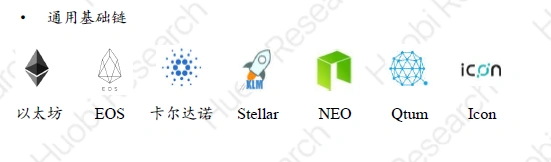

Overview of the public chain in the first half of 2018
Under such a market environment, investors in the primary market basically open their mouths to the consensus standard, and shut their mouths to TPS. Today, they study how to solve the asynchronous problem with a directed acyclic graph, and tomorrow they think about how Byzantine generals can achieve point-to-point communication. But most public The chain is in the early development stage, and there are very few projects launched on the main network. The first-level investment can only start from the angel stage, but no one knows whether it will land. Such a market environment has spawned a large number of pseudo-technical projects. A white paper Financing can be started with just a few consultant platforms, and project due diligence can only look at technical solutions, but there is no data or developed products to verify. Everyone is looking for the next generation of public chains other than BTC and ETH, 18 years Someone told me it was called EOS.
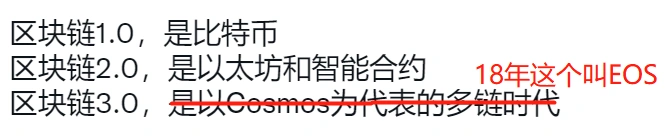
(Foresight Ventures is still very optimistic about the cosmos ecology and various new public chains)
In addition to general-purpose public chain solutions, many projects choose to go Pifeng adopts vertical solutions for specific application scenarios, public chains for Internet of Things, storage, and privacy, and protocols for data, security, and transaction scenarios. Most of the projects stay before the mainnet goes online, even in the initial development stage, and only a small part are actually made. The incompleteness of the infrastructure has led to the shrinking of the demand of the application layer, and there are few other uses except for transfer payment, clearing and settlement, and using the ETH smart contract ICO to issue coins. As for traceability, identity credit, distributed computing and other scenarios, it is even more difficult to solve.
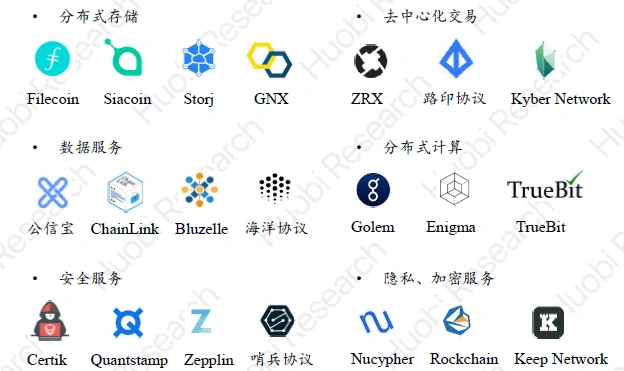

Overview of agreements in the first half of 2018
< br>
Chain reform
After the wealth creation effect of ICO spread across the country, a large number of companies in traditional industries want to pass blockchain Chain technology solves the problems of the industry or itself, and the trend of "chain reform" has risen rapidly. Among them are many insightful people who are full of faith and eager to join the technological revolution, and there are also ghosts and monsters who take advantage of the heat to cut a handful of leeks. The trend of chain reform spans P2P, mobile phones, e-commerce, traceability, AR/VR, SaaS, games and other sectors. Only you can't think of it, and I can't change it. It seems that the emergence of the blockchain can solve all the pain points that cannot be solved online and offline, but for most projects, there is actually only one problem that can be finally solved-the financial problem of the project party.
Transaction Mining
After the market sentiment fell slightly, most investors began to consider To invest in some projects that can generate cash flow, the exchange becomes the first choice. The "trading mining" exchange headed by Fcoin was born. In order to realize the cold start of the exchange, Fcoin issues FT according to the user's transaction volume for transaction incentives. In fact, the annual rate of return was only 30-40% at that time, but users who had never experienced Yield Farming flocked to it. As the popularity soared, FT tokens rose hundreds of times in a few weeks, and because of the flaws in the design of the mining mechanism, they quickly crash. However, this innovative model has been used, and a large number of exchanges have begun to use "transaction mining" as a selling point to raise funds for platform tokens. Exchanges, like Internet companies, strive for long-term product and operational capabilities, and the discovery and capture of high-quality assets. Most of the follow-up exchanges were short-lived, and only a small number survived.
Death spiral
After the secondary market reached a high, the primary market passed All kinds of strange hotspots have been "booming" for half a year. In August 2018, the most exciting part of the bear market came - the ETH death spiral. Since a large number of projects in the last round of bull market used ETH for financing, there is a large amount of ETH in the hands of project parties and primary investment institutions that has not been realized. When ETH fell, investors began to sell, and the project side also reduced their holdings. As the anchor of the altcoin market, the decline of ETH led to the decline of the entire market. Project parties, investors, and traders began to reduce their holdings of various altcoins, and the death spiral began. ETH fell from $400 to $200 to cut in half, and then fell all the way to $89 after two months of sideways trading. The primary market also completely Declared dead. The original accumulation of most investors in the last round of bull market has seen a retracement of more than 50-80%, and the glory of ICO has long since disappeared.
STO, EOS/Tron dApp and others
During the two-month market sideways The primary market also tried to do some small work: the first is compliance-oriented ST (Security Token) and STO (Security Token Offering), which are simply a form of asset tokenization. The process from Asset backed security to Asset backed token. Owning assets or cash flow as a value support, but it is essentially another form of ICO that is closer to regulation. In view of the downturn in the market at that time, the demand for issuance in the primary market had begun to shrink, so the concept of STO did not become a reality in the end.
The second is the outbreak of EOS dApp, a large number of games and spinach projects appear on the EOS chain. The EOS dAPP represented by BetDice created a turnover of 8.2 billion RMB in two months and attracted hundreds of thousands of users. Decentralized exchanges, wallets, mining robots and other related services built on EOS have developed rapidly, and their popularity has even led to the explosion of EOS RAM. For the first time, the situation where the entire public chain ecology is brought to life by the application side. However, the projects on EOS are mainly based on spinach attributes. The transaction volume of spinach dApp accounts for 90% of the total transaction volume, and the life cycle of its users is basically kept within one month. The game of stock funds has led to the collapse of the EOS application ecology. Crashes quickly. Later, Tron also copied the EOS model, trying to continue the glory of EOS, but its user data and activity also fell off a cliff within a few weeks.

As Bitcoin maintains a three-month horizontal trend near $6,000 After the market, it quickly fell to $3,000 in November, and the primary market has since entered a stage where there is nothing to speculate, and the most desperate moment is coming.
Market participants - stay or leave
Exchange
The exchange is one of the participants with the best cash flow in the digital currency industry, and it is also the longest surviving party in the bear market. As an asset issuance and circulation channel, the exchange occupies the entire industry upstream of the chain. However, under the background of the bear market, assets have no wealth creation effect, the spot trading volume has shrunk severely, and users' trading habits have also changed from buying coins to trading contracts, which has spawned many contract exchanges.
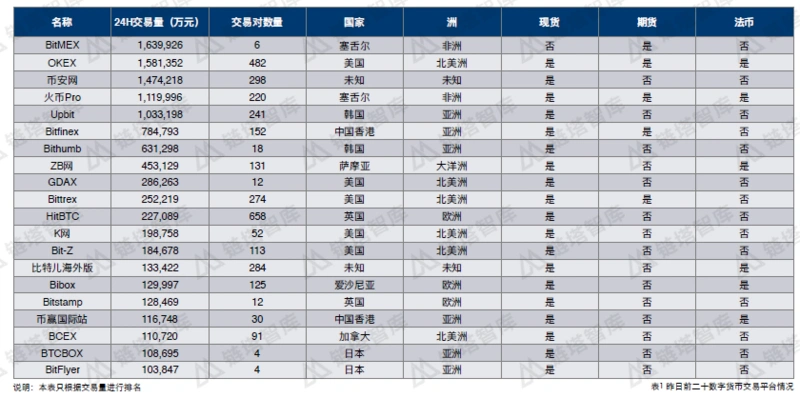
2018 Exchange Trading Ranking in April
The picture above shows the trading volume ranking of exchanges in April 2018. It can be seen that BitMEX, which focuses on contract trading, occupies the top spot, followed by domestic The three major exchanges and overseas regional exchanges.
BitMEX and OKEX were the places where the contract trading function was launched earlier, and it was also the place where most people traded contracts at that time Choice. In the second half of 2018, most exchanges began to develop contract trading business. Huobi opened the contract trading area Huobi DM at the end of 2018, and Binance opened the USDT perpetual contract business after acquiring JEX in September 2019. In terms of spot, Binance first created the Launchpad concept in the first half of 2019, and then major exchanges began to launch their own IEO imitations, and there was a wave of IEO market independent of the market.
In the two years from 2018 to 2019, the top exchanges basically maintained their original status, and Binance gradually climbed to the top of the list through innovative operating methods and management models. For small exchanges, some Can continue to earn income by maintaining existing customers, and some will gradually stop business in the reduction market.
Project Party
< br>
Before discussing the situation of the project party, let’s first look at the financing situation of bull market projects. The following figure shows the public offering data of the top ten projects in 2017, and we can find the valuation and financing amount of the projects at that time They are all very large, and the amount of financing for large-scale projects is basically between tens of millions to hundreds of millions of dollars. By the first half of 2018, the project valuation of 100 million dollars in the early white paper stage has become the standard. Therefore, for project parties financing in the bull market For most projects, there is no funding problem.
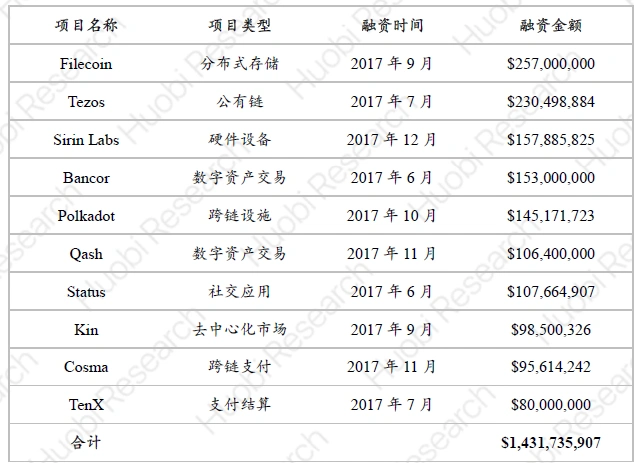
The top ten digital asset crowdfunding projects in 2017 financing amount
Here we classify the project parties into Projects that have raised funds and have issued coins, projects that have raised funds but have not issued coins, and projects that have not yet raised funds.
For projects that have raised funds, the project party that issued coins in the first half of 2018 basically does not need to consider the issue of market value management and maintenance, and a large amount of funds will be returned entering the market. There are many high-point cash-out projects represented by EOS. Blockone can be called a master of cash management. At the high point of the market, it sold the funds raised and exchanged them for cash and U.S. Treasury bonds, successfully avoiding the bear market. Some project parties did not sell, and after experiencing the ETH death spiral in August, the funds in their hands have also shrunk sharply. Some teams choose to give up currency price maintenance and concentrate on development, and more project parties choose to completely lie flat and break the tank. Project parties that failed to issue coins in the first half of the year began to delay issuing coins, or did not issue coins, which is commonly known as running away. As for the project parties that have not yet raised funds, most of them have changed the direction of the project. Some choose to leave the blockchain industry and return to the embrace of the traditional market, and some transform the industrial blockchain and provide some To G services.
Institutional investors
The primary market in 2017 is basically based on individual participants Mainly, a large number of Token Funds and traditional VCs began to appear in early 2018. The quality of these institutions varies, some are professional investors from the traditional financial and Internet fields, and the other are early digital currency players and large investors with primitive accumulation. The figure below lists the well-known domestic investment institutions in the market at that time, as well as A16Z, Pantera, Hashed, Kenetic and so on overseas. If we compare it with the current list of investment institutions, we can find that most of the domestic institutions have withdrawn from the stage of history, and the reshuffle of primary market participants is also quite thorough.
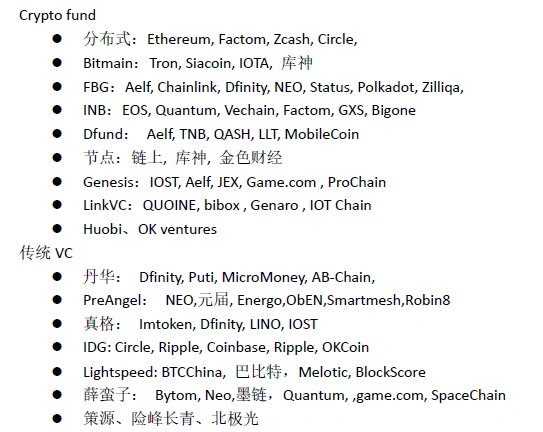
The iteration of the organization was not obvious in the first half of 2018. In the last wave, everyone basically made a lot of money. As long as they get the quota, they can make money and raise funds , Exit, and cash out are not a problem. But when the market went down, most of the projects broke, returned to zero or even did not issue coins. A large number of institutions without investment capabilities were unable to withdraw from the previous Haitou projects, so The tide of rights protection in the primary market has begun to rise. A large number of Saft agreements have been resold second-hand, including Filecoin, Algorand, Difinity and other star projects that have risen thousands of times and hundreds of times. For institutions that still have faith in the market and have investment capabilities, they have begun to transform. In addition to seeking money from project parties, some funds have begun to find ways to generate cash flow, so secondary asset management and quantitative transactions have become popular choices.

SAFT resold at the end of 2018
Media, community and other service organizations
For service organizations, the downturn in the primary market is devastating. Without a trace, the demand for media distribution and public relations has dropped rapidly, and the service agency has lost its main client and source of income. As the wealth levels of all market participants are declining, the personal networks and resource relationships accumulated in the past are gradually losing their effectiveness. The original proxy investment community began to run away and disband, and the investment exchange community gradually transformed into a contract order group. Service organizations without cash flow and income began to withdraw from the stage of history.
Investment Logic——Transformation from the Bureau Path to the Research Path
I am at the beginning of 2018 I started to study in the digital currency market. Before entering this industry, I was engaged in securities research. I believed in fundamental analysis and sneered at technical analysis. When I started to invest in the primary market, I started with the principle of the project, and examined the technical solution, consensus mechanism, token model, release rules and team quality of the project. Although I do not come from a technical background, I have read a lot of papers, white papers and technical articles. I have done in-depth study of commonly used solutions on the market, and I am full of longing for the blockchain world.
Later, when I really devoted myself to the market, I found that fundamental analysis is basically invalid in an invalid market. There is no data support, only concepts and theories, how to make investment judgments in this situation? I try to sort out the following logic from the limited data and due diligence information:
-Technical solution: project progress, technical popularity, technical feasibility;< /p>
- Market popularity: number of media reports, roadshow situation, community data, search index;
- Economic model: token distribution plan, token function, token unlocking situation, financing and valuation;
-Team situation: founding team background, advisory team background, investment team background;
But in most investment funds In actual operation, this set of investment system is gradually transformed into two - tokens and teams. Investment has become extremely simple. There are only two points to consider when investing in a project: one is when the tokens will be listed, the proportion of the first release, and whether the unlocking time is reasonable; the other is who is the advisor, who will invest, and who will come to the platform. As a result, investment in the primary market has become a complete follow-up behavior. There is a list of institutional seats that everyone keeps in mind. Basically, if the top-ranked investment institutions invest, other institutions will inevitably follow suit. After the primary market shrank more and more, the above logic eventually degenerated into the logic of being the dealer. Incubation, management, and market value management have become the last resort to harvest the stock market.
With the slow recovery of the market in the past two years and the emergence of various statistical tools, fundamental analysis has come in handy in the digital currency world. In the 2020 Defi Summer, through the mining of on-chain data, transaction data, business models, and project mechanisms, research-driven investors finally made money for the first time. The digital currency market is also gradually transforming from ineffective to effective, and the Holy Grail of investment no longer bows to dealers, but to market participants who really work hard to research and build.
What did we get?
By sorting out the investment hotspots, market participants, investment logic and other aspects of the bear market, and comparing them with the current market conditions, we can easily conclude that The following conclusions:
1. Market volatility is huge, and investment targets and market participants have undergone a huge reshuffle. The Beta of the industry is very large, but how to keep the profits of Beta through the bear market is difficult, which requires strong investment ability and forward-looking judgment on market trends. More than 90% of incompetent people have been eliminated in the bear market, and more than 90% of unreliable projects have been abandoned by the market. The essence of this industry is what settles down after the big waves wash away the sand.
2. The market is getting better and more effective. With the recognition of digital currency and blockchain technology worldwide, a large number of professional investment institutions and capable industry builders have continuously entered the digital currency industry in the past few years. There are fewer and fewer fraudulent projects, more and more teams doing things, and great changes have taken place in the participants and fundamentals of the industry.
3. The market is rewarding long-termists and those who work hard to build. To have a firm belief, persistence is victory. 2018 is just the beginning of the bear market. The most painful stage is actually 2019 and 2020. The entire market is in a half-dead state. When market participants are no longer able to expand their business from any angle, the belief in the blockchain will collapse. I believe that everyone who was still in the industry at that time would repeatedly ask themselves these questions: Is Bitcoin a tulip bubble? Will the bull market still come? Most people's hopes are lost in waiting. But during this period, there are always some long-termists who are still working on the project, investing in it, and supporting the project. They also dare to devote their time or money to what they believe in. Some of these people have become top institutions, and some have become blue-chip projects, and the market has rewarded them thousands of times.
The Last Story
The last little story for everyone: April 2019 On the 19th, my colleagues and I had a meeting with a curly-haired guy on WeChat. He told me that they were going to be a contract exchange, and after listening to it, I felt that it was no different from the BitMEX model. So I asked him a few related questions encountered by BitMEX, and he didn't have a good answer. I went to their website and looked at the transaction data and saw that there were only a few transactions a day. In addition, the market conditions are very cold, and we no longer plan to invest more in the primary market, so we quickly passed the project. Later, I saw him again on the live broadcast of the hearing in the United States. On the name tag on his chest, there was a line of words "Mr Bankman-Fried"
The last and the last , I hope everyone can survive in the future market cycle, the bear market sows, the bull market reaps.
Source of data:
Huobi Research Institute "Global Blockchain Industry Panorama and Trend Report (First Half of 2018)"
p>
Chain Tower Think Tank "2018 Digital Currency Exchange Research Report"
DappReview "80 Days 8 Billion, Undercurrents Surging in the Cold Winter - EOS DApp Ecological Bigness You Don't Know Outbreak"
Original link
Welcome to join the official BlockBeats community:
Telegram Subscription Group: https://t.me/theblockbeats
Telegram Discussion Group: https://t.me/BlockBeats_App
Official Twitter Account: https://twitter.com/BlockBeatsAsia

 Related Articles