a16z, Axie, and YGG talk: Web3 game outlook
Original title: "A Conversation: What is Next in Web3 Games?"
Original author: Jonathan Lai, Andreessen Horowitz
Original translation: TechFlow intern
Sky Mavis/Axie Infinity co-founder and COO Aleksander Larsen, Yield Guild Games co-founder and CEO Gabby Dizon, and A16z partner Jonathan Lai discussed Web3 games during the GDC 2022 A16z-hosted event. The following is a record of the conversation about NFT games.
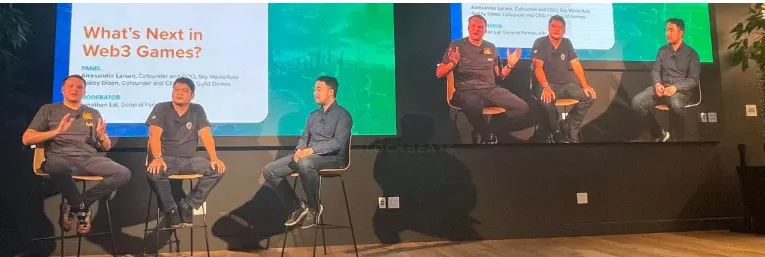
Jon:Thank you all for joining me. I'm Jon, a partner at a16z. Today we're discussing a topic that's very close to home and on everyone's mind at GDC, which is NFTs, Web3, and their impact on gaming. So, I'm honored to be joined by two luminaries in the Web3 gaming industry.
Aleks Larsen, Co-founder and COO of Sky Mavis, the company behind Axie Infinity, and Gabby Dizon, Co-founder of Yield Guild Games.
Let's get started. Aleks and Gabby, over the past year we've heard a lot about how NFTs and Web3 gaming will revolutionize the way people play games, and change the way the industry develops, so let's break it down into details. First, from a player's perspective, what can we do today with NFTs or other Web3 infrastructure that wasn't possible before?
Gabby: As a gamer from a developing country, the Philippines has been one of the launch countries for gaming because there are a lot of people who love to play games and are very active socially, but people are not always able to get real-world rewards for the time and effort they spend in games. Now with gaming NFTs, people can own their own assets and in turn participate in the gaming economy. So it's a huge game changer for people from my country and other developing markets to be able to participate in gaming economies such as Axie Infinity. It enables people to own digital assets that have their own value in the form of NFTs, such as Axies or Tokens. It really changes the way people look at gaming. I think almost 2% of the Filipino population plays Axie Infinity, so it's a huge game changer for the entire population.
Aleks:I think one of the things we've seen with Axie is higher engagement and retention, and people care more about that part of the asset. When we look at what an NFT actually is, it's part of your digital identity. So, I really believe that part of the reason we made Axie and Sky Mavis is that we want people to own their data, and when you start your online journey, especially young people, a lot of it is in games. Whenever you play a game, I'm a firm believer that you should own something that's yours.
This is meaningful to a lot of people, and it's not just about monetary value. It's about the emotional connection that people have to these game assets. In the past, if the game shut down, your data was gone. Now, at least you have some tangible proof that, "Hey, I actually did this in that game." That's meaningful. So, that's really important to me, and that wasn't possible before. So while the money is what draws people in, I believe they'll stay for the other things that make them unique.
Jon:It's really interesting that the first thing you mentioned is ownership, the idea of these being digital assets that nobody can take away from you. If the game shuts down, if Axie Infinity shuts down tomorrow, your Axie will still be in your wallet. You can trade them, they have some intrinsic value. The counterargument we get from Web2 developers is that digital ownership might just be a policy change for Web2 game developers to existing games. For example, in World of Warcraft, they could only allow people to trade accounts with gold; in Diablo, for a while there was a real money auction house where people could buy and sell weapons and armor that they found in the game. If you could go one layer deeper, what is so special about Web3 and NFTs, other than the ability to own and trade your digital items?
Aleks:It really ties back to what I was saying about identity. Players spend years finding game assets in games like World of Warcraft. The items they acquire have value to them because of the time it took to acquire them, not because of the sales value. If they then quit the game but want to come back later to prove to someone that they did all these cool things, it's not certain that they are there. Game developers can easily delete these game assets.
Gabby: Yes, NFTs are digital property. You can completely make your own game around these assets, and owning NFTs moves the concept of digital ownership to the digital world.
Jon:From a developer perspective, if you're developing games right now, how should you think about NFTs and exploring Web3? We're seeing a lot of game developers moving from the Web2 world to Web3. What's motivating them? What's exciting?
Aleks:We've talked to a lot of game developers, and they're all curious, "How did this innovation happen? What's the dual-coin model? What's SLP?" To be honest, a lot of it is just about experimentation, trying to figure out what this new technology can actually bring. For game developers entering this space, they have to look at tokens very, very carefully. I emphasize to a lot of entrepreneurs, especially those who are trying to raise money by selling tokens, how important these tokens are. Because this is the liquidity that players have immediately, or the liquidity that investors have immediately, and it's something that you as a game studio or developer have to maintain over the long term.
Instead of selling NFTs to make a little cash, it's better to actually reward early community members and connect them to your community by giving them NFTs. When you sell something to a player, they feel like you owe them something; but when you give a player something, they feel like they owe you something in return, and that gratitude is incredibly strong. That's how you can start to build core members of your community.
Gabby:My view on the difference between Web2 and Web3 is that you really start with assets as the base layer - NFTs are the base layer of your IP, your intellectual property. Instead of thinking about the game and then thinking about what assets can be put in it, what are the base assets themselves? Let's take Yuga Labs as an example. You have BAYC, and then you get MAYC from airdrops there. So, you're actually creating your world one by one from these assets. When you have base assets, you think, create a three-month game experience, a six-month game experience, or a two-year game experience for my community. What that means is that all of these use the same base asset layer to reward your community with not only different experiences, but also different assets that they can get by holding your base assets.
Jon:I find Yuga Labs and what they're doing with ApeCoin really fascinating because I think it's a great example of building a game from the bottom up. They basically gave the community a set of primitives, the NFTs themselves, and told them, "Hey, we want to build a universe around this." And then they gave the commercial rights to the NFT holders. How do you reconcile that with the traditional game development model? When you have a centralized game studio, an organization like Sky Mavis, making sure the game is fun to play, there are no cheaters, and so on, do you feel like those approaches are inconsistent? How do they reconcile?
Aleks: In a sense, the Sky Mavis approach is actually hybrid. When I look at Yuga Labs, what are they doing? They are giving away commercial rights to use BAYC on all kinds of things. That's great - you can unleash creativity. As game developers, we are trying to decentralize incrementally. At Axie, users can get a decent monetary value, but if they want to participate more deeply in the ecosystem, they need to enter into an agreement with us. In our case, we are trying to align incentives with people who hold the underlying tokens, like AXS. The revenue generated either goes back to the players or goes into our treasury, which then benefits the token holders.
Now, with ApeCoin, I have a stronger opinion on this because I am not bullish on currency tokens. I believe that tokens need to have a clear way for people to capture some kind of value, whether it's money flow or a governance platform, and just using them for trade is not something I think will drive the price up, which is actually what a lot of things are about. I would rather focus on, especially if you're issuing a token, why should people hold it? Make people want to hold your asset for the long term, not just as currency.
Gabby:It's really hard to make games, but NFTs and the Web3 community have empowered a lot of things. One of my favorite examples is RTFKT and CloneX, which started out as a bunch of NFTs. But then they launched another NFT, Space Pods, which is like a physical 3D space that people can decorate. A lot of people actually came in as creators and are decorating their own pods and even learning Blender to do that. So make your community feel like, "I'm a true owner of this economy and I can co-create with developers." Of course, you can set some boundaries there. There is a core game experience that only developers can create.
Jon:One of the challenges we have in Web3 today is that there aren't that many players. To give you a personal example, two days ago I finished Elden Ring, which is a best-selling 3A console game. They recently announced that 12 million people played Elden Ring last month. However, to my knowledge, there is no blockchain game that has 12 million cumulative players, let alone monthly active players. What do you think it will take to achieve the same level of success as Elden Ring in blockchain games?
Aleks: At Axie right now, we have about 1.6 million daily active players, and that’s without any app stores. You can’t download the game on iOS, and the only way to get it on Android is to download the APK directly. That being said, what happens when we can lower the barrier to entry even further? As a developer, it’s not about making a lot of money, it’s about giving something back because gamers are forever taken for granted and actually exploited. They are exploited to the extreme, especially by mobile game studios.
Aleks: As a mobile game developer, we went down this path and found that actually the worst part wasn't the game developer, it was the middleman. It was the way you had to pay for advertising. Now, what's possible with blockchain games is that you can market directly to consumers by selling tokens, which is why Axie Infinity has been able to get so many users in such a short period of time. We went from 36,000 people to now 2.5 million people by the end of last year. By further reducing the barriers and making it possible for people to play games for free, that's what it took to get to these numbers.
Gabby: We created YGG on top of the Axie community. The community figured out that basically, with this dual login system, you can actually lend your NFTs to other people without giving up wallet access. If I give you access to a username and password, but not to my blockchain wallet, you can play the game, experience the game, and earn value without having to trust the person who owns your assets. So we started doing that in 2020, and now this has really exploded in Axie Infinity in the Philippines and other parts of the world. We were built as a community of players, or run as a DAO (decentralized autonomous organization). Now assets are being purchased for different types of games, and we've now purchased assets for over 40 games. Whether it's a card game, or strategy, or RPG, we now have assets that allow players to come in and enjoy these games and start playing without having to buy NFTs. Of course, if they like it a lot, then they might buy something later.
You can see that YGG has seen huge growth, and a lot of it is in developing regions like Southeast Asia, India, Latin America, where people are playing these games and making extra income. But I think we're going to see an evolution similar to World of Warcraft guilds having bank accounts. The guild itself might buy a castle or a kingdom, and it will produce buildings. People will come in and harvest resources. So having this kind of guild layer on top of digital assets gives you new game primitives that haven't been available before.
Jon:Gabby, on the topic of DAOs, maybe just a moot point…Have DAOs today essentially become Web3 game publishers? If you were building a new Web3 game, you'd want YGG to look at the token design, look at the game design docs, and sign off on them. That way, your community, your academics, and your scholarship administrators would know that this is a legitimate project that they should invest their time and money into. Do you think that DAOs have actually become too powerful from that perspective? Because they've effectively become the gatekeepers to future Web3 games and dApps in general, even outside of gaming. How do you think about that as you build your company and grow it?
Gabby:That's a really good question. I think the way to win and create value in Web3 is very different than before. Before, if you had something proprietary, you wanted to keep it closed and charge for it, which is why Facebook and Google grew so big on top of their algorithms. In Web3, the way you grow is through compounding network effects, which means if YGG comes in and helps with the game launch, helps with the token design, and buys assets, we don't gatekeeper and we don't let other guilds in. We're actually setting up the design so that hundreds of other guilds can come in, enjoy the game, and have a thriving economy. We're actually reducing the network effect by gatekeeping, which reduces the value of what we're doing. That's really the core difference between Web2 and Web3 in terms of creating value.
Jon:And one last question, there are a lot of Web2 developers in the audience who are curious about cryptocurrencies and want to learn more about Web3. What general advice do you have for them? How should they get started?
Aleks:Honestly, NFTs are building blocks that can be used as building blocks. If you do it right, you can gain a lot of experience. But you need to start with the basics and don't get involved in all the hype around fundraising until you are ready.
Gabby:Understanding the difference in community value in Web2 and Web3 is critical to creating games. Communities have always been valuable in games, right? But in Web3, they can actually make or break your game. So, joining a DAO, joining a community, joining a guild, and voting on some proposals, or playing the game from a DAO perspective, it really makes you understand how powerful the network effect of digital assets owned by a community of players is.
Jon:Thank you all for joining us.
Original link
Welcome to join the official BlockBeats community:
Telegram Subscription Group: https://t.me/theblockbeats
Telegram Discussion Group: https://t.me/BlockBeats_App
Official Twitter Account: https://twitter.com/BlockBeatsAsia
 Related Articles