Top game guilds in the bear market: some thrive in the sun, while others quietly fall behind.
Original author: Scarlett Wu
Original source: Mint Ventures
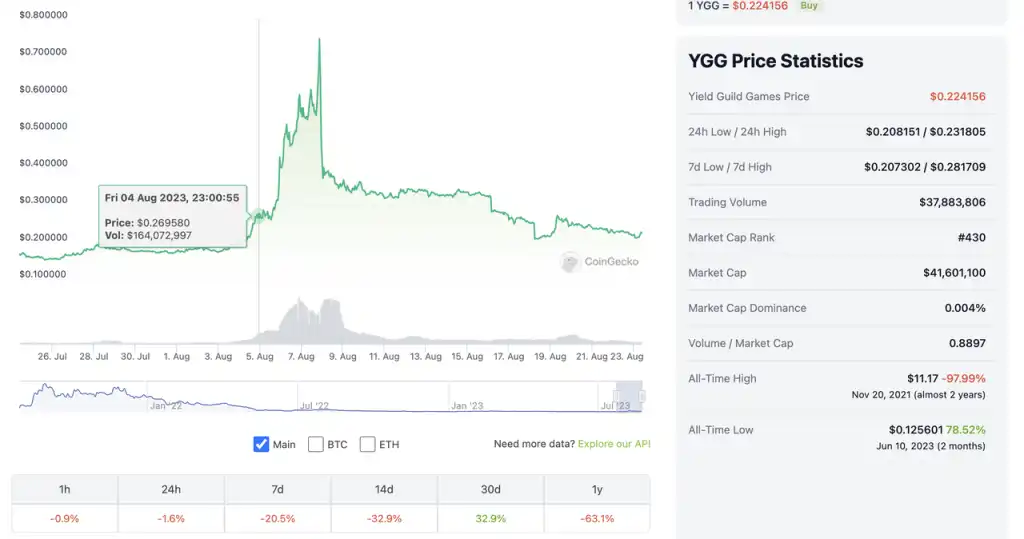
Over the past two weeks, the roller coaster ride of YGG prices has refocused the market's attention on the game guild track. At the beginning of the rise, the author shared a summary of the game guild treasury from the perspective of the national treasury on Twitter, "Game Guild Treasury Comparison & Valuation Summary: YGG, MC & GF, Whose Valuation is More Reasonable?" At that time, MC was the most promising, and now its price has risen by 50%, while YGG's price has rapidly fallen back to the price before the summary was written after doubling. This article is a revision and expansion of the summary, conducting a complete inventory of the game guild track from four perspectives: business ability, investment ability, risk control ability, and valuation.
Many gaming guilds, Quest platforms, gaming news aggregation platforms, and the NFTfi protocol that uses pay-after-use are actually all subdivisions of the same service. This is because game project parties have only three requirements:
1. User acquisition
2. Activation
3. Further promote in-game consumption
Web3 players have only 2 requirements:
1. Sense of companionship
Due to the demand for pre-funding investment brought by Ponzi in early 2020-2022 (such as guilds purchasing NFTs at thousands of dollars on Axie and renting them to Southeast Asian players, and taking a cut from users' subsequent income), as well as the wealth effect generated by the rapidly expanding economic system, people mistakenly believed that the drumbeat of passing the buck would never stop, giving rise to another important function of Web3 game guilds:
2. Advance Payment
The premise of generating the demand for companionship is that users will spend enough time on the game, which is not currently met by all non-Ponzi Web3 games. In order for guilds to purchase "shovel" NFTs and rent them to users, a Web3 game with sustained economic expansion is required - if the principal invested two weeks ago has already started to lose money, any institution that provides the principal must be on edge. However, the fact is that, except for the crypto game Ponzi pioneer Axie Infinity, there is still no game in the industry that has sustained user growth for more than six months. Given that the premise of Ponzi's profitability is user growth, guilds willing to provide the principal need to spend two months discovering "games that can make stable profits," two months observing "this game can indeed make stable profits," and two months implementing the plan. After that, they will despairingly find that the principal cannot be recovered because the "scholars" (the guild's name for its players) may never be able to recoup their investment even after playing for ten years.
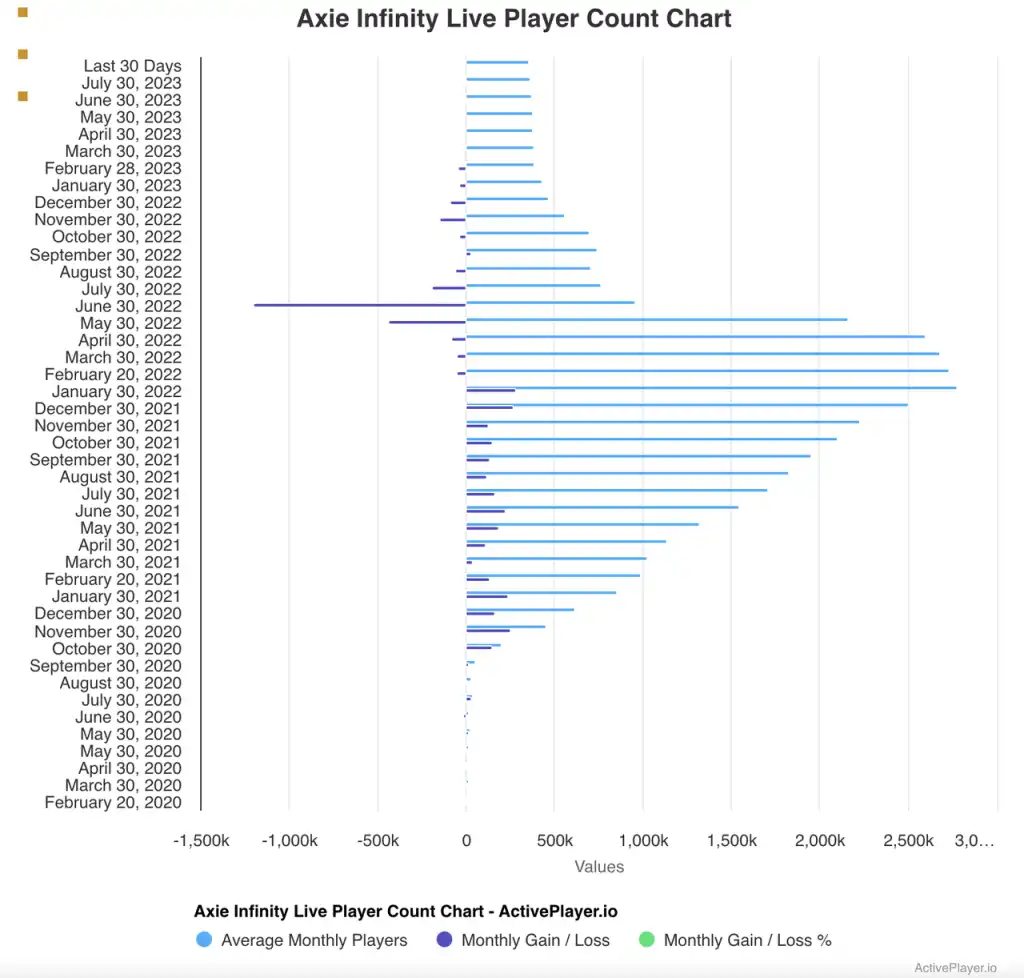
It is obvious that guilds in the industry have realized this problem earlier. With the fact that every Ponzi scheme cannot reproduce the heat of Axie and the demand for companionship in every game cannot be strong enough to charge through live broadcasting (the source of income for traditional game guilds), guilds have transformed from "serving players" to "serving project parties": on the one hand, guilds hold a large number of player resources (which is now in fact questionable and will be discussed in the following text), on the other hand, guilds have a large amount of funds in their treasury (although liquidity is likely to be questionable and will also be discussed in the following text), which can enjoy the growth dividend of Web3 game track through investment. Of course, there are also guilds like Merit Circle, which cooperate with Avalanche sub-chains to enhance their valuation imagination with the narrative of game public chains.
1. Business data comparison: YGG and MC are still active, while GF has fallen behind in terms of volume
Currently, the main traffic sources for several major guilds are:
1. Quest System
2. Twitter
3. Discord
Discord is very deceptive. Even in YGG's 70,000-member DC group chat, without any hot games/tasks, there are only a little over 100 messages in General Chat every day. Half of them are "gm" and "hi", and the other half are the team providing Medium/official website links to answer members' questions.
On the other hand, Twitter can reveal the truth through page views. Even though YGG has 180,000 Twitter followers, Merit Circle has 100,000, and GuildFi has 120,000, the page views of YGG's Twitter content are stable at several thousand to tens of thousands, with only major updates reaching 40,000 to 50,000 views. Merit Circle is slightly behind, with daily content views around 5,000 and major updates reaching tens of thousands. GuildFi is even worse, with less than 1,000 views for regular updates and only 10,000 views for semi-annual reports. In comparison, the tweets I post with my 2,000+ followers can easily get hundreds of views, and a summary with some depth can get tens of thousands of views. With Twitter's transparent data display, the water content of guild data is nowhere to hide.
而 Quest 系统,则可以从项目情况和激励情况两方面一探究竟:
And the Quest system can be explored from two aspects: project status and incentive status.
YGG Guild Advancement Program
Recently, YGG launched Guild Advancement Program Season 4, where players can earn rewards by completing tasks and submitting proof. Among them, Axie still has the advantage with a maximum reward of 2700 YGG (equivalent to approximately $900 USD at current YGG prices), while other games offer rewards ranging from 30 YGG (equivalent to $10 USD) to over 1000 YGG per task. For players who are still able to compete for the Axie Infinity reward pool, the rewards offered by Axie are undoubtedly more attractive (with a maximum value of tens of thousands of dollars), while for players of other crypto games, the reward pool that needs to be shared with competitors, totaling only tens to hundreds of dollars, is not very appealing. Instead of spending a lot of time completing tasks with low ROI, it is better to use the time to participate in airdrops. From a user's perspective, YGG's Quest System is difficult to attract a lot of attention.
From the perspective of the project party, the cooperation between YGG and the game will most likely receive cash or other game assets, while the rewards given to players will be valued in YGG tokens, which is essentially YGG exchanging its own tokens for other cash/game assets.
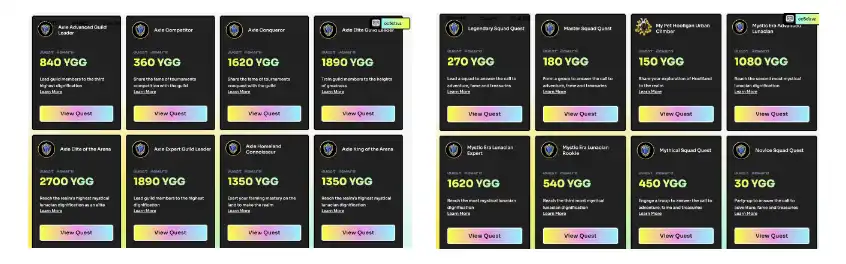
https://www.yieldguild.io/gap/season-4
Merit Circle Gaming
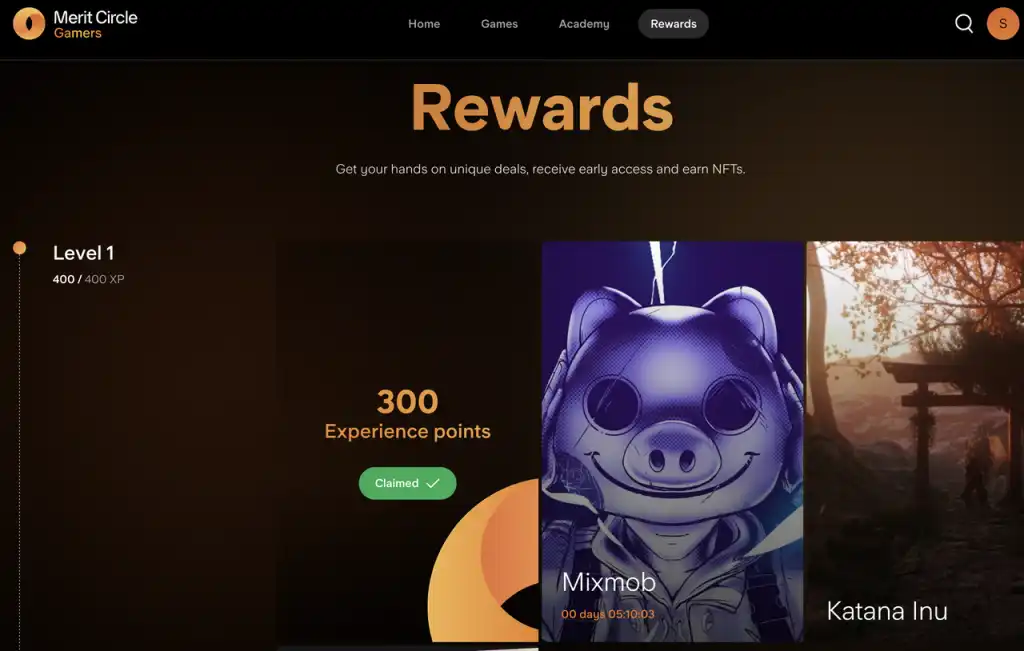
Compared to the YGG Quest System's straightforward tasks, the interface of Merit Circle Gaming is more user-friendly. The official website of this incentive system is divided into four parts: Home (with a focus on game introduction and activity timeline), Games (with a focus on game display and related information summary), Academy (with game tutorials and Web3 operation basic teaching), and Task System (complete tasks, earn experience, and participate in game NFT lottery).
In YGG's Quest system, players can have a more direct ROI calculation (although the ROI is not high, it is still attractive to Southeast Asian audiences), while Merit Circle's Quest system is more focused on information aggregation and game display, and the rewards for tasks are mostly distributed through lucky draws.
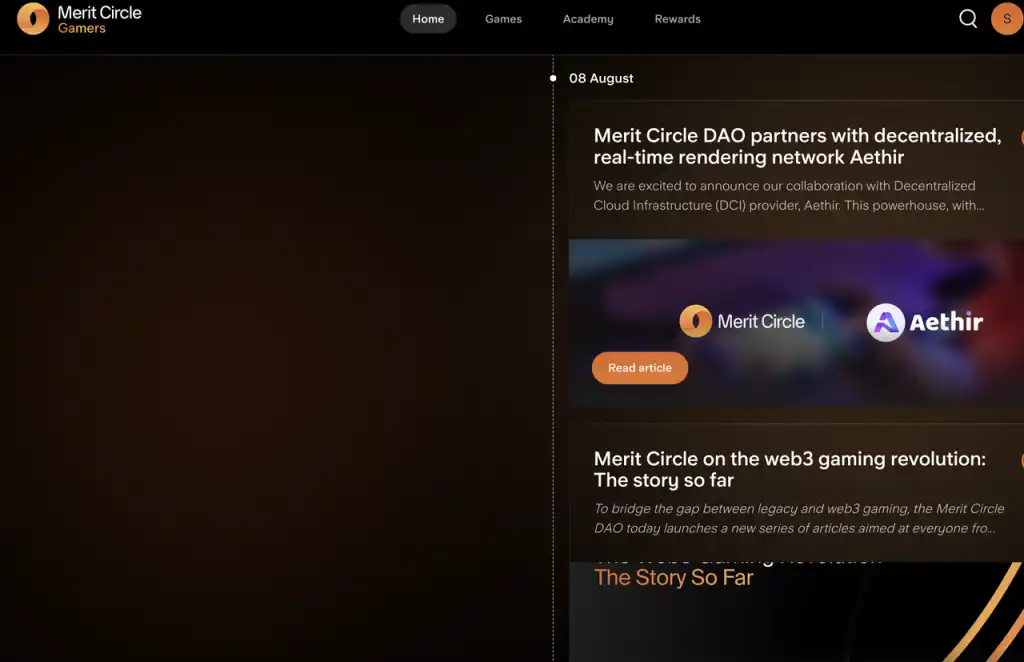
Merit Circle - Home
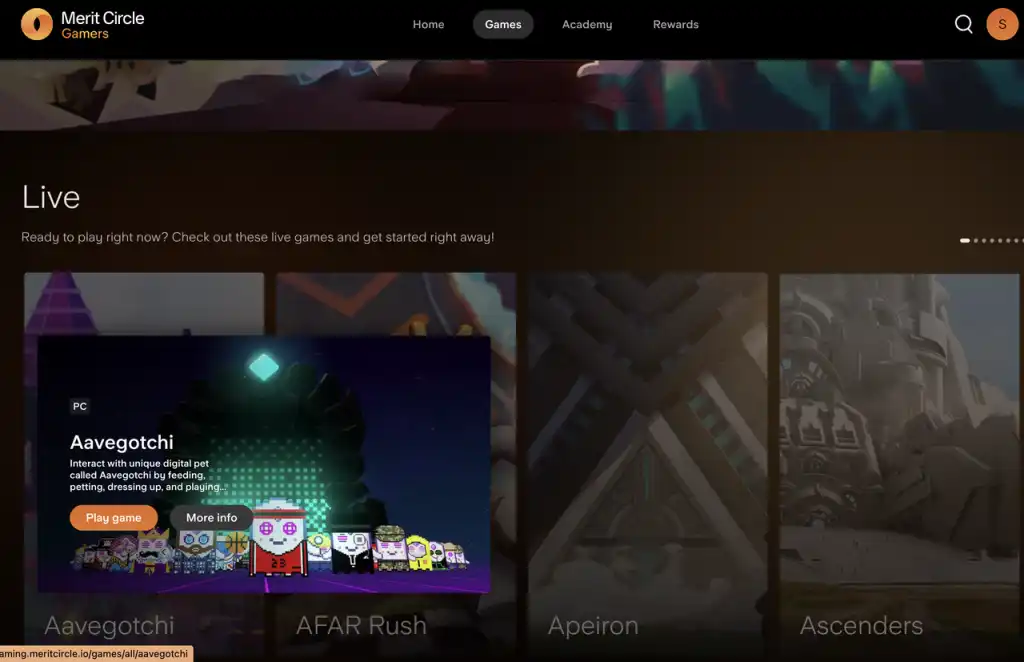
Merit Circle - Featured Game Display
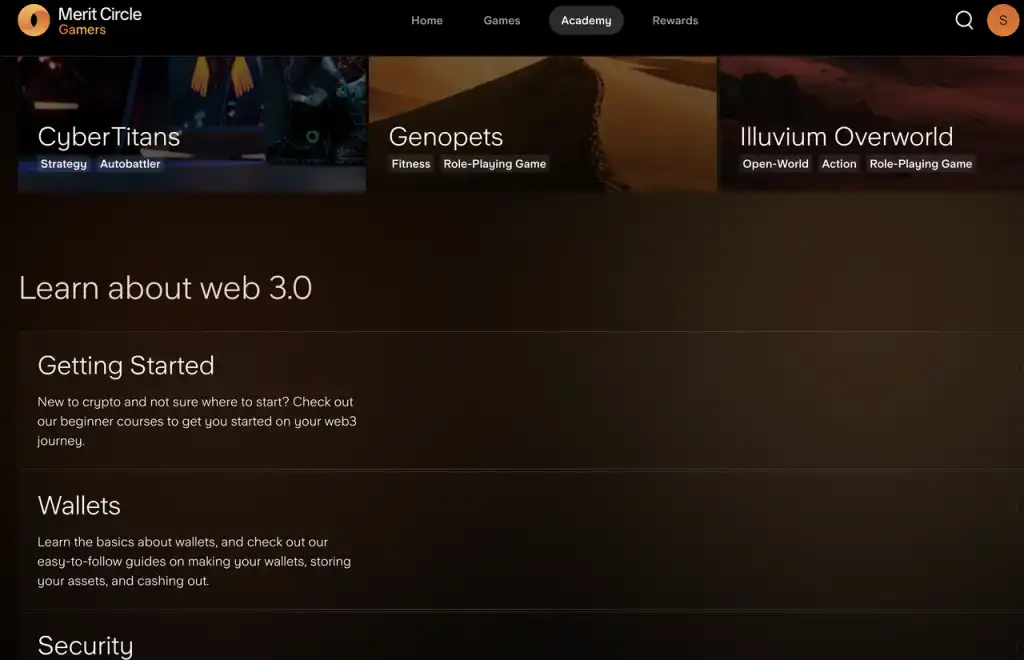
Merit Circle - Academy
Merit Circle - Task Reward System
GuildFi Quest & Achievements
GuildFi uses an in-game point system to create a mission and achievement system. By completing corresponding missions and achievements, players can earn corresponding point rewards.
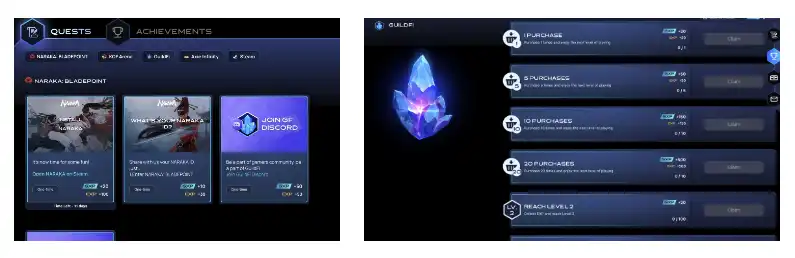
GuildFi Quest & Achievements
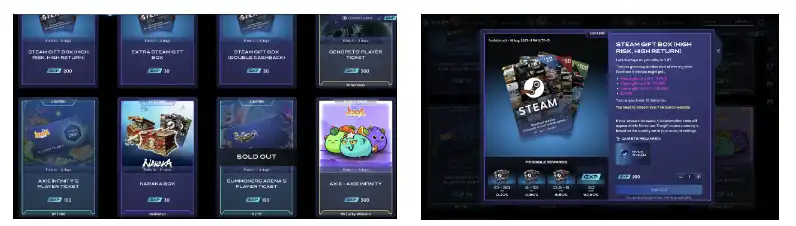
Points can be used to exchange for gift cards, game tickets, whitelist, treasure chests, NFT, etc. However, currently, the products that can be exchanged for GuildFi experience are quite limited, mainly Steam gift cards (with a probability of opening gift cards worth 0.5-30 dollars, or returning 15% of the cost), Genopet and Axie game tickets, Axie NFT and CyBall NFT (distributed in the form of limited-time lottery). This blind box lottery exchange for Steam gift cards/game props has already been widely used in traditional game information aggregation and casual game platforms. On the one hand, it cooperates with game project parties to distribute game assets (although it can be seen that GuildFi's BD ability is already quite limited, and it cooperates with old projects), and on the other hand, it directly converts a small part of the income into assets that players already have a concept of value, and joins the blind box mode to gamify the elimination of inflation.
GuildFi Marketplace
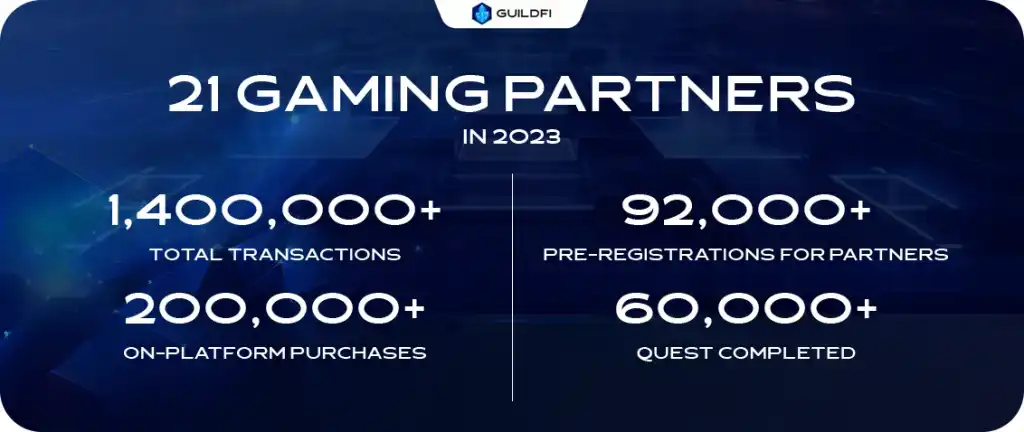
In GuildFi's semi-annual summary, they stated that "in the past year (2H22 - 1H23), the platform has had over 200,000 purchases, a 42% increase from the previous year. It is clear that our community's enthusiasm for our gaming products on the platform is on the rise. It is worth noting that the Lootbox event for Diablo IV had over 65,000 purchases, winning first place, while the KOF Lootbox had over 30,000 purchases." Through this collaboration, GuildFi brought a total of 92,000 pre-registered users to 21 partners in one year, averaging less than 5,000 registrations per game. Considering that pre-registration usually does not require wallet interaction and it is easy for users to create multiple accounts for good projects, the actual number of effective users brought in is worrying.
Source: GF Half-Year Summary
It is not difficult to see from the previous context that the power of game guilds in the market has greatly decreased. YGG and Merit Circle are still relatively active in the market, while GuildFi has fallen behind in terms of business resources and content production.
2. Financial Comparison: MC has a balanced development in finance and business, YGG has strong business capabilities but lacks financial strength, and GF has a market value smaller than the value of its held blue-chip and stablecoin assets.
YGG: Gaming dissemination platform + gaming investment fund, almost all of the national treasury is YGG, less than 4.4% of high liquidity assets on the chain
Due to the significant devaluation and illiquidity of NFTs in the current gaming market, we can roughly estimate the state of the project's treasury directly from FTs. According to the official address published by YGG, 95% of the treasury on the YGG chain consists of their own token YGG, with less than 4.4% being highly liquid stablecoins and blue-chip assets (such as USDC/USDT/ETH), indicating a highly unbalanced asset allocation.
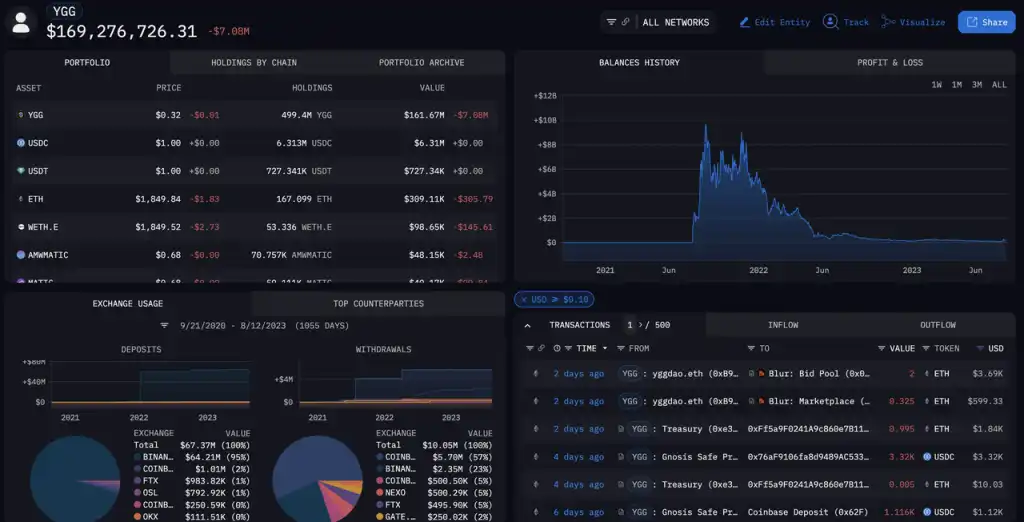
YGG Treasury Address Asset Status Arkham, Mint Ventures Mapping *Excluding assets not on non-EVM chains, the amount of these assets is approximately $220,000, which can be ignored when calculating.
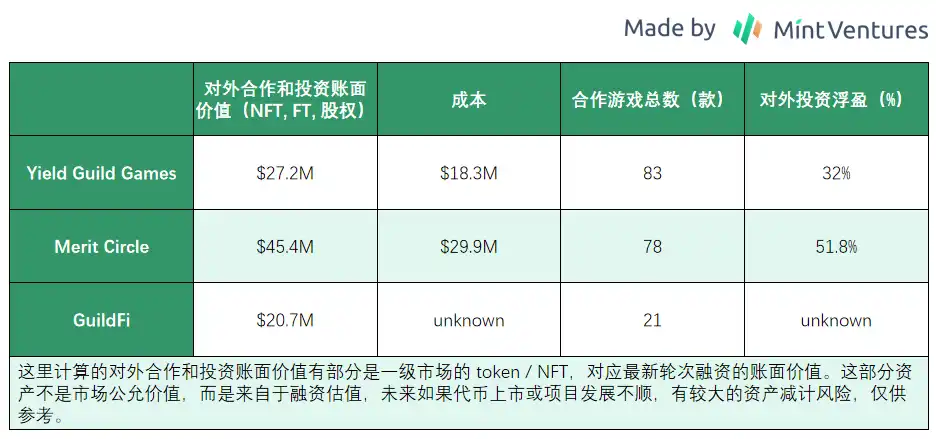
In addition, YGG provided a valuation of its investment/collaboration project assets in the 2023 Q2 Community Update released in early August. YGG holds a total of $27.2 million worth of gaming assets (NFTs, tokens, equities, etc.), with a corresponding cost of $18.3 million and a book profit of 32%. The update can be found at https://storage.googleapis.com/external_communication/YGG-2023Q2-CommunityUpdate.pdf.
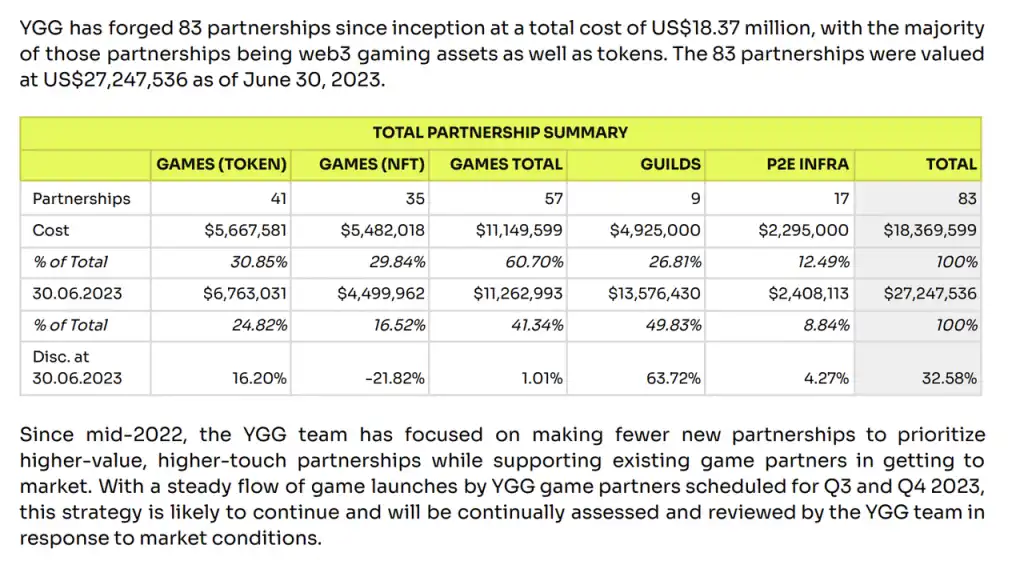
Source: YGG Medium
Although YGG has been relatively transparent about the market price decline of Gaming NFT, the valuation of token/NFT in the Games section may have some calculation errors: even if YGG obtained a good price when investing, the book value of the first-level investment game token is likely to be greatly reduced after listing in the current market situation. In the current situation of extremely poor NFT liquidity, it is difficult to sell NFT and obtain liquidity. The same situation also applies to Merit Circle and GuildFi.
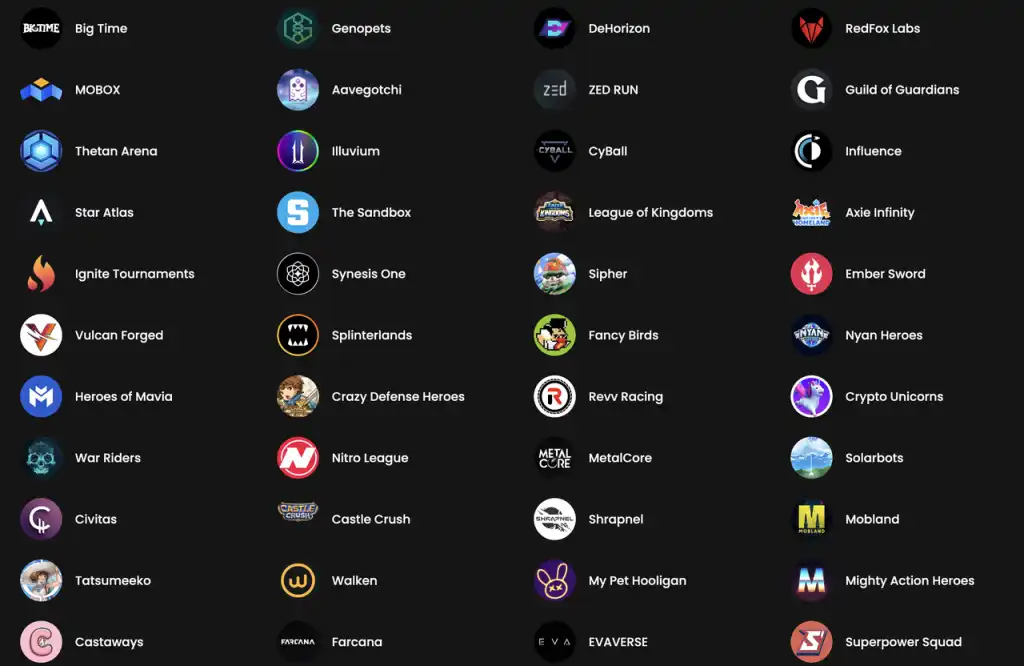
YGG Partnered Games (including first-level investments and secondary market purchases, chainplay.gg not fully counted)
Merit Circle: Steady business operations, optimal balance of national treasury funds, stable returns and a 50/50 split between high-risk assets
Merit Circle (hereinafter referred to as MC) defines itself on its official website as a Gaming DAO with four functions: investment, game studio, reward system, and infrastructure (building a game chain Beam through Avalanche sub-chains). In terms of communication transparency, MC outperforms the other two guilds: the bulletin board for treasury funds is updated in a timely manner, not only including FT/NFT data that can be checked on-chain, but also publicly disclosing non-liquid assets such as first-level investments. Here, we mainly analyze two parts: the situation of investment and incubation, and the distribution of treasury funds.
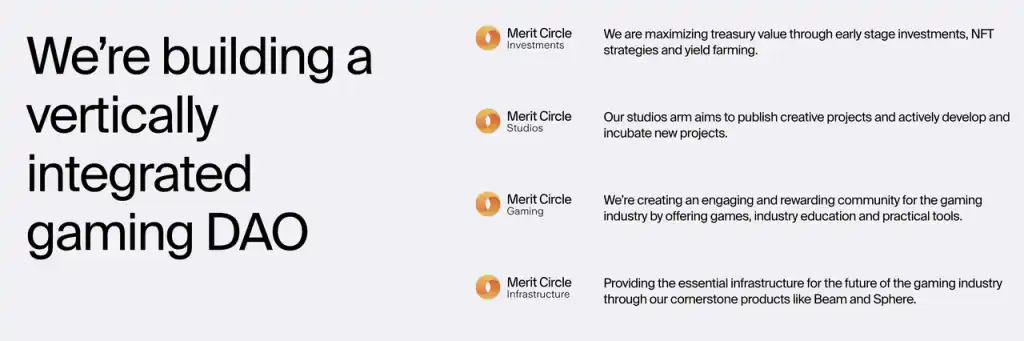
Merit Circle Official Website
First, let's look at investment and incubation. According to the data publicly released by MC Treasury until June 23rd, MC holds Equity/token in a total of 79 game projects, including major projects with good team backgrounds and financing backgrounds such as OhBabyGames and Xterio. The value of these assets is $45.4 million, of which $1.6 million can be publicly traded, $43.8 million are non-current assets, and $0.3 million are MC. In addition, according to the disclosed purchase price, the total cost of these assets is $29.9 million, with a book profit of 51.8%.
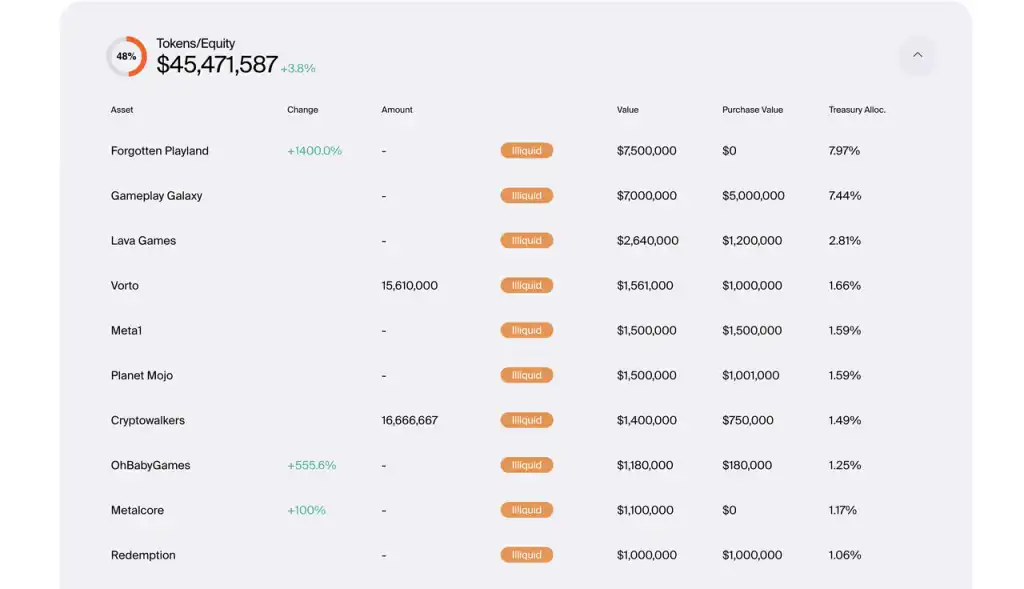
https://treasury.meritcircle.io/treasury Incomplete screenshot of MC investment project
And the quality of on-chain treasury funds MC is also significantly stronger than YGG, with only 27.4% of MC tokens in the wallet being their own, while 69.5% are high-liquidity stablecoins and mainstream assets.
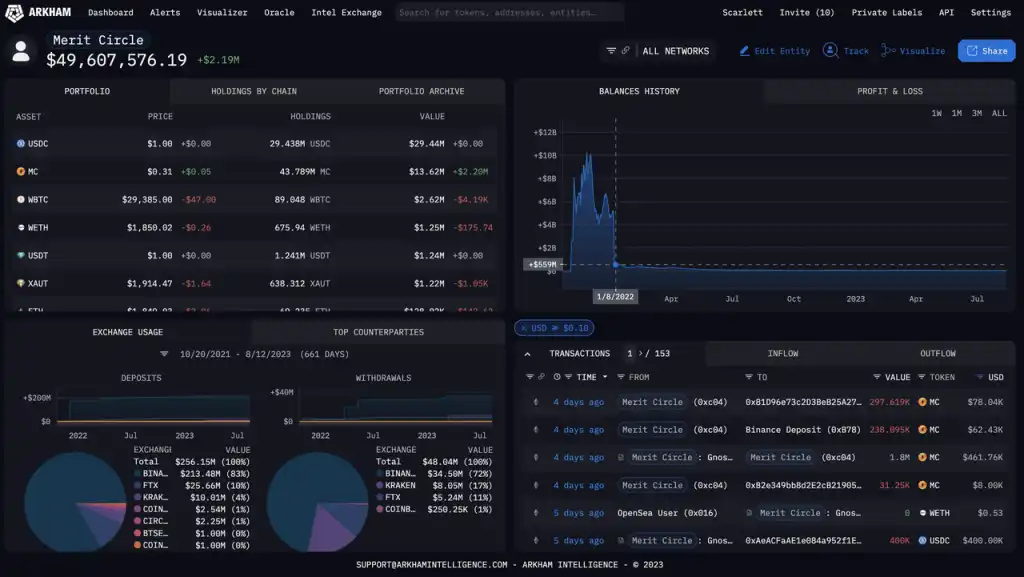
Merit Circle treasury address asset situation, Arkham, Mint Ventures mapping
In addition, the launch of Avalanche sub-chain Beam on the MC test network is also an important event for future trends. Beam will adopt the Proof of Stake model, using MC as the gas token, and will use LayerZero as the cross-chain infrastructure. Currently, three games are being developed based on Beam. On August 14th, the team proposed a draft in the community governance section and opened it for discussion:
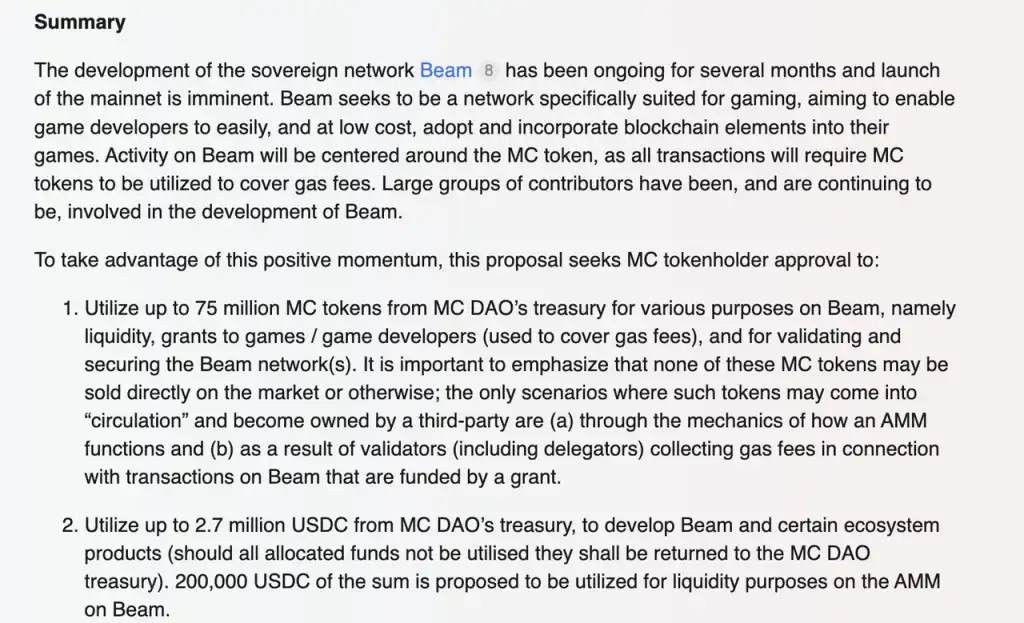
https://gov.meritcircle.io/t/beam-development-and-ecosystem-funding/822
GuildFi: Weak business capabilities, good balance of on-chain treasury funds, 13% GF, 46% stablecoin, 41% stETH seeking stable returns.
Due to the fact that GF's assets have a lot of LPs on Uniswap, it is difficult to display them directly through Arkham. The following figure shows the asset statistics on the ERC-20 asset chain of the publicly disclosed wallet: it can be seen that GF's on-chain treasury has 46% stablecoins, 41% ETH/stETH, 13% GF, and some small game-related token investments, totaling 57.7 million US dollars.
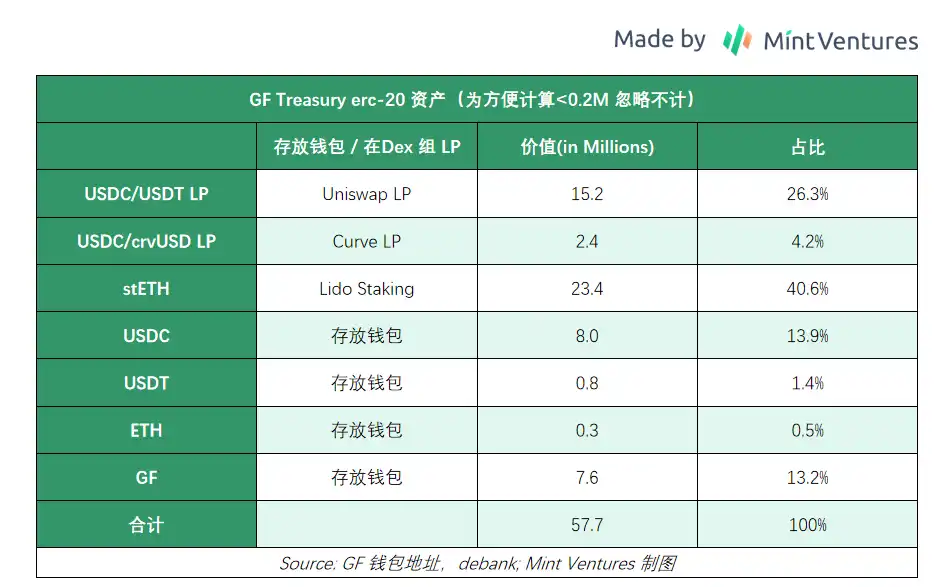
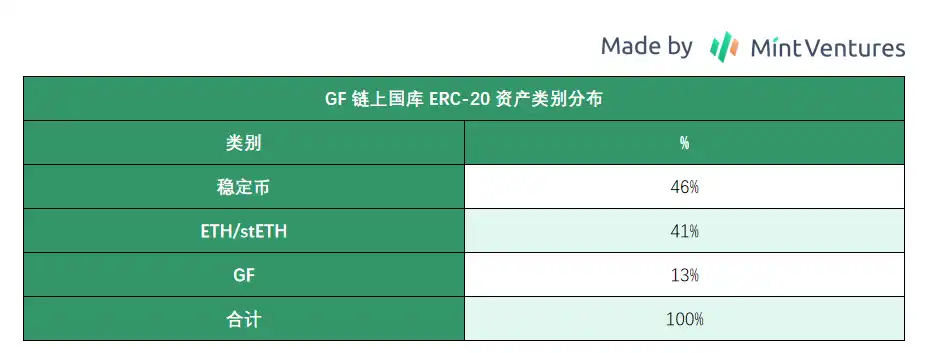
Compared to the financial summary released by GF half a year ago, the official on-chain assets have decreased by 19% from the previous total of $71 million. This is mainly due to the decline in token prices and the transfer of 8 million USDT to Binance. The official team stated that the assets stored in cex are mainly used for daily operations and buybacks from investors.

Source: Debank
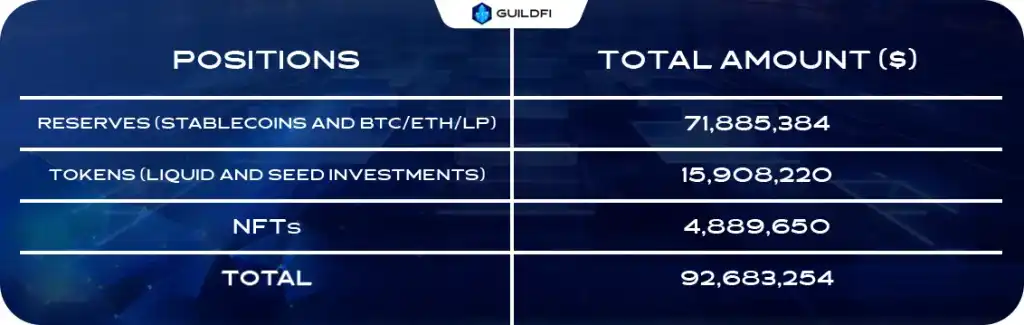
Source: GuildFi
However, when further asked about "whether there is a public buyback mechanism and buyback history record", besides the two-day long "please be patient", no reasonable answer was given.
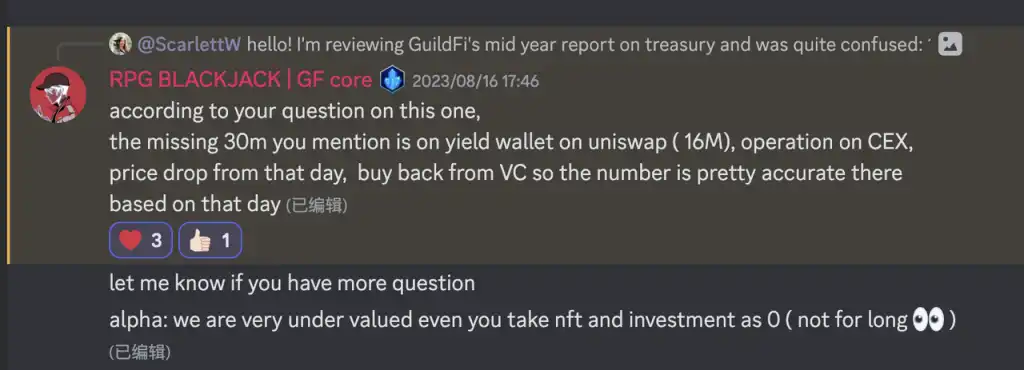
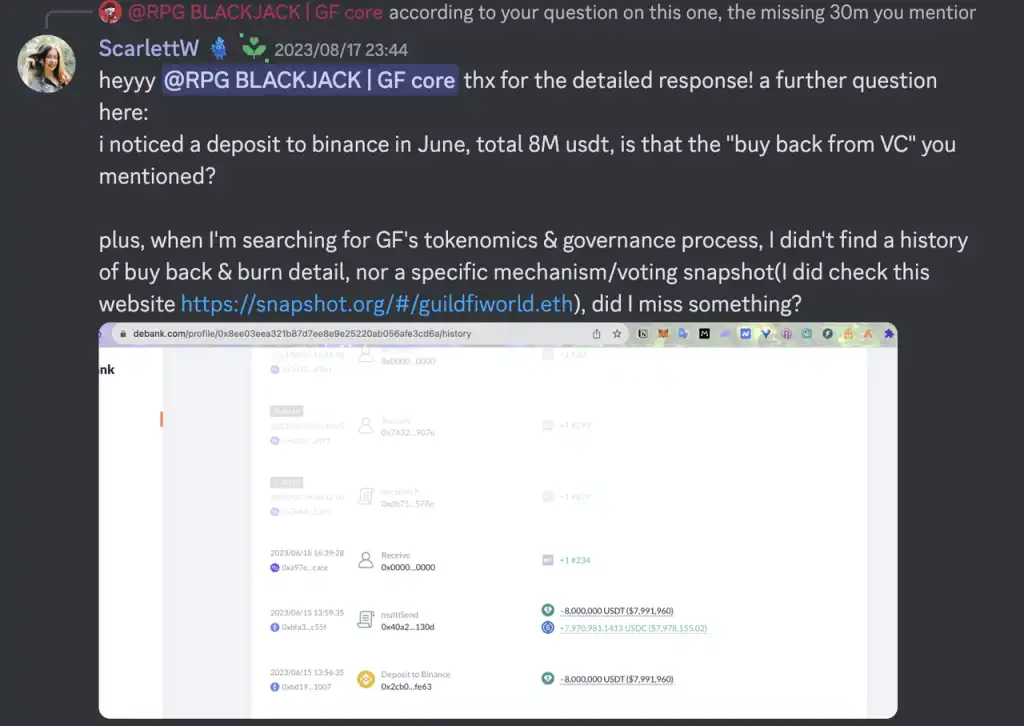
Discord Q&A Record
In the semi-annual summary, in addition to the 71 million US dollars of assets in Reserve (currently totaling 57.7 million US dollars on the chain), there are also primary market investments worth 15.9 million US dollars and other game tokens, as well as NFTs worth 4.8 million US dollars.
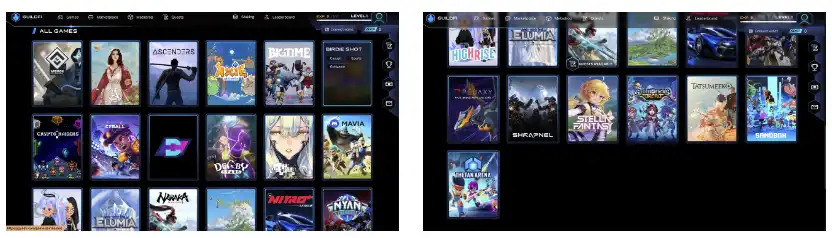
GF Collaboration Game
3. DAO Construction and Governance Capability Comparison: Merit Circle is far stronger than its competitors
Although both YGG and GuildFi expressed their desire for this gaming guild to ultimately become a Gaming DAO in the white paper released in 2021, it is actually Merit Circle that has achieved this goal in reality.
Clicking on the Snapshot of YGG and GuildFi, we can only see a few long-standing voting records:
YGG: Proposal for SubDAO two years ago.
GuildFi: Eight months ago, three proposals and details about the Staking System were launched.
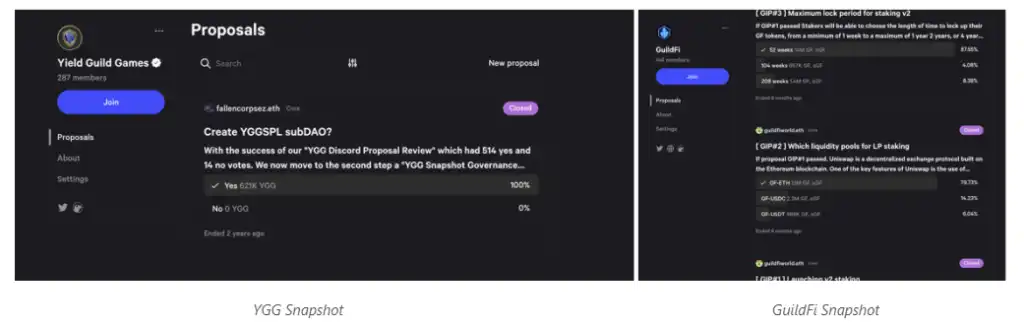
而 Merit Circle will show users how a Gaming DAO / Investment DAO with a complete operational process and risk management awareness should operate: over the past two years, Merit Circle's Snapshot has had a total of 26 proposal votes, including DAO governance, investment risk management (exit and investment authorization mechanisms), and game development. Some of the more important proposals include:
2022.01 MIP-7, determining profit distribution and token destruction. 20% of the profits are saved in the treasury in the form of USDC, 5% of the profits are saved in the treasury in the form of ETH/WBTC, and 60% of the profits are used for low-price repurchases at appropriate times to maintain token price stability (repurchases are made when the price is 10-35% below the 7-day average, and most of this MC enters the staking rewards, which can also be sold to strategic investors willing to lock up for the long term), and 15% of the profits are used for direct repurchases and destruction of MC. In addition, since most of the unlocked tokens are released to "community incentives," it is decided to destroy 75% of the unlocked "community incentive" tokens each month (the proportion can be modified by community voting). Provide enough tokens to the DAO's financial repository to cover any major community proposals, and also transform mCap into a more realistic FDV. It is difficult not to be amazed at MC's foresight and calm in the face of great temptation - actively destroying 75% of the tokens released to the community is not an easy decision, and the completeness of the mechanism is the foundation of MC's treasury fund balance.
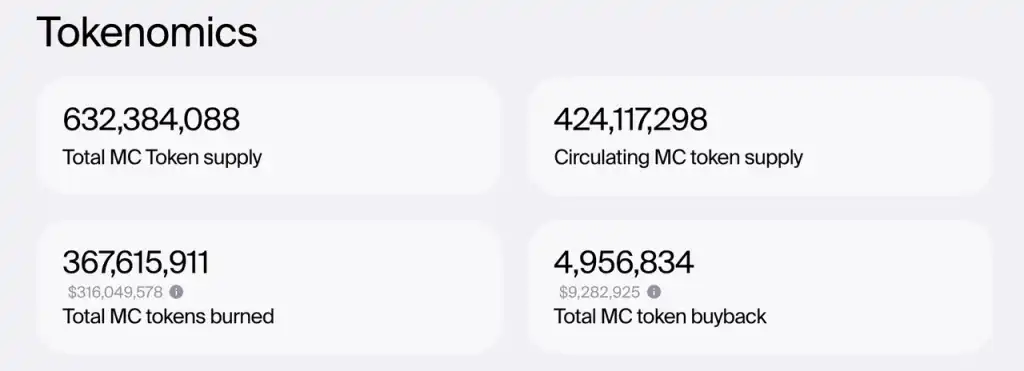
MC repurchase and destruction announcement https://treasury.meritcircle.io/
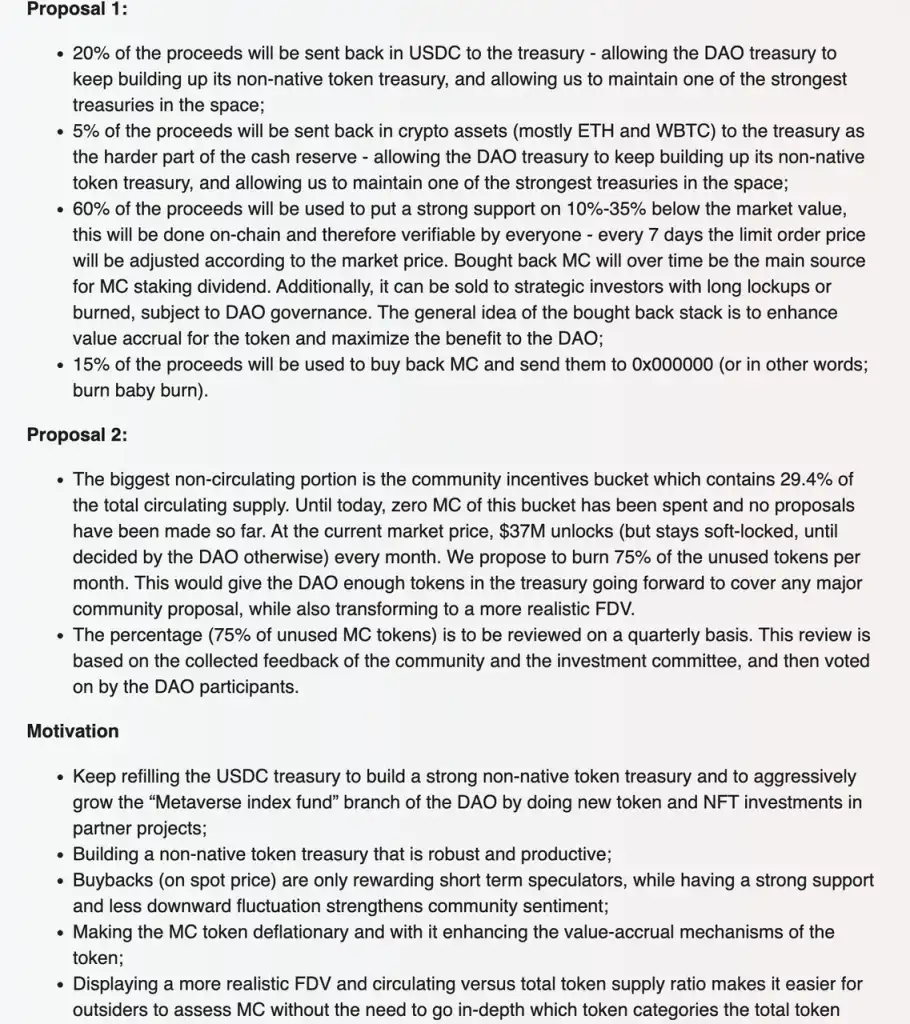
https://gov.meritcircle.io/t/mip-7-sustainable-future-vision/192
2022.05-06 Return of investment to YGG. Termination of relationship with investors who did not provide substantial assistance.

https://snapshot.org/#/meritcircle.eth/proposal/QmT71tWtTwk6q5Cd2kvhoLzxm76SpNaQGBR9RE7pCxBM58
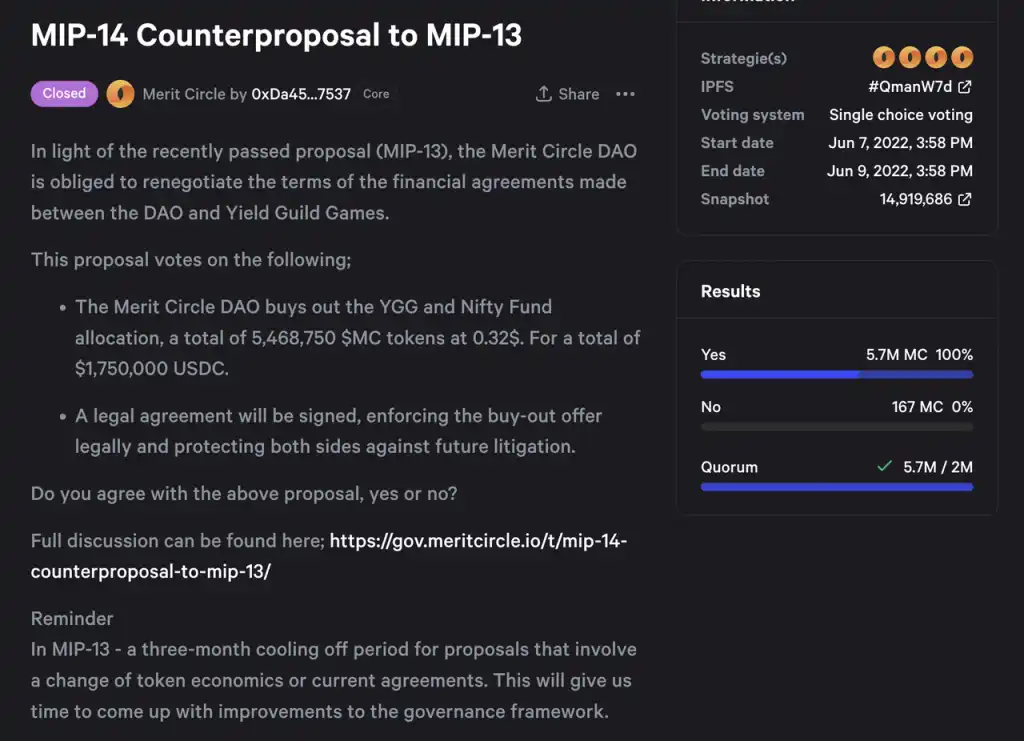
https://snapshot.org/#/meritcircle.eth/proposal/QmanW7dTyF2LvvU9iAGwj3i9D4F3TS7ZbxR33jVCmKMrgR
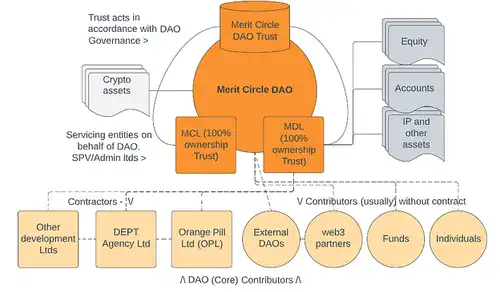
2022.07 Restructuring of DAO Architecture.
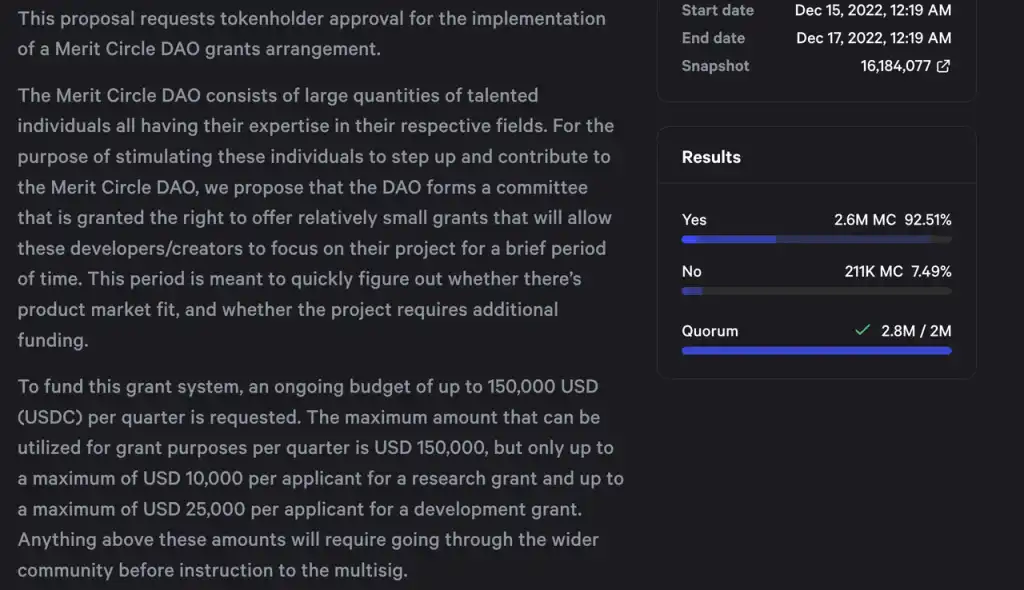
Proposal for 2022.12 Merit Circle Grants. Reserve 150k USDC per quarter for small incentives for research and game development. Research Grants are limited to a maximum of 10k per grant, and Development Grants are limited to a maximum of 25k per grant.
Cancel the subsequent Staking rewards for Uni V2 in 2023.07 and destroy this portion of future rewards. This is mainly due to the fact that the existing Staking model does not bring much benefit to Merit Circle, but there is a clear use case for staking on Beam (the game chain that MC plans to build, proof-of-stake) in the future, so the V2 rewards are cancelled and the staking rewards will be concentrated on Beam in the future.
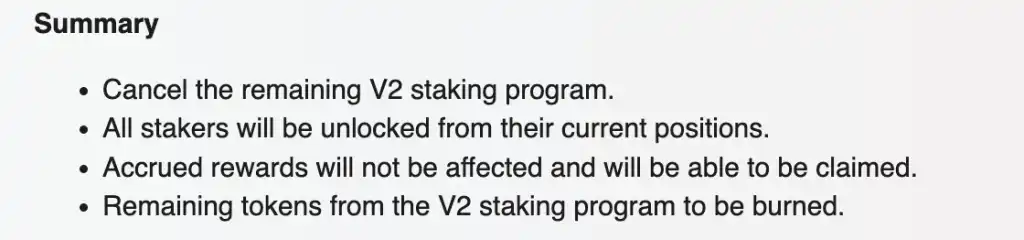
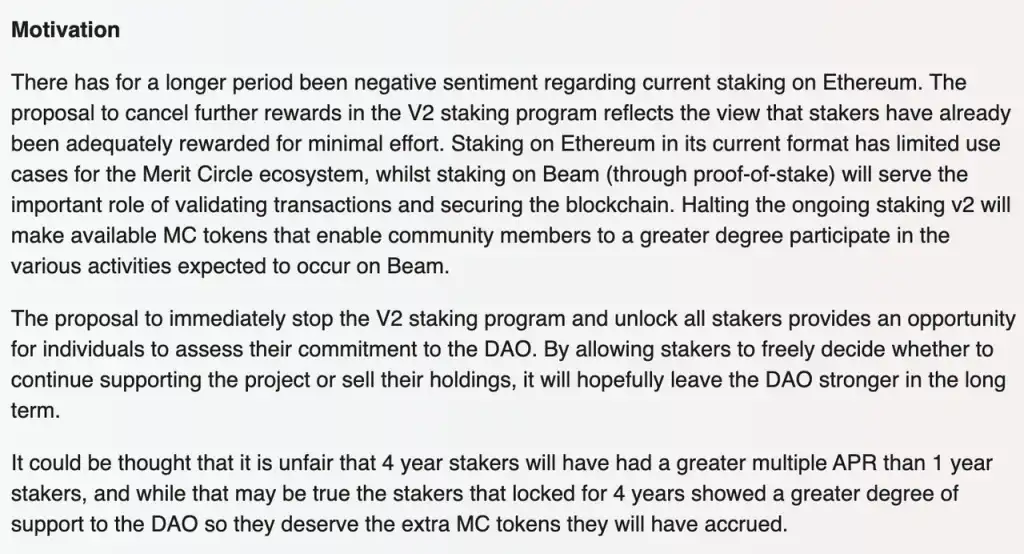
https://gov.meritcircle.io/t/mip-26-cancel-all-future-v2-v3-staking-rewards-and-unlock-all-v2-stakers-proposal/803
Through the analysis of several proposals, it can be seen that although the proposers are mainly teams and the number of voters is not large (basically around 5 million MC), the Merit Circle team is quite clear in its strategic thinking, willing to give up short-term benefits to maintain the long-term interests of the community, and the governance is relatively transparent.
4. Summary Comparison: Business Capability, Investment Capability, Risk Control Capability, and Market Value Comparison
4.1 Business Capability: MC Business is more diverse, YGG has a wider user base, GF is falling behind
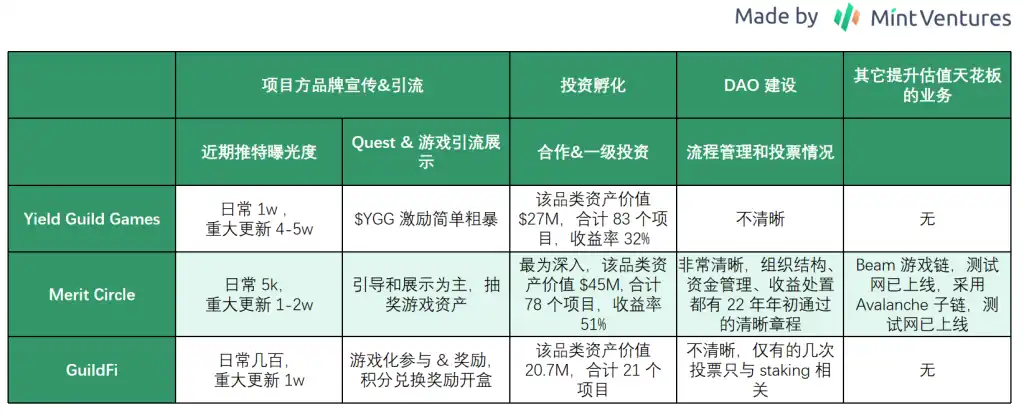
In addition, from an organizational perspective, YGG's model is a product of the Axie era - sub-DAOs that extend from YGG regionally, making it easier for regional members to reach and manage, but lacking an up-to-date risk control system. Merit Circle, on the other hand, is more like a game factory, with good investment (and a complete risk control system), incubation, promotion, and infrastructure in all dimensions. GuildFi's investment capabilities and market activity are inferior to the first two.
4.2 External cooperation and investment capabilities: MC ranks first, YGG ranks second in terms of scale and yield, and GF has the smallest scale with an unknown yield.
4.3 Risk control ability: MC ranks first, GF second, YGG performs poorly
The evaluation criteria for this part are divided into two aspects:
· Whether the team's trading, management, and control of assets are transparent and comply with pre-established mechanisms, this is where MC >> GF/YGG.
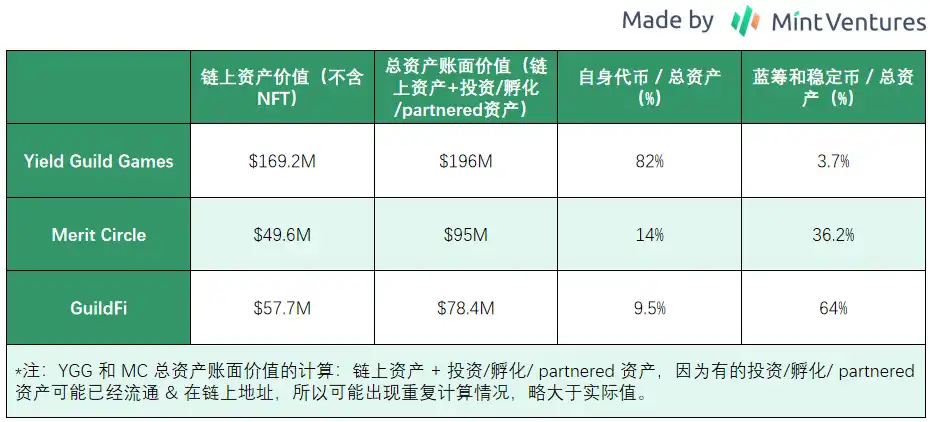
· The impact of asset tokens on the total asset price is significant. If the "self-token/total asset" ratio is too high, it indicates poor risk control ability. Position management GF>MC>YGG.
Overall, MC ranks first, GF second, and YGG performs poorly.
4.4 Valuation Comparison: MC has entered a high level, YGG is falling back normally, GF's weak business leads to a market value < the total value of the Treasury stablecoin and blue chips
Due to the nature of the guild's business, the treasury assets of the project can partially reflect the business situation. As mentioned earlier, the guild's current core functions are:
1. Relying on players at hand to serve game project parties
2. Investment Incubation
Part of the project assets corresponding to these functions have entered external cooperation and investment book value (NFT, FT, equity), and part of them may have been converted into stable coins and blue chips and remain in the treasury. Therefore, the comparison of treasury assets can partially reflect the valuation of guild projects.
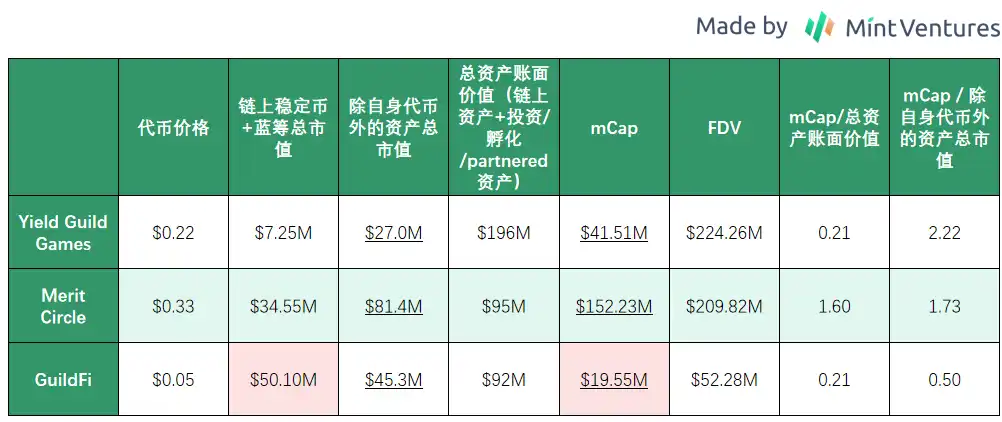
Before the YGG ramp-up, YGG's daily trading volume was only a few million dollars, and liquidity was quite limited. YGG's share in the YGG treasury is as high as 82%, which means that once it is sold, it will only cause a devastating blow to the price. Therefore, we will compare "mCap/total asset book value" and "mCap/total market value of assets excluding its own tokens" to seek objectivity. Taking into account all factors, the value support is GF > MC >= YGG (please note that both "total asset book value" and "total market value of assets excluding its own tokens" include "stablecoins + blue chips" and "FT/NFT brought by investment/external cooperation", the latter is not the market fair value, but comes from financing valuation, and there is a risk of asset impairment if the token is listed or the project development is not smooth in the future. In addition, for "FT/NFT brought by investment/external cooperation", except for Merit Circle, which publicly discloses the cost and book value of all projects, the other two have not given specific algorithms, so there may be statistical caliber issues.)
Due to the fact that the unlocking of MC has been mostly completed, but YGG and GF still have a large amount of tokens to be unlocked, from the perspective of FDV/mCap, the potential downside risk is YGG>GF>MC.
Except for MC, which has a clear token buyback mechanism, all other projects do not have a token buyback mechanism. GF has a Staking mechanism with a fixed reward release amount, while YGG doesn't even have staking. Adding to GuildFi's weakness in business, even if GF's market value is less than the total market value of its stablecoins and blue chips on the chain, it is difficult to conclude that it is "undervalued".
From the perspective of Upside in the future, MC will have a narrative with gaming chains, and the value capture of staking on POS chains will follow naturally. YGG's follow-up plan is to establish a new Quest System on Base. GF currently has no breakthrough in business narrative.
Reference
https://meritcircle.io/
https://medium.com/@meritcircle/looking-back-at-2022-an-unforgettable-ride-c45b9fdcd225
https://medium.com/guildfi/guildfi-mid-year-update-94ac88a55017
https://medium.com/yield-guild-games/yield-guild-games-community-update-q2-2023-e534b60340fd
This article is from a submission and does not represent the views of BlockBeats.
Welcome to join the official BlockBeats community:
Telegram Subscription Group: https://t.me/theblockbeats
Telegram Discussion Group: https://t.me/BlockBeats_App
Official Twitter Account: https://twitter.com/BlockBeatsAsia