What are the challenges of incorporating NFT into the framework of copyright law?
原文标题:《 Copyright Vulnerabilities in NFTs 》
Written by James Grimmelmann, Yan Ji, Tyler Kell
原文编译:Shaun@DAOrayaki.org, DAOrayaki
Many NFT and DAOs aim to provide new or more convenient ways to own and sell creative work. Beeple's NFT work "EVERYDAYS: The First 5,000 Days" sold for $69 million at auction. Some observers believe the surprising rise of Bored Ape Yacht Club is due to its personalized approach to copyright licensing. More artists and developers are diving headlong into the industry.
But at the same time, many projects struggle with the question of how copyright applies to NFT
1. When SpiceDAO purchased director Alejandro Jodorowsky's richly illustrated brochure for the never-filmed version of Dune, some participants hoped that purchasing the book would allow them to bring Jodorowsky's vision to the screen. But the plan was quickly shot down, as the owners of dune's copyright rejected the idea.
2. "Right-Clickers/Right click" saves JPEG copies of artwork from popular NFTs. The owners of these NFTs say this is a breach of copyright. Only one of these two statements is correct.
Quentin Tarantino and Miramax are locked in a lawsuit over pulp Fiction NFT rights.
4. Too many NFTS using stolen art.
In this post we hope to clear up some confusion about NFT copyright and help those working in the field understand the challenges of incorporating NFT into the framework of copyright law. Our bottom line is simple: Ownership of the NFT can be used to give the owner substantial control over the creative work, but that control is not automatic. Copyright law does not grant NFT owners any rights unless the creator takes positive steps to secure NFT rights. Our survey of some existing NFT projects and their licenses shows that very few have taken all the steps necessary to bring NFT copyright's behavior in line with community members' expectations. Thinking about legal issues should be part of the NFT design process, not an afterthought.
On-chain and off-chain assets
When talking about blockchain assets, it is common to say something like "Alice owns 10 Bitcoins ". Most of the time, this expression is correct: Alice holds the private key to a blockchain address that has transferred 10 Bitcoins in unused transaction output. Alice can use the private key to transfer the bitcoins to another address if she wishes. (Alice may also control the key, either directly or through a wallet, but we'll ignore one complication below.) In the words of the current uniform Commercial Code draft articles on blockchain assets, Alice has "the right to exploit the majority of the benefits of these bitcoins." For more complex assets, such as NFT controlled by smart contracts, this control may take the form of transferring control to someone else by knowing the private key needed to initiate the transaction.
This situation is relatively simple, as bitcoin and SmartCombine's tokens are on-chain assets. They exist entirely as entries on the blockchain. Things get more complicated with off-chain assets, where entries on the blockchain are used to represent things that exist elsewhere, such as tungsten blocks. The cube itself is an object that exists in the physical world. It weighs 2,000 pounds, measures 14.545 inches on each side, and is housed in a warehouse at Midwest Tungsten Services in Brook, Ill. But the Tungsten-block NFT is an entry in a smart contract deployed on the Ethereum blockchain using the ERC-1155 standard. If Alice bought the tungsten cube NFT from TungstenDAO, the solid tungsten cube would still be in Willowbrook, Illinois.
Although tungsten square NFT is not the same as solid tungsten square, the two are related. According to the "description" TungstenDAO provided to OpenSea when he created the NFT list, when Alice received the NFT, she was also entitled to "access once per calendar year to view/photograph/touch the cube". If Alice sends the NFT to a special address to prevent anyone from controlling the NFT again (a process called destruction), she is entitled to physical possession of the cube via a freight truck. If she sells the NFT to Bob, then Bob has the right to access the cube once a year, or burn the NFT and receive the cube. Some lawyers call this connection "Tethering" : rights to an off-chain asset (the physical cube) are linked to an on-chain asset (NFT) through an invisible Tether. (In theory, at least. Some legal scholars respond to "Tethering & NBSP;" Whether it really works is questionable).
Therefore, there are really three different assets involved in NFT:
First, there is an NFT itself on the blockchain. It looks something like this
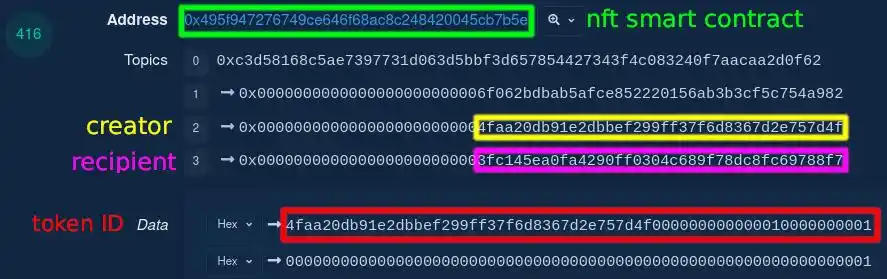
You can view the creation of this NFT online on the Etherscan blockchain
Second, there are the physical cubes in the warehouse. It looks something like this
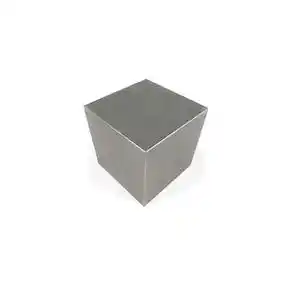
Third, there is a legal right to control the solid cube. It looks something like this

Because legal rights are intangible, they have no physical existence.
If all goes well, legal rights are what connect the NFT on the chain to the cube off the chain. The current owners of the NFT are able to control the physical cube because they have the relevant legal rights.
Introduction to the copyright
The following quote is sometimes attributed (humorously but incorrectly) to Albert Einstein:
You know, a wire telegraph is a very, very long cat. You pull his tail in New York, and his head meows in Los Angeles. Radio works exactly the same way, you send signals here and they receive them there. The only difference is, there are no cats.
Copyright is exactly the same as the tungsten cube, except without the cube. Tungsten cube is a specific physical object. It exists somewhere in the real world. Any other tungsten cube is a different cube. But creative works like photographs or stories are invisible. It can exist in just one object (called a "copy"), like an oil painting on a canvas. Or multiple copies of a work can exist simultaneously, such as when a publisher prints thousands of books, or when a photograph is displayed on millions of computer screens. Or a work can have no copy at all, like one person telling a story to another. The point is that a creative work should not be identical to any copy that embodies it.
Thus, the act of copyright in a creative work differs from the ownership of a physical object, such as a tungsten cube. The cube's owner can move it, sculpt it, or melt it; If others do so, they violate the owner's property rights. But the copyright holder is not necessarily the owner of any particular copy. If Alice buys a copy of Bob's novel, Alice owns the paper with the ink on the physical copy, while Bob owns the copyright of the words.
Bob's copyright consists of a limited set of exclusive rights. Most importantly, Bob can prevent anyone, including Alice, from making more copies of his novel. (That's why it's called "copy" and "right.") If Alice wanted to adapt Bob's novel for the screen, a derivative work in copyright terms, she would need Bob's permission. She can get permission in one of two ways. She can buy the copyright directly from Bob, a transfer of ownership, or Bob can retain the copyright and give Alice a license to make the movie. The difference is that if Alice becomes the new owner through transfer, she can now decide whether to license other uses, such as graphic novels and reprocessing of characters. If Bob merely gives Alice a license, he reserves the right to decide how to use (or not use) the copyright.
NFT, copy, copyright
Back to NFTs. It should be obvious by now that NFT can be linked to a creative work in one of two ways. First, it can be used to control copies of the work: just as whoever owns the tungsten cube NFT is entitled to the tungsten cube, whoever owns the physical copy NFT is entitled to a specific copy of the work. Second, it can be used to control the copyright of a work: whoever owns the intangible copyright NFT has the right to decide who can make new copies. The two can go together, but they don't have to.
这就是 SpiceDAO 雄心勃勃的野心可能出问题的地方。该项目购买并标记了 Jodorowsky 宣传册的一份物理副本的所有权。SPICE Token 的所有者可以(集体)决定将其出售或借给他人,或将其离线公开展示。但他们从来没有,也不能将基础创作作品的版权 Token 化。小说《沙丘》的版权仍由弗兰克·赫伯特(Frank Herbert)的遗产持有,该遗产将电影版权授权给了传奇娱乐,后者制作了 2021 年的电影版本,宣传册中艺术品的版权由原艺术家及其遗产持有。
Another pattern of NFT copying failure is that copyright law has an unintuitive idea of what a copy is. What we've been talking about in contrast are obviously different physical things, like printed books. And under US copyright law, "copy" includes any "material object... To fix the work in it by any method now known or later developed and to perceive, reproduce or otherwise communicate the work directly or by means of a machine or device." This definition includes hard disks and SSDS, and sometimes even RAM. Each computer that interacts with the work makes a separate "copy" for copyright purposes, even if it is just browsing a web page, an image on the "copy" is made on your computer. Therefore, for all practical purposes, any NFT that contains digital artwork must contain some copyright interest (assignment or license), otherwise the owners of the NFT will become infringers when they try to do anything with the artwork.
In particular, it is not enough to provide NFT buyers with copies of the artwork. Us copyright law clearly states that assignment of copyright and assignment of copies are different:
The transfer of ownership of any material object, including a copy or audio tape of the first fixed work, does not in itself transmit any rights in the copyrighted work embodied in that object; The assignment of the copyright or any exclusive rights under the copyright without agreement does not convey property rights in any material object.
If you buy a painting from an artist, you don't get copyright ownership either. Yes, you own the original, but the artist retains the copyright and can sell prints of it if they wish. If you also want to purchase the rights, you will need to obtain a separate agreement. The same is true for NFT. Owners should not assume they have a right to use the work or prevent others from using it unless the NFT explicitly grants the owner a copyright interest rather than merely accessing the work.
Some popular NFT projects, including CryptoPunks, are released without explicit copyright terms. There are legal risks for all parties involved. A rival could approach the creator of NFT, buy out the copyright of the artwork, and then Sue the NFT buyers for infringement because they put the image on their profile picture, put it on the OpenSea list, etc. This is not the intent of creators and purchasers, and we hope the court will not cooperate in such a copyright-based attack, but that could happen if the copyright rights of NFT owners are not clarified. (The court is not known for its nuanced understanding of cutting-edge blockchain technology and community norms.)
在最初的 CryptoPunks 推出后,其创建者 Larva Labs 后来又试图追溯性地增加一个版权许可。一些法律学者对这是否有效持怀疑态度。最近 Yuga Labs 获得了 CryptoPunks 的权利,并宣布打算将商业权利授予 Token 所有者。虽然许多 CryptoPunks 所有者会欢迎这一变化,但在最初推出和铸币后改变许可条款比在前面授予它们更棘手。
More blatantly, some NFTS create copyright trouble by using art stolen from artists, or famous works that are not affiliated with or licensed by NFT creators. Copying these works as part of NFT marketing (e.g. for OpenSea listings) may infringe copyright. In addition, NFT creators can engage in false advertising by implying that NFT owners will acquire rights to these stolen works. In fact, since copyright infringement is "strict liability", NFT owners who reproduce stolen art may also be liable for infringement, even if they were misled by the NFT creator into believing they had obtained proper permission.
While straightforward scammers are unlikely to care about infringement, unfortunately, many well-meaning projects also seem to believe that NFT casting a work in a certain way automatically brings copyright benefits to the work. A particularly harrowing example is Andy Williams, who produced an NFT video clip depicting his daughter's murder. Mr Parker was apparently told that creating NFT would give him enough rights to his videos to remove them from sites such as Facebook and YouTube. But that's not how copyright works. The television station that filmed the footage owns the copyright. Parker could not change this by casting NFT.
Another myth associated with NFT is that casting NFT helps enforce copyright protection against infringers. The Blockchain director of the Associated Press, for example, believes that creating an NFT for some of its photos will make it easier for unauthorized users to remove them. But copyright comes from copyright law, not from blockchain. The process of filing a copyright lawsuit or DMCA removal notice is not made easier by owning the NFT of the work. To be sure, in the future of Web3, everything will happen on the blockchain, and unless approved by a blockchain transaction, it is technically impossible to publish a photo without the express permission of the copyright owner. But first, that world is not today's, and second, a world in which it is impossible to speak without prior permission would be profoundly dystopian. It would completely contradict the values of freedom and openness that blockchain is supposed to represent.
Copyright transfer is a problem
In practice, ensuring that NFT owners own the copyright they think they own is also a more nuanced issue than it seems. Please refer to the following paragraphs related to terms and conditions from Bored Ape Yacht Club.
I. You have NFT. Each Bored Ape is an NFT on the Ethereum block chain. When you buy an NFT, you own the bottom layer, Bored Ape, completely.
This seems to tie the ownership of copyright to the ownership of NFT. Suppose Woodchuck Labs applies these terms to its WoodChuckers NFT. When Alice bought the WoodChucker NFT, she acquired the copyright. When she sold NFT to Bob, he acquired the rights. In terms of copyright, copyright ownership is transferred to Alice when Alice buys NFT, and then another copyright ownership is transferred to Bob when Alice sells NFT to Bob. Full ownership of the copyright allows Alice to use artwork, for example as a hexagon in her Twitter profile. It also allows her, if she chooses, to Sue any right-clicker who downloads and displays art for infringement.

Unfortunately, copyright doesn't work that way. Us copyright law sets high barriers to transferring copyright ownership. Section 204(a) of the Copyright Act states:
Except as provided by law, no transfer of copyright ownership is valid unless the instrument of transfer or the description or memorandum of transfer is in writing and signed by the owner of the rights being transferred or by an agent duly authorized by that owner.
There's no problem with the written part. Under federal law, the terms on the site count as "written." The bigger problem is that copyright owner Woodchuck Labs didn't "sign" the BAYC clause. Without a signature, it is impossible to pass copyright ownership to Alice.
In theory, Woodchuck Labs could solve the problem of missing signatures in the first step by modifying the terms to add signature lines. Under the Electronic Signatures Act, even a digital signature like a person's name printed in script font can be "a record attached to or logically associated with a contract or other record and executed or adopted by a person intending to sign the agreement." In fact, the court held that clicking on the "I agree" site terms when you created your account was sufficient to indicate an "intent to sign."
Unfortunately, there is a bigger problem. This happens when Alice decides to resell the WoodChucker to Bob. The intent of the BAYC clause is that Bob now owns the copyright and Alice does not. But because of the signature requirement, that's not what happened. There is no signature transfer of copyright from Alice to Bob. If there is no signature transfer, Alice still owns the copyright, not Bob.
这就是智能合约和法律合约之间的区别所在。Bob 可能会试图争辩说 Alice 已同意 BAYC 条款,这使他成为版权所有者。但 Alice 没有!就她而言,BAYC 术语只是某处网站上的一堆词。版权系统在创建时并未考虑到数字 Token ,也不了解它们。就它而言,Alice 拥有 Woodchucker 的版权,并且没有做任何事情来放弃所有权。法律合同通常只约束明确同意的人。
True, Alice has called the ERC-721 smart contract transferFrom() to transfer Bored Ape to Bob and applied her encrypted signature to the smart contract that transferred NFT to Bob. But the method is smart contract terms, not legal contract terms. The smart contract makes no mention of copyright or links to BAYC terms. Even so, there is no guarantee that Alice has read or even knows about the terms. She will not attach her cryptographic signature to the legally binding meaning of "a transaction related to a [legal] contract or logically related...... intended to be executed".
Moving from smart contracts to legally binding terms is a tricky and delicate issue. Adding off-chain assets such as tungsten blocks and Copyrights to the portfolio makes things more difficult. Changing the ownership of these assets requires an off-chain effect, but since smart contracts exist on the blockchain, it is perfectly possible to interact with them without invoking any additional contract terms. If copyright in nFT-related artwork is based on a legal contract, then users who only deal with smart contracts have a good argument that nothing in the legal contract applies to them because they only interact with smart contracts.
Alternative: Copyright license
There is another way to build NFT copyright that avoids signature writing problems. NFT creators can use copyright licenses rather than transferring ownership to each owner of the NFT. The creator holds ownership of the copyright and licenses it directly to each successive NFT owner.
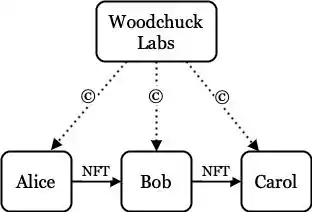
At first glance, this looks more complicated, because now the creator must deal directly with each NFT owner, not just the first owner. But it has the great advantage that copyright licenses do not have to be signed in the same way as copyright assignments. (In fact, they don't even need to be in writing, although for any serious financial transaction, it's much safer to write down the terms.) Carol and Woodchuck Labs do not need to rely on Alice and Bob to get the correct signature transfer. Instead, Woodchuck Labs can simply write its terms so that it automatically grants licenses to each NFT owner as soon as they obtain an NFT.
There is a good precedent for this approach in both free and open source software licensing. For example, the GNU General Public License says:
Each time you transmit a covered work, the recipient automatically receives a license from the original licensor to run, modify and disseminate the work subject to this license. You are not responsible for enforcing third party compliance with this license.
And the Creative Commons attribution license says:
Each recipient of licensed Material automatically receives an offer from licensor to exercise licensed rights pursuant to the terms and conditions of this Public license.
A clear example of this approach in the field of NFT is the RTFKT license, which states:
1... Any digital work or other content made available to digital collectibles owners through the platform as an "additional benefit" (as the term is defined in the Digital Collectibles Terms) will be identified as an "additional benefit" on the Platform or when downloaded. As long as you have an applicable digital collectible, any such content will be licensed to you under any license terms presented at the time of download or, if no such terms are presented, as relevant to that particular digital collectible under the applicable digital Collectible terms. .
The details are tricky, and this is not meant to be a complete legal analysis. Our view is that NFT creators need to think carefully about how to structure their terms to ensure that NFT owners actually receive the necessary copyright licenses for NFT-related artwork, and that copyright licenses are far more effective than direct transfers of ownership.
Derivative power
Another difficulty involves derivative work -- that is, "translation, musical arrangement, dramatization, fictionalization, cinematographic version, sound recording, artistic representation, abridgment, reduction, or any other form in which a work can be recast, transformed, or adapted". No one has been able to explain why The Bored Apes have achieved such rapid cultural and economic growth. This will always be one of the mysteries of the age. But there's at least one factor, sometimes said to be The Bored Apes terms that allow the owners to make a wider range of derivative works based on them. While the NFT license allows owners to use the art for their own "personal, non-commercial use" and projects with annual revenue of up to $100,000, the BAYC clause allows unlimited commercial use of the artwork. Specifically, "Yuga Labs LLC grants you an unlimited, worldwide license to use, reproduce and display purchased works of art in order to create derivative works based on the art."
The first problem here is that this license is inconsistent with the statement in the two paragraphs above in the BAYC clause that "when you purchase NFT, you completely own the basic Bored Ape, i.e., art". If Alice really "owns" the art, then Yuga LABS has nothing to offer, and commercial licenses are redundant. (This is another sign that Bored Ape NFT's claims to "own" artwork, like many other claims about what users actually own when they "buy" content online, cannot be taken at face value.)
The second problem is that the term has an uncomfortable relationship with downstream transfers. Or consider Alice and Woodchuck LABS. Suppose Alice has the WoodChucker number 12345. She gave film producer Fern permission to create a series of videos based on Woodchuck 12345. These videos are derivative works under copyright law and Fern has its own copyright in these videos. Now Alice has decided to sell Woodchuck number 12345 to Bob. How should Fern's license be handled?
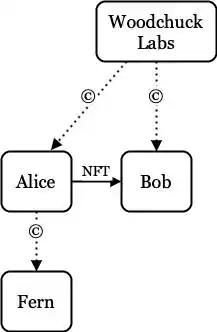
A simple answer is that since Alice's copyright license to use Woodchuck no. 12345 ceases when her ownership of NFT ceases, so does any sub-license she grants. This means that the videos are no longer licensed the moment Alice sells them to Bob, and if Fern continues to play them, she becomes a copyright infringer! This was bad from Fern's point of view, as he had invested time and money into making the video. It's also bad from Alice's point of view, because if Alice could have gotten out by selling NFT to Bob. Fern would have been very reluctant to pay for Alice's rights. Thus, this solution effectively makes the rights to the derivative work unsaleable.
Another answer is that Fern's licence continues to be valid. Once Alice had given Fern permission, There was no way Bob could back out. This protects Fern, and thus Alice's licensing business. But it can create its own headaches. For example, Bob might license his own video to Georg, so there are now two competing WoodChucker 12345 series. Fern would be very angry, but what could they do? If their lawyers are good, Fern will insist that Alice make the video license exclusive, so Alice can't license anyone else to make the video series. But this is a private contract between Alice and Fern. Bob has no signature and is not bound by it! Bob licensed the copyright directly from WoodChucker Labs, without the exclusivity restrictions Alice had promised Fern.
So perhaps the license should be packaged with the NFT itself. This often happens with real estate. If Alice owns a piece of land and grants Telecorp an "easement" to lay fibre-optic cables under a corner of the land, that easement still exists after Alice sells the land to Bob. It is said to be "binding on the heirs of the owner" or "run in conjunction with the land". That is, an easement is attached to and limits (or "burdens") legal rights to the land itself. It's not just Alice's personal commitment to Telecorp. When Bob buys land from Alice, he "walks in her shoes." He inherited not only her rights to the land (such as building a house or growing crops), but also her obligations (allowing Telecorp to continue operating the cable).
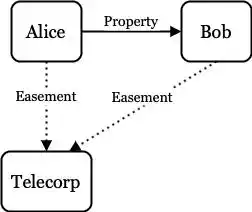
Similarly, we can imagine that when Bob buys NFT from Alice, he will wear her shoes. He inherits not only Alice's rights in The Bored Ape 12345 copyright (such as the right to make glossy art prints), but also any restrictions or obligations Alice assumes (such as Fern's exclusive video license). Now Bob is not free to license Georg to make a second video series.
Maybe this is a good solution. Or maybe not. If Alice is now free to guarantee artwork copyright in this way, it limits Bob's rights. When he buys NFT, he buys less than Alice's full right to buy. Alice divvied up the copyright, effectively keeping a portion for herself. If Bob were in the NFT market, he would have to investigate the entire chain of ownership of the NFT he purchased to make sure that no Alice quietly gave up part of the copyright before he did. This need for investigation runs counter to the spirit of encryption, which should be done publicly and on a chain whenever possible. Therefore, an exclusive license signed by an owner probably should not run with NFT.
So far, we have listed three different possibilities that can happen when Alice sells NFT to Bob:
Fern's license terminated.
Fern's license remained valid, but Bob could license the same rights to Georg.
Fern's license continues to be valid and Bob cannot license the same rights to Georg.
The court could conceivably adopt any of these three outcomes. In fact, there is no clear consensus on which is the best solution. (The three authors of this blog post don't even agree!) Worse, these don't even sum up the possibilities. A fourth possibility is that Fern's license to create new spin-offs terminates, but they can continue to use existing spin-offs they have already created. This is how copyright law deals with certain license terminations. Or, if Fern's license continues to exist, what should happen to any royalties Fern has promised to pay Alice? Should Bob inherit these powers? There are arguments for and against.
Our view is that these are the issues that need to be addressed by NFT licenses that allow derivative works. Otherwise, NFT owners and their business partners may not be happy with the results. Everyone who runs a project based on NFT and doesn't answer these questions has great faith in the courts that if the deal goes bad and the parties end up suing each other, then the courts will take care of it. (Blockchain advocates aren't generally known for their faith in the courts to sort things out.)
We are not saying that every project has the best solution. (This is one of the many reasons we don't provide our own suggested license text). For NFT projects based on musical or literary works, what works for The Bored Apes probably doesn't. Instead, we believe NFT creators need to consider these issues, discuss them with their communities, and then clearly communicate how copyright licenses will work with NFT.
conclusion
Clearly, many NFT projects are designed to transfer ownership of copyright as well as NFT itself. This is a core design goal, on the same level as creating compelling content and making transfers irrevocable. Despite this, many projects seem to have considered the legal aspects of their design far less than the technical and artistic aspects.
We think this is a big mistake. The legal infrastructure that runs blockchain is as complex and fraught with pitfalls as the technical infrastructure. While some cryptocurrency and Web3 projects aim to get rid of the existing legal system, or replace it entirely, many creative NFT projects are not. They are designed to work within the legal system that currently exists, allowing people to create new and interesting art now and commercialize it using real-world contract, property and copyright laws.
Some existing NFT licenses are not fit for purpose. They do not propagate copyright interests with NFT in the way they want. If the code is the law, then these licenses are error codes. A responsible NFT creator would not start a project built on a library of smart contracts known to have unpatched vulnerabilities. They should pay equal attention to the laws and regulations on which they depend, or the results could be just as disastrous.
Whatever one thinks of NFT, it is in no one's interest to start them when copyright licenses are broken.
The original link
Welcome to join the official BlockBeats community:
Telegram Subscription Group: https://t.me/theblockbeats
Telegram Discussion Group: https://t.me/BlockBeats_App
Official Twitter Account: https://twitter.com/BlockBeatsAsia
 Related Articles