Bankless: The age of the Ethereum empire is coming

原文标题:《 以太坊的「帝国模式」 》
David Hoffman, co-founder of Bankless
South Wind, Unitimes
Tribalism is rife in Crypto, and always has been.
There's only one Number one market cap on CoinGecko, and we all want to be number one.
For now, there is plenty of room in Crypto to "grow the pie"; We're just in the first few rounds of a long growth phase for many Crypto networks. At the beginning of this Cambrian explosion, there was so much room for multiple chains that there seemed to be no limit to the number of L1 blockchains the entire Crypto ecosystem could accommodate!
What's with all this tribalism and infighting? Each L1 strand has space, right?
Not so.
It doesn't matter that we can make the cake bigger; When one L1 chain ecosystem takes the lion's share (the bigger the better), the game inevitably collapses.
Blockchain is like chess: if you don't make the best move, you make the wrong one. If you give your opponents a little space, they are sure to seize it. If you leave something on the table, someone will snatch it away at once. If you are not competing for the first place, then you are at the mercy of others.
Therefore, each chain must compete for first place.
Liquidity brings liquidity. Capital begets capital. Network effects generate network effects. The winning L1 chain catches all of these things.
Currency wars are a daily occurrence in the Crypto industry.
"Currency premium" is the scarcest resource in Crypto. This is something every blockchain wants, but not every blockchain can have. Bitcoin has a lot. Ethereum has a few. The other chains have very little.
There's only so much currency premium.
That's why tribalism exists. That's why we've been fighting. There's only one number one encrypted network, and we all want to be number one.
Currency wars in nation-states
The same competition is taking place at the nation-state level.
Based on a time frame of several centuries, you see nation-states competing, colluding, and going to war to take first place in global power.
Nation-states compete to monopolize violence. Whichever country has the strongest military owns the world's reserve currency. They use their power to defend their currencies as global reserve currencies.
When your currency becomes a global reserve currency, you have the world's most powerful asset: the ability to print money for global demand.
When the world uses your currency, you reach the summit of the jungle. You're the boss. You have a power that no one else has.
Any nation state that is not dominant can print money. But without the support of global demand, they could slip into hyperinflation. Only the number one nation state has the privilege of "sustainable" money printing.
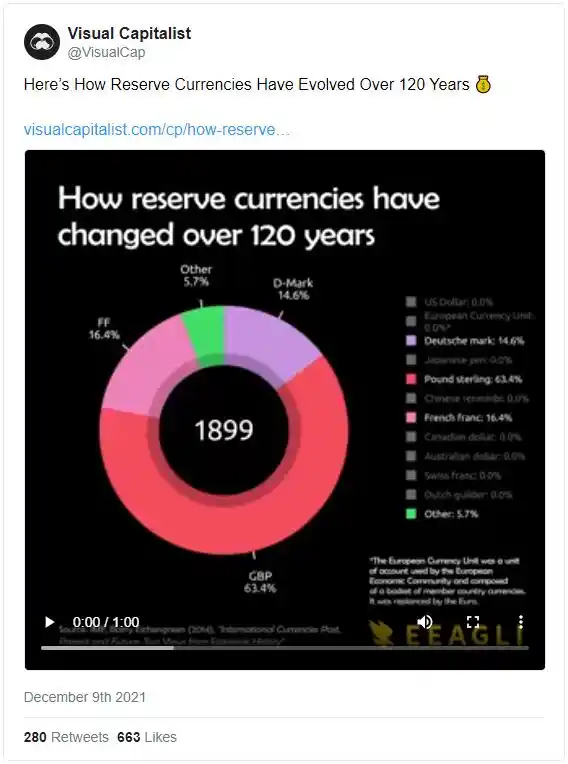
When you own the number one currency, global demand for your assets greatly mitigated the negative impact of additional issuance of that currency. This is why the US was able to "get away with it" for so long; Because of the oil-dollar system, any new supply of dollars is immediately absorbed by global trade.
But wasteful spending and corruption have finally reared their ugly heads, and confidence in the dollar is waning.
Credible neutral and clean blockchain networks are racing to replace the global reserve currency.
Positive feedback loop
Nation-states with the world's reserve currency also have the world's most powerful militaries -- the two go hand in hand. Military power ensures the value of currencies by controlling global trade. It ensures that the global economy always uses its own currency.
This is reflected in the positive feedback loop of power. Once a first Nation nation, it becomes cheaper to maintain an army because of its control of the world's reserve currency. The value of the dominant reserve currency further subsidizes military costs, which in turn underpins the value of the currency.
The same is true of blockchain.
Nation-state armies are the equivalent of blockchain security.
Bitcoin's army is its miners.
Ethereum's army is its pledge.
Every blockchain has a security expense. The sustainability of blockchain is achieved by optimizing the amount of money that is issued for cybersecurity. How safe can you get with the least amount of currency issuance (aka Token inflation)? Which blockchain network can best answer that question will (eventually) land at the top of CoinGeck's market cap list.
Strictly speaking, blockchain's security forces are defensive forces. They don't attack, they defend.
PoW erected a wall of electricity around the Bitcoin economy. Anyone with a weaker energy wall can't penetrate Bitcoin's PoW field.
PoS erected a wall of capital around the Ethereum economy. Anyone with less money can't penetrate ethereum's protective walls.
The price of BTC and ETH is an important factor in the low cost of security for these ecosystems. If the value of a chain's assets increases tenfold, so does the security budget. A ten-fold higher price means that for the same number of assets issued, the system can obtain a ten-fold higher level of security.
Currency premiums are linked to safety.
The supply of computing power on the Bitcoin network has increased along with the price of BTC.
The incentive to pledge ETH increases as the price of ETH rises.
The issuance of BTC is hard programmed, so an increase in the value of BTC increases security spending on Bitcoin (at least until the bitcoin block reward subsidy runs out!). . This could lead to overruns in its security. If bitcoin is safe at $1,000, then the bitcoin network is 10 times more secure when its price increases 10 times to $10,000... In any case, the bitcoin network is inherently secure.
In contrast, Ethereum's ETH distribution is more flexible. As the price of ETH has increased, the issuance of ETH block rewards has decreased:
Block 0 to Block 4,369,999:5 ETH per block;
Blocks 4,370,000 to Blocks 7,280,000:3 ETH per block (effective 2017 via IP-649);
Block 7,280,000 to date: 2 ETH per block (effective 2018 via IP-1234).
In 2021, IP-1559 began recycling excess ETH by destroying transaction fees.
Later in 2022, with the merger of Ethereum PoS, ETH circulation will be further reduced by 90%.
Ethereum's security philosophy is "minimum viable release." So how does Ethereum issue the minimum amount of ETH to achieve the required security quota?
Let's go back to the nation-state: How do we optimize our military for maximum effectiveness at the lowest cost? Fewer tanks, more drones.
The decrease in ETH issuance makes ETH more scarce and increases its value in the secondary market. Higher prices in the secondary market increase the security of the Ethereum network, creating a positive feedback loop of more security with fewer ETH releases.
This is the currency premium.
Rollups: Empire mode for security
Ethereum's "modular" design structure allows it to scale indefinitely.
Rather than trying to host the entire global economy on top of a single blockchain, Ethereum becomes a settlement layer for other blockchains.
The United States has the most powerful military and guarantees and facilitates global trade between nations so long as they adopt the dollar.
Ethereum has the highest security and can guarantee and facilitate transactions between L2 networks as long as THE L2s (Layer 2) network uses ETH for L1 transactions.
The strength of the dollar comes not from domestic production in the US economy, but from external demand for dollars to enable countries to participate in global trade. The US does not control the economies of Germany, France, Argentina, etc., but it still captures the advantages of these economies because in order to trade with other countries, these countries must convert their GDP into dollar demand for imports and exports.
Similarly, Ethereum does not control the economy of the L2s blockchain. Each L2 network has full sovereignty over its own economy. However, when GDP needs to be output from one Rollup (L2) network to another Rollup network, ETH must be consumed for L1 transactions. Consolidating tens of thousands of Rollup transactions into a single L1 transaction is how economic activity on L2 interoperates with the rest of the Ethereum ecosystem.
The beauty of Ethereum's "modular" design is that you can attach essentially unlimited L2 networks to it, making Ethereum L1 the most scalable blockchain design, enabling it to grow from a kingdom to an empire.
The cost of creating a new L2 network on Ethereum is close to zero. As long as there was enough demand, it was the equivalent of an empire displaying New Territories and economies out of thin air. Each new L2 network adds to Ethereum's net GDP, and Ethereum is free to add as many L2 networks as the market demands.
As I wrote in 2020, all roads to Ethereum lead to value growth for ETH.
Simple center, complex edge
Ethereum's L1 / L2 structure is similar to the FEDERAL/state structure in the US. Central simplicity; The edges are complex.
The US system is flawed. I know that there is a difference between the theory of the American model and its performance in reality. America is far from perfect. In this article, I ignore these imperfections to make my point.
The US federal government is like ETHEREum L1. It determines universal "meta-laws" that all states (L2s networks) abide by. These "meta-laws" are designed to promote interoperability between states. It provides trust for efficient interstate commerce.
For example, the US FDA (Food and Drug Administration) maintains food standards between states, ensuring that food can be traded between states, while ensuring that one state does not sell contaminated food to another. Similarly, the EPA maintains environmental regulations to ensure that negative environmental externalities in one state do not affect the economies of other states.
But the federal government should provide only the bare minimum of regulations needed to create an "America." All other laws and rules are left to the individual states (L2s networks) to decide.
The same pattern exists on Ethereum.
Ethereum L1's EVM (Ethereum Virtual Machine) rules are designed to coordinate economic resources across L2. EVM is a shared set of rules that all L2 networks agree to follow. This common standard is how L2 networks share the economic benefits of each other's growth. What is good for New York is much better for California than Canada!
Sharing the same L1 protocol is how each independent blockchain moves from adversarial to allied. The success of one Rollup network on Ethereum has positive externalities for other L2 Rollup networks due to interoperability brought about by the underlying L1 chain. There are shared benefits between these "aligned" L2s networks.
The beauty of L2 network/State power is that each L2 network/State can decide what works best for them. Ethereum does not determine L2's rules, only the rules needed for coordination between L2s exist.
An L2 Rollup network may be:
An Optimistic Rollup network, such as Optimism or Arbitrum;
A ZK-rollup network such as zkSync or StarkNet;
A Validium network, such as Immutable;
A centralized ledger, like Coinbase or Wells Fargo;
A federation chain, such as Hyperledger;
. .
There is no limit to how you can build L2 networks on Ethereum; As long as you comply with EVM interoperability standards.
This demonstrates the principle of "complex at the edges, simple at the center", which is a universal principle in nature.
This is how organisms grow: the genetic code is in the center, and gene expression is at the edges. That's how the app store works: at the center is a basic publishing platform, and at the edge is developer innovation. This is also the US federal/state model: "meta-law" at the center, innovation at the edge. This is the "modular" Ethereum structure: EVM at the center, L2s at the edges.
"Central simplicity" maximizes the expression of the edge. Give humans the ability to build anything they want, and they will create something amazing. By restricting human beings with arbitrary laws and regulations, you stifle innovation and progress. Do one thing and do it well, while allowing the developer/entrepreneur ecosystem to flourish and do the rest well.
This L1/L2 model and the federal/state model is an individual empowerment mechanism.
Has your state become coercive and overbearing? Do they squeeze more tax money out of you than they provide services? Your solution is simple: move to another state.
In this state model, since individuals can leave, states must compete with each other to keep their voters happy and stay. States that do better are rewarded with more economic resources and more people moving in.
The same dynamic will occur in L2s networks.
Is your L2 network charging too much? Does it invest enough in infrastructure to make the user experience easier? Is it keeping pace with innovation?
If your L2 network is not satisfactory, you can just jump to another L2 network. L2 networks will compete with each other for users and money, and this competition is good for users.
Who pays taxes to whom?
Ethereum is a modern example of the global coordination model we've seen for thousands of years.
Kingdoms make armies to fight other kingdoms. The victorious kingdom annexed the defeated kingdom, and the defeated kingdom began to pay taxes to the victorious ruling empire. The empire would be responsible for protecting its newly annexed kingdom from external attack, using resources within the new kingdom to support its army and expand its sphere of influence.
When humans evolved from a hunter-gatherer society to a sedentary agricultural one (at the same time that we established the concept of "property"), the question of "who pays taxes to whom" became a fundamental question of human coordination.
The process has become less violent over the years, but the basic structure remains the same. The US did not maintain its empire through violence (well, it often did), but by ensuring that global trade was denominated in dollar currencies.
Ethereum Empire
The Ethereum empire will evolve in two ways:
New L2 networks are created and added to the Ethereum ecosystem;
Other insecure L1 blockchains transform themselves into ethereum L2 networks.
Adding new L2 networks is quick and simple. Rollups networks (such as Arbitrum, Optimism, and zkSync) are generated within Ethereum; They left the crowded central empire (Ethereum L1) and established new sub-kingdoms outside the main castle.
These new Ethereum satellites manage themselves and generate their own economies. But every few blocks later, they bundle together their combined economic activity and make a single transaction on Ethereum L1. The security of Ethereum L1 is given to the L2 network, which then charges the L2 network an ETH fee for processing the transaction.
The transformation of other L1 chains into ethereum L2 networks is more complicated.
In short, other L1 blockchains need to issue more "native currency" to pay for less security than Ethereum. If they want to stop issuing their coins, they can choose to be protected by the Ethereum network (i.e., the ETHEREum-based L2 network).
Let's explain it through the data:
Ethereum currently has an inflation rate of 4.15% and provides $45 million per day in security payments to its network (this does not include destroyed ETH, which reduces inflation!). .
BTC currently has inflation of 1.7%, but provides $40m a day for security. BTC's current cargo premium is very obvious.
BTC's inflation rate is 2.4 times lower than ETH's, while generating ethereum security equivalent to 89%. That means bitcoin is 2.7 times more secure and efficient. Too bad it can't be a smart contract, otherwise I might be more bullish on BTC. No smart contract = no DeFi & AMP; No L2s network.
You can use moneyprinter. info To check the inflation rate of L1 blockchains like Bitcoin and Ethereum:
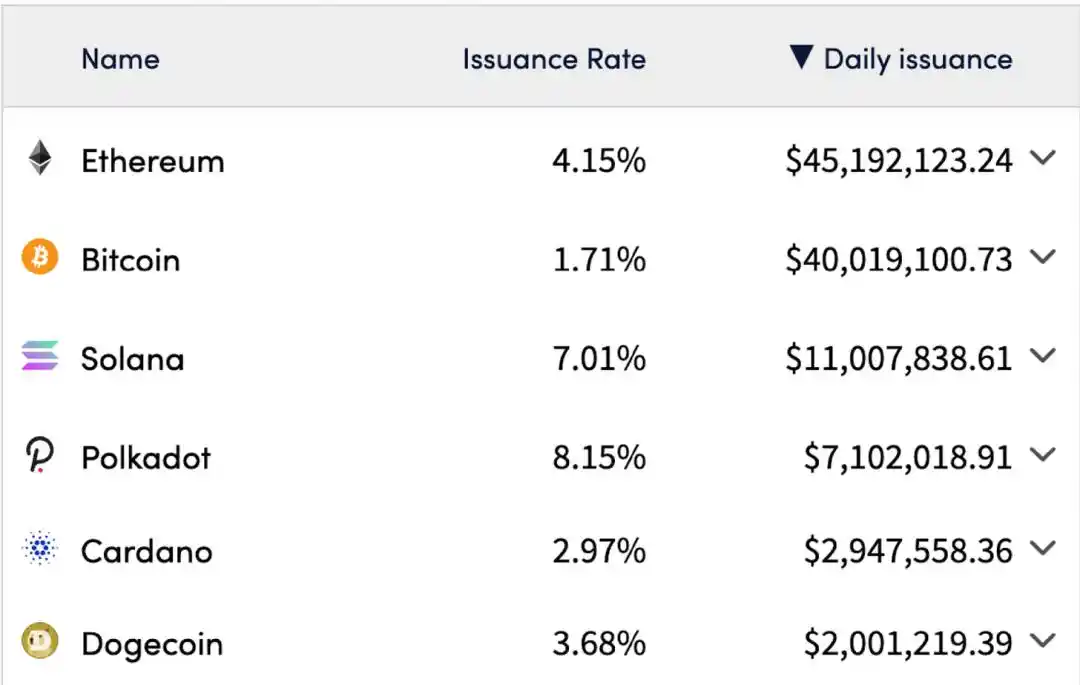
Solana's current inflation rate is 7 per cent and security costs just $11m a day. Its inflation rate is 1.75 times higher than ETH, but it only achieves 24.4% ethereum security. Ethereum's security efficiency is 7.17 times higher than Solana's.
Avalanche is currently running 5.5% inflation and spending $5.7 million a day on security. Its inflation rate is 1.3 times higher than ETH, but it achieves only 12.5% ethereum security. Ethereum is 10.4 times more secure than Avalanche.
And that's just before Ethereum moved to PoS (Solana and Avalanche already use PoS). The merger will reduce ETH issuance by 90% while enhancing Ethereum's security mechanisms.
The pitfalls of monolithic blockchains
This is the trap that "scalable" monolithic blockchains fall into. Avalanche and Solana both position themselves as low-cost L1 blockchains, but this attribute forces them to issue more currency to pay for security. Solana and Avalanche both have higher throughput than Ethereum. They generate more total block space to hold more data. If you have more block space, you have to increase security spending to protect the extra space.
More blocks need more troops to protect!
Extending a monolithic kingdom is like extending the walls of a fortress further and further out, rather than allowing people to leave the kingdom to build outlying settlements.
To differentiate themselves from Ethereum, these monolithic L1 chains have increased their L1 throughput to reduce overhead. This could be disastrous for the long-term currency premium of these L1 chains. This design choice resulted in high circulation and limited the fees that could be charged.
Higher distribution, lower fees. This kills the currency premium.
In contrast, Ethereum prioritizes decentralization in L1 and scalability through L2, which generates higher L1 fees while minimizing the need to publish ETH.
Lower distribution, more fees. That's how you get a currency premium.
As circulation has been minimized, the cost of EIP-1559 destroys the value of capturing the economic energy of the Ethereum ecosystem and injecting it into ETH (by making it more scarce). As the value of ETH increases, less ETH will need to be issued to pay for security. This decrease in issuance increases ETH's scarcity, increasing its value, and further reducing the demand for issuance. This is a positive feedback loop of currency premium.
Conversely, blockchains that attempt to scale at L1 have a negative feedback loop: L1 blockchains that scale require high circulation and fail to capture significant fee revenues. This leads to supply inflation, reducing scarcity and putting downward pressure on their currencies. These L_1 chains cannot be subsidized through fees, as this runs counter to the purpose of these L_1 chains. With more and more issuance, currency depreciation (due to inflation) has triggered the need for further issuance.
The battle field for the top L1 chain is always skewed towards who can issue the fewest currency for the most security. With security, you have everything. If security is expensive, your options are limited.
Write in the last
Optimism and Arbitrum are already operating Ethereum L2 networks, and they don't even need to issue native tokens. They are economically viable and do not require any issuance. They generate revenue by selling blocks and pay only a small tax to Ethereum L1 each time they make a L1 transaction.
Avalanche, Solana, Terra, and even all other L1 blockchains with secondary security have a flow. Their ship is leaking, and the longer they allow inflation to spread, the worse the problem will get.
By becoming an Ethereum L2 network, their issuance (the source of the vulnerability) can be reduced to zero. They immediately generate positive revenue and even increase their throughput.
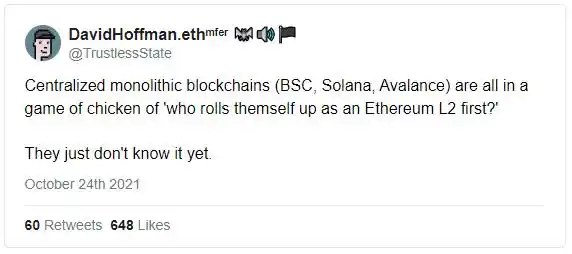
Do they do that? No one wants to bend the knee. Hubris and ego get in the way.
The argument presented in this article is usually why these L1 blockchain communities describe me as "ETH Maxi" (Ethereum maximalist).
In fact, it is decentralized maximalism that makes blockchain's imperial model possible. Ethereum's promise to act as a decentralized L1 layer and provide limited L1 block space is its way of creating a vibrant and rich L2 ecosystem. This is our way of extending the decentralization and security of Ethereum L1 to an infinite number of L2 networks. These L2 networks have the advantage of not having to worry about security, enabling them to be more scalable than any L1 chain.
Just as all roads lead to Rome, all roads lead to Ethereum.
*** This article represents the views of the original author only and does not constitute any investment opinion or recommendation.
The original link
Welcome to join the official BlockBeats community:
Telegram Subscription Group: https://t.me/theblockbeats
Telegram Discussion Group: https://t.me/BlockBeats_App
Official Twitter Account: https://twitter.com/BlockBeatsAsia
 Related Articles