Review of the development status and trends of decentralized applications
Original title: "The State of Decentralized Applications (dApps)—H2 2021 Review "
Original author: Kyle Ellicott
Original compilation: DAOrayaki
2021 is an extraordinary year for decentralized applications (dApps), the blockchain industry and even the web3 industry ecology. The digitalization of our lives has also enabled dApps to grow communities, attract active users, and generate higher revenue. Strong momentum in 2021 lays the groundwork for a more transformative 2022, which will also bring more infrastructure, new financial (GameFi) and governance (DAO) mechanisms, and increased security for identity verification tools (wallets) s concern. Therefore, DAOrayaki compiled Kyle Ellicott's article on "Review of the Development Status and Trends of Decentralized Applications (dApps)" to jointly understand the overall status of the development of the dApp industry.
 < /p>
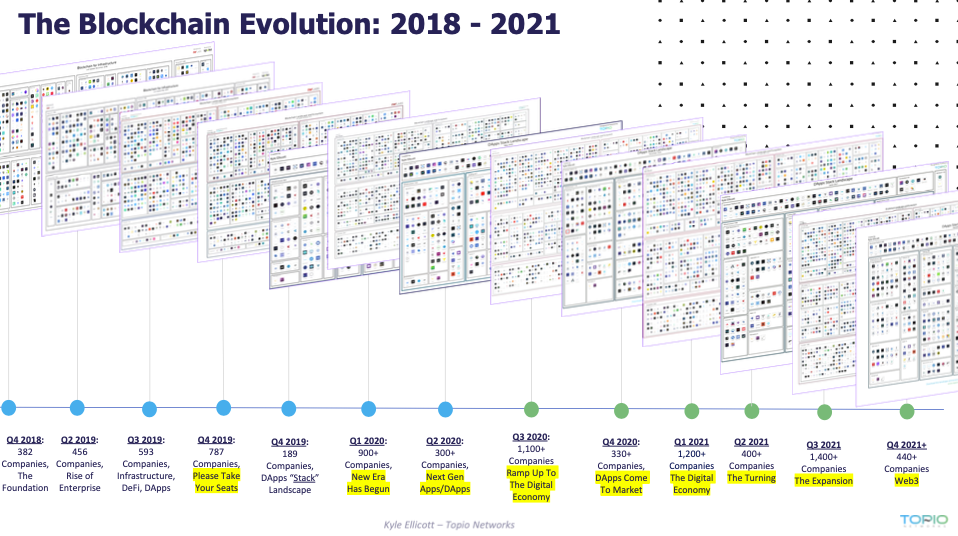
Industry changes since the fourth quarter of 2018
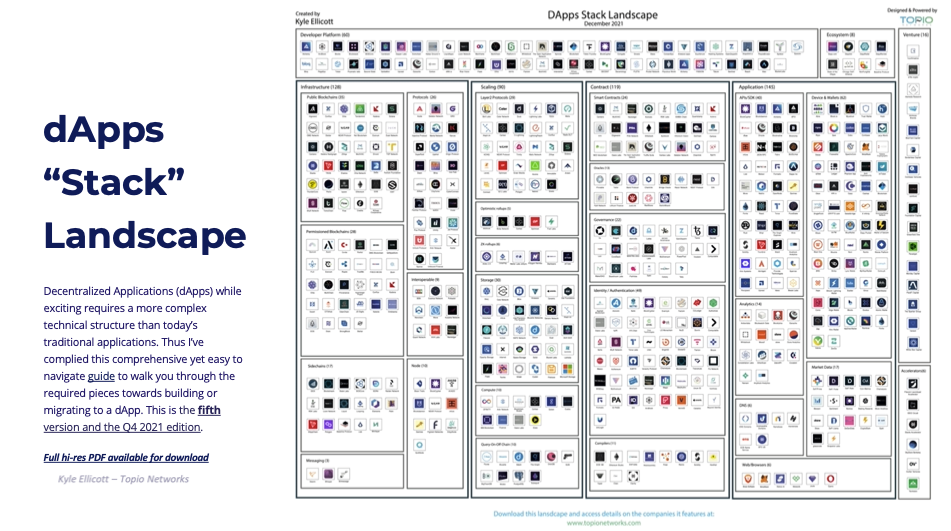
Current dApps pattern:
There are currently over 440 companies focused on developing the infrastructure layer for industry and Web 3 applications. This is a 33% increase from the fourth quarter of 2020. On the venture capital side, over $5.5 billion was invested in dApps infrastructure layer development (with 15 funding rounds over $100 million).
 < /p>
Q4 2021 Decentralized Applications (dApps) Layout by Kyle Ellicott
VC and funding:
In the second half of the year, the capital deployment of the entire field continued to grow, with more than 62 investments disclosed in the third and fourth quarters, ConsenSys (November), Alchemy (October), DeSo (September), Blockdaemon (September) and Dapper Labs (September) have raised more than $100 million.
The ranking of venture capital funds has also changed, with Coinbase Ventures topping the list, followed by Digital Currency Group ( DCG ), Andreessen Horowitz ( a16z ), Pantera Capital and CoinFund.
At the same time, there are also some "newcomers" entering the market, such as from Variant Fund ($110M, Fund II ), Paradigm ($2.5B Fund II ), Borderless Capital ( $500M M Fund II ), Chapter One ($40M ), and foundations from Solana, Polygon, and Oasis Protocol, which added an additional $40 million this week, bringing their total fund size to $200 million.
In addition, the total investment in blockchain exceeds 30 billion US dollars (15.5 billion US dollars in the first half of the year alone), accounting for about 621 billion US dollars of total venture capital investment in the whole year 4.85%.

Source: Pitchbook & Bloomberg
Layout breakdown:
Building dApps is different from the previous web2 and mobile era. For ease of understanding, I've broken down this layout diagram into sections that will help you understand what each building block (or layer) does as you read it.
L 0+1/Infrastructure (Blockchain, Protocols, Nodes+)
L 2/Extensions (L2s, Rollup, storage, query, etc.)
L 3/contracts (smart contracts, oracles, authentication, etc.)
L 4/applications (API, wallet, DNS, etc.)

Key direction:
In December 2021, I mentioned that the following key directions were "on the verge of moving", and sure enough, in January 2022 they have made great progress.
1/Protocol
2/Rollups
3/DNS ( .ENS .BTC ;.SOL)
4/DAO
5/Contract language - Solidity vs. Clarity6/Wallet (authentication)
< /p>
Protocol. As more and more protocols are launched and developed from testnets to mainnets, the topics are varied. Examples include the CityCoins protocol, where developers can create "CityCoins" (such as Miami Coin and NYC Coin) that communities can use to govern better cities, while providing cryptographic rewards for individual contributors and city governments, all powered by Stacks provide support.
Rollups. Because dApps have the need to maintain competitiveness and improve security, both Optimistic and Zero-Knowledge will become important directions in 2022. For example, ConsenSys and Mastercard (Mastercard) cooperated to launch ConsenSys Rollups, and Polygon, one of the layer-2 solutions, acquired Mir (now Polygon Zero) for $400 million in December.
DNS. Developments between Q4 2021 and January 2022 have shown us that domain names (.ETH .BTC .SOL .crypto, etc.) can be used not only for website or wallet addresses, but also as a means of identification and verification. For example, Unstoppable Domains has launched the option to "Sign in with Unstoppable" that uses NFT to provide single sign-on services for ETH and Polygon. Allowing users to log in with NFT (such as "yourname.crypto") gives users the ability to control what data can be shared or displayed to applications, which is a step closer to "users truly owning the Internet." It is expected that in the coming year, applications around identity-based NFTs (LinksDAO, Poolsuite, RAD Live) and domain names (.ETH .BTC .SOL .crypto, etc.) will be more extensive, which also means that the convenience of access will greatly increase.
Revisiting the "turning point":
In my last post covering the first half of 2021 In the dApps summary, I called what happened in the industry a "turning point". The time has come to the present, and the changes in the industry have prompted me to re-examine some of the content I raised before, and reflect on what happened in the second half of 2021 and the implications for 2022. Forecast of the year:
1. Protocol developers and maintainers cooperate with traditional venture capital, with the goal of developing and improving the industry ecology. [Looking back at Q4, we saw more and larger funds of this form, such as Hedera's $5 billion funding, Oasis' $200 million, NEAR Protocol's $150 million (Jan'22) + $800 million $21 million from Polygon+ AU21, $300 million from Harmony, and more. I expect this trend to expand further in 2022, as more and more developers continue to enter the industry, the network will become a "battlefield" for developers and new dApps. In theory, this would also speed up exchanges and cooperation between different networks, as developers look to engage with cross-chain communities. ]
2. Venture capital has added "dApps" to the investment research report, and launched a new fund specifically for the protocol. [In Q2, dApps appeared in many investor research reports, in H2, we saw this trend shift to a wider range of specific keywords, such as "Web3", "infrastructure tools", and "ownership economy"" Play-To-Earn", "GameFi", "Blockchain Games", "DAO Stack" and "NFT", etc.]
3, DAO (decentralized Autonomous organization) This is a kind of company-like organizational structure with great potential. [We will see this space grow extremely rapidly, such as PleasrDAO bought Wu-Tang Clan album for $4 million, ConstitutionDAO raised over $40 million in a week trying to buy a US constitution, but there are also negative ones like SushiSwap case. But I, and many others, still think that 2022 will be a big year for DAOs.
4. We are seeing investments through SAFT (Simple Agreement for Future Tokens) making a comeback. Although it is different from the prosperity of 2017-2019, it is undeniable What is surprising is that traditional venture capital and other institutional investors are participating on a large scale. [In short, investment in the entire space is currently over $30 billion. If you and your company haven't started considering these new financing methods, I encourage you to.
5. The trading platform expands NFT into alternative asset classifications. (such as Binance, Korbit (Korea), Wazirx (India), FTX, etc.)
6. Cross-chain bridges can allow blocks that have not yet been granted interoperability Exchanges can be made between chains. [I touched on this above and expect to see more mature cross-chain bridge products emerge in 2022.
7. The consensus mechanism extends from Proof of Work (PoW) and Proof of Stake (PoS) to Proof of Transfer (PoX), Proof of Protocol Authorization (PoA), etc. .
8. Cloud computing companies are in acquisition mode because they cannot keep pace with the development of decentralized infrastructure. [This space is likely to start heating up in 2022 and take shape in early 2023, largely because of the concerns raised by dYdX's outage on AWS in December. ]
9. More and more companies, governments and small businesses are adding digital assets to their balance sheets.
10. Business models like "Play-To-Earn" (P2E) will be widely promoted. [2022 may be the golden year of DAO, I expect P2E and blockchain games will also become the most prominent themes this year, behind this is their determination to bring the next billion people into the encryption + web3 world. So, I expect to see more "XYZ-To-Earn" models across many industries. ]
Take Action:
If you are a developer considering Where to start building your dApp and which public chain to choose, here's a snapshot of developer activity in 2021 to help, courtesy of the Electric Capital team.
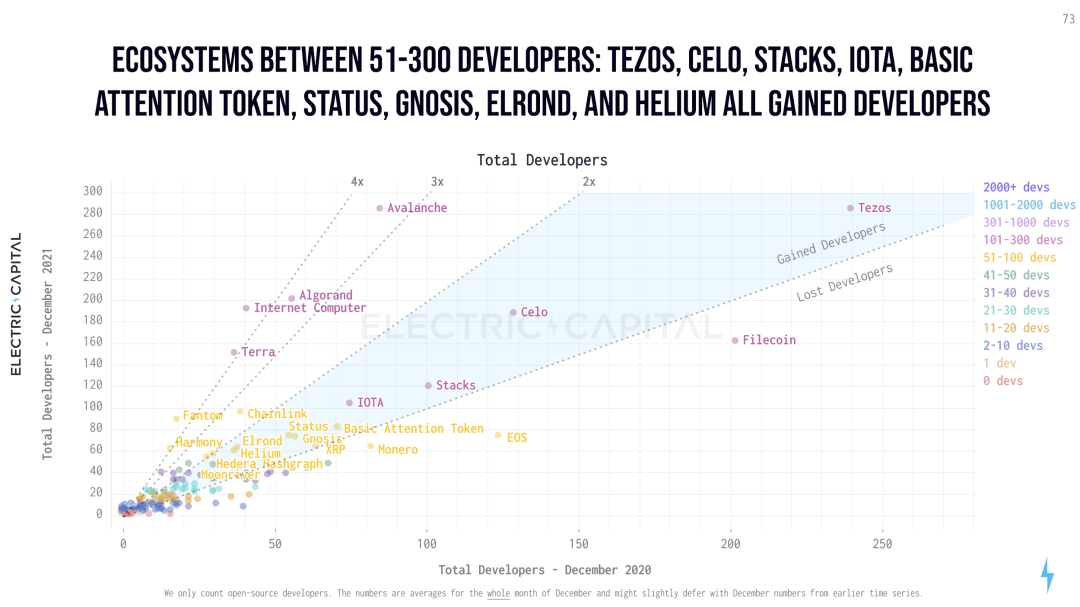

Source: Electric Capita 2021 Developer Report
All that said, the year leading up to 2022 will be exciting one year. If you are interested in building dApps, web3 infrastructure on the above topics, or want to discuss more about the future of decentralization, please contact us.
Original link
Welcome to join the official BlockBeats community:
Telegram Subscription Group: https://t.me/theblockbeats
Telegram Discussion Group: https://t.me/BlockBeats_App
Official Twitter Account: https://twitter.com/BlockBeatsAsia

 Related Articles