Did the DAO evolve from the cooperative?

原文标题:《 DAO 是否从合作社演变而来? 》
Austin Robey
This article is from wechat official account:Old yuppie

In 2014, a year before Ethereum was launched, Trebor Scholz, an academy-activist and professor at the New School in New York, coined a new term. Platform cooperatism ". In a blog post, Scholz outlined a bold alternative to the mining Web 2.0 sharing economy: a platform operated as a cooperative, collectively owned and controlled by its workers and users. The aim is to find ways to usher in a future of car-sharing apps owned by drivers, grocery delivery platforms owned by individual shoppers, and sites like Patreon, owned by creators.
Since 2014, platform cooperativism has become a growing global tech subculture. At conferences in New York, Hong Kong and Berlin, down-and-out community organizers and social entrepreneurs gather every year to support each other, swap stories and offer solace in the struggle to find funding.
A few years ago, I started a digital co-op called Ampled, a Patreon alternative to artists and worker-owned musicians. I've also been involved in several DAOs recently, including Forefront, Seed Club, and Friends With Benefits. It was enlightening to step one foot into the platformist movement and the other into the DAO space, and I came to believe that both fields yielded valuable new tools for human organization, collective ownership, and cultural production. While it sometimes seems like these innovations are taking place in parallel isolation, I believe the two communities have a lot to learn from each other -- and even open the door to meaningful hybrid approaches between the two.
The cooperative, is a business owned by workers, customers or both and operated on a one-member-one-vote basis. Although this ownership structure forms the basis of the cooperative model, its applications and cultures are diverse.
Cooperatives:
Consumer cooperatives
Purchasing cooperative
Cooperatives with multiple stakeholders
Housing cooperative
Marketing cooperative
Producer co-operative
DAO Internet native organizations coordinated by blockchain-based tokens also come in many forms. These include.
The DAO:
Protocol/platform DAO
The creator DAO
Service DAO
Store the DAO
Investment in the DAO
The social DAO
Although both cooperatives and DAOs are collectively owned and jointly determined forms of organization, there are some key differences. Each member of the cooperative has a voting power of governance. No one member of the cooperative can have more power than any other.
While it is possible for the DAO to mimic cooperative governance, it is more common to observe a governance model of one token one vote that is easier to implement, as verifying a person's identity is still an emerging field in the blockchain world.
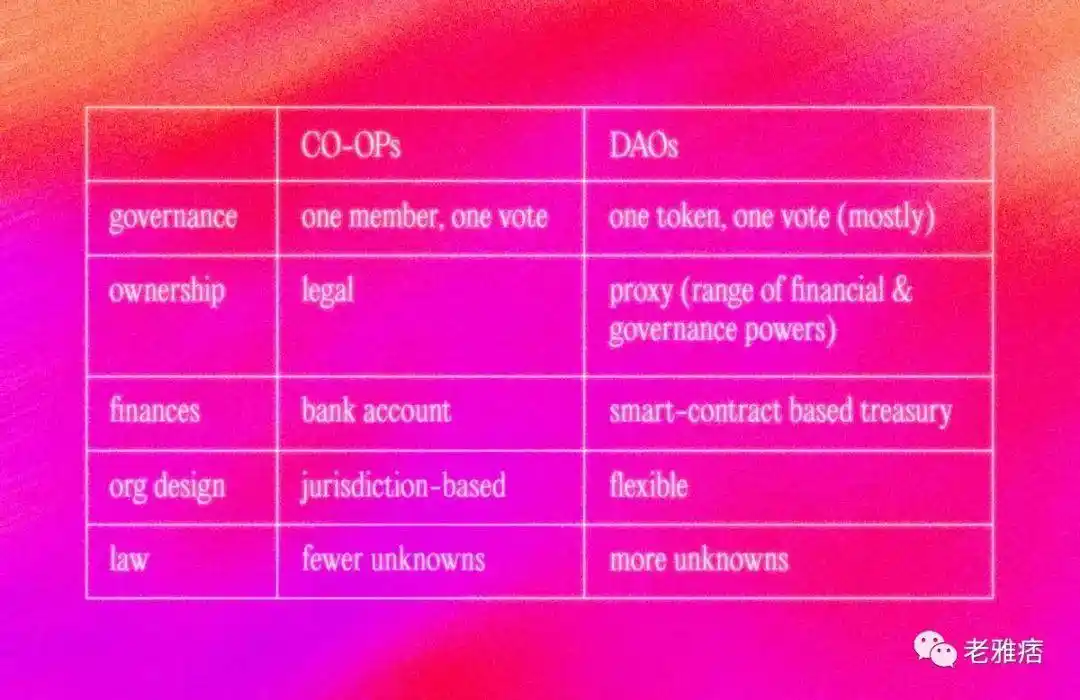
Differences aside, there is an increasing overlap in the conceptual space between DAO and platform partners. Both forms seek to expand collective ownership and governance of digital infrastructure. Both have a culture that prioritizes collective control and creating shared products.
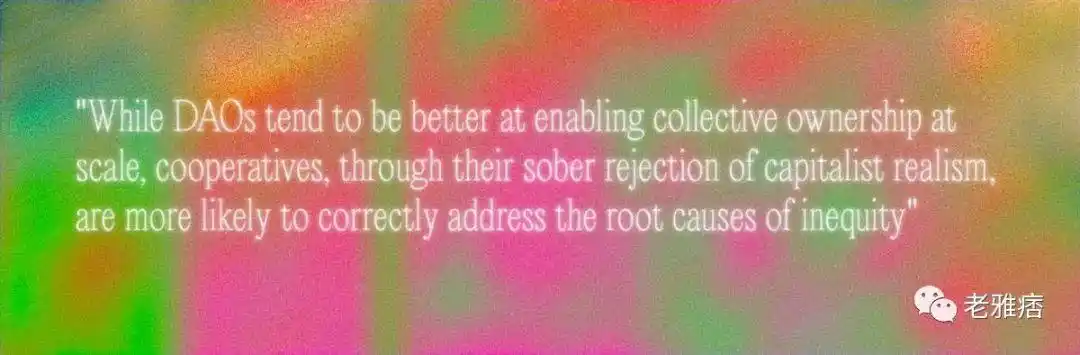
From my experience in both Spaces, I have noticed that DAOs tend to be better at achieving large-scale collective ownership, even if they have a relatively underdeveloped cultural understanding of the rights, responsibilities, and accountability associated with ownership. While co-operatives tend to have trouble accessing capital, they are also more likely to reject capitalist realism and get the root causes of inequality right. Below, I'll share some key lessons I've gleaned about what DAOs and partner organizations can learn from each other.
What can DAO organizations learn from partner organizations
Historical background
People in the DAO world would be wrong to think of the collective work and organization model as a technology invention. In fact, mutual assistance and democratic ownership have been practiced in almost every corner of the world throughout history.
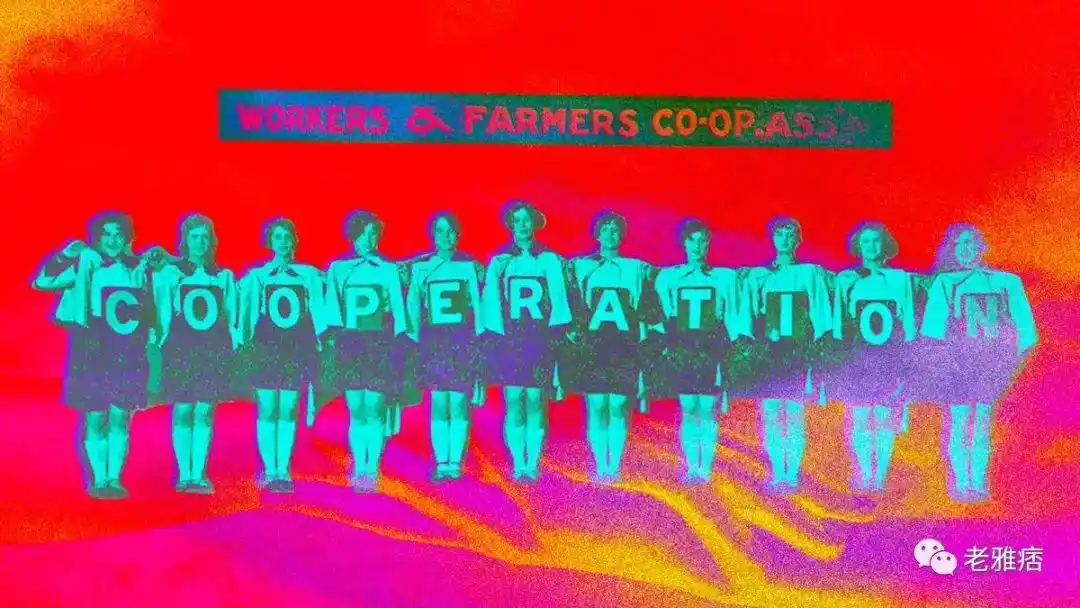
Cooperation has a neglected history in the United States, where marginalized groups are forced to create solidarity networks in order to survive and be self-sufficient.
John jay college professor Jessica - Gordon's, she's in her the collective courage: African americans thought and practice of cooperative economy history, summarized the hundreds of years of freedom and enslaved African americans engaged in example of economic coordination, including pooling funds for the freedom of individuals to buy, and the formation of intentional community and village society. The underground railroad itself was a network of solidarity. These forms of co-operation predate the Rochdale Fair Pioneers Society, a British consumer co-operative founded in 1844 to expand access to quality food and supplies for skilled workers forced out of work by mechanization and widely cited as the basis of the modern co-operative movement.
During the Great Depression, Americans set up alternative networks of barter and value exchange, such as the Unemployed Exchange Association in Oakland. Most rural areas in the United States are provided by electric cooperatives because existing utilities consider certain areas unprofitable. The United States also has a rich history of community and local currencies, including Ithaca Hours and BerkShares.
Daos can learn a lot from these historical examples, especially when it comes to non-hierarchical work patterns and collective decision-making. Studying the failures of collaborative organizations can also be instructive, and mistakes can be avoided. However, I think there are three areas where studying past cooperatives and solidarity networks is particularly instructive for the DAO: struggles around racial and economic justice bring people together, foster a strong sense of shared ownership, and build communities based on common principles.
Economic and racial justice
Cooperatives often arise in response to market failures and exploitative economic systems. They are designed to bring benefits to their members: good jobs, dignity and collective institutions. Because cooperative organizations are motivated to serve the needs of their members rather than profit, they are often guided by missions of racial and economic justice. There is no specific structural mechanism for cooperatives to focus on social justice more effectively than DAO; It's more a question of founding vision.
In contrast, some of the best-known examples of collective economic organizations in the cryptocurrency world serve as exercises in commodification and speculation. Examples like PleasrDAO fragmentation Doge NFT, or ConstitutionDAO raising over $40m to buy copies of the US Constitution, are valuable because they provide a template for a new model of global economic co-ordination. So far, however, few of these DAO funding groups seem to coalesce around the goal of meeting the basic needs of their community members.
While there are more and more mutual and task-driven DAOs (including the PleaserDAO's Free Ross DAO), these projects haven't generated the same amount of collective excitement, support, or resources. Still, for those who want to use Web3 to make a difference, the stories of co-ops like Cooperation Jackson and the 40 Acre co-op offer plenty of examples of coming together to pursue common goals and build an organization that reflects those values.
Definition of ownership
Cryptocurrency networks and DAOs often use the concept of an "ownership economy," an idea first proposed by venture capitalist Jesse Walden as a guiding philosophical infrastructure.
"所有权经济并不总是意味着 Token 、股票期权或股权的字面分配,"Walden 在一篇概述该理念的文章中写道。"相反,它意味着所有权可能表现为新的经济奖励、平台治理或新形式的社会资本--可以成为用户体验的新基石,有大量的设计空间可以探索。"
By defining ownership so broadly, the argument runs the risk of diluting the concept of ownership so that it simply means "exposure to the rising space" or "the feeling of ownership". As Cory Rosen, director of the National Employee Ownership Center, puts it, "Ownership feels like eating." But the concept of an "ownership economy" ignores some key principles of true ownership, such as giving members transparency over investments and agreements, a say in hiring and other important decisions, and the ability to hold leadership accountable.
In this regard, co-operatives have a long history of professional practice and can create strong shared ownership through legally enforceable means: charters, operating agreements and ownership of intellectual property, with clearly defined lines of rights, responsibilities and accountability.
As DAO continues to develop new forms of collective governance, from real estate co-op charters, to Stocksy's proposal flow chart, to Ampled's decision matrix, it's useful to look to smaller or older collaboration models as inspiration.
Common principles
Co-operatives also have something in common: they tend to unite around a common set of principles. The Rochdale Principles are a set of cooperative ideals developed by the Rochdale Equity Pioneers Association. Two centuries later, cooperatives around the world are still based on these principles.
The first three principles outline how cooperatives should operate:
- Voluntary open membership
- Democratic membership control
- Economic participation of members
The other four principles outline common virtues and values:
- Autonomy and independence
- Education, training and information
- Cooperation among cooperatives
- Concern for the community
Not all DAOs are interested in adopting a common set of principles. But for those of us motivated by collaboration, impact and uniting around shared social or technological goals, it's important to ask ourselves the right questions. What will our common values be? Do we prioritize transparency, participation and collaboration, as the open source movement did? If we do enough reflection, we may find that we share many principles with the collaborative movement, including principle 6: DAOs should seek to collaborate with other DAOs.
As new DAOs flood the Web3 ecosystem, it may be beneficial to develop a common set of principles to guide the construction of Web3 -- values that can help avoid a repeat of Web2's dark model, and perhaps serve as a basis for collaboration among like-minded DAOs.
What can partner organizations learn from DAOS
A quick experiment
In April 2021, Denis Nazarov, the founder of Mirror, floated the idea of a tool called PartyBid on Twitter that would enable a group of people to bid and buy NFTs. Shortly thereafter, PartyDAO came together, raised $100,000, and then quickly built and delivered an impressive product that allowed collective bidding and partial ownership. In just a few months, the distributed team created a collectively owned platform that has since facilitated multimillion-dollar bids.
Because DAOs are blockchain-based organizations that are not typically tied to business entities, they leave a lot of room for rapid experimentation in organizational and incentive design. Members can collectively come up with an idea that directs collectively managed resources toward common goals, iterates, and ships at a rapid rate.
By contrast, co-operatives often spend a lot of time discussing charter and registration procedures with lawyers, making them harder to set up than traditional companies. Rather than getting bogged down by the complex processes formalized by traditional cooperatives, it's better to look at DAOs like PartyDAO, which have the ability to quickly ship products and scale impact -- providing an initial proof-of-concept to build as an organization.

用 Token 启动网络
Cooperatives have long been plagued by capital problems. Because they are essentially for-profit organizations, qualifying for grants can be difficult. Because they revolve around group ownership and democratic collective control, they are functionally disqualified from receiving traditional equity-based venture capital, which requires the sale of a majority of ownership to investors.
除了作为协调和投票的强大工具, Token 可以让合作社在现金不足时更容易启动。Helium,一个用于 "LongFi "无线互联网基础设施的分布式网络,提供了一个例子。为了给网络提供动力,全球各地的人们在他们的家里和办公室设置了路由器,作为网络的节点。节点以$HNT 作为补偿,这是一种原生的 Helium Token ,代表着治理能力并持有价值。如果没有这种 Token 和经济激励,很难想象这种规模的去中心化网络是如何形成的。
New ways to quit the community
如果一个合作社正在维护一个公共或共享物品,向该物品的早期采用者分发 Token 可以被认为是一种忠诚的奖励:根据过去的消费或支持,授予人们自动会员资格、投票权或项目中的所有权。
一个例子是最近以太坊名称服务(ENS)的 Token 空投,这是一个公共设施,允许用户注册一个以".eth "结尾的 Web3 用户名,与以太坊地址相关。这使得人们更容易发送和接收以太坊,而不需要记住长公钥。
ENS 已经开发了 4 年多,最初由一小撮人控制。但他们想把控制权和管理权下放给他们的社区,所以他们评估了以前注册过.eth 域名的用户,并想出了一个算法,把 25% 的 ENS 供应公平地分配给这些用户。在最初的分配之后,用户最终比核心贡献者拥有更多的控制权和权力,他们总共获得了 18.96% 的 Token 供应。
虽然合作社可能希望坚持一人一票的决策模式,但 Token 空投可以成为在松散的大型网络中分配奖励的一种方式,并吸引更多的决策成员加入组织。
For those who have long advocated quitting the community, or as a startup's way of transitioning ownership to its employees and stakeholders, as an alternative to an IPO or acquisition, the DAO airdrop can be a powerful tool for allocating control of the community.
New hybrid mode
Not surprisingly, many organizations are currently trying to merge the DAO concept with the collaboration model. DisCo (Distributed Co-op) is a framework that uses feminist economics to reorient our idea of how DAOs should operate more like traditional co-ops. Some other examples.
ETHDenver,一个会议和法律合作社,最近推出了一个 Token
Opolis,一个数字就业合作社,推出了一个 DAO 和它自己的WORK Token
Common Lands, a "decentralized self-owned housing cooperative," aims to help one million families become home buyers through community-owned, affordable co-op housing.
SongADAO, a DAO formed around musician Jonathan Mann's daily song releases, was recently established as a legal co-operative.
一个组织的最佳框架可能不是在合作社或 DAO 模式之间的选择,而是两者的混合。将合作价值纳入加密货币网络可以采取传统合作社的形式,通过链上的 Token 化贡献来引导其网络。或者,一个 DAO 可以决定在某些情况下采用合作式的一票制治理。
We can create better communities with two forms of organization: effective, principled, and well-resourced organizations committed to building a more equitable, democratic, and collectively owned future.
The original link
Welcome to join the official BlockBeats community:
Telegram Subscription Group: https://t.me/theblockbeats
Telegram Discussion Group: https://t.me/BlockBeats_App
Official Twitter Account: https://twitter.com/BlockBeatsAsia
 Related Articles