IOSG: Does the Prophet make Web3 better?

原文标题:《 IOSG Weekly Brief|预言机,让 Web3 变得更好了吗?#118 》
原文来源: IOSG
Part.1 Insight
Does prophecy make Web3 better?
By Sally, IOSG Ventures
This article is only for the purpose of industry learning and exchange, and does not constitute any investment reference suggestions
Prophecy machines: Machines that build trust
Oracle is often thought of as a bridge and window for on-chain and off-chain data. In short, the Predictor is a piece of middleware that provides real-world data services for blockchain projects.
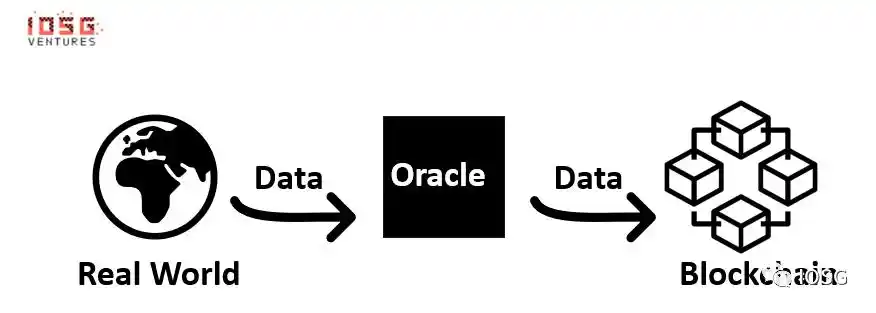
Source: IOSG
If we define blockchains as trust machines, then prognosticators can essentially be called machines that maintain and build trust. In fact, the blockchain itself does not generate trust; the input for trust comes from the predictor. The vast majority of blockchain projects will be unable to survive if they are not connected to the predictor and walk in the dark as if their vision is lost.
As we all know, blockchain is a closed black box that does not have the ability to initiate network calls. Smart contracts, on the other hand, require third parties to verify data due to consensus. To facilitate understanding, we can think of the role of the prophecy machine as the messenger between two civilizations, just like the "Wisdom son" who maintains the communication between human beings and the Three-Body Civilization in the Three-Body Problem. Only through the data feed of the predictor can the smart contract obtain certain information from the Internet and the real world, including stock prices, exchange rates, the final result of the presidential election and so on.
The big four spectrum
According to the form, we can divide prognosticators into four types: software prognosticators, hardware prognosticators, centralized prognosticators and decentralized prognosticators:
1. Software predictor
Software prognosticators connect to the Internet and can access and transfer data and information from any third party server or website in real time via APIS, such as commodity prices, weather indices, flight numbers, etc., and write them into smart contracts.
2. Hardware predictor
Hardware predictors are widely used in IoT as electronic sensors and data collectors. It converts physical events into numeric values so that smart contracts can understand them. Bar code scanners, bank card POS machines, medical devices that collect all kinds of medical data can all be used as hardware prophets.
3. Centralized prognosticators
A centralized prognosticator is a single-source prognosticator, usually provided by a trusted third party such as a government or reputable company. It prevents data tampering and loss by separating the data from the untrusted operating system on the local device. However, a single centralized data source also brings potential risks to smart contracts.
Decentralized prognosticators
Decentralized prognosticators are prognosticators with distributed consensus mechanism, also known as consensus prognosticators. It gets data from multiple external sources rather than a single one, so it is more reliable and does not require trust. Based on relevant research theories of Huawei Laboratory, decentralized prognosticators can be divided into four categories according to different data processing methods:
Aggregation-based processing: Multi-source aggregation eliminates the impact of a single malicious data, such as Chainlink
Pledge-based processing: require participants to hold assets to enhance credibility, e.g., Band
Game theory-based approach: Offer non-hostile economic incentives, such as NEST
Reputation-based processing: Limit hostile nodes such as Witnet by reducing reputation
Although the operation efficiency of a decentralized predictor is relatively lower than that of a centralized predictor, it solves the failure of a single node, so it is less likely to pose a security risk. Due to concerns about risk, most DeFi applications prefer to run on decentralized prognosticators.
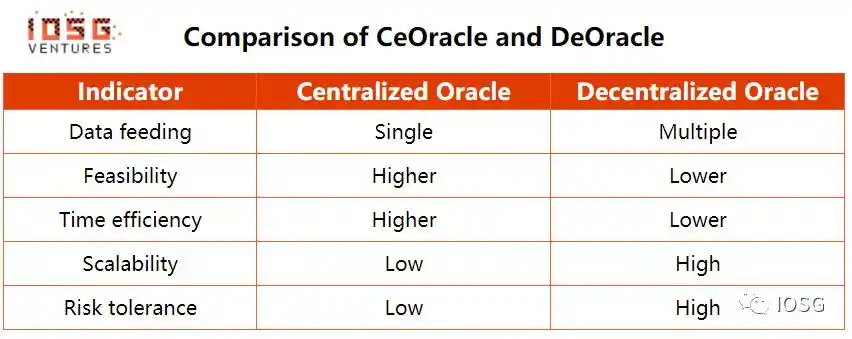
Source: IOSG
Prognosticators in Web3: not just DeFi infrastructure
Based on the above, we have a certain basic understanding of the value of blockchain using predictor. However, when it comes to the application value of the predictor in web3.0, much of the current research still adopts an ambiguous tone.
Last year, the concept of DON (decentralized prophet network) was first introduced in Chainlink2.0's white paper. DON is a network maintained by a set of Chainlink nodes that has the flexibility to boot any predictor service, so in the near future Chainlink will be able to provide external data to the blockchain via trust-free off-chain computing. To realize this vision, Chainlink has launched a series of products and services, including VRF, Keepers, and CCIP, and the deployment of these services has largely opened up the imagination of the Prophet in a Web3 application scenario.
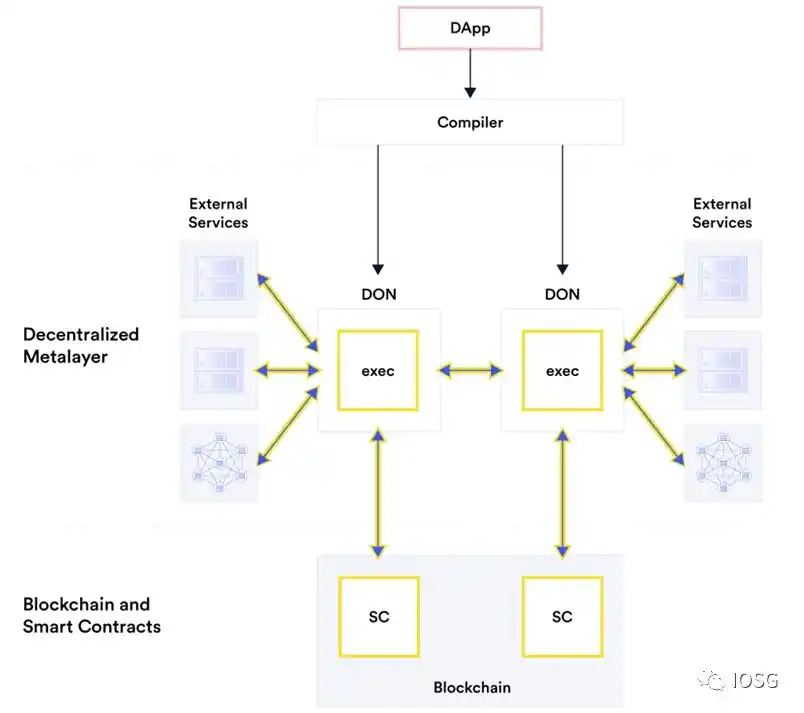
Source: Chainlink 2.0 whitepaper
In order to better demonstrate the great potential of prognosticators in the future web3 world, we have listed a few typical use cases and discussed them in the following sections according to different application scenarios:
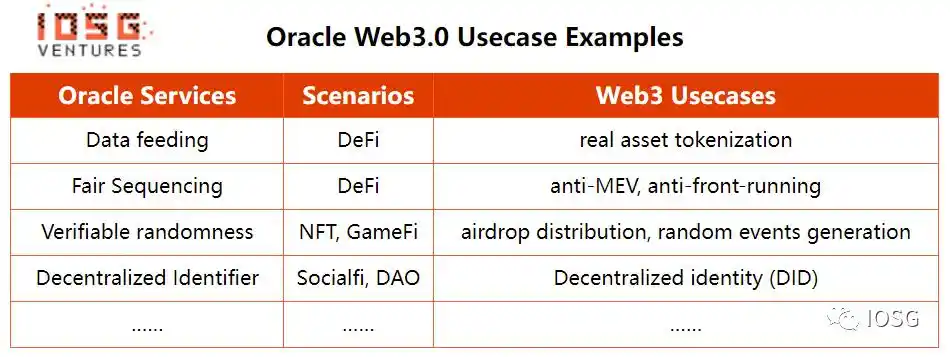
Source: IOSG
DeFi
虽然如今原生加密货币和稳定币仍是 DeFi 的主流,但可以预见的是,基于现实资产 Token 化的新兴市场会将会吸引越来越多的目光。例如,在美国没有合法身份的外国人可能无法直接介入美股交易市场,但通过在现实资产 Token 市场上购买与某些美股挂钩的 Token ,达成近似的投资效果。此外,用户也可以通过抵押 Token 化的房产来为自己攫取更大的流动性。
Another emerging use case for the Predictor in DeFi is fair sequencing. In the current trading system, trades are vetted and sorted by miners, leaving huge scope for arbitrage and manipulation. Miners and verifiers can modify the order of transactions to their benefit by taking advantage of the transaction information that is about to be submitted to Mempool but not yet linked. The term MEV (extractable value) is used to describe this phenomenon.
So, in order to solve this problem of compromising fairness, prognostics like Chainlink have come up with a fair Sorting service (FSS) solution. FSS intends to help DEX achieve fair trading by designing deterministic algorithms to prevent MEV, front-running, or any other scheme that leads to trading chaos. This scheme is mainly composed of three mechanisms: monitoring, sequencing and Posting. You can get a quick overview of FSS through the following diagram:
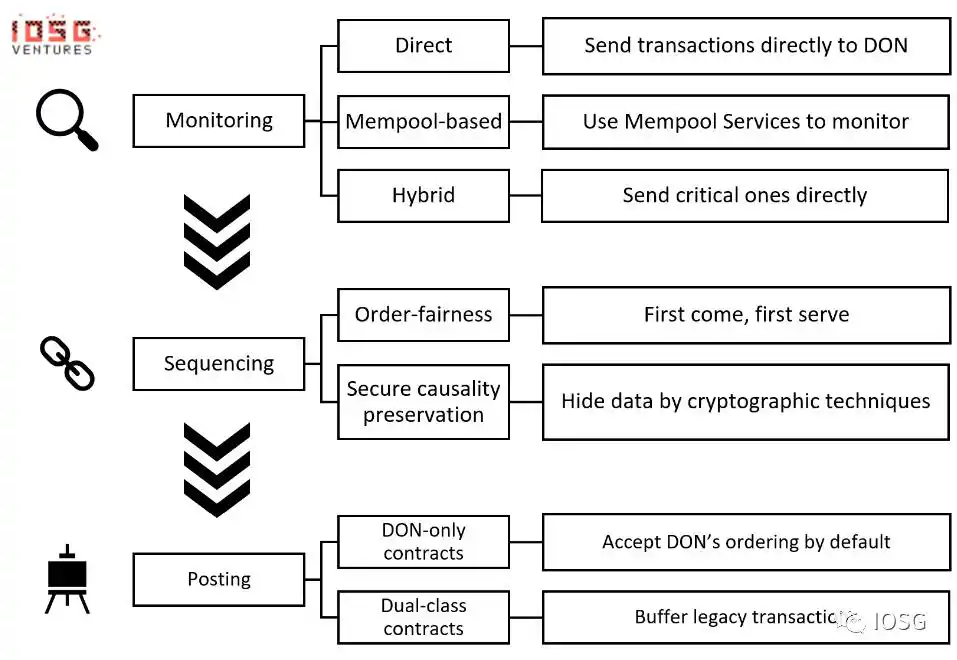
Source: IOSG
NFT & GameFi
NFT provisioning and GameFi's user experience can also be greatly enhanced by external data under the Oracle link chain. A typical use case is the chain generation of random numbers provided by a predictor. For example, an artist can generate NFTS of varying rarity based on verifiable random numbers and ensure that airdrops are fair. For example, game manufacturers can also use random numbers to generate a wider variety of fighting equipment and combat scenarios.
Theoretically, random number usually refers to the number that is generated at random in statistics. It plays an indispensable role in network security, games, scientific simulation and so on. A generator that produces a Random sequence is called a Random Number Generater (RNG). According to the different nature of the generated Random sequence, it can be divided into "True Random Number Generator (TRNG)" and "Pseudorandom Number Generator (PRNG)". TRNG usually uses uncertain physical phenomena such as noise, chaos and quantum random process to generate truly random sequences. PRNG, on the other hand, is a deterministic algorithm that requires external input of an initial value to act as a seed. Common algorithms include Linear textuality, Cryptography, ANSI X9.17, Mersenne Twister, and so on.
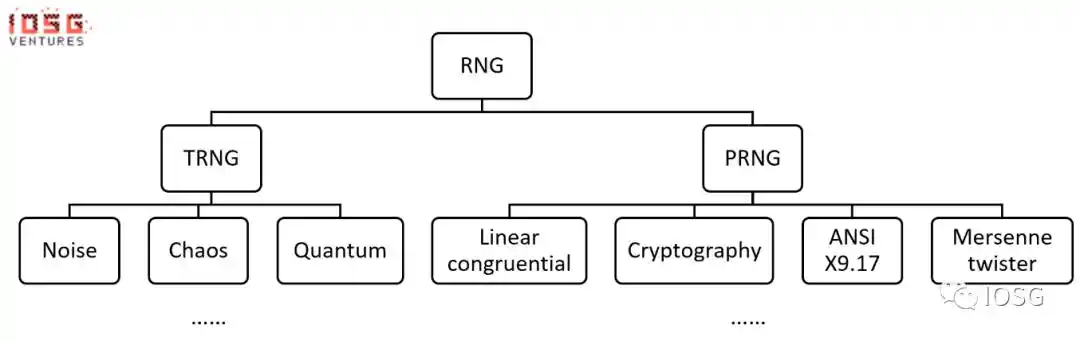
Source: IOSG
The obvious thing is that the random numbers generated on the blockchain chain are all pseudo-random numbers. In addition, due to the transparency of blockchain content, random numbers generated on the chain are easy to be attacked by dishonest nodes, facing great security risks. Typically, miners can gain a comparative advantage in betting by discarding unfavourable blocks through "Block Withholding" Attacks. In this case, in addition to increasing the miner attack cost through repeated hashing, the most convenient solution is to treat the predictor as TRNG, which can generate verifiable true random sequences by integrating sub-chain data to ensure the confidentiality and fairness of random numbers. At present, Except for the Commit Except and BLS protocol proposed by Oracle such as Randao, VRF(Verifiable Random Function) provided by decentralized Oracle is the most common service. The VRF workflow can be summarized as follows:
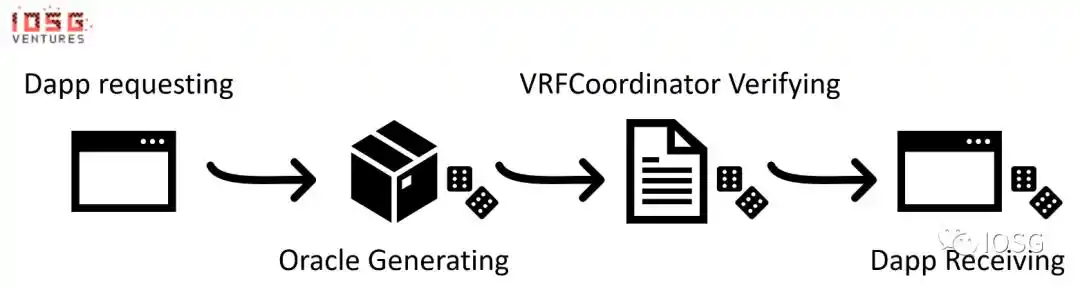
Source: IOSG
SocialFi & DAO
In some cases, the Predictor can also act as a decentralized authentication (DID) tool in socialFi and DAO application scenarios. By using DON to integrate Internet and offline activity data, the predictor can help users verify and manage their identity credentials in Web3, while providing traditional compatibility and privacy guarantees that traditional DID tools do not. For example, by using the predictor to integrate the participation information and qualification information of DAO members in the chain, DAO managers can issue corresponding POAP (proof of attendance) and certify the competence of DAO members.
CanDID is an internal tool to help DON do that. By integrating predictor, CanDID allows users to securely import identities from existing systems and prevents multiple identities from being created. For example, Wang can use his social Security profile page to generate an agreement certificate proving his social security number. Mechanically speaking, CanDID consists primarily of two subsystems: an identity system and a key recovery system.
In an identity system, CanDID can secure identity migration across existing web services like social media and electronic bank accounts by using two types of predictor, DECO or Town Crier, and doesn't require data providers to explicitly create diD-compatible credentials, Greatly facilitates the convenience of the credential ecosystem.
In a key recovery system, CanDID allows users to take advantage of existing network authentication schemes to recover keys with a quick and easy workflow. Users can store their keys on any device they use frequently and select recovery policies in advance or through secret sharing. The specific recovery process is shown in the following figure:
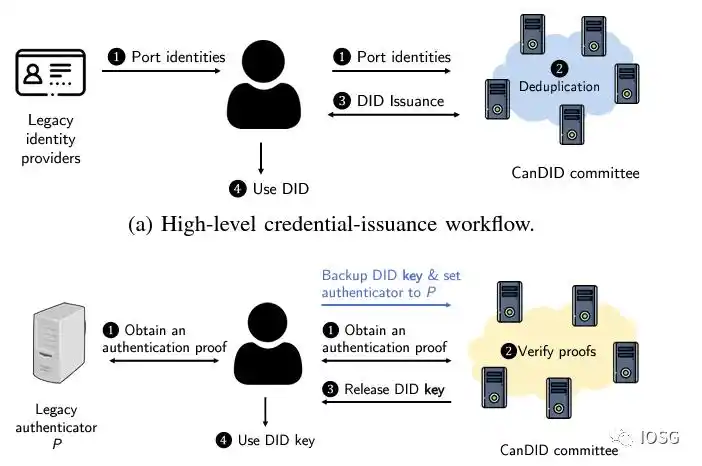
Source: CanDID: can-do Decentralized Identity with Legacy Compatibility, sybil-resistance, and Accountability
Write in the last
To sum up, prophecy has opened a new chapter in the web3 era and is ready to surpass the old ideas and features of the past. Although there is still little discussion about the emerging use of prognosticators in Web3, we believe that as technology continues to evolve and Web3 cannibalize Web2, more and more savvy market participants will recognize the potential value of prognosticators and their significant contribution to Web3.
Discover undiscovered, imagine unimaginable. In the following research, we will further interpret the details of more emerging use cases and mechanisms such as feed-price innovation and cross-chain solutions of the predictor.
(Thanks to Chainlink China for supporting this article!)
Part.2 Investment and financing events
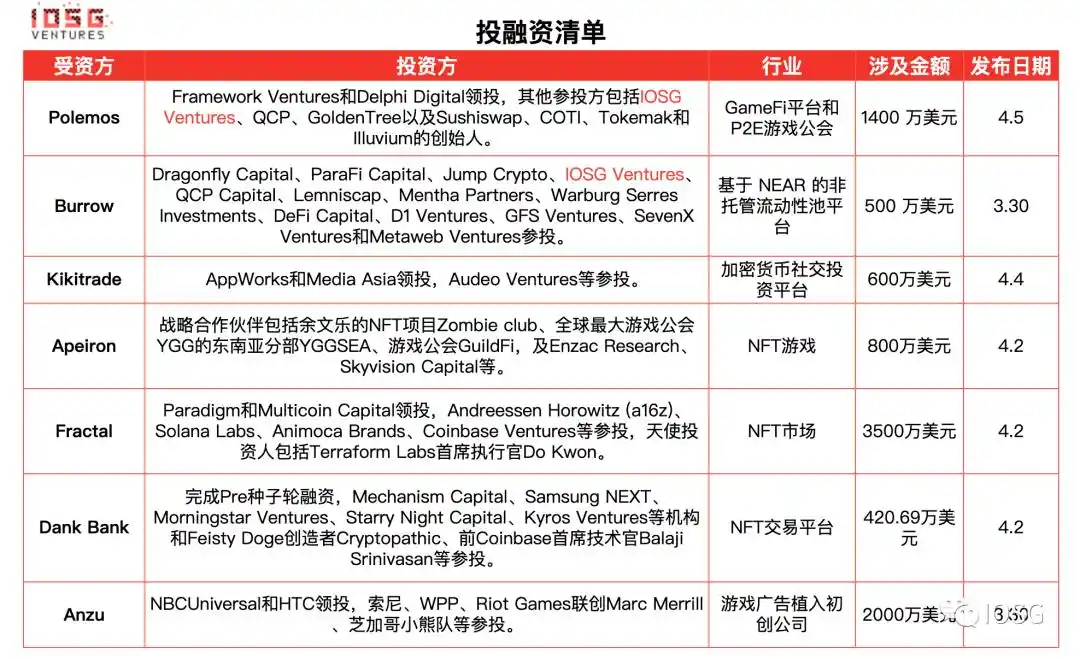
GameFi Polemos has raised $14 million in seed funding
* Game
GameFi and Polemos, a P2E gaming association, have raised $14 million in seed funding at a $100 million post-funding valuation. Led by Framework Ventures and Delphi Digital, Other investors include IOSG Ventures, QCP, GoldenTree and the founders of Sushiswap, COTI, Tokemak, and Illuvium. Sascha Zehe, Polemos co-founder, said the money will be used for staff recruitment, game investment and technology development. Polemos currently employs about 25 people, but expects to have at least 50 by the end of the year. As previously reported, Polemos raised $2 million in strategic funding in November, led by Delphi Digital and Framework Ventures, at a valuation of $40 million.
Burrow completes $5 million funding round with Dragonfly Capital and Jump Crypto
* DeFi
Burrow, a NEAR-based unmanaged liquidity pool platform, announced the closing of a $5 million funding round, The round was funded by Dragonfly Capital, ParaFi Capital, Jump Crypto, IOSG Ventures, QCP Capital, Lemniscap, Mentha Partners, and Warburg Serres Investments, DeFi Capital, D1 Ventures, GFS Ventures, SevenX Ventures and Metaweb Ventures participated. The platform will use the funds to direct its initial trading liquidity.
Burrow 作为去中心化货币市场,将允许用户提供和借入资产进行交易。Burrow 目前支持 NEAR、DAI、USDT、USDC、ETH 和 wBTC 进行存款和打包资产,如 stNEAR、stETH、stSOL 和 stFTM 进行质押。Burrow 表示将在第二个月启动治理 Token 质押计划。如果用户质押原生 BRRR Token ,他们将收到 xBRRR,这允许他们对 DAO 治理提案进行投票。
NBCUniversal and HTC have led a $20 million funding round for game placement company Anzu
* Game
Gaming AD placement startup Anzu has announced a $20 million round led by NBCUniversal and HTC, SONY, WPP, Riot Games, Marc Merrill, and the Chicago Cubs. This round of funding will be used to work with HTC to build virtual reality products and expand the team.
Kikitrade, a cryptocurrency social investment platform, has raised $6 million
* Encryption investment
Kikitrade, a cryptocurrency social investment platform, has raised $6 million, led by AppWorks and Media Asia, with Audeo Ventures and other investors. Kikitrade has also partnered with Media Asia to form a joint venture called Kiki NFT Platform, which will focus on helping creative industries integrate blockchain technology. Kikitrade is a one-stop cryptocurrency investment platform. Founded in 2020 by Everest Ventures Group (EVG), a leading Asian blockchain investment Group, Kikitrade has a social focus and combined with gaming to create an active community of investors.
NFT game Apeiron has raised $8 million in seed funding
* NFT
NFT game "Apeiron" recently received an $8 million investment in the seed round. Its strategic partners include Yue Wen Le's NFT project Zombie Club, YGGSEA, the Southeast Asia branch of the world's largest game association YGG, and GuildFi, Enzac Research, Skyvision Capital, etc. According to Apeiron, the first NFT pre-orders will be available on April 14.
Fractal closed a $35 million seed round, led by Paradigm and Multicoin Capital
* NFT
Fractal, a NFT marketplace created by Twitch cofounders on Solana, has raised $35 million in seed funding, led by Paradigm and Multicoin Capital. Andreessen Horowitz (A16Z), Solana Labs, Animoca Brands, Coinbase Ventures, and angel investors included Terraform Labs CEO Do Kwon.
Dank Bank, the NFT trading platform, raised about $4 million in Pre seed round financing
* NFT
NFT trading platform Dank Bank completed $4.206,900 Pre seed round financing, Mechanism Capital, Samsung NEXT, Morningstar Ventures, Starry Night Capital, Kyros Ventures and creator of Feisty Doge Cryptopathic, former Coinbase CHIEF technology officer Balaji Srinivasan and other participants.
Part.3 Project progress after IOSG investment
CBridge, Celer's cross-chain payment network, announced support for Conflux
* Across the chain
Celer Network, a cross-chain and cross-layer communication platform, announced on its official Twitter account that cBridge, Celer's cross-chain payment Network, now supports Conflux bridging. Users can now transfer USDT, USDC, DAI, ETH, and WBTC across the chain between Ethereum and Conflux via cBridge.
Tesla used 6S Capital, a makerdao-backed lender, to finance a real estate deal
* DeFi
On March 30, 6s Capital, a commercial lender backed by MakerDAO, closed a $7.8 million real estate financing deal for Tesla. 6s Capital was launched in 2020 to facilitate lending through the MakerDAO protocol, where 6s Capital entered MakerDAO's vaults as a client of RWA (Risk Weighted Asset) companies.
Gotchiverse, Aavegotchi's metasverse game, has officially launched on Polygon
* Yuan universe
Gotchiverse, a metaverse game from Aave ecouniverse platform Aavegotchi, has launched on Polygon, according to its official Twitter account.
Phala Network wins Polkadot Network's 13th parallel chain slot auction
* Privacy Cloud computing
Phala Network, a private cloud computing protocol, announced on Twitter that it has won the 13th parallel chain slot auction for the Polkadot Network. A total of 610,759 DOT items were auctioned by Phala Network. All PHA bonuses will be released in a linear manner. Phala Network unlocked 15% immediately after launching PHA. The remaining 85% will be released within 96 weeks.
1Inch Wallet is a Wallet app for Android users, and it's already available for iOS
* DeFi
中心化交易所 (DEX) 聚合器 1inch 宣布已为 Android 用户推出了钱包应用「1inch Wallet」,Android 用户将能够在以太坊、BNB Chain、Polygon、Avalanche 上存储、发送、接收和交易加密货币,并使用 Token 交换功能,用户还可以将钱包连接到任何浏览器或设备中的去中心化应用程序。
On - chain analysis platform Nansen will support Arbitrum chain
* L2
On-chain data analysis platform Nansen announced on Thursday that it had extended its coverage to the Arbitrum blockchain, which now supports dashboard views of Hot contracts, smart funds, Hot Contract, Top Depositors/Recipients, and more.
Attendance badge awards will be suspended at the MetaMask Community Conference call
* The wallet & have spent
MetaMask will host a community conference call on March 31 at 13:30 EST (April 1, 1:30 Beijing time). The website for the conference said it would stop handing out attendance badges to the audience. This session will discuss hardware wallets and introduce the various hardware wallets currently integrated with MetaMask, including Airgap, GridPlus/Lattice1, Keystone Wallet, Ledger, Trezor.
Part.4 Industry pulse
Celo Treasury organization Ocelot plans to change Celo roadmap to L2 Rollup
* L1
Celo Treasury organization Ocelot says it plans to make a major change to Celo's development roadmap, transforming Celo from L1 public chain to L2 Rollup on the modular blockchain network Celestia. Celo will address verifier and consensus issues with the help of Celestia network, allowing the development team to focus more on improving Celo's EVM and ultimately making Celo an EVM-compatible and interoperable L2 network.
Flow chain launches CAST, a decentralized voting governance tool
* L1
Flow Chain announced the launch of CAST, a decentralized decision-making governance tool for on-chain public voting proposals, developed by the Dapper Collective team, based on Snapshot improvements and currently in Alpha testing. The first public vote will open at 12 p.m. Pacific Time on April 8 on proposals to implement "Flow Dynamic Transaction Fees."
StarkNet Ecological DEX Starkswap Online StarkNet test network
* L2
StarkNet 生态 DEX Starkswap 上线 StarkNet 测试网,用户可在官网领取测试 Token 。
NFT avatar feature is added in the new version of jike
* Web3
According to Apple's App Store, "NFT Avatar" has been added to jike's 7.31.0 version. Instant members support the display of digital collections and can set NFT as their avatar. The ENS domain name and NFT collection display functions are already supported on jike's platform, and it also works with RSS3, where users can link to jike accounts.
NFT aggregator Genie has released version 2.0 of mobile applications
* NFT
NFT aggregator Genie has released version 2.0 of mobile applications. In addition, the Genie web page can display the rarity of NFT among more than 1,000 NFT series.
STEPN hit a $1 billion market cap and became a unicorn
* Game
STEPN announced that it has become a unicorn with a $1 billion market cap. In addition, STEPN made a profit of $26 million in the first quarter, all of which will be used to buy back GMT and destroy it. The total number of official APP downloads has exceeded 1 million, and the daily NFT transaction volume has exceeded $10 million.
The original link
Welcome to join the official BlockBeats community:
Telegram Subscription Group: https://t.me/theblockbeats
Telegram Discussion Group: https://t.me/BlockBeats_App
Official Twitter Account: https://twitter.com/BlockBeatsAsia
 Related Articles