DAOs: A Paradigm Shift in Organizational Structures

Original title: "DAOs: a Paradigm Shift"
Original author: Jan Baeriswyl, Outlier Ventures
Original compilation: Peter Pan, Rhythm BlockBeats
Bitcoin network as the first DAO (Decentralized Autonomous Organization) can be seen as a major invention like the Dutch East India Company, and it will continue to Upgrading our organizational structure to adapt to today's digital age will dramatically change our economic landscape.
We are at the beginning of a paradigm shift from hierarchical command and control structures to heterogeneous, self-organizing networks.
In this article, we will elaborate on why DAOs can be described as a paradigm shift in the way we organize, how DAOs differ at the structural level, what they How the structure of the network can help to expand human organization and collective intelligence. At the same time, the article also summarizes the use cases of several active DAOs today, and how the future of work consistent with these bold claims will be realized.
A short definition of DAO
Enough has been written about the definition of DAO, this article assumes a working definition, roughly as follows:
— Vitalik describes the DAO as "a capitalized organization in which software protocols inform its operations, placing automation at its center and humans at its core its edge".
— Coopahtroopa In a recent The Future of DAO, the DAOs are defined as "Internet communities with shared caps and bank accounts."
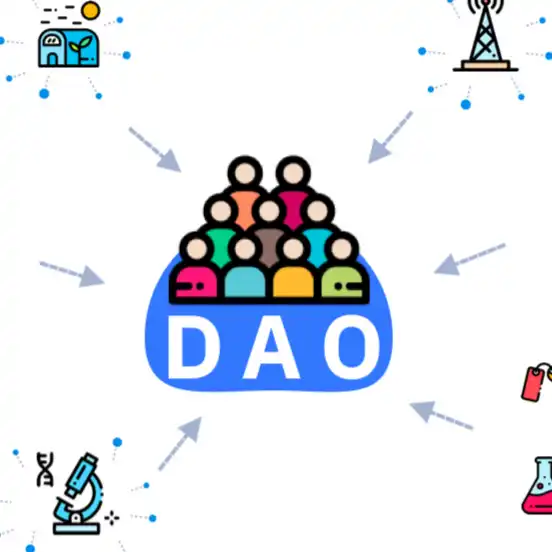
Both descriptions point to a structural difference between DAOs and traditional organizations such as corporations: not human hierarchies, but surrounded by fluid communities Automated software protocol. We'll start with this structural difference before explaining how this different structure enables the leap in scale.
Network structure replaces pyramid structure
DAOs are a true paradigm shift as emerging innovations touch upon the fundamental building blocks of human organization. From hierarchical command and control structures (which are currently adopted to varying degrees in virtually all modern organizations, from states to corporations), to heterogeneous, self-organizing networks.
This paradigm shift can be outlined in terms of two fundamental axes: the structural axis and the quantitative axis.
At the structural level, the network structure will replace the pyramid structure as the dominant form of human organization. On a quantitative level, DAOs can effectively scale human collaboration far beyond what we have seen so far: through smart contracts and an incentive system layer to eliminate transaction costs in the market, larger groups of organizations will be able to The level of trust in the marketplace operates.

This graph (from the classic TIMN report) shows how network organization is structurally different from hierarchical organization. In a hierarchy, information flows upstream and decisions are made top-down. In the network organizational structure, all nodes are making decisions, and information is shared openly.
Why do we need hierarchy in the first place? The answer in classical economic theory is transaction costs.
In 《 In The Nature of the Firm, Coase argues that (hierarchical) firms exist because the transaction costs of direct coordination between economic actors (workers, suppliers, customers, etc.) make such direct interactions impractical.
Hierarchical structure has always been the most popular model. Some companies in the market constrain both parties to build trust through contracts and other methods, which also stems from its Simplicity and the clarity, security and identity it provides.
And smart contract-based agreements are how we can eliminate the transaction costs that previously required layered companies. With smart contracts and an automatically incentivized ownership system, we can now replicate talent, capital, knowledge, resources, etc. with a decentralized and permissionless network structure.
In practice, each DAO typically has a native governance token that functions to make decisions, distribute rewards, and establish other incentives. Typically, only those who hold a minimum required amount of native tokens can participate in community decision-making. Sometimes, certain behaviors also require tokens to be locked and pledged, but such behaviors will be rewarded in the form of tokens.
Towards massive collective intelligence

The promise of DAOs (and cryptoeconomics more generally) is the ability to build collective intelligence at scale, but creating intelligent organizations is not as simple as hiring smart people. Counterintuitively, sometimes the intelligence of the constituent members does not affect the intelligence of the group. More important for collective intelligence is the relationship between members and the extent to which their interactions can effectively represent and "compute" information.
The incentives developed by smart contracts allow individuals to coordinate without a designated leader or any clear control structure, and each participant can to make decisions based on their interests, and the shared protocol links them together to form a swarm intelligence.
If guided by the correct incentive mechanism, the self-decisions of each member can be aggregated into a collective wisdom, which far exceeds that of any hierarchical decision-making mechanism ability. Not only can each participant make a decision, there is fundamentally more information to be processed in the network organization of a DAO.
Hierarchical structure is a kind of linear processing information, making decisions one by one from the top; while network structure is parallel processing information, each node in it can contribute its intelligence.

This table contrasts the traditional hierarchical institutional paradigm with the emerging network of organizational structures. Note: If access and information within an organization is open rather than closed, the entire economic paradigm shifts from competition to cooperation. Since DAOs often cannot hide or legally protect their innovations from being adopted by others, the only way forward is to keep going.
The DAO's winning strategy thus becomes further and faster innovation, rather than building a "defensive moat" around past innovations. This also encourages members in the DAO to continuously collaborate rather than compete with each other.
Governance is a competitive advantage
In addition to the DAO's network architecture, the very nature of blockchain-based applications requires openness: the inner workings of smart contracts need to be inspected by others to Being trusted. As noted above, this shifts the economic paradigm from competition and proprietary information to collaboration with open source software.
In the future, most active DAOs will use the same set of battle-tested off-the-shelf smart contracts without having to rebuild everything themselves. In an open environment, each new innovation can be immediately fed back to the entire market, rather than accumulated as a single project's proprietary advantages, and the quality and speed of decision-making will also be greatly improved.
Typically, a proposal/voting mechanism is used to make decisions, and ownership of governance tokens grants proportional voting rights. However, this is in stark contrast to the current reality of DAOs. Currently, most projects still adopt simple governance mechanisms. Industry leaders like Vitalik have been pushing for more advanced governance for a long time, but so far we have only See earlier experiments.
Three Main Use Cases for DAOs
But it is still far from the desire to change the entire economic structure. So far, we have seen mainly three use cases of DAO: protocol DAO, investment DAOs and the first worker and social DAOs, although they are still limited to the Web3 space, these early use cases will be pointers for future developments.

Protocol DAO
The first use case: protocol DAO, deeply combined with Web3, any blockchain can be described as DAO. The Bitcoin network is the first DAO, which coordinates a large number of participants through its automated software protocol to secure its decentralized ledger.
Since the Bitcoin network was released, there have been many attempts to add a way for stakeholders to change a given protocol beyond just being able to accept preorders Mechanisms, exits, or “forks,” these experiments have been accompanied by years of discussion about off-chain versus on-chain governance.
And over time, well-defined and enforceable governance (“on-chain”) has become more popular: governance such as proposal and voting systems Patterns are currently the most widely used in protocol DAOs.
Protocol DAO remains by far the most prevalent use case, as most Web3 protocols with native tokens and treasuries also have governance mechanisms associated with them, including major DeFi protocols such as Uniswap, Aave, and Compound. Token holders can manage how funds are spent, change any parameters of the protocol, etc.
Furthermore, most protocol DAOs follow a progressive decentralization playbook, where token holders typically have limited control in practice, though in the future In a few years we will gradually see the protocol DAO mature and become truly autonomous.
Invest in DAO
The second use case for DAOs that is clearly emerging is investing in DAOs, which aim to gain most of the benefits of being easy to set up and use, and improving upon traditional funds in Administrative Friction in the Global Investment Environment.
Especially in an international environment, in traditional finance, syndicating investments from different countries is often complex or impossible if the target asset is unconventional (e.g. crypto currency), will be further restricted. Although investment DAOs are not tied to a legal structure, they are still subject to the regulations of the country where the participants live. For these reasons, investing in DAOs is usually limited to a given number of accredited investors (e.g. in the US).
At present, pooling funds and managing shared investments through DAOs is becoming more and more popular, such as MetaCartel is one of the earliest and most active investment DAOs. The trustworthiness of smart contracts that hold pooled funds (such as Gnosis Safe, which has protected billions in treasury assets for years) replaces the need for legal contracts, while token-based voting replaces traditional governance procedures.
Note, however, that some DAOs fall somewhere between protocol DAOs and investment DAOs. An example is OlympusDAO, which holds a diversified treasury for the purpose of backing its decentralized reserve currency. Likewise, the DAO at the heart of the protocol has grown into a large ecosystem, often spawning an investment arm or at least a grants program (such as Unigrants).
Work / Social DAO
In addition to protocol DAOs and investment DAOs, we also see a third use case: work/social DAOs.
The first working DAO, usually similar to traditional cooperatives, pools resources and knowledge to jointly produce products or services of economic value. Examples include Metafactory, a DAO that creates Web3-themed merchandise and apparel; and DeveloperDAO, an early effort by a developer collective.
The boundary between work DAO and social DAO has been blurred. For example, YGG and game guilds have created social communities that combine work and entertainment. Metaverse workers are both You can make a living by participating in Web3 game guilds, and you can also socialize in games.
For example, Friends with Benefits is a social DAO, but it also started to have more and more funding and career opportunities in it, thus blurring the social and Boundaries between jobs.
In addition, we have previously explored in the topic of social tokens, including how to value them and how to describe them from an ecosystem perspective work and play. In the future, we will, for the most part, be playing (to varying degrees) and working at the same time.
Welcome to join the official BlockBeats community:
Telegram Subscription Group: https://t.me/theblockbeats
Telegram Discussion Group: https://t.me/BlockBeats_App
Official Twitter Account: https://twitter.com/BlockBeatsAsia