Notboring: Deconstructing Flow for the mainstream blockchain
Flow: The Normie Blockchain
原文作者:Packy McCormick, A16z 顾问,Not Boring 资本创始人
Flow
My favorite thing to write is that it seems like everyone is on the same page... But it turned out to be totally the wrong thing. And that's what today's article is about.
Flow Chain, the blockchain first developed by Dapper Labs, has been criticized by many in the crypto world as too centralized or corporate. While this is true at first, the subsequent developments and the dynamics behind them are more complex and intriguing. What Dapper is building is a platform that is as centralized as possible, which can support billions of users to create a complex world on the chain, even if realizing this means that the Flow chain needs to make some hard choices in advance.
Like Solana and Braintrust, I think the interest in the Flow chain is broad enough to warrant a long Monday post. The points in this article are true - there is no perfect blockchain; It's all about making the right trade-offs for the target audience and the usage scenario. The future is multi-chained.
Let's start the Flow chain journey.
Physical attributes plus digital power
The crypto world gives digital assets physical attributes and digital power.
Bitcoin is the equivalent of gold, but easier to store and move.
·DeFi is equivalent to the financial system, but it removes the medium and adds programmability and composability.
·NFT is similar to physical objects, but with lower storage costs, programmability and composability.
·DAO is similar to a limited liability company, but more flexible and fast, with ownership and control by stakeholders.
In recent articles, I've explained why encryption amounts to going back to basics. inDAO DAOIn one, I wrote, "I think stakeholder ownership is the natural state of things, but we just don't yet have the technology or models necessary to reconcile such widely distributed governance and ownership." I flattered myself that I had made such a comparison.
It turns out that my understanding is better thanRoham GharegozlouYears too late. In December 2018, this oneDapper Labs"Life is Not Homogeneous: Ownership, Assets, and Our Evolution.
In his lectures, he traces the history of ownership, collections and money to emphasise the place of NFT (non-homogeneous tokens) in the grand narrative of human history. He even used Lego bricks to describe the concept of composability, a metaphor that would not become the default concept until much later. At the end of his speech, he said:
Blockchain is creating a world of digital assets and open source software that is as real and sustainable as the world of objects, interacting like Lego bricks. But don't get me wrong, the barriers to blockchain adoption are still very high. The speed, scalability, user experience, and cost of these tools will all need to change dramatically before mainstream users can even consider using them in their daily lives. But if you look around you, the unthinkable is happening.
For the first time, we have the reason and the ability to dismantle the feudal castles that control our experience on the Internet; For the first time in history, we can walk the path to real digital freedom; Identity, self-expression, and ownership return to their true owner: every ordinary person.
This is a visionary statement. Roham delivered his speech a full two years before 99.99 percent of the population first heard the word "NFT." Since then, many people have used Roham's concepts to explain this new world.
Today, Roham cofounded Dapper Labs and the blockchain it developedThe Flow chainWant to give the entire digital world the physical properties of digital power. Flow describes itself as an "open world blockchain". Lego pieces it can combine include encryption, Defi, NFT and DAO.
Roham and the Flow team understand that the open world, like the physical world, thrives as people from all walks of life, skills and abilities continue to join. Their job is to simplify as much as possible the process of turning ideas into reality and assembling them with other people's ideas. They know that cities and Spaces in the real world are vibrant not because of the space itself, but because of the people who live in it.
Geeks created the Internet, but it was the participation of ordinary users in public Spaces such as chat rooms, Facebook and Twitter that brought it to life. Both are necessary to see a thriving digital ecosystem. But as Roham pointed out in his talk, the barriers to blockchain adoption are still very high. The speed, scalability, user experience, and cost of these tools will all need to change dramatically before mainstream users can even consider using them in their daily lives.
We spend more and more of our time in the digital world, playing online games in 2D worlds like Twitter, or fully immersive video games. We both use and shape the digital world. The question is whether in the digital world we will gain the same attributes and voting rights as in the physical world. The answer is yes, if we can get things right. We'll get the properties of the physical world plus the power of the digital world.
This is why Roham and his team decided to develop Flow chains. It's an open-world blockchain, but more importantly, it's designed for access to millions, if not billions, of mainstream consumers.
Although it seems that Flow chain is the dark horse of the crypto world. But after the hot spring of 2021, Flow usage has declined.
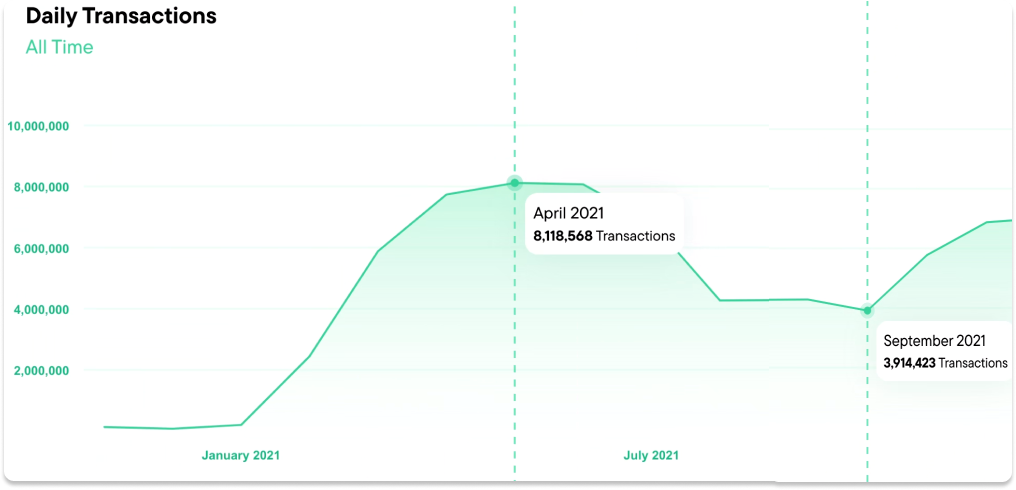
The number of on-chain transactions, which peaked at 8.1 million in April 2021, had halved to 3.9 million by September.
For five months between April and September, the Flow chain didn't generate a lot of discussion in the crypto space on Twitter. When I asked this jihad-provoking question on Twitter, MY intention was to sound out ideas about Flow chains without revealing that I was writing this article...
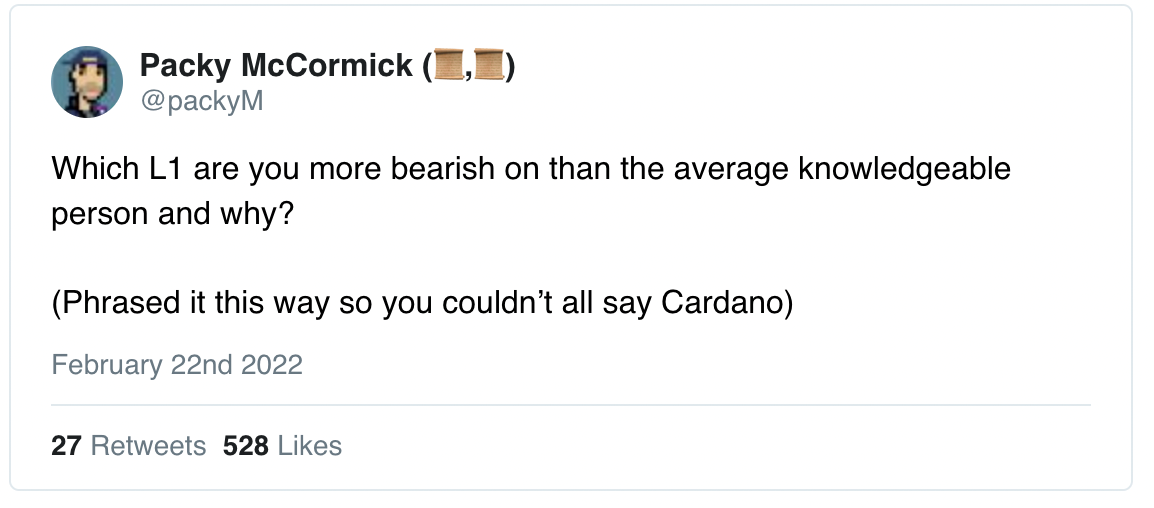
... No one mentioned Flow chains.
I get the feeling that crypto people on Twitter are not taking Flow seriously as a separate blockchain right now, because people's initial experience with the Flow chain seems to be too centralized. The debate under my tweet has shifted to one-tier public chains like Solana, Avalanche, Near, Boca and Celo, and two-tier side chains like Polygon and Fanton, as well as leading zero-knowledge proof blockchains like Starkware and zkSync.
While each of these blockchains is already permissionless -- that is, anyone can write a smart contract and deploy it to the main network without anyone's approval -- Flow is not yet open (though it is expected to do so by summer). It doesn't feel like Web3.
But it would be a mistake to dismiss Roham and Dapper's team for this. They've done as much to bring users (mainstream or speculators) to Web3 as almost anyone except satoshi nakamoto and v-god.
Because when you ask people why they got into crypto in the first place, there are two things that a lot of people say:
1. The encryption cat
2.NBA Top Shot
As far as I can tell, some of the lowest-profile speculators in the circle are either buying jPeGs like the one below (technically, SVG files) :
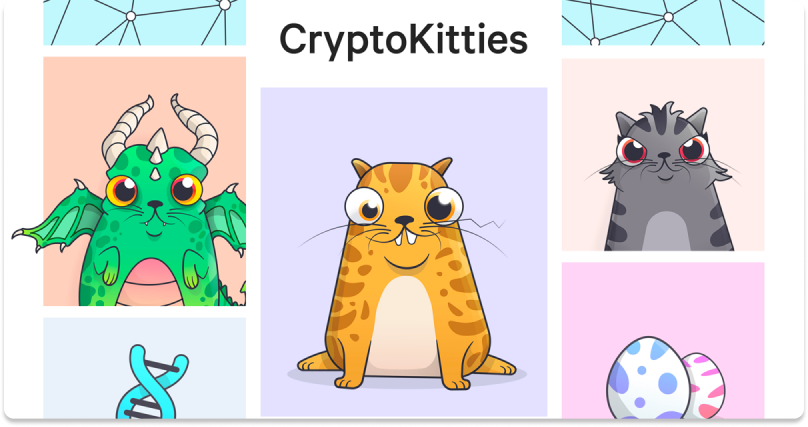
Or waiting in line to buy the picture below... .
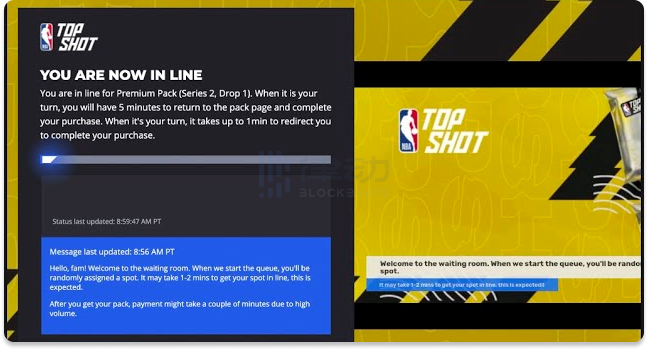
... . Enter your credit card information and store NBA highlights in your hosted wallet.
Crypto cat and NBA Top Shot were also my first stop into Web3. In my first article on Web3,I wrote about these two projects in the Open Meta-universe value blockchain. NFT is the first Web3 usage scenario that I've come to agree with outside of speculation. They represent my aha moment. As more and more things go digital, I realize that there is no question that we need to own our own digital assets.
Thanks to the advent of the ERC-721 token standard, users can own unique digital assets. ETH and BTC are homogeneous tokens: each ETH costs exactly the same, and people don't care which one they own. The homogenized tokens on Ethereum are all based on the same standard: ERC-20. But for something as unique as a crypto cat, the ERC-20 standard is simply not enough. So Axiom Zen, the development team behind Crypto, created a new standard: ERC-721. If ERC-20 stands for digital money, ERC-721 stands for digital things. In fact, the market for digital things is huge.
Here's the crazy part: Crypto, ERC-721, and NBA Top Shot were all built by the same people: Roham and his team.
Dapper Labs' current team is co-led by co-founder and CEO Roham, CTO Dieter Shirley (" Dete ") and CBO Mikhael Naayem (" Mik "), Worked together since the Days of Vancouver-based startup Axiom Zen and developed the Crypto Cat project based on Ethereum while at Axiom. At the same time, Dete co-wroteERC - 721 standard, and put forwardThe term "NFT".
When they realized ethereum couldn't handle the volume of transactions generated by crypto cats, they decided to form a new company, Dapper Labs, and developed their own blockchainThe Flow chainAfter that, he created the first PROJECT NBA Top Shot based on Flow chain to show the potential of this blockchain.
To avoid confusion, the relationship between Flow chain and Dapper Labs is distinguished here. Dapper Labs is the parent company of Flow blockchain and NBA Top Shot, which is a separate entity from Dapper. The relationship between Dapper and Flow is like the relationship between ethereum Foundation and Ethereum, or between Solana Labs and Solana, except Dapper Labs is a for-profit organization that also develops applications based on the Flow chain. Examples include NBA Top Shot, NFL All Day and UFC Strike. In the following sections, we will further discuss how Flow chains are becoming increasingly independent of Dapper, and over time, it will become a completely independent entity.
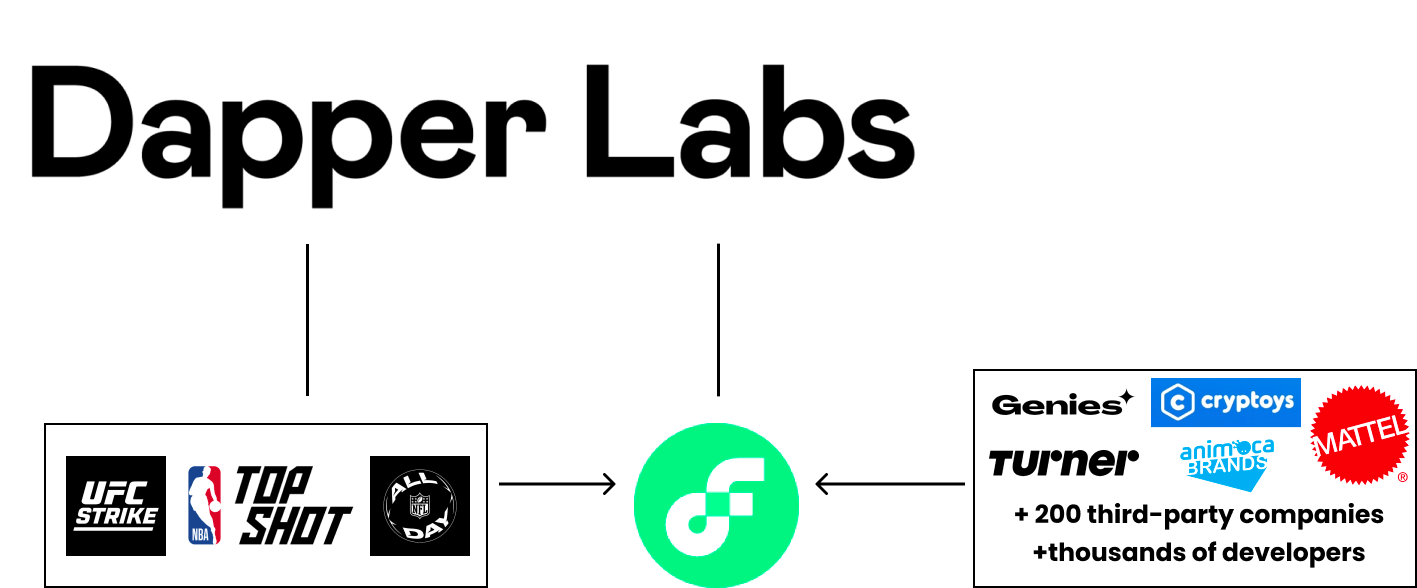
The Crypto-cat's Top Shot Dapper actually creates a great funnel for Web3, but it's not impenetrable.
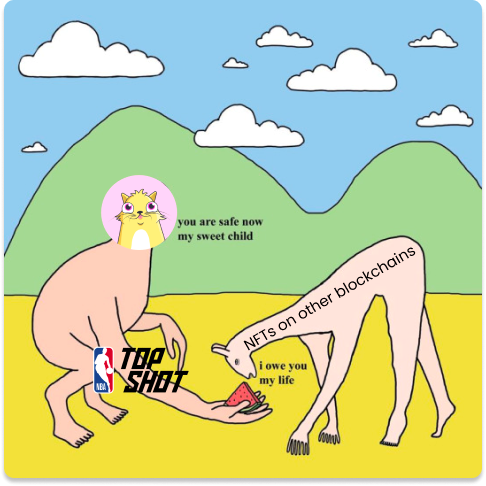
When NBA Top Shot took off in the first half of 2021, millions of people got their first taste of Web3. But when they want to explore further... Only to find that they had no choice. Flow chain is dominated by Top Shot, and third-party developers cannot develop based on Flow without the permission of Dapper team. In other ecosystems, permissionless deployment drives things wild, but Flow does not open this up.
Users either returned to Web2 or were forced to continue exploring Web3 in other, more mature ecosystems, including Ethereum and later Solana.
For the most part, aspiring Web3 entrepreneurs and developers have chosen to explore other chains. For the most hardcore Web3 developers, Flow's ability to pay with credit cards and its early lack of support for a transition to an unmanaged wallet were too centralized.
This is the reason for the downbeat Flow, and it is now widely accepted.
inBecome the owner of the InternetIn this post, I laid out my reasons for being bullish on Ethereum and also wrote against chains that attempt to compete directly with Ethereum. I like a layer of public chains that are differentiated and try to win in certain usage scenarios. Two chains are highlighted: Flow and Solana.

inAn article from Last August", I wrote that Solana is looking at high-frequency DeFi tracks, where it is already the leader.
Flow wants to win by reaching as many ordinary consumers as possible.
This means Flow needs to start by partnering with these international brands that consumers love: NBA, NFL, UFC, La Liga, and Dr. Seuss. This is exactly what most people think of when they think of Flow.
In addition to IP, Flow seems to be tapping into a huge mainstream consumer base through tech giants; Google is an investor, and a leak last month revealed that Instragram is also working on an integration with Flow NFTs. This also represents the emergence of a very interesting developer ecosystem on Flow, with unicorns like PlayCo and Animoca developing games based on Flow, as well as othersGeniesandCryptoysSuch an up-and-comer.

Cryptoys
In addition to today's mainstream consumers, Flow has its sights set on the next generation of users and developers. One of Flow's biggest hidden strengths is that it is trying to attract (and retain) all young users through Genies, Cryptoys, Brud, and more seamless experiences. These young people will become creators, developers and whales. Developing for these people means that Flow can be laid out for the long term.
The time dimension is often overlooked by those who do not have a thorough understanding of Flow. I lost sight of that for a while.
When I first started collecting material, I talked to the Flow team, and at the time I thought the team had decided to completely sacrifice decentralization for scalability and securityBlockchain can't be triangulated-- that blockchain security, decentralization and scalability are not compatible.
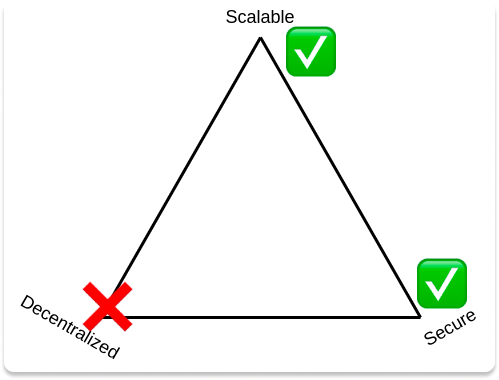
Now I think the team is actually trying to add a fourth dimension: time to solve the impossible triangle without sacrificing a single corner.
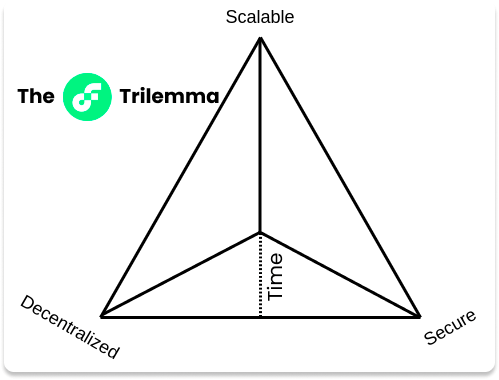
The Flow team is rethinking how to develop a blockchain from scratch that can handle complex DApps to host billions of users. They realized that they might be able to solve the impossible triangulation problem by adding a bunch of complexity up front, which would reduce decentralization in the short term, but would create a product and an ecosystem that could achieve all three in the long term.
In other words, impossible triangulation cannot be solved in a simple way from the beginning, but it can be solved in the long run if time constraints are relaxed and gradual "decentralization" is implemented.
So what is this complexity in particular?
At the bottom, Flow's architecture reimagines everything:
· A new programming language -- Cadence -- allows tokens to have their own resource type, which means developers can better develop and protect users' assets.
· A new multi-node architecture that separates consensus and computation and divides nodes into four types: consensus, validation, execution, and collection.
·Dapper provides a hosted wallet for novices, but experienced users can access or develop their own wallet.
· Due to the wallet secret key cycle, users can choose to switch to an unmanaged wallet at any time without transferring assets.
· More sustainable blockchain, according toA report by Deloitte, casting an NFT on Flow consumes less energy than sending an Instagram tweet.
Flow has been decentralizing in a slow, gradual way. They are in no hurry. They're building for the next billion, the mainstream consumer.
Developing for mainstream consumers means making different short-term trade-offs to pursue long-term goals, which means making Flow the most popular platform for the next generation of developers, allowing them to develop rich, composable experiences. It takes time.
Trading time for space is a risky move that is not guaranteed to bear fruit in the current fast-moving environment. But if the strategy works, Flow could be the first blockchain to have a true network effect, "where everyone is using it."
It's hard to bet against the Flow team. So far, the team has gone through several hype cycles, but they just keep developing and continue to attract millions of users. Now, Dapper Labs has been developing for 4 years, and the main network of Flow chain has been running for nearly 18 months. We may not even have to wait for a long time to see its takeoff. Flow is finding its rhythm.
Remember at the beginning of this article that Flow's on-chain transactions went through a cooling off period? Now it's back. And it's gaining momentum.
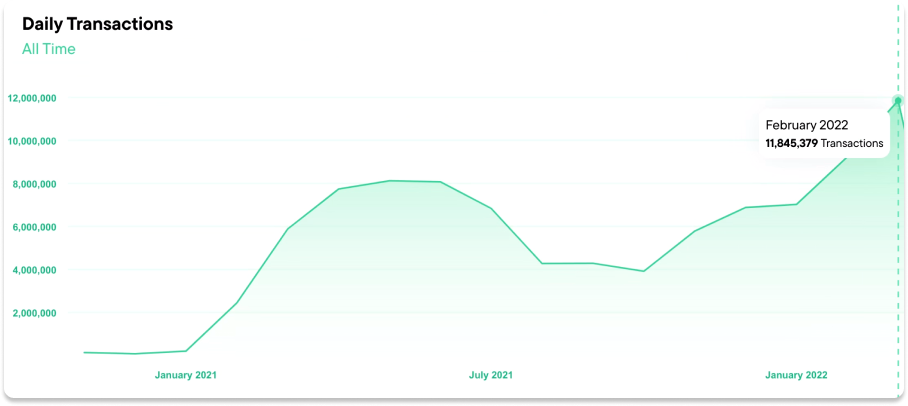
Even in the current NFT bear market, Flow's on-chain activity last month was three times higher than in September. In total, Flow has so far handled more NFT transactions than any other blockchain.
But Flow's ambitions go beyond being an NFT blockchain. It is building an "open world blockchain".
As Flow co-founder and product lead Layne Lafrance explains, "Flow is designed to maintain high performance when people come together, collaborate and build on each other's products. Complex communities need to be able to evolve."
So last October,Dapper bought BrudLed by Trevor McFedries, the team behind virtual icon Lil Miquela. Trevor, himself the founder of the well-known DAO Friends with Benefits(FWB), will be responsible for the layout of Dapper in DAO, called Dapper Collectives, starting with the Brud DAO.
When I asked Trevor when he would be launching the Brud DAO, his answer best represented Dapper's approach to development: "We're getting it out as fast as we can, but the slogan here is the anti-Facebook: Go slow and do it right."
"We may be wrong," Roham admits, "but if we're right, this is how you build a new mainstream consumer product."
There is no guarantee that they will do it right. If you compare Flow's market cap to that of other tiers of public chains, the numbers show that people think they are unlikely to succeed. But the Flow team has been patiently piecing lego pieces together in pursuit of a bigger, longer-term vision, and they know better than anyone how to bring mainstream consumers to Web3. So it's worth finding out what they're doing:
· Blockchain for mainstream users
· Crypto cat take off!
· Post-Crypto cat
, the structure of the Flow
· Acquisition and decentralization of Brud & NBSP;
· Young users and real network effects
· Risks and trade-offs
· Token economics of Flow
·Flow milestones
It's quite a lot, so before we delve further, I'd like to... .
Blockchain for mainstream users
In the process of writing this article, I asked one of my circle friends for their opinions on Flow, and he asked another circle of friends and got the following replies:
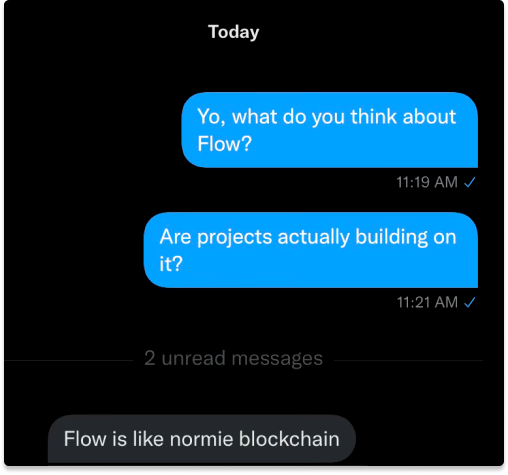
"Flow is like a mainstream blockchain."
In the crypto world, that might sound like an insult, but let's take a quick look at a few numbers.
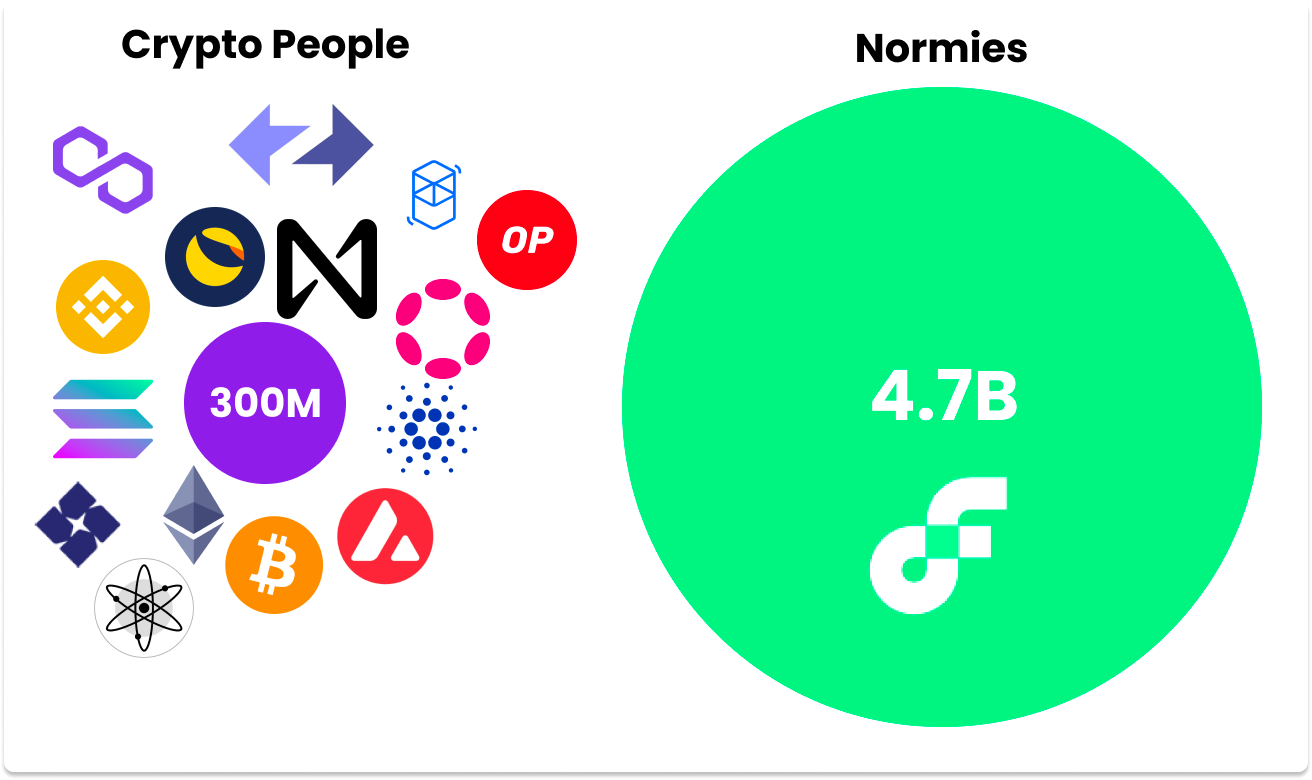
As of Last September, MetaMask had 21 million wallet addresses. Let's make a bold assumption that behind each wallet address is a different real person, which means 21 million people have direct access to Web3. Crypto.com estimates there are about 300 million crypto users worldwide, which includes all bitcoin holders and users of centralized exchanges like Coinbase. So we're going to go with 300 million.
There are about 5 billion Internet users worldwide. For simplicity, let's assume two extremes:
1. None of the 300 million current cryptographic users have ever used Flow.
2. Crypto purists are either already one of the 300 million or too young to participate.
Both assumptions are crude and wrong, but wrong in opposite directions, so should cancel each other out.
So if Flow is the mainstream blockchain, it seems like a pretty good playground, too.
So look to the future as you read this. As Layne described it:
Flow is designed for the future. Digital cities will emerge on the blockchain, and Flow needs to provide the guarantees necessary to build cities -- to keep residents alive, to provide guarantees to developers, to give property rights to owners, and to ensure that no one will destroy them. All cities built today must respect the environment, and Flow is no exception. This is a sustainable way to own digital assets in the long run.
We want this to be a product that crosses generations, designed for a decade of DApps, and incubated for the next decade of DApps.
When you stretch out development timescales to decades, you make different decisions in the short term. In the case of Flow, for example, while the transition to permission-free development seems to some to be endless, a year and a half is a very short time in the larger narrative. Taking the long view is also why Flow has more well-known programs for teens and kids than any other ecosystem, including Cryptoys, Genies, and Brud.
Among my favorite classic tech quotes, from StripePatrick CollisonOnce said:
The concept of using time scales as a competitive advantage is profound, because you're just willing to wait longer than everyone else, and you have an organization that's geared toward that.
After digging deeper into Flow, I saw the same spirit and patience in the team. The Flow team is willing to trade time and short-term user recognition for an opportunity to seek to make things right for billions of mainstream consumers.
The strategy is sound, and the trade-off is valid, but there are still a few issues that remain before Flow can reach a billion users, including the following core issues:
· Does it prove that a large number of mainstream consumers prefer to use consumer-grade blockchain applications when entering Web3, rather than apps that look more Web3 native?
· Can it attract enough users to attract the attention of developers and take the initiative to learn a new programming language incompatible with EVM to build applications on Flow?
· Can developers on Flow build applications that retain users in the Flow ecosystem?
· Can Flow and ecosystem developers provide users with a complete Web3 experience?
Which brings us back to the big bet Flow is making:
Can Flow have it both ways by going the other way - developing for mainstream consumers first, then progressively decentralizing? So you get real network effects, and you solve impossible triangles?
There's no guarantee that Flow will make the transition -- in fact, Flow looks like a cute little guy among blockchains -- but it has a lot of power. In fact, if anyone in the industry has the experience to tap into the next billion consumers, it's the Dapper team.
Crypto cat take off!
Roham GharegozlouGrowing up on the Internet. Born in Iran, his family moved to Dubai when he was six and then to Paris for high school. He found his permanent home online, making websites and running a side business. Such experiences helped him apply to American universities.
He received a B.S. in Economics and a M.S. in biological Sciences from Stanford University. In 2012, three years after graduating, he founded Axiom Zen, "an award-winning studio focused on mainstream applications of new platforms and emerging technologies, including blockchain and artificial intelligence."
Back in 2014, Roham was attracted by the huge potential of blockchain. Axiom Zen won the grand prize at the Money 20/20 hackathon in Las Vegas. Of the three entries submitted by the team, two were Bitcoin apps. OG
In 2021, a Coindesk article named Roham one of the 10 most influential people in cryptography that year,And introduced him in detail"What initially attracted Roham was the opportunity to remove platform risk for developers," the article said. In 2016, he convinced Dete, Axiom Zen's chief software architect, to develop something tangible, interesting and even a little awkward based on Ethereum to showcase this opportunity.
Around the same time, Mik Naayem, a high school friend of Roham's from Paris, had just sold his mobile game as a service startup to Animoca Brands and decided to take a break. While Mik was kite-surfing in Brazil, Roham kept telling him about the blockchain. A few weeks later, Mik finally realized that the technology had the potential to give people ownership, rights and freedom.
After repeated pleas from Roham to "go north" (from Brazil in the southern hemisphere to Canada in the northern), he eventually gave in and left for Canada. Upon arrival, the team was chewing on this sentence:
We believe in a decentralized world, what kind of Bridges do we need to build to get there?
At first they wanted to make a stablecoin, which was USDT at the time.
They then explored building a privacy-protected blockchain with zero-knowledge proof.
But neither achieves the ultimate goal: allowing such new technologies to permeate People's Daily lives.
Finally, "One day after another fruitless brainstorming session, Dete's colleague Mack Flavelle turned to him and said, 'We need to put cats on the blockchain.'"
After figuring out what that meant, the team jumped into development. Fall 2017 is all set. They launched the Crypto Cat at the ETH Waterloo Hackathon.
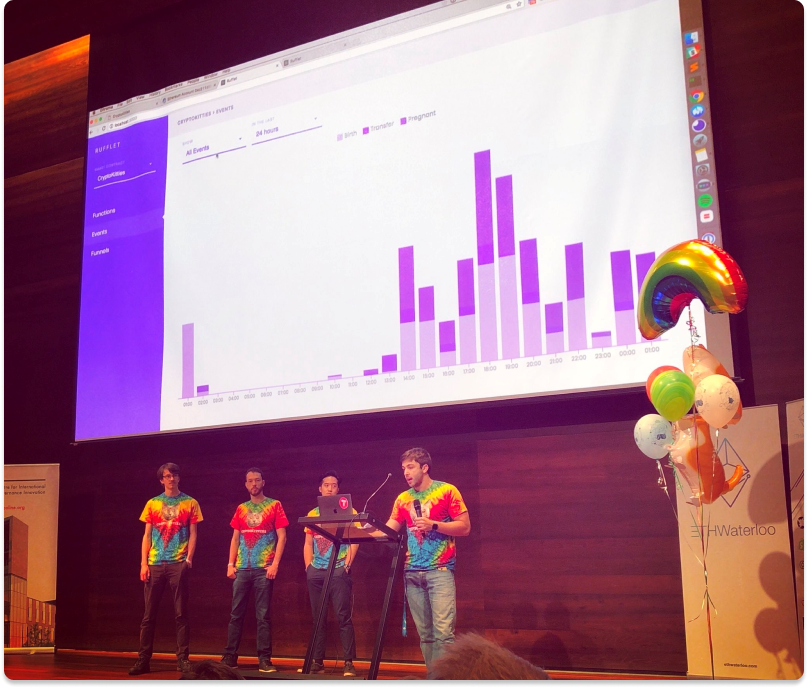
Crypto won, along with seven separate entries, includingAnother Axiom Zen project: Blockchain analysis tool Rufflet. How much is the bonus? $1000 worth of team designated tokens.
But the prize the team really wanted was to bring blockchain into the mainstream world. They are inCrypto Cat Manifesto"List their beliefs.
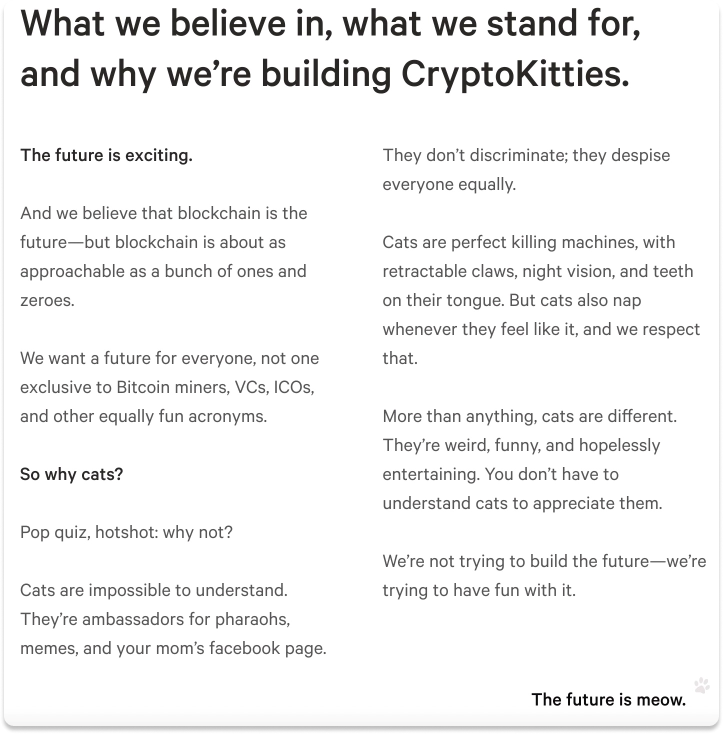
Mik put the logic behind crypto more succinctly: "The idea of getting people to accept a new technology starting with banking is crazy."
In this version, Dapper's strategy is already visible. NFT stands for what people care about and believe in. And the Internet loves cats. They are right.
Consumers love Crypto, and it does give many of them a way to interact with Ethereum. On November 28, 2017, just one month after ETHWaterloo, the launch of the Crypto cat main network caused severe congestion for ethereum, the decentralized Internet. According to theDelphi DigitalAn article from the
Unconfirmed transactions soared from less than 2,000 to more than 11,000, with crypto cat contract addresses accounting for about 12 percent of all transactions across the network during the period.
Crypto cat became too big and too fast for Axiom Zen, so Roham, Dete, Mik, and Mack decided to spin it off. In March 2018, they announced crypto as an independent entity, unveiling a $12 million round led by Chris Dixon of A16Z and Fred Wilson of Union Square Ventures (USV), both early investors in Coinbase.
When USV and A16Z invested, they invested in a digital collectibles company -- not just crypto cats, but not the entire blockchain. But you end up with a chain.
In April 2018, one month after announcing the funding, Roham approached the NBA about working with him, according to Coindesk. But after seeing a few pictures of cats causing massive congestion on the Ethereum network, the team realized it couldn't support demand from the NBA.
So Dete leads the tech team, which includes Crypto Cat's OGKim CopeandLayne LafranceStart looking for other chains. Luckily, it was 2018 and everyone was developing chains. They "read over 100 white papers" and talked to more than 20 teams, but, in Dete's words, "no one was building a chain of high-quality, consumer apps."
Of course, initially they assured Roham that they didn't need to develop a new chain themselves, but eventually they realized that they did need to develop a blockchain of their own.
"We had to develop our own chain," says Dete:
Once we decided to develop our own chain, we got to the bottom of it. What else needs rethinking? So we wrote a new programming language (Cadence) and developed a new interface (FCL) between dApp and wallet to allow users to use mobile, hosted, and browser wallets. We did a lot of design on the protocol layer to lower the learning barrier for users.
The investment required to develop a new chain is huge, but in the crypto frenzy of late 2017 / early 18, it seemed worth it.
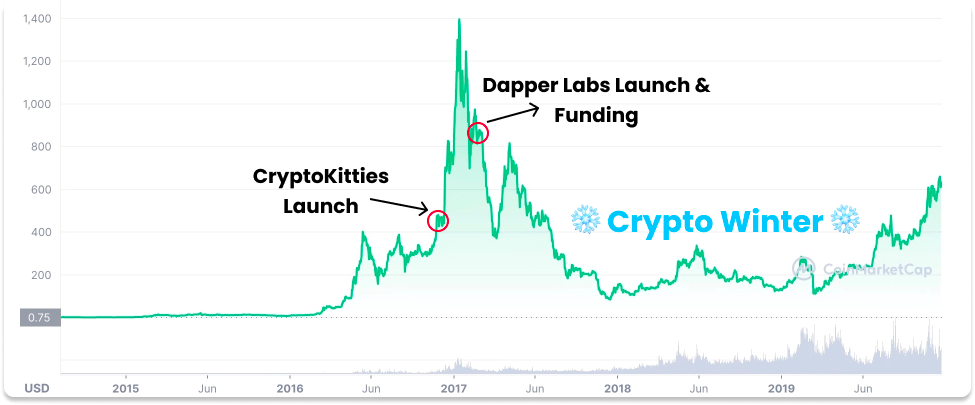
Then things took a turn for the worse. They were unable to recover.
The post-Crypto cat era
One criticism of Dapper Labs and Flow is that, unlike Ethereum or Bitcoin, Dapper is vC-backed. VC got in very early, and the average user didn't get in at that time. Come so, once VC lock storehouse period is over, they can almost do not have this ten thousand profit of let retail investor take dish.
This is true in some cases, but not always. asCobieSays:
Cryptographic VC is also divided into two extremes: one is the co-creator, with cryptographic native long-term thinking. They develop alongside the companies they invest in and keep them alive in bear markets.
As far as Dapper is concerned, VC guaranteed the company's survival in the bear market, and Dapper's subsequent price to the public is the same as that to VC, even though VC entered first.
A16z's Chris was one of Dapper's earliest supporters and has offered his support in every subsequent round, even when things seem a bit crazy. "Please check with your team if you can say that."
"Yes, we can." Mike laughed.
"We were having a really tough time. In the middle of 2018, we were labeled Crypto Cat, a group of people making pictures of cute little cats, and we were going around saying we were going to build a platform. People thought we only had one axe.
Just one month after Dapper Labs officially launched and raised $12 million, the market took a nosediving turn and entered the crypto winter. In October, ethereum's price plummeted 85% from its January peak, and crypto's trading volume was declining, so the team managed to raise $15 million in an A2 round in October 2018. This round was led by Venrock, with Google Ventures, A16Z and USV participating. Ethereum fell another 55% by the end of 2018.
In 2019, things became dramatic. Most of the projects that were born during the ICO frenzy are gone. Competition between the new layer of public chains is fierce, but they are fighting for scraps. Crypto cat usage continues to decline...
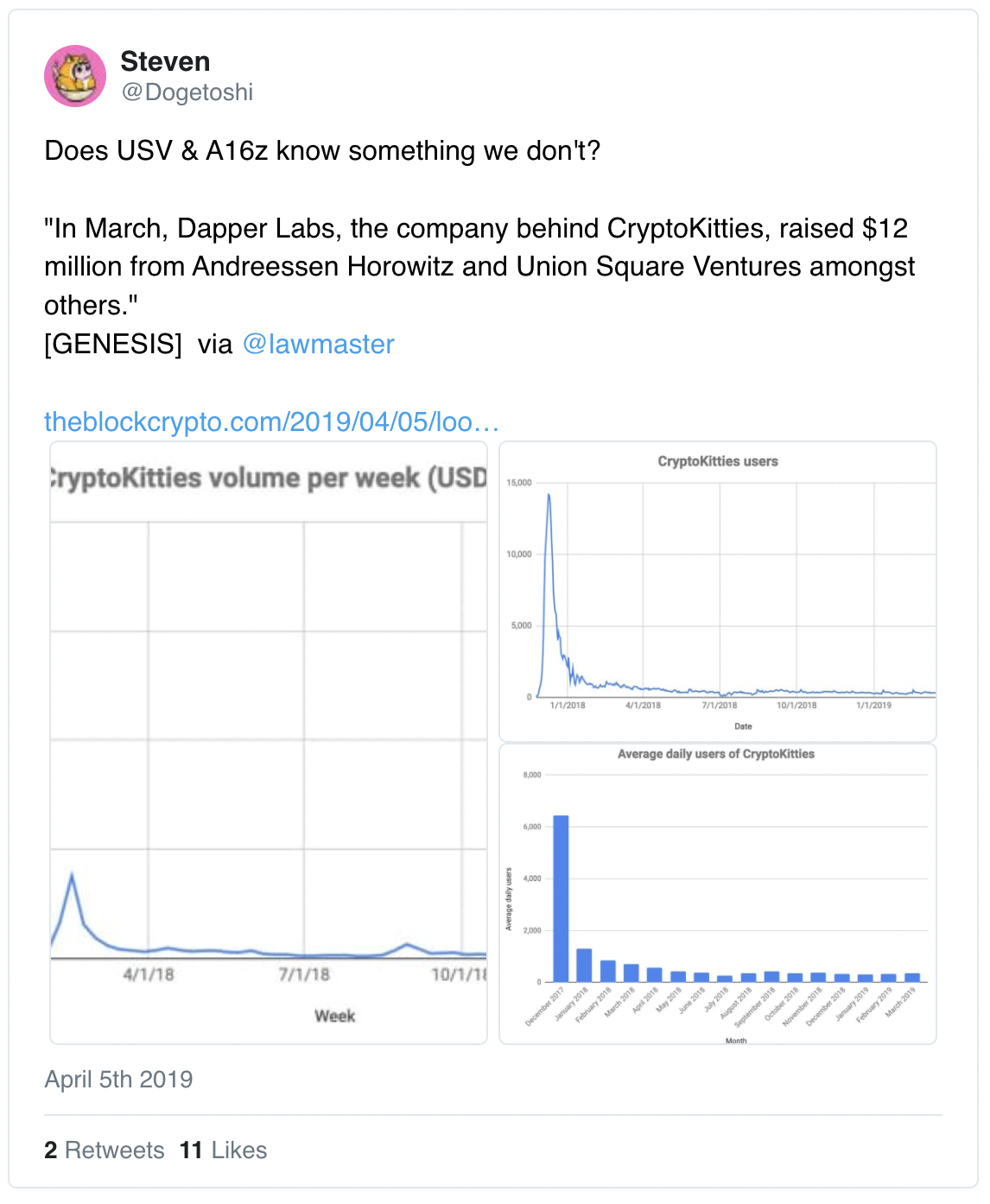
However, in December 2019, Chris Dixon and Fred Wilson arrived to participateThe $11.2 millionConvertible bonds. In announcing the funding, Roham also announced Dapper's own Chain Flow to the world and explained how it differs from other chains.
Bitcoin and Ethereum show how cryptography can make finance more open and transparent; Flow will show the same possibilities to consumers of entertainment culture.
This round was also the first VC investment that could be converted into FLOW tokens later. At that time, THE price of VC entry was $0.1/FLOW, while the current price of FLOW is $5.78. It seems that VC has made a great profit again, but the prospect of FLOW is not clear when VC invests.
Let's stop and take stock. Until then:
· Crypto will soon be 2 years old with low volume;
·Dapper has raised $39 million;
· The Flow chain has been published, but the main network is not online yet;
· There wasn't another popular dApp yet.
Then came the new coronavirus.
VC investment had not yet surged in the early days of the COVID-19 outbreak, which threatened the survival of many start-ups. Companies give up office leases and lay off workers. Inside A16Z, the team analyzed all the projects they invested in, asking "Who still has cash and who doesn't?" The most dangerous is Dapper.
Mik tells me how critical the situation was: "At one point, at the beginning of the pandemic, we only had enough money on our books for six months. But then we raised $10 million."
I asked Chris how he decided to reinvest, and he honestly told me, "There's no way I could have done it if I wasn't the head of the fund. Dapper had raised around $50 million and didn't have a marketable product. If I was just an ordinary employee, there was no way I could have let the project pass."
However, Chris is really in charge of A16Z. Apart from A16Z, USV and Dapper's previous investors, including Venrock, Leave ice, Animoca and Samsung NEXT, have all re-entered. toWhen it is officially announced in August, has risen from $10 million to $12 million and eventually $13.4 million, thanks to the addition of NBA stars Andre Iguodala and Spencer Dinwiddie, as well as Coinbase Ventures and A.Capital. The FLOW price of this round is still $0.1.
"Then," Mik recalls, "things started to take off."
The turning point was the community round of sales. In September, DapperThrough CoinlistSale, unlimited number of participants, each person can buy up to $1,000 worth of FLOW, that is 10,000. FLOW sells for $0.10 each, the same price VC has paid for the past two years. More than 12,500 users from 100 countries invested nearly $9 million, breaking CoinList's record at the time. In the second week, Dapper put out another 25 million flows for auction, and closed the deal at the price of $0.38 /FLOW, raising $9.5 million again.
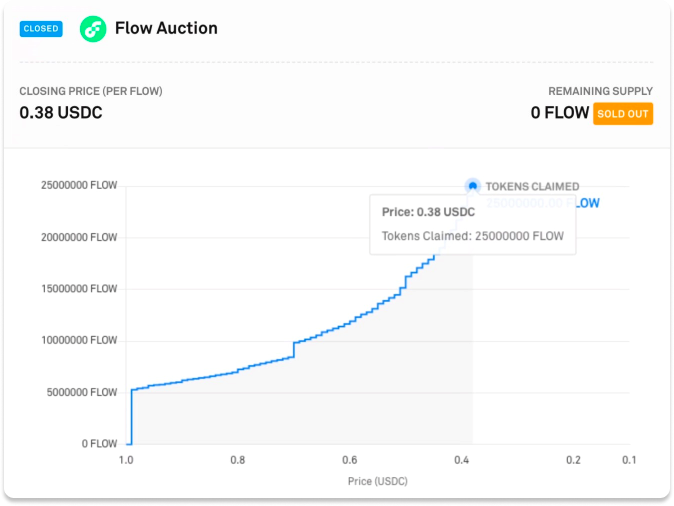
When FLOW tokens were officially issued in October 2020, A16Z was the most held VC among all VCS, accounting for 3.2% of the entire network. Not bad, given the uncertainty, but not particularly surprising...
The NBA Top Shot came online in week 2.
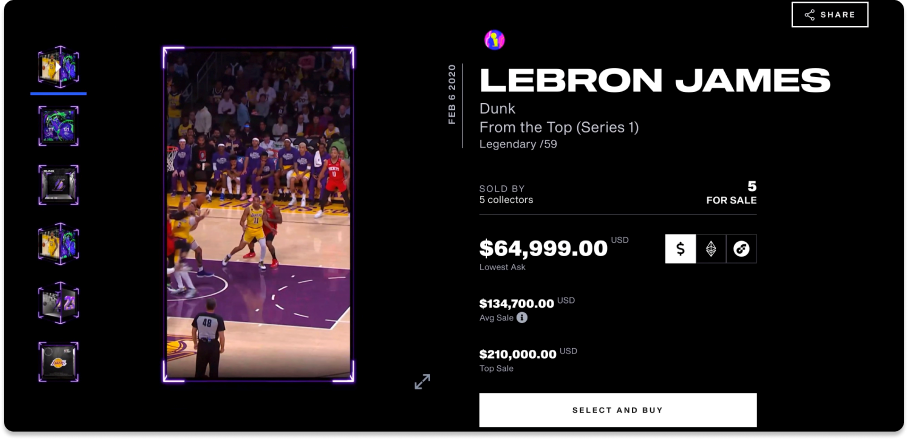
On January 25, Top Shot's trading volume soared so much that I noticed it andHe wrote an article about it. The next day, FLOW launched at $6.87, according to Data from Kraken. CoinMarketCap, a return of 68 times for both institutional and community investors.
After the Top Shot, NFT's popularity soared, with FLOW's price peaking at $39 in March. In late March, Dapper Labs, the parent company of Flow and Top Shot, announced that it had raised another $305 million from Coatue's lead round (which also included A16Z, of course) at a pre-round valuation of $2.3 billion. This round ofInvestors in theIt also included NBA legends Michael Jordan and Kevin Durant, singer Shawn Mendes and a number of NFL stars, which paved the way for Dapper's future collaborations with the LEAGUE.
At the same time, the NBA's Top Shot numbers skyrocketed -- it peaked at $47.9 million on February 21, 2021, peaked at 186, 000 users on May 7 -- and then began to decline.
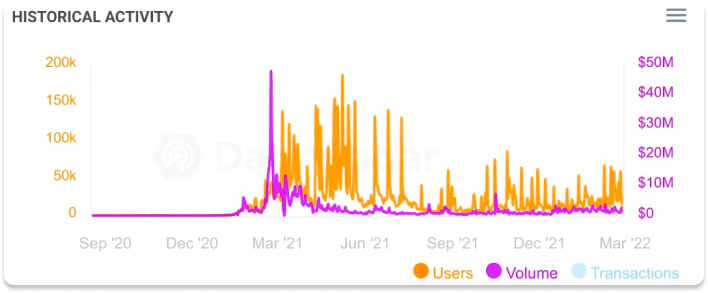
Despite declining usage of its flagship product, Dapper successfully raised another $250 million in September, again led by Coatue at a pre-valuation of $7.4 billion, with a16Z and Bond's Mary Meeker among the investors.
It was a bold bet. As you may remember, the trading volume on Flow hit a low point in September. Dapper's team has proved that it can capture the market demand again and develop a blockchain product that consumers love. However, entering at this valuation means that investors are betting on Dapper's next project. NFL All Day, UFC Strike, and La Liga continue to attract consumers, and more importantly, they're betting that Dapper can use Flow chains to attract developers who want to reach a mainstream audience.
Although Crypto Cat caused the collapse of the Ethereum network, Flow handled the need for Top Shot well, and it was designed for this scenario; To some extent, Top Shot is a very successful test of Flow chain. The development behind it is even more fascinating.
The Flow of architecture
The most important thing to understand about the Flow chain is to understand that it is designed to meet mainstream consumer needs - quickly, cheaply - without sacrificing safety - and in the long term, without sacrificing decentralization. To this end, Flow's architects designed a multi-node architecture that separated consensus from computation.
Despite the high volume of transactions, Top Shot ran on the Flow chain without failure. According to CryptoSlam, the Flow chain processed more than twice as many NFT transactions (17 million) as any other blockchain, most of which came from Top Shot.
But Flow is designed to handle many times that amount of transactions from different DApps -- not just NFT, but DAOs and DeFi as well; Not just by Dapper himself, but by a large number of independent developers. To attract them, Flow needs to channel a lot of consumers and provide a better development experience, starting with its programming language, Cadence.
All the choices the Flow team made increased complexity at the outset in exchange for a better experience in the future. This is why Flow feels more centralized at first, but it is not the final state.
Therefore, this section will dig deeper into flowsAn introduction to requiredThe three main contents of
·Flow chain: multi-node architecture
·Cadence: Developer-first experience
· Consumer: Consumer-friendly entry
Ok, here we go.
Flow chain: Multi-node architecture
Flow is a chain developed for toys, but it is not a toy. When I heard this conversation between Dete and Solana founder Anatoly Yakovenko, IT struck me.
Listen to geek joy! Both participants in this dialogue have been trying to solve the same challenges, and have each come up with a more advanced solution than almost anyone else in the world.
But whereas Solana's marketing strategy involves working with SBF and developing for hardcore traders, Flow's strategy involves cats, dunks, and credit cards, which belies much of the technical wizardry that happens at the protocol layer. We're back to the blockchain impossible triangle.
Each new layer of common chain essentially tries to solve the impossible triangle in a new and better way, either by eliminating the need for trade-offs or by reinforcing the advantages of one corner: scalability, decentralization, and security.
In ethereum founder Vitalik first proposed the impossible triangleThe article", he wrote, "The impossible triangle represents the three desired attributes of blockchain (scalability, security, and decentralization), and you can only have two of them if you stick to 'simple' technology."
The title of this article isWhy is sharding good"The title implicitly suggests that he thinks the solution to impossible triangulation is not simple: sharding.
Like the Solana team, the Flow team saw several problems with sharding, the most important of which was that sharding broke the "ACID" principle and thus broke composability.
Sharding essentially transfers complexity to the developer and user of the application:
In a sharded blockchain, a simple user action (buying a hat for a crypto cat with a stablecoin such as TUSD) requires twelve transactions and seven blocks. In a non-sharded, ACID complete environment like Flow, the same behavior, or even more complex behavior, requires only one atomic transaction within a block.
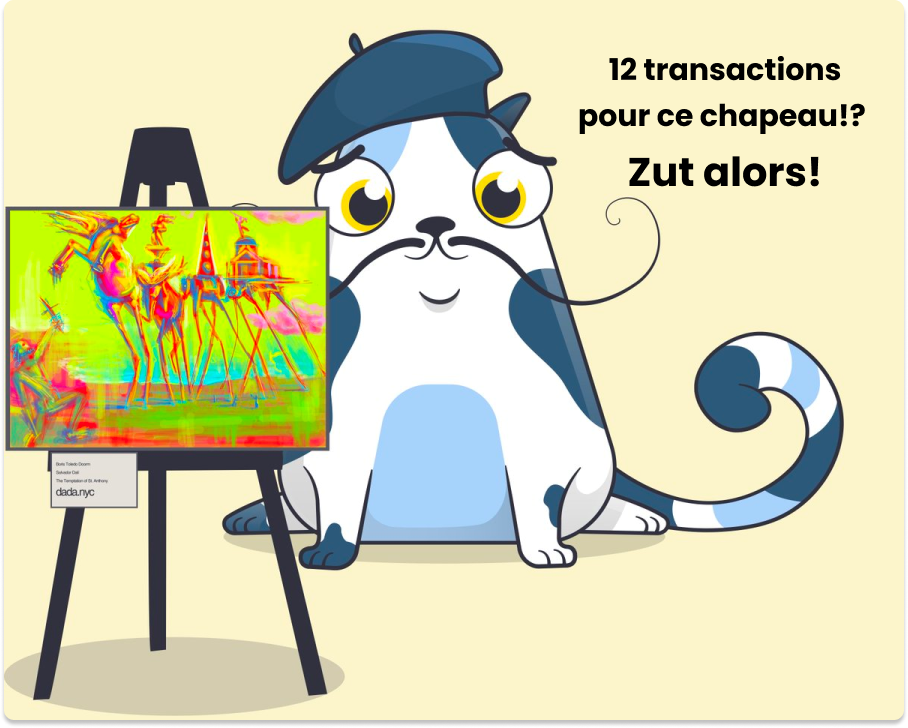
As the first NFT dAPP development team to require composability, the Flow team is uniquely positioned to understand the challenges facing Ethereum from an application developer's perspective. In addition to writing the first NFT standard and crashing the Ethereum network with crypto cats, they also developed the first consumer smart contract wallet on Ethereum, which included many of the features of the Dapper wallet they subsequently deployed directly on the Flow chain.
As Dapper Labs, the team wanted to work with top IPS, such as the NBA and NFL, to build NFT projects and blockchain games, but they knew two things:
If they bring in the huge demand for IP, the ether will collapse again, and neither they nor anyone else will be able to use it;
To attract more developers and creators to NFT and the open world, they need to find a blockchain that is faster, cheaper, and easier to develop consumer applications.
They had no intention of developing their own chain; But in a sea of options, they couldn't find a single chain they wanted. So they decided to develop their own, and Flow was born.
The core insight of the Flow team was the ability to separate computation from consensus.
Simply put, there are two types of blockchain tasks: nondeterministic and deterministic.
Consensus, which is to agree on the order of transactions, is a nondeterministic task and subjective.
Computation, that is, figuring out the outcome of the transaction, is a deterministic task, it's objective.
Computing consumes more computing resources, but faces less security risk; It is easy to prove whether someone is lying about the 2+2 calculation. Consensus consumes less computing power resources, but faces greater security risks. The architects of the Flow chain realized that a more efficient architecture could be achieved by separating the two:
· Computing: fewer but more expensive computers to run compute nodes;
· Consensus: more but cheaper computers to run consensus nodes;
Existing blockchains do not differentiate between tasks assigned to nodes, so both throughput and security are limited. Flow wants to have it both ways.
"As a consensus node," Dixon explained, "you just know that the state change is valid, you don't have to calculate it. It's similar to the concept of ZK Rollups."
Released in September 2019 under the titleFlow chain: Separate consensus and computationIn the technical white paper, Dete, Lafrance and Alexander Hentschel explain the logic of the new architecture.
The purpose of this article is to formalize the separation of consensus and computation and to demonstrate that this approach increases throughput without sacrificing security. Unlike most existing proposals, we achieve scalability by separating concerns, in other words, our solution is to use network resources more efficiently rather than sharding.
In February 2020, the Flow team released its second article entitledTechnical white paper", which explains multi-node architecture in more detail. This white paper includes four types of nodes:
· Consensus nodes determine the order of transactions on the blockchain;
· The verification node is responsible for ensuring that the execution node is not evil;
· The execution node is responsible for executing the calculation of each transaction;
· Collection nodes acknowledge the existence of transactions and provide better network connectivity and data availability for dApps.
Assigning tasks to four types of nodes was, and still is, a key innovation in Flow chains; no other chain uses this architecture.
The following figure shows how four types of nodes work together to pipeline the confirmation of a transaction, with each node having a specific task and passing the result of that task to the next node.
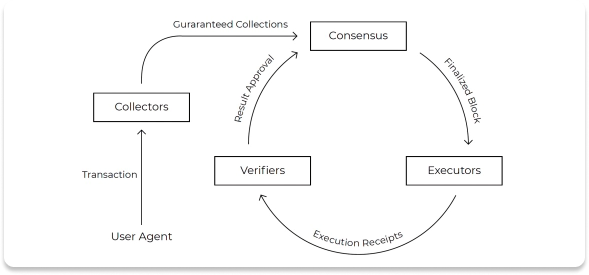
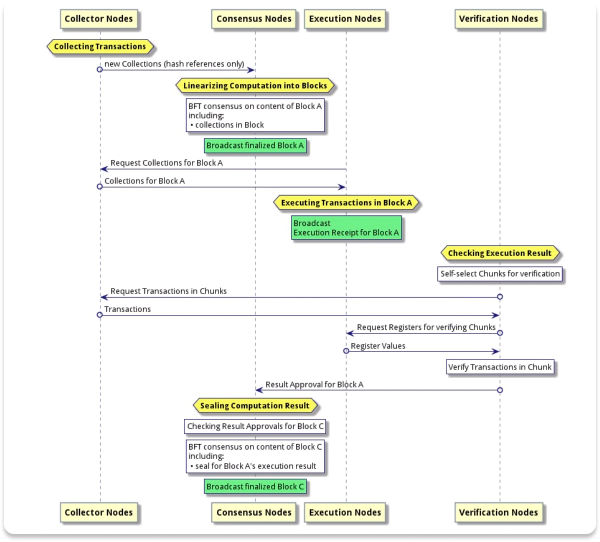
The diagram looks complicated, but it actually represents a series of checks and balances in the network. "As long as a single node is honest, regardless of the class, it can punish dishonest collection or execution nodes and trigger loss recovery due to invalid data." Transactions in Block A are not settled until two blocks later, when all checks are completed.
Here is a visualization of this process:
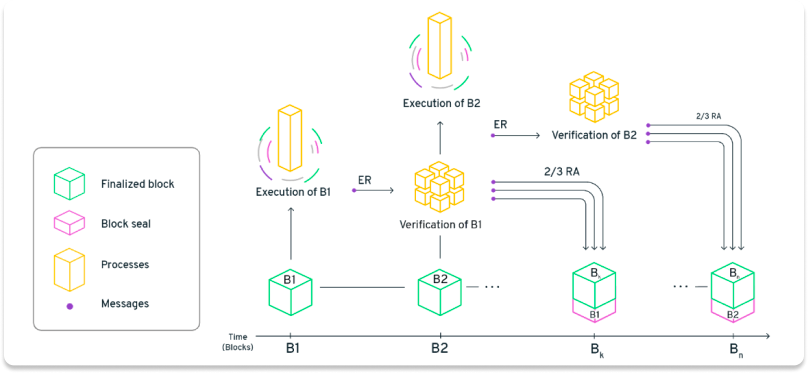
Like in a car factory, the entire assembly line can run quickly and efficiently, but any node can pull the safety cord to prevent a particular transaction from going through.
Despite the vague description of blockchain on Top Shot's interface, its underlying architecture is always Flow chain, and this architecture runs smoothly. In the early stage of the project, many nodes were run by Dapper, but as time goes by, they are constantly decentralized, and now most of the consensus nodes related to security in the Flow network are run by third parties. This number will continue to increase in the future, and the Flow chain will become more and more decentralized. (You can clickFlowscanView the real-time information of all nodes on the network.
"Flow was developed on the principle of maximum decentralization on a large scale," Dete explained. "Anyone with a home computer can participate in consensus or validation."
Currently, Flow chains are secure and extensible. Over time, it will continue to decentralize.

It seems that decentralization requires more than just decentralization of nodes; It also means permission-free deployment for third-party developers.
So while developing the Flow chain, the team decided to create a new programming language,Cadence.
Cadence: Developer first
"As a businessman," Roham recalls, "I was scared when my CTO told me he wanted to develop a new programming language when we were down to a year's worth of money."
Developing an entirely new programming language not only requires resources - something Dapper Labs lacked in its early days - it also means making a huge trade-off: time.
Developers need to learn a new language to develop on Flow, and existing blockchain developers need to rewrite their dapps on Flow.
Both bitcoin and Solana have programming languages that already exist: C++ and Rust. The Ethereum smart Contract language is Solidity, which has become the standard language for most Web3 apps. Many of the Layer 1 and Layer 2 chains are "Ethereum compatible", i.e. their smart contract parts are written in Solidity and therefore can access the Ethereum Virtual machine (EVM).
Having a separate programming language and architecture means Flow chains are not compatible with Ethereum. It forces developers to make choices and learn. It's a risky gamble: third-party ecosystems take longer to develop, even if they work out as expected. Cadence does not have a wealth of open source resources, nor does it have a large number of auditors to audit smart contract code. Cadence is another reason why Flow had to be more centralized in the first place.
Still, Cryptoys CTO Emilio Cueto told me that it's very easy to switch from Solidity to Cadence's learning curve and that from a code perspective the difference isn't that great, but from a developer experience perspective where there are differences, Cadence often wins.
Obie Fernandez, founder and CEO of Let the Music Pay, developed the NFT platform based on Flow chainsRCRDSHPHe's also a Cadence fan:
We tried several blockchain programming languages, and Cadence is arguably the most developer-friendly of them all. We love its familiar syntax and high productivity, especially when compared to Solidity.
The endorsement is very strong. Prior to founding RCRDSHP, Fernandez served as CTO of Andela, a Ruby on Rails development bible.The Rails WayAuthor of the book.
The magic of Cadence is that it is a programming language designed specifically for digital ownership.
According to the Flow chain primer,"CadenceIs the first developer-friendly, resource-oriented programming language for smart contracts."
Unlike in other programming languages, where "programmable money" came later, Cadence actually turns the currency into a data type, meaning that it can operate on the currency just like ordinary numbers or strings. Unlike strings, for example, Cadence doesn't support copying and pasting currency directly, which means it's easier for developers to keep user assets safe.
The idea came at the right time. Facebook's Libra team took a similar approach with Move, a resource-oriented programming language.
Flow chains also provide dApp developers with a series of additional optimization experiences:
Developer-friendly syntax is easy to read and, more importantly, easy to audit.
· Open source SDKS and standard libraries developed by Flow team (e.g. FT and NFT standards, erC-20 and ERC-721 on Flow chain)
· A robust static typing system allows errors to be reported during compilation rather than at runtime.
· Upgradeable smart contracts allow developers to release labeled beta versions to the main network and find and fix bugs before relinquishing control of the contract completely.
·Flow Client library (FCL) simplifies the interaction between dApp and wallet without writing special code on either side.
Moreover, Flow's minimal impact on the environment -- a transaction on Flow consumes less energy than a Google search -- is attractive to developers, users and partners alike.
Cadence and other developer-friendly decisions Flow has made make users safer and the learning curve for new developers flatter, which is a big advantage of Flow. But it also means making a trade-off: complexity versus time.
Initially Dapper only allowed teams that had been audited to deploy projects on the Flow chain. However, all projects audited by well-known audit institutions can be developed on the Flow chain, and the audit costs are borne by Flow. At present, more than 50 teams can deploy freely. Flow is expected to be fully open for permission-free deployment by this summer, a key milestone worth watching.
Because Flow has not been deployed permissionless, many developers are wary of moving into Flow. But Dete also explained the logic behind it: "Because the web is so complex today, we have to protect it."
He pointed out that early projects on Ethereum also had bugs, but since usage was small at the time, it didn't matter. But for any current blockchain, the potential risks have increased. Therefore Flow deliberately chooses not to open in the short term to ensure that everything runs smoothly and opens at the appropriate time.
Flow makes the same trade-off when it comes to consumers.
Consumer: Consumer friendly introduction
Flow starts from the protocol layer to simplify the process of developing products that protect user security and provide convenient experience.
Flow, for example, promotes human-readable security, which means wallet developers can tell consumers in simple language exactly what permissions are granted when signing transactions.

I logged in with my Blocto walletMatrix WorldThe approval page clearly shows my authorization content - "You are signing to approve transaction fees - free (subsidized by Blocto)" - and lets me know that a script is currently running so I can check. The page is clear and easy to understand.
Human-readable security helps avoid attacks like the recent OpenSea hack, which exploited the fact that users didn't really know what was licensed when they approved transactions,Click here to see why. So human-readable security is essential to appeal to mainstream users. If history is any guide, mobile apps didn't really take off until Apple made it safe to download. In the world of Web3, this is even more important because of the amount of money available.
In addition, Flow allows users to apply for a wallet without having to store or memorize a 12 - or 24-word mnemonic, which is equally important for mainstream users to get started. The Flow wallet experience is more like a normal consumer app than other wallets, but allows users to upgrade to a more advanced experience later.
"Top Shot initially integrated a managed wallet into a private interface," Dete explains. "Our new products, such as NFT All Day and UFC Strike, use FCL, which is an open interface. Top Shot now allows you to transfer assets to an unmanaged wallet, but we believe that you don't need to apply for an unmanaged wallet each time to participate."
Instead, Flow wants to give the user choice.
Some users will always want to pay with a credit card and host the NFT or token to the wallet developer.
Other users want to log in, pay for, and store NFT and tokens with an unmanaged wallet, such asBlocto- Currently the most popular third-party unmanaged wallet on Flow.
The Flow team also believes that some users want to start with a managed wallet and a more centralized experience, and gradually move to an unmanaged wallet. Some of them will want to use a cross-chain bridge or wormhole to transfer assets to other chains.
Flow wants to meet the different needs of consumers at each stage and support these scenarios. Ultimately, Flow is gradually decentralizing itself and its users in an incremental way.
Gradual decentralization & NBSP;
So much has been said, so I want to pause for a moment and give you a framework for thinking about Flow.
One of my favorite books on Web3 is Jesse Walden's progressive decentralization: a handbook for cryptographic application development. In the book, he proposes that a successful blockchain application requires three elements:
· Suitable for the market
· Community participation
· Community ownership
The following table provides a quick reference:

Of course, this manual is more applicable to applications, such as decentralized applications (DApps) that have been transformed into DAOs. Blockchain should be more decentralized.
Although I have blurred the technical definition a bit, and Flow is decentralized from every aspect of the table, since it has issued tokens and the network is not controlled by any one entity, Flow shows progressive decentralization at every level:
· Blockchain is gradually decentralized. As more and more ordinary people run consensus nodes through low-resource hardware, the number of consensus nodes controlled by Dapper Labs drops to less than a third.
· Gradual decentralization of development. From the beginning, it was completely developed by Dapper, to open to developers who passed the Flow audit, to only be audited by Flow authorized audit agencies, and finally to complete permission-free deployment this summer.
· Gradually decentralize user experience. Better user experience, users can abandon the managed wallet, choose to use unmanaged wallet.
The decentralization of Flow is fluid and dynamic, rather than static or fixed.
The usage scenario on Flow also reflects this dynamic process.
Dapper Labs builds Flow to serve games, media, entertainment and the open world. NFT is just the first example, and use scenarios require more legos to be put together.
As a result, Flowty, a DeFi (decentralized finance) project, came online in early February. It is a PEER-to-peer NFT lending marketplace that has reached 65 loans totaling more than $300,000. The biggest deal to date involved a $50,000 LeBron James Cosmic Top Shot Moment card. Flowty has also been progressively decentralized: initially it only supported high-value legendary NBA Top Shot assets, but has gradually opened up to more Flow collectibles. Other DeFi projects, including decentralized exchanges, will also gradually come online. Instead of focusing on attracting insiders, these projects focus on building financial architectures that serve NFT, games, and the open world.
DeFi into Web3 may not be suitable for ordinary people, but the Flow ecosystem starts with NFT and gradually shifts to DeFi, allowing ordinary people to enjoy the benefits of the on-chain financial system. One step at a time.
The DAO is also coming online, and is being managed by the Dapper Collectives business unit, starting with the Brud DAO. In October 2021, Dapper acquired Brud, the operating company behind virtual celebrity Lil Miquela. The acquisition not only gave Flow its first DAO, but also gave Dapper access to a Web3-native entrepreneur who was behind one of the most successful Ethereum projects.
Acquire Brud and decentralize it
Dapper's involvement in DAO was caused by the repeated setbacks in Brud's founders' efforts at progressive centralization, which is hardly surprising given that progressive decentralization and complex communities have been throughout Dapper's history.
Brud was founded in 2016 by Trevor McFedries with the aim of creating a new model of digital storytelling based on "community-owned media and the world at large." This is exactly what Flow expects. Brud's flagship virtual idol, Lil Miquela, has more than 10 million followers on social media, and the interaction with her fans helps flesh out her image.

Trevor talked to me and said that Dapper bought Brud because he was trying to turn Brud into a DAO, but the board didn't agree. He has been making the case to the board for years that the company should move to communities, but they are skeptical of cryptocurrencies and have little interest. One of the board members told him that their last investment in tokens had been annulled by the SEC, so they didn't want to repeat that mistake.
But Brud's mission was to build characters, stories, and worlds around communities, and Trevor felt that community ownership was the only model that worked for the company, so he never gave up on his idea. Realizing that persuasion was useless, Trevor decided to let the facts speak for themselves. "One of the goals of launching FWB was to convince boards of the tremendous value of the DAO."
FWB stands for Friends With Benefits, Trevor's culture-focused DAO launched in September 2020. He turned out to be right. A year later, in September 2021, FWB secured a $10 million investment from a16Z. While the Dapper team popularized NFT, Trevor and FWB popularized the non-DEFI DAO.
The success of FWB and the growing popularity of THE DAO eventually convinced the board that decentralization was the right choice. But a number of board members were unable to hold tokens due to fund filing restrictions, so they asked Trevor to approach cryptocurrency investors and buy out their stakes in the company. With the paperwork in place, Trevor started contacting investors, including Roham. Dapper and Roham were both active in web3 investing, but after Trevor and Dapper got involved, he changed his mind:
No one is better at building experiences for the next generation than you are, and we both believe that the future is multi-chained. Why not choose us? You build tools for the Brud community, but on Flow you can build tools for everyone.
The deal wasn't done immediately, as Trevor needed to be convinced that Brud and Dapper were a cultural fit. After several rounds of contact between the teams, Trevor found that the two companies were a good fit for each other. "We are an artistic EmO tribe, and they are a super friendly and intelligent group of Canadians."
In October 2021, Dapper Labs officially acquired Brud and announced the formation of Dapper Collectives, with Trevor as the DIVISION's CEO. Dapper Collectives is "committed to paving the way for the decentralization of social media on Flow and the democratization of online communities of common interest, ensuring that creator communities capture value".
·USV's Fred Wilson describes the initial work to be done by Dapper Collectives in his blog post:
· With Lil Miquela and her 10 million fans as the starting point, the products of Dapper Labs are endowed with two features -- community ownership and joint construction;
· Create and publish open source tools that allow other mainstream communities to access the Flow blockchain for centralized ownership and decentralized governance;
Assist the most visionary Web2 companies to achieve decentralized operations, conduct INTERACTIONS at the CEO and board level, and provide assistance in token economy and technology implementation.
Roham said the DAO is "the most interesting area after NFT" in achieving the goal of "having a cryptocurrency wallet in every pocket" based on "mainstream adoption."
For Trevor, it was also an opportunity to rethink the DAO and the online community:
· What kind of voting mechanism should be created for decision-making?
· How to make everyone a creator?
· What about a friendlier front end for multi-signature wallets?
· How can multiple groups use time and origin information to tell stories together on the chain?
· It should be characteristics, not universals, that drive the meta-universe, right?
On the last question, Trevor explains, "People don't move to New York because of the architecture, although the architecture is beautiful. It's the people: they fall in love, they work, they make money, they enjoy life."
Although "crypto" and "NFT" were terms invented by Dapper's team, Top Shot did not adopt them. Like Top Shot, Dapper Collectives has the opportunity to create a new term for online communities (shared by community members). For example, they didn't use the name Dapper DAO.
Trevor confesses, "The word 'governance' makes me lose my passion for participation. If you were a 13-year-old, would you want to be involved in 'governance'? I don't know..."
Like creating a new blockchain or a new programming language, rethinking early adopters' understanding of the DAO leads to slower adoption and market time, but in return for a better long-term solution.
"Slow forward, steady win the race."
When I asked when Brud would go decentralized, Trevor replied that it is customary for Brud to become the first DAO in Dapper Collectives after decentralization, which is then open to partners and third party groups. This statement also reflects the Flow team's approach.
The Flow team adopted this style of approach because everyone says "we were early" these days, but the Flow team thinks they were early.
Young users and real network effects
To understand why Flow chose its current strategy, consider what Dete had to say about network effects:
Before the iPhone, everyone thought Palm or Blackberry had network effects. You only get real network effects if you do it at scale.
He points out that while everyone is obsessed with ethereum's network effects -- most of the money spent on Web3 goes to Ethereum -- "money has no loyalty. Liquidity is available. Users and developers are sticky."
The Flow team's goal is to become the first blockchain with a billion users. That's enough to create a network effect among one user group: mainstream consumers. In order to achieve this goal, we need to focus on differentiation and clear priorities.
Dete doesn't think Flow will be the next giant DEX (decentralized exchange) chain. Similarly, he doesn't think ethereum should reach a billion users because it's not what ethereum was created for. As mentioned earlier, the Flow team has its own concerns about the impact of sharding on the cooperation and composability needed to build a true networked world.
To reach a billion users, Flow has adopted two strategies, one for the present and one for the future.
Flow is now working with popular IP owners (and developers focused on mainstream platforms), including the NBA, NFL, and La Liga, to bring more people into the Flow ecosystem and web3 space. "It's not about stealing market share," Dete says. "It's about building something that a billion people want to use." It's up to Flow to retain and improve the experience of web3 tools as users reach a billion.
In my opinion, multi-line layout will be Flow's biggest differentiating advantage and secret weapon in the future.
First, Flow created its own blockchain and programming language designed to appeal to Web2 developers who are new to the Web3 space and are still evaluating the strengths and weaknesses of each ecosystem. The Flow team believes that it's difficult to get web3 developers to abandon the programming languages and ecosystems they already use, but the "web2 refugees" are most likely to settle on Flow because they're going to have to learn new programming languages anyway, and building experiences for hundreds or billions of people is what they're good at.
Second, and most importantly, Flow is the only blockchain focused on young users.
One of my favorite strategies is to tap into the synergy of young users, and there aren't many companies that do this.

This strategy focuses on providing the best possible experience for the youngest segment of the target market, getting to know and retaining them as they age, while continuing to focus on serving the new youngest segment. The problem is that in the short term they are not the highest spenders or the most profitable, but if you can keep them for a long time, the future belongs to you.
This is Stripe's strength (founder Patrick Collison developed the "time horizon" concept that helps build a competitive advantage), and the company focuses on startups rather than larger companies and grows with them. This is also Snap's strength. After years of criticism that Snap should simplify its offerings for an older, more affluent demographic, the company has managed to dominate this segment by sticking to building the best experience for its younger users.
This is exactly what Dapper wants Flow to do. Cryptocurrencies are currently focused on Ethereum and the chains that are compatible with the Ethereum virtual Machine (EVM), but it's unclear who will be the next billion-user app.
I was impressed with the idea after talking to Trevor. Miquela, which he created for teenagers, has attracted 10 million followers, a testament to his understanding and dedication to this group. This attitude is reflected in his efforts to create more accessible new vocabulary and Flow tools:
What we're doing is like safer Legos. Ethereum is not that easy to mess up, and if you mess up, you face real financial consequences. If you want to unlock the next billion, you need 13-year-olds to dig into hacking and ecommerce. They can't be stopped from playing because they're afraid or have no money.
The DAO is now being dealt with by young millennials and Gen Z. Younger Generation Z is still sitting on the sidelines, they can't play ethereum, they can't even afford gas on their $20 allowance, so it feels like a blank space.
He wants to broaden the definition of what it means to be a tech entrepreneur: from the traditional 22-year-old Stanford computer science graduate to creators and ardent fans.
We want to give 15-year-olds the tools to say, "How about this?" Wanted to provide tubing up owners with tools to model themselves. To put it bluntly, we want to provide the tools and the design space for people to feel comfortable doing things.
I'm old, and I hate to admit it, but it's true: The next big consumer fad isn't going to come from or be built for my generation. Flow and its ecology are focused on the next generation.
While Trevor and The Dapper Collectives team are busy building tools for young users, third-party entrepreneurs are also building products, experiences, and worlds and integrating them on Web3. The two most frequent third-party Dapps built on Flow are aimed at very young users: Genies and Cryptoys.
These two examples provide a good illustration of the types of projects Flow supports. Here is a brief overview of each:
Genies
My friend's Nemesis called Flow "blockchain mediocrity" and then tweeted: "Checked with the NFT people I know and they say they haven't heard much about Flow in months, but there's a project called Genies building on it and Genies looks good."
Akash Nigam and Evan Rosenbaum founded Genies, an unencrypted avatar company, in 2016 with the mission of "being the digital identity of humanity."

In its first five years, Genies focused on allowing users to create custom avatars and express individuality by dressing them up in a wide variety of clothing and accessories, including a clothing line created in collaboration with Gucci. Users can use their avatars in apps like Instagram, WhatsApp, iMessage and Giphy. Genies has also worked with celebrities like Justin Bieber, Cardi B and Dapper Labs investor Shawn Mendes to create avatars.
Last May, Genies announced the creation of an NFT marketplace on Flow as the popularity of NFT grew, having just raised $65 million in funding from Bond legend Mary Meeker.
I asked Akash how he came up with Flow, and he said it all started with a quote from Roham on Instagram:
The underlying logic of NFT is digital scarcity, a topic I've been discussing for a long time, but I don't know anything about NFT. I was talking about digital scarcity on Instagram Story a few years ago, and Roham came up to me and said, "You're talking about NFT." I was like, "What's that?"
After talking to Roham, Akash realized that NFT was exactly what he had been looking for. "Certifying digital assets was a vision of mine, and I thought it would be 2025, but 2021." He looked around for the best platform to build and chose Flow for the following reasons:
·Flow focuses on young people rather than the existing Web3 community
· It comes from Web2, so it's the easiest base to build on
· Allow users to create NFT and evolve their avatars over time without complex destruction mechanisms
Perhaps most important, the two companies have similar missions. Akash said.
Dropping a $100 million NFT today is no problem, but it doesn't make any sense to move the world forward. What really makes sense is to equip kids with the knowledge and how it works, giving them the tools to build their own decentralized avatar ecosystem. So we're all three, four, five, seven, ten dollars, not thousands.
Genies users are also generally different from Web3 users. Akash told me that 14- to 16-year-old girls make up the majority of Genies users. "They can get a lot out of NFT, but you have to speak a language they understand to make them creators."
Genies also gradually moved from its initial centralization to decentralization. In January, the company announced a further extension of its mission: "To empower people to create their own digital identity ecology." Starting with ownership -- "Effective immediately: Each Creator (both artist and user) now owns their Genie" and extending in the future to include tools and materials for creating virtual worlds and digital experiences, all ownership and all rights of commercialization are vested in the Creator.
The flows Genies needs to realize its vision are all there: scalable, accessible, composable, and decentralized -- to ensure that its creators can't be arbitrarily de-platformized. If you want to create a world, you have to make sure that the foundations you're building don't fade away.
Genies NFT plans to launch in Flow this summer.
Cryptoys
Cryptoys is designed for a younger audience.
The company started out as a digital-first toy company, but with original IP, games, toys, etc., it looked more like NFT's original Nintendo.

In October,A16z led a seed round for Cryptoy's parent company, OnChain Studios, with a total investment of $7.5 million. Dapper Labs contributed.
Cryptoys co-founder and CEO Will Weinraub told me they first started looking at Flow because they thought the NFT bull market was benefiting from Top Shot and Dapper Labs. Although Top Shot doesn't mention NFT, they lower the barrier to entry, and from then on you just have to explore it on your own."
Just as NBA Top Shot did for fans, Cryptoys hopes to provide a similar experience for kids and gamers. "We want parents and grandparents to buy Cryptoys for Christmas, and Flow is the perfect fit from that perspective."
More specifically, Cryptoys chose to build on Flow for several reasons.
First, the impact on the environment is key. Cryptoys wants to work with big brands, which are attracted by Flow's minimal impact on the environment. Gamers are notorious for hating NFT because they are concerned (often due to insufficient information) about its impact on the environment.
Second, co-founder and CTO of CryptoysEmilio CuetoExplains that composability is necessary for Cryptoys. Each Cryptoy has a bunch of attribute layers that represent what that Cryptoy owns. "If you put a hat on a panda," he stressed, "the panda owns the hat. If you sell the panda, you can sell the hat in the same transaction." This doesn't just apply to clothes. Each Cryptoy comes with its own set of skills that can change, evolve, or be learned over time.

The design of composability on Flow makes composability easier to implement on Flow than on other chains. Because Cadence is a resource-oriented programming language, where one resource can own another, it is easy to combine different assets in code. On Ethereum, this can be done by destroying the original panda and the hat, and then regenerating into a panda with a hat, rather than simply putting the hat on the panda's head.
I asked Will and Emilio point-blank if they were worried about betting their company's future on chains other than Ethereum and Solana, but they didn't seem worried. They say it is only a matter of time before the Flow breaks out.
Flow is on the rise, and it already has a lot of users. The reason most people don't see this yet is that projects on Flow are more interactive and naturally take longer to develop.
Again, the old refrain: the higher the upfront complexity, the better the experience and the richer the world will be over time.
Cryptoys wants to make it possible for the youngest users to automatically enter Web3. In fact, most Cryptoys users will probably never call it Web3 (until some of them start writing articles comparing Web4 to Web3); They just expect and build digital projects with ownership, composability and fun.
Collectively, this is what the Flow team wants to achieve: build a more durable platform that provides a better, richer experience for mass consumers. They add complexity beforehand, and then give it to time. There are obvious risks to such an approach.
Risks and trade-offs
I want to make it clear -- both in this article and in the history of Not Boring -- that I believe there is no perfect blockchain, and that no one blockchain can dominate the others. As I've said many times, I'm a minimalist.
I hope you can also clearly understand what I think is the biggest risk of Flow at present. We've been talking about trade-offs in this article.
· Complexity means it takes longer to achieve maximum decentralization
· Developing for mainstream consumers or crypto native users requires different things
After spending a few hours with the Flow team and the participants in the ecology, I believe they are aware of the trade-offs and happy with the status quo. Still, the trade-off is risky.
First, Flow has been quiet in an industry dominated by momentum and narrative. Many of the people I spoke with pointed out that Solana and Flow seemed to be in a tight race for the second public chain early last year, but now Solana has pulled away.
I don't think any developer on Flow would see Solana as a competitor -- they cater to different audiences and do different things -- but there's no doubt that Solana is attracting more attention from the community and attracting more third-party developers. A big risk for Flow is that they can't make it clear to people why they want to do something different. They want to change what "cryptosphere" means, but that means adding another layer of complexity and educational tasks to an already daunting challenge.
Moreover, the perception of Flow, rightly or wrongly, is that it is more centralized and licensing required than other blockchains. We've discussed at length why Flow made these trade-offs, but in order to win over more native crypto industry developers, the team needed to change the label. It's just a matter of riding the wave and sticking to the developer's schedule. In Nike's words: Winning takes care of everything.

Second, Flow needs to solve the funnel problem. After attracting users through a project, it needs more ways to keep people engaged throughout the ecosystem to create true network effects. Of course, this means continuing to evolve the Flow ecosystem, but it also means getting through the different DApps within the ecosystem and aggregating them. This work is often done with tokens.
Flow, for its part, makes it easier for new users to get started by pricing in DOLLARS and allowing users to pay with credit cards. But I think it needs to find a way to increase the use of FLOW tokens in the ecosystem. FLOW tokens derive their value from developers' use and pledge, but they can also be used to connect to this increasingly rich ecosystem of Dapps. Pricing with FLOW means consumers are less likely to sell crypto assets and walk away with their dollars, as they do now.
There seems to be good news on this front:

Finally, Flow has some catching up to do in terms of ecology. I sincerely believe that Flow's architecture and its strategy of incremental decentralization (allowing developers to build complex interactive user experiences) has great advantages, but there is a price to be paid for being more centralized and licensing in the beginning.
On other blockchains, anyone can enter development and deploy to the main network, regardless of whether the end result is good or bad. The "good" part is that 18,146 monthly active developers can enter, develop, or upgrade apps without a lot of work from a centralized team. We may see that happen once Flow is fully permit-free this summer, but it needs to hit that milestone and get developers interested again. Because while time is Flow's big advantage, it's definitely a race against the clock.
Whatever the problem is, with enough money and enough smart people, it will be solved in the long run. Other blockchains have been able to take advantage of this at both the application and layer 2 improvements. Flow is betting that these issues are best addressed at the blockchain level, rather than leaving developers to find workarounds. But given enough time, developers can find clever workarounds. Ethereum and Solana ecology can handle more scenarios every single day, and do it better.
Flow needs to win over the next wave of Web2 developers, which requires changing the narrative to reflect reality and build momentum.
In spite of this, in my head and Flow product Layne, she doesn't agree with me on the definition of ecological, she thought, "a dynamic block chain ecological should allow people to pass the happy time together with friends, and experience their experience less than things in other places. There are developers is just one small part of it."
Even the coolest amusement park would not be fun without visitors. No matter how well designed the product is, there is no user and no place to use it. Flow believes that a consumer-friendly blockchain ecosystem is defined by the unique experiences within it, which ideally should be superimposed.
Unique experiences also drive Flow's tokenomics.
The tokenomics of Flow
Having said that, we haven't talked much about the value of FLOW tokens, because tokens haven't been a big part of the overall narrative until now. The price of the FLOW token has fallen 85% since its spring Top Shot peak.

Price action of FLOW on CMC as of February 5th, 22
But the Flow team doesn't seem to be really worried about this. What people really want, Layne explains, is a currency that has to be used in an indispensable way. As with many other things, the value of FLOW tokens will depend on supply and demand.
Let's start with the supply side.
Flow is a proof-of-stake (PoS) blockchain. In other words, all nodes pledge Flow tokens to participate in the network and are rewarded with Flow tokens (their pledged flows can be confiscated if they do evil). Due to the multi-node architecture of Flow chain, the relative benefits of the four types of nodes will change dynamically to ensure the balance of the number of nodes. According to theWhite paper on the economics of Flow tokens, the target proportion of each type of node is as follows:

The tokenomics of FLOW
According to theFlowscanAt present, a total of 722 million FLOW tokens have been pledged by 391 nodes in the whole network, while the number of consensus nodes with low hardware requirements is slightly higher than the target value, reaching 207, accounting for 52.9% of the total nodes.

Flowscan
Although there are only 207 consensus nodes at present, the architecture of the Flow system ensures that it can support tens of thousands of consensus nodes in the future. At this critical level, Flow can achieve a great degree of decentralization.
The verification node is responsible for maintaining network operation and security, and will be rewarded with FLOW tokens issued by inflation. FLOW's initial issuance of 1.25 billion and an estimated 162 million increase in supply over the first four years, or an inflation rate of 13%, will be used to incentivize the pledge verification nodes.
Ultimately, Flow's tokenomics is pretty straightforward on the supply side. It's a PoS chain with low inflation.
The demand side is more interesting. The need for FLOW tokens is in many ways directly linked to creating products that users need based on FLOW.
The first is transaction fees. Flow charges users or the Dapps they use two things:
1. Transaction fees include the cost of submitting a transaction to the block and packaging it
2. If there is a more complex calculation than the updated balance, there is also a calculation fee
While inflation would increase the token supply, transaction fees would effectively reduce the supply. The network charges a fee as part of the reward payout for each cycle. Charging more means that fewer flows need to be newly minted (which lowers the FLOW inflation rate).
In addition, creating and storing assets also requires a FLOW balance in the account, thus creating a need for FLOW.Account needs to have"Minimum account balance"To pay for storage. The current storage cost is extremely low, only0.04 the FLOW(about $0.2272) /400KB, paid by Flow Treasury. Storage costs rise as users own and store more assets. It's important to note that developers can, and often do, pay for their users. Take the Matrix World I showed you earlier.
从技术层面上而言,这就是当前的 FLOW Token经济学机制:更多优质的产品 - 更多的使用和存储 更高费用和更高余额 对低(无)通胀 FLOW Token更多需求。
The good news is that Dapper Wallet is about to start fully supporting FLOW tokens.
Users will be able to hold, earn, and consume flows. In addition to dollars, people can also purchase NBA Top Shot Highlight moments NFT with FLOW tokens. At a minimum, you can save ~ 5% on credit card fees by using FLOW. It's not hard to imagine Flow offering special rewards and subsidies to users paying with Flow tokens to incentivize them to use them.
As top IPS like NFL and La Liga form partnerships with Flow, Flow brings more people ecologically and motivates them to spend with Flow tokens, which creates more demand for the limited Flow supply.
As more crypto native games and virtual worlds like Cyptoys and Genies bring Flow to a new, younger audience (and their parents' money), this will create more demand for Flow's limited supply.
As more and more people use FLOW tokens to earn, hold, pledge, and trade, it will create more incentives for people to stay in the FLOW ecosystem, helping FLOW attract more developers, new users, and more.
So that's the hard part. Next, let's talk about some of the milestones Flow has achieved.
Flow milestones
Flow has long made a series of obscure bets.
· It has developed a blockchain that aims to sustainably support a complex, evolving world over the long term.
· It designed a new multi-node architecture and developed its own programming language from scratch.
· It focuses on mainstream consumers and children, not crypto users.
· It redefines the concept of decentralization to include accessibility, not just initial node distribution.
As it turns out, while other public chain ecosystems have thrived over the past year, Flow has also experienced a brief explosion of its APP, NBA Top Shot. But the unintended consequence of this differentiation is less relevance to the market.
Over the past few months, as other cryptocurrency markets have continued to fall, activity on Flow has actually picked up.
February was the best month ever for trading. With new projects coming online (NFL All Day, FanCraze, UFC Strike, etc.), transaction volume exceeded its spring 2021 transaction peak by nearly 50%, with two dates each exceeding 1 million transactions:

Flowscan
Last week, Flow ecological NFT marketGaiaReported $6.2 million in transactions, ranking fourth compared to other NFT markets tracked by Dappradar.
Flow is also gaining popularity among unicorns of all kinds,AnimocaandPlayCoAre building games on Flow, a Web3 native decagon companyAlchemyandCircleSupport for Flow is also being developed. Fancraze cricket NFT, with its official licence and strong backing, attracts hundreds of millions of passionate fans of India's popular ICC league.
Flow is continuing to attract more mainstream giants. In December 21, YouTube airdropped flow-based NFTs to top creators on the platform...

. And at the Super Bowl, Ticketmaster airdropped commemorative tickets to all attendees via Flow:

TicketMaster's NFL Super Bowl tickets NFT
Youtube and the Super Bowl are both relatively small ventures, but they represent an opportunity to tap into a huge market of the future through practical use. Imagine if TicketMaster were to distribute tickets as NFT via Flow, or if YouTube were to partner with Flow to allow creators to cast popular videos and sell them to fans, a move that would leverage the economic value of creators and subtly bring more people to Web3.
All this partner-driven activity began to attract dozens of community-building projects, Examples include Matrix World, KLKTN, Flovatar, Chainmonsters, Emerald City, Mantle Finance, Zeedz, Legaci, The Football Club and Ballerz. These projects have grown and evolved independently without much involvement from the Flow team (although Zeedz was founded by a former Dapper Labs team member who left the bottom of the public chain to build an ecosystem, which is a good sign to build an internal empire on Top of Flow). Thus, the ecological network effect of Flow begins to emerge.

Matrix World is building cross-chains based on ethereum and Flow public chains
Flow is at an inflection point right now, and it may just happen this summer:
·Dapper Collectives will release its first DAO tool and begin supporting ecology and community on Flow.
·Genies will go live on Flow and everything they build will be owned by the community. Perhaps one day, the company will also become decentralized in Flow
·Dapper Wallet will be open to all third party developers for integration.
· FLOW will be supported by Dapper Wallet and all Dapper projects as well as many projects that may be developed by third party developers.
·Flow enables permissionless deployment, unleashing a wave of unlimited creativity.
Once the last two visions are completed, Flow will make a qualitative leap towards the goal of full decentralization.
In the long run, however, the most important thing for Flow to meet its architects' own definition of decentralization will be to ensure that hundreds of millions or billions of people -- anyone -- can build, hold, interact, and thrive on Flow.
What would the world look like if it worked?
It's hard to imagine when millions of users and creators program currencies, combine digital assets, and create open worlds and communities based on specific applications. But that's the wild beauty of innovation and composability.
But, just as the Flow team envisions a world in which owning digital assets is as smooth and taken for granted as owning physical assets. In this world, people shape the platforms they use and benefit from collective success. In this world, people have the ability not just to create content or products, but to create economies around them.
If it takes years of concentrated effort to build a richer, decentralized future for billions of users, this is the trade-off the Flow team is willing to make. We can see that such a decentralized future is still a long way off. But if anyone can do it, I'm sure the Flow team is one of them, and they will continue to demonstrate how to bring the world into the future of Web3.
Perhaps the biggest arbitrage in the crypto world is letting go of distractions and sticking to yourself.
The original link
Welcome to join the official BlockBeats community:
Telegram Subscription Group: https://t.me/theblockbeats
Telegram Discussion Group: https://t.me/BlockBeats_App
Official Twitter Account: https://twitter.com/BlockBeatsAsia

 Related Articles