Messari: Entering the Flow Blockchain Universe
Original title: "Entering the Flow Blockchain Universe"
Original source: Messari
Key points of the report:
< p>·Flow blockchain achieved great success in the early days due to NBA Top Shot NFT. Currently, the entire network has more than 3 million active users, including verification and delegation nodes.
· Flow is currently in the leading position in C2C NFT transactions, surpassing Ethereum and Solana.
·Flow recently announcement A USD 725 million ecological fund was established to further support ecological developers and users.
In Q2-Q3 of 2021, the NFT market will see massive capital inflows, It is estimated that the turnover has increased by more than 8000%. Since then, individual investors, independent artists and consumer giants have turned their attention to the NFT market, ushering in the so-called "Renaissance 2.0 ". Platforms that provide NFT minting and trading services accelerate the pace of technological innovation and become a gateway for individual investors to participate in the crypto market and the Web3 world.
Flow is one of the most well-known platforms. Flow is a one-layer (L1) proof-of-stake (PoS) blockchain developed by dapper Labs, which aims to provide a platform for Dapper Labs, independent project parties, developers and artists to create decentralized applications and avoid complex Ethereum Layer 2 (L2) network expansion solution. The Flow blockchain adopts a unique multi-role network architecture design, which is simpler and more efficient than the Ethereum L2 sharding scheme, with improved network speed and throughput.
Brief history
In Q4 of 2019, the Flow blockchain first released the Flow development The preview version allows developers to develop smart contracts without accessing a full instance. Prior to this, it had secured three rounds of private funding, raising more than $30 million from more than 80 VCs including Coinbase, Samsung, and Union Square Ventures (USV).
During this time, Dapper Labs developed the NBA Top Shot - One of the earliest and most well-known sports NFT projects on the market. With the success of NBA Top Shot and the release of Flow Beta mainnet V0.1 in the second quarter of 2020, Flow has risen rapidly in the L1 protocol ecosystem. Since the beta mainnet was launched, Flow has cooperated with world-renowned sports brands such as UFC and NBA, and deployed over 800 smart contracts on the network, with more than 4 million independent accounts.
Flow Blockchain
As mentioned earlier, the Flow Blockchain network runs multiple Node architecture design. In order to avoid the complexity of Ethereum sharding, Flow's multi-node architecture can separate the tasks of verification nodes at different stages of the transaction, so that each type of node can focus on one task to improve the efficiency of each verification step and each transaction . In contrast, in the sharding design, the sharding nodes are responsible for different transactions, but no dedicated verification nodes are set up for each step of a single transaction.
This design encourages nodes to focus on deterministic tasks or non-deterministic tasks. The idea is that the main link that causes network congestion is deterministic tasks, that is, "objective "Tasks, such as computing the results of sequential transactions. Each node is continuously optimized in terms of existing capabilities, thereby improving the throughput of the overall blockchain, and then solving the problems of users and developers in the network.
Flow blockchain tasks are performed by four different types of nodes, each node needs to pledge a certain amount of funds to perform the specified task: < /p>
· Consensus node: Determine whether each transaction exists and its sequence.
· Execution Node: Executes calculations related to each transaction.
· Verification node: Ensure the normal operation of the execution node and maintain network security.
· Collection Nodes: Collect transaction data from user agents, providing better network connectivity and data availability for projects on Flow.
In order to ensure the security of the network, a large number of nodes on the Flow chain are consensus and verification nodes that perform non-deterministic tasks, thereby providing network security guarantees. Execution and collection nodes perform purely deterministic tasks and are therefore less vulnerable to attack. This also means that execution nodes must be run by specific specialized hardware devices.

Source: Flow White Paper
· Consensus node: 500,000 FLOW
· Execution Node: 1,250,000 FLOW
· Verification Node: 135,000 FLOW
·Collection Node: 250,000 FLOW
Flow Chain Data
In the initial stages of the project, Flow launched three large-scale< /a> Token distribution/participation plan to expand the participation of community members and the scalability of the network:
1. Cloudburst partners: by the initial FLOW Token Holders elect, run one or more types of nodes, and distribute rewards to builders on the Flow platform.
2. Floodplain Validators: Ecosystem participants interested in getting involved early and helping Flow expand its content and resources.
3. Decentralized Reputation and Incentive Protocol (DRIP): Aims at distributing FLOW Token to dApp end users on Flow to incentivize users to stake, delegate Or actively participate in the ecosystem.
During this period, as most of the tokens are concentrated in centralized entities, Flow faces the potential risk of security and scalability breaches. The transition to a decentralized network depends on when its Token distribution plan can incentivize developers and users to participate in maintaining the security and scalability of the network. Since then, Flow has successfully decentralized the network through Token distribution. As of now, community nodes have accounted for more than 68% of the network consensus nodes, Flowrecently also considered "controlled by the community".
The latest data shows that there are 305 nodes in the whole network:
· Executing nodes: 7
Consensus nodes: 115
Collection nodes: 106
· Verifiers: 77
In addition, there are more than 31,000 users who have contributed to the Flow network through delegation made a contribution. Specifically, entrustment refers to the holder of FLOWToken pledges FLOW by entrusting the Token to the node operator. At present, the entire network has pledged more than 730 million FLOW (accounting for about 52% of the total supply), and the pledge reward exceeds 100 million FLOW (accounting for more than 7% of the total token supply).

Technical features :
Cadence
With most new Like the current L1 protocol, Flow has its own programming language, Cadence, for smart contract development. Cadence provides a higher level of decentralization when it comes to storing data such as digital assets. Unlike Solidity, which stores information on a central ledger, Cadence stores data directly in users' accounts. With no centralized data storage, Cadence can provide higher security for Flow's network architecture. It also provides an easier way for developers and users to create and transfer digital assets on the Flow chain.
SPoCK
Furthermore, Flow integrates developed an innovative cryptographic technique called Professional Proof of Confidential Knowledge (SPoCK) to address Verifier's Dilemma. SPoCK is characterized by cryptographic commitments. They certify that validators have performed their work correctly and will not blindly approve the results they generate without properly verifying that their tasks have been completed correctly. SPoCKs also constrains execution nodes by ensuring that each execution node correctly computes each block.
Flow Client Library (FCL)
Almost all L1 protocols allow interaction between crypto wallets (e.g. Metamask), decentralized applications (dApps) and blockchains. Traditionally, dApps access crypto wallets through browser plugins or browser wallets. These methods, while adopted by many blockchains, hinder user entry. They are difficult to scale and require additional development for wallet and dApp interaction. In contrast, FCL allows developers to connect to wallets or dApps with just a few lines of code. It also allows any dApp to interact with any FCL compatible wallet and vice versa. For developers, this provides a seamless development experience for building dApps on Flow, and enables consistent interactions between applications and various wallets.
FLOW Token
FLOW Token is the foundation of the Flow blockchain, which allows developers Interact with users on the Flow chain. Holders can pledge FLOW Token, participate in maintaining network security, and contribute to the execution of computing and storage tasks across the network. FLOW Token is also used to pay rewards to stakers and as a gas/transaction fee for on-chain activities.
FLOW Allocation
During the initial issuance of FLOW Token, a total of 1.25 billion were minted FLOW and distributed to the following holders:
· Dapper Labs: 20%, allocated to the long-term treasury.
Development team: 18%, release in three years, one year cliff.
· Ecosystem development: 29%, locked in the first year, and the unlocking time is not earlier than the first unlocking time of early supporters and teams.
· Community sale: 13%, locked for 12 months[Office1].
· Large supporters (contributed more than $1 million): 11.1%, 24-month lock-up period, one-year cliff.
· Small supporters (contributions less than $1 million): 8.9%, 24-month lock-up period, one-year cliff.

Source: Flow official website
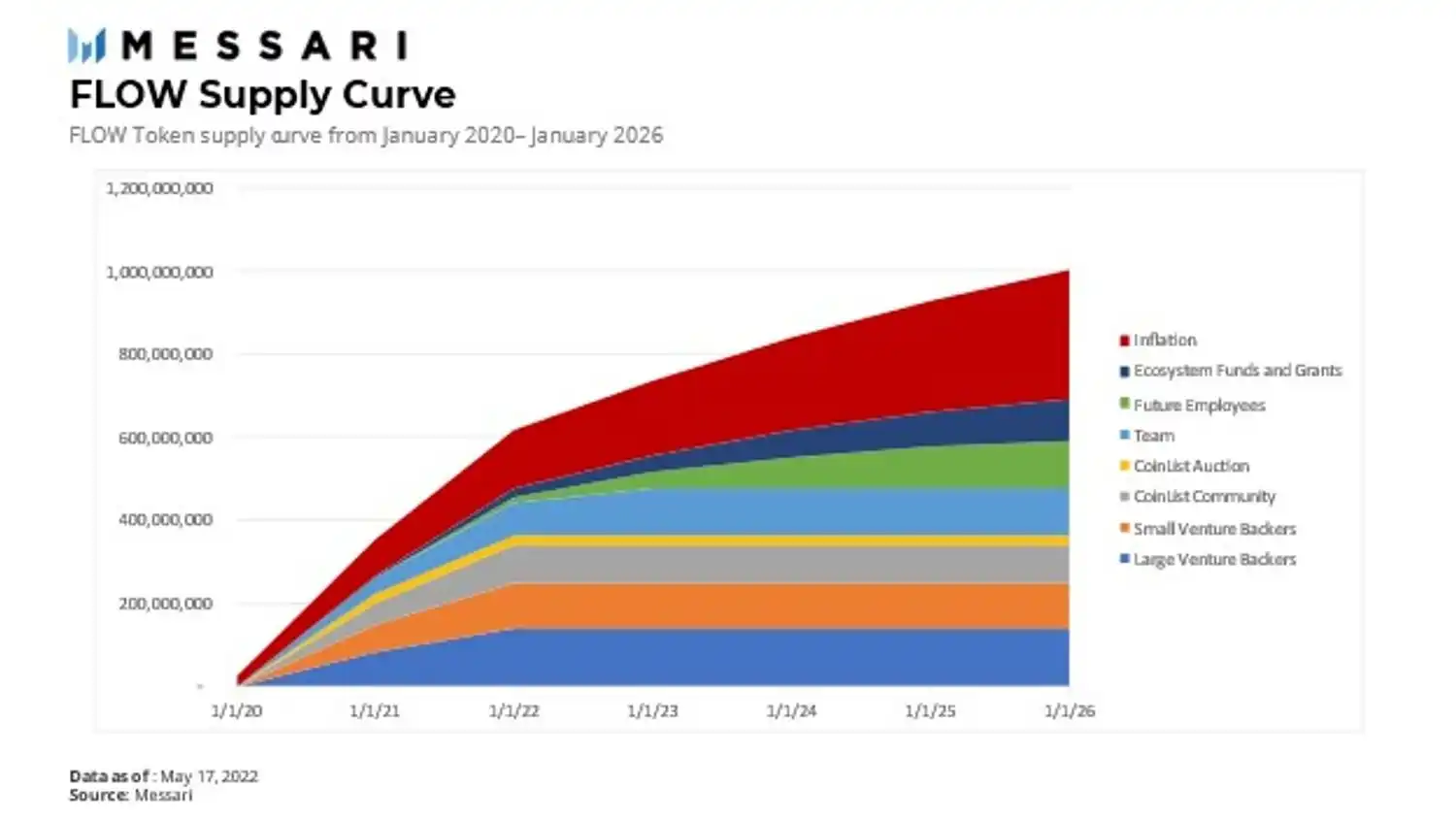
It should be noted that during the lock-up period, FLOW Token can only be used for pledge or in NBA Top Shot from the very beginning. For all parties mentioned above, the lock-up and transfer restrictions are strictly following the timetable.
Flow has not set up its own treasury; however, the Flow Foundation will participate in the management and reserve 250 million FLOW Tokens for long-term distribution and ecological development in advance .
Governance
The on-chain governance of FLOW stakeholders includes three types of decision-making processes :
1. Ecological decision-making: Including issues related to electing council members and determining the distribution of foundation funds.
2. Protocol parameters: matters involving network parameters and not requiring protocol upgrades.
3. Protocol Upgrade: All matters involved during the network hard fork require significant participation from all FLOW stakeholders and support.
These features are planned to be available to the public in the second quarter of 2022. Currently, most decisions in the Flow ecosystem are It is made off-chain, including submitting the proposal to the Flow GitHub repository, discussing the proposal in the community, and making a decision based on the community consensus, whether to implement the changes involved in the proposal. After the community has reached a consensus, changes need to be implemented through authorization for deployment to relevant nodes.
Ecosystem overview
Compared with other blockchains, the Flow mainnet launched The relatively short amount of time, and considering that, the on-chain transaction volume is impressive.

Just total In terms of transaction volume and active wallets, Flow currently has over 3 million active users, including delegators and validators. Due to the short time the protocol has been online, Flow still has a long way to go to catch up with "ancient" L1 ecosystems such as Ethereum. However, Flow has made significant strides in accelerating user activity, providing new developers provides sufficient support to attract dApps in various tracks, such as DeFi and Web3 projects. As more and more projects are built on Flow, the gap between it and other chains in terms of network traffic and ecological participation is also shrinking.
As mentioned, there are currently more than 800 smart contracts deployed on Flow, and it is especially known for attracting NFT projects. The volume of NFT secondary market transactions on the Flow chain is in stark contrast to other L1 chains (and the L2 chain on Ethereum). Flow seems to be the leader in C2C transactions of NFT. In addition, as users of native projects continue to participation, and a large number of new projects emerging, Flow continues to make strides in the NFT space.

As far as the secondary market trading volume ranking is concerned, based on Flow Chain's NBA Top Shot is still a strong contender for new NFT projects and existing well-known projects.

At After the Q1 2021 testnet, the number of new developers entering Flow has increased significantly. Cooperation with well-known brands such as Samsung, Ubisoft, and Warner Music Group gives Flow a unique advantage, allowing it to continue to attract mainstream users, not only entering the NFT market, but also further exploring richer encryption projects. On the other hand, the mainstreaming of Flow-based DeFi and Web3 projects can also increase the awareness and participation of users and large institutions in Flow.
Dapper Labs continues to invest in projects built on Flow and partner with top VCs like a16z, Animoca Brands, and more. In addition, the Dapper Labs team provides extensive resources and investor relations for ecological projects to help project financing.
L1 Chain Competition and Risk
Competition
The development of the L1 chain has always been at the forefront of the encryption field, and the evolution rate is constantly accelerating, and various technologies are proposed to improve the throughput, security and speed of the blockchain.

Flow's efforts to compete with other chains cannot be ignored, especially It is in the NFT and Web3 game track. Thanks to the performance of the Flow chain itself, coupled with high-quality partners, Flow's performance in 2021 is significantly better than other L1 chains.

In addition, the developer activity on the Flow chain last year< a href="https://medium.com/electric-capital/electric-capital-developer-report-2021-f37874efea6d" target="_blank" rel="noopener noreferrer">significant increase.

Source: Electric Capital
The above data is compiled from open source repositories and code submissions on multiple platforms, including GitHub, Gitlab, CoinGecko, and DappRadar. In 2021, among public chains with more than 50 developers, Flow's growth rate will rank ninth, and if only full-time developers are considered, Flow's ecological growth rate will rank fifth.
Potential risks
The graph above shows how market participation has shaped over the past year , especially for new blockchains that provide innovative solutions for users and developers. However, all L1 chains face the problem of achieving a balance between scalability, security, and decentralization. In general, an L1 network consisting of a single node type can present a difficult trade-off between scalability, security, and decentralization.
Flow's multi-node architecture helps to achieve this balance. The division of labor of nodes allows each type of node to give priority to certain aspects of scalability, security and decentralization. For now, consensus, validation, and collection nodes are more decentralized than execution nodes. Because execution nodes are responsible for performing deterministic tasks, they do not require the same degree of decentralization. On the other hand, execution nodes require specialized hardware devices to run, so they are more conducive to scalability.
Due to the complexity of executing nodes, network performance and availability issues may arise. While the failure of these nodes does not threaten network security, failure of all eight execution nodes could halt transaction processing. For example, in a recent network upgrade, FlowExperienced a network outage. Specifically, the execution nodes are responsible for deterministic tasks, but the newly implemented identifiers are non-deterministic, which leads to block generation failures, and nodes require additional memory to maintain network operation. The design of the Flow blockchain is to give priority to security when liveness and security conflict, so the network is suspended at that time to avoid packing wrong blocks.
However, the incident response team made responsive and clarified what happened during periods of network instability. The team is also taking steps to avoid similar incidents in the future.
Future Direction
Flow has not yet provided a clear roadmap. However, according to Dapper Labs' core vision, the Flow chain can host large-scale, high-detail encrypted games. Dapper Labs is currently bringing in other projects and mainstream consumer brands to gradually realize this vision, and also plans to migrate existing projects such as CryptoKitties to the Flow chain.

Source: Dapper Labs
< br>
With the development of NFT on the platform, the activity of developers has also increased. Flow is introducing more encrypted track projects, including IncrementFi - a decentralized market and liquidity engine aimed at building the first batch of DeFi protocols on the Flow chain.
Thanks to the influx of mainstream partners, high-quality on-chain projects and the performance of the blockchain itself, Flow has laid an important foundation in the encryption industry status. According to Dapper Labs’ project team data, the Flow testnet has over 6,000 developers actively building and learning how to deploy smart contracts using Cadence. NFTs and crypto games have seen widespread adoption among mainstream investors, and Flow continues to empower artists and developers to innovate in the space. Flow recently announces an eco-fund dedicated to supporting developers and user. The fund raised a total of $725 million to support and accelerate the development of Flow-based dApps.
Furthermore, with the diversification of native encryption protocols and Web3 applications on Flow, it is foreseeable that it will attract more attention and adoption from developers. While Flow still faces a tough competitive environment before it becomes the most efficient and most-used L1 blockchain, it is poised to grow into a serious challenger.
This article is from a contribution and does not represent the opinion of Rhythm BlockBeats
Welcome to join the official BlockBeats community:
Telegram Subscription Group: https://t.me/theblockbeats
Telegram Discussion Group: https://t.me/BlockBeats_App
Official Twitter Account: https://twitter.com/BlockBeatsAsia

 Related Articles