From the Devcon hackathon, look at the mainstream narrative of Ethereum in the next stage
Original title: "Long text with ten thousand characters sees the dawn of the bull market: building the application layer to become the mainstream narrative of Ethereum in the next stage"
Original source: R3PO official account
Preface
Ethereum has entered the post-merger era, PoS has successfully replaced PoW, and improving the scalability of the network has become the next focus . Bulider can finally build Web3 applications for billions of consumers on Ethereum. L2, ZK and other technologies will further reduce the cost of use, and DApp may gradually replace various applications of the current giants.
ETHBogota Hackathon has selected 12 projects, R3PO believes that this represents the Ethereum The direction of ecological development, the dawn of the future has appeared.
Not only the entry into force of EIP-4844 has brought strong impetus to this, but also the promotion of layer2 projects such as Arbitrum, Optimism, zksync, StarkNet, Polygon, including DApp, DeFi, NFT, Various categories such as infrastructure, social network, etc.

Keyword cloud map of 12 winning projects
Competing for incremental users has become the consensus of all
In the last round of bull market, all kinds of protocols have been full, but Web3 applications are still in the development stage, and in this round of projects, Bulider has paid more attention to how the public uses and participates The problem.
For example, Bet Streams, a paid live broadcast platform, uses livepeer as a live streaming solution, and UMA as a prediction This is a relatively complete web3 development kit usage scenario, rather than the previous pseudo-web3 experience of storing addresses on the NFT chain and storing pictures off the chain.
For example, diZKreet, a combination project of ZK technology and NFT, marks that ZK technology will be more versatile , is expected to open up more usage scenarios in the next bull market.
From the perspective of investment and project discovery, this hackathon has inspired us It’s more than that, similar to how DeFi will develop in the future, unsecured + DID + L2 can stack projects such as PULP, R3PO believes that the next stage of technology and application stacking will be more basic, more likely to be a mutual basis , beyond the simple combination of DeFi, the super high rate of return of the next stage is also hidden in it.
The following is a detailed introduction of the selected projects :
1, Frens
Official Link: https://ethglobal.com/showcase/frens-5qq7h
Project Description
Frens is a DApp used to pledge ETH with friends. With the trust between friends as the basis, the security of the Ethereum network will be improved.
Currently, staking Ethereum is difficult, expensive and risky, and the risk of centralization is also greatly increased.
Specifically, to run an Ethereum validator, It requires a lot of technical knowledge and infrastructure, and the threshold is high. 32 ETH is also a lot of money for a single staker, especially with the risk of loss if validators are misconfigured. As a result, most people currently choose to stake through centralized, non-custodial staking services such as Coinbase or Kraken. This centralization is a risk for Ethereum itself.
Frens wants staking to be fault-tolerant, rewarding, and It's social and fun. Users can stake in the staking pool with friends in Frens in a convenient and fault-tolerant manner. It is built on:
Deposit Smart Contract Factory;
SSV's DVT technology for fault-tolerant staking;
Smooth UI for smooth start and Automation;
Assumption of trust between (non-technical) friends and professional pool operators.
How it works

Frens trip from pool The operator starts. A pool operator is someone who understands Ethereum staking, has a good reputation, and is willing to help out friends. Ta creates a "staking pool" smart contract with a one-click button on the Frens website. The site generates links for him to a simple UI so his friends can deposit the necessary ETH to get a full validator. Only friends with this link can deposit ETH into the staking pool. Click on the link, and a minimalist UI will appear, making the action of depositing ETH very simple. Once the 32 ETH has been accumulated, the pool operator can activate the deposit machine on the Frens website:
1. Select 3 additional SSV operator (except his own operator node)
2. Depositing Ether Collateral Contract
< p>3. Split Authenticator Key
4. Register a validator (using SSV)
Once a validator starts validating, the reward is added to the pool's smart contract . An additional percentage of rewards will be paid to the pool operator to cover the required SSV Token cost, as well as some additional work fees. Once withdrawals are enabled after the Shanghai upgrade, participants will be able to withdraw rewards from their pools.

NFT: Every staker gets an NFT proving their share of the staking pool. If one of the stakers decides to leave the staking pool for any reason, they can sell their NFTs to other stakers (to keep the pool closed) or to a third party.
The Frens website also provides a status page for each member of the pledge group to monitor Statistics and status of its staking pool.

No permission required : The Frens website is a minimalist DApp. It doesn't use a database, it only talks to on-chain resources, and the website can run in a fully decentralized manner on IPFS.
Who benefits?
Frens: Friends benefit from a safe and fault-tolerant staking pool, above common pools APY. They will also learn more about Ethereum from their pool operator friends. NFTs increase influence and "social currency" for participants. It will also push more people to stake.
Pool Operator: He will be his friend's hero and earn "SVV Operator reputation ”, which will likely lead to more SSV evaluators opting for their pool, increasing his reward in SSV tokens. He also earns fees from rewards from the staking pool, which should exceed his operating costs.
Ethereum Ecosystem: Our solution aims to To further improve the decentralization of staking. Frens believes their initiative will ultimately help build a more secure chain, a contribution to the Ethereum ecosystem.
Making principle
Front end and back end
For the frontend, Frens used rainbowkit's enabler to provide An easy wallet connect button. On the design side, Frens added tailwindCSS and daisyUI. We split the UX process for two users (operator and staker). Two pages that end up being the next JS page. Wagmi.sh hooks make it easy to interact with contracts deployed by Frens.
For the backend, Frens uses scaffolding eth as a development environment. All contract development, deployment and testing is done in this environment. Use the hardhat mainnet fork to test the interface between the staking pool contract and the beacon chain deposit contract. After the contract is completed, the hardhat folder in the project is imported into the WAGMI project for front-end development.
Supporting Technology
SSV. Network: Frens uses SSV to run created stakes Validator for the pool. The operator selects 3 other operators from the operator list of the SSV network, enforcing decentralization and fault tolerance at the validator level.
ENS: Frens uses the ENS protocol to display on his staking page Operator information. Frens also displays the operator's avatar (exported via the wagmi.sh library), giving it an extra homely feel.
WalletConnect: We use Wallet Connect to integrate Ethereum wallets into During the process, all participants in the Frens staking pool must add some ETH to participate. Using the wallet connection is easier and allows Frens to add new friends through the mobile wallet.
Lens Agreement: Frens identified a button to lenser. Track operator on xyz.
Frens introduced the concept of staking pool factories, they are not just Instead of creating a pool, generate a new pool for each group, automatically mintNFT for each participant who has a lot of potential in DeFi, collateral and NFT transactions. NFTs become tradable “securities” for decentralized staking pools. This approach spurred the creation of many new small staking pools, rather than growing one large ETH staking pool, thanks to Frens’ careful design.
2, Blobscan Explorer
Official link: https://www. blobscan.com/
Project Description

EIP -4844 introduces a new transaction type for ethereum that accepts data blobs that remain in beacon nodes for a short period of time. They are good for storing data needed for rollups such as Optimism, Aztec, and Scroll.
The development tools used to handle these new types of transactions are completely new , specifically the Blob Explorer that was just enabled.
With blobscan.com users can navigate and visualize blob data . Examples include finding block numbers and hashes, transaction hashes, addresses, blob versioned hashes, and blob KZG commitments.

Production principle
The architecture of the Blobscan system consists of the following parts:
Modified consensus and execution layer client;
A blockchain indexer that saves data in a MongoDB database;
Frontend that allows navigating data, with zones Specific pages for blocks, transactions, addresses and blobs.
Blobscan is running an execution and consensus client (respectively geth and prysm), which is synchronized with the EIP-4844 development chain. Also, more precisely, it uses a specific branch of the prysm repository that contains the new HTTP API to retrieve EIP-4844 sidecars (detachable data that will be pruned in a month).
Blobscan writes a daemon that executes The layer (EL) and consensus layer (CL) retrieve data, match transactions (stored in EL) with their corresponding blobs (stored in CL), and index them in the MongoDB database. However, Blobscan only indexes final blocks, so the ethers.js provider is also extended to be able to read them.
https://blobscan.com provides a simple blockchain browser frontend that reads information from the database and allows navigation.

3、 Bet Stream
Official link: https://ethglobal.com/showcase/bet-streams-i90s7
Project Description
At the opening ceremony of ETHBogota, we were struck by the fact that all these activities are happening in the traditional Streaming on the Web2 stack... So what if we created an app with a Web3 native live experience?
Bet Streams allows players to prepare, send information about various events notifications and offers pay-per-view live streams: important announcements, sports games, travel challenges and even Web3 Hackathons! Users can easily join the platform using Web2's popular wallets and integration platforms. Users can also bet on the outcome of the live content before or during the live stream, such as the final score of a game, the score of a skateboard trick or the winner of a hackathon.
Once the results are announced, the winner will receive a press from the pool proportional bonus.

The platform Great for:
Live challenges like skateboard tricks;
Pay-per-view sports events, betting final results;
Large Web3 events can be carried out through Bet stream Streaming - (imagine live betting on the Ethereum merger, Bitcoin halving, or ETHBogota final);
Yes Reality shows bet on the outcome of "social interaction".
Bets work like this: First, a user bets on an event Whether the outcome will be positive or negative, such as whether a certain challenge will be successful. If the bet is "yes", buy long tokens, if you vote no, buy short tokens - it's that simple! After the results are displayed, all short Tokens are assigned a value of 0, and all long Tokens are assigned a value of 1.

Production principle
Superfluid supports pay-per-view authentication. We deployed our own Mintable Super Token (MintableSuperToken) to control access to video streams.
Live View is used for streaming video. When the user starts watching the video:
The player starts a new Token stream;
Connect to a video source;
Send notifications about new viewers.
LivePeer (or whatever backend is serving content) should be in Check that SuperFluid flow is active before sending anything to the viewer - we currently do this locally.
UMA ensures users can bet on live content, Push notifies users of upcoming live streams and betting results, Coinbase wallet as a perfect CEX <->BetStreams Bridge, Walletconnect for easy access to Web3 apps, Web3auth for a seamless onboarding experience for new users, Pocket Network RPC for node implementation, and Optimism for UMA and SuperFluid contract deployment.

4. ETHernal Review
Official link: https://ethglobal.com/showcase/ethernal-reviews-9kwmk
Project Description
This is a DApp rating platform. Only users who interact with a DApp can rate it. A user logs in with an ETH address, and the user can evaluate projects only if the user has activity on his address and has an associated contract address. This guarantees that only real users rate Dapps.

Current status
Users can now view a project as an example: the ENS protocol.
The review database is centralized.
Log in with an Ethereum address.


< br>
Next Step
Another DApps implementation (Aave, Uniswap ...)
Ratings are stored on the blockchain as NFTs (put rating text on IPFS). Every rating record will be mint to user address, so no one can hide them. The front end just checks the mint and stores the NFT at the address. Consider Optimism or Polygon.
Sign in with a Polygon ID.
Making principle
This project uses Web3 Modal to connect to the rating website. We're using express API and Vue on the frontend, and the backend is built in Python. As an example solution, we chose ENS to demonstrate how validating a functional address works - one of the possible ways to scan activity on an address to check if an evaluation item is valid.
5, PULP
Official link: https://ethglobal.com/showcase/ pulp-bfx1i
Item Description

Applying for a loan is a slow, time-consuming and paperwork-heavy process. And many loan applicants have been denied loans due to potentially discriminatory factors, which is also a result of the misuse of personal information.
Using digital self-sovereign identities allows users to verify their reputation as well as verify their reputation score.

Production principle
Solidity JavaScript and React provide a toolkit for front-end foundries to test and deploy smart contracts. Figma is a design tool for creating UX/UI designs.
Pulp uses Polygon ID technology to integrate verified self-sovereign identities solution.
Pulp deploys these chains: Optimism, Gnosis Chain, Polygon
Pulp boosts the Metamask and Walletconnect tech stacks to allow users Connect to their designated wallet.

6、 Superseed
Official link: https://ethglobal.com/showcase/superseed-sch5g

Item Description
Superseed is a DeFi DApp that provides an easy solution: not only can it automate the implementation of dollar-cost averaging strategies for buying cryptocurrencies, but also Their cryptocurrency income can be maximized while encouraging them to share profits for the public good. We're targeting users who hold and exchange cryptocurrencies but aren't too proficient in more advanced strategies or don't have the time to see their Dollar Cost Averaging (DCA) for cryptocurrency purchases in real time. Web3 maximizes agency, and we want to build on these principles to enable our users to have agency to grow their wealth and capture some of the value in DeFi, and empowered to fund further development of the Web3 ecosystem.

We provide users with multiple choices: how much do you want to invest in DCA Funding, time period, and how often they want to buy cryptocurrency. The user deposits the full amount of the month's funds used to purchase the asset during that time period to initiate the DCA cycle. All funds allocated to incremental purchases are pooled together for liquidity mining to provide users with interest while their funds await DCA purchases. Typically, capital that has not been allocated to purchase assets loses value due to inflation, but with Superseed, we allow users to invest that capital in AAVE to earn yield until it is ready to flow into a DCA position. This provides users with additional advantages that they would not otherwise have. We chose Superfluid to set up the purchase flow because, despite being pre-deposited throughout the month, we wanted to give users the ability to keep their funds liquid when they wanted to withdraw their initial funds.

We believe that true wealth building includes community building and we automatically integrate At least 2% of the profits that users get from our system are allocated to their choice of Public Goods, Open Source or a rotating Community Choice. Superseed allows users the option to offer more or all of the interest profit if they wish. Our goal is not only to generate profit for our users and causes, but also to foster a sense of community around wealth growth and giving. Therefore, we plan to integrate gamification elements on two levels. In terms of investment, as a reward and to encourage users to develop and maintain a consistent DCA strategy, Superseed will issue "seed" Tokens, which can be collected and combined for the evolution of NFT art (seeds to buds, small buds to flowering). For donations, Superseed will issue "donate" NFT badges that can be displayed on their profiles. In the future, we plan to integrate additional platform interest perks for those users who keep collecting “Donate” NFT badges due to their generosity.
Making principle
When users log into Superseed, they can Select Login with Wallet Connection. Then, they choose the amount to distribute. Once they are ready to start investing, we use Superfluid to continuously flow money into the dollar cost average position of their chosen asset. We are using 1inch to perform token swaps, but in the future we plan to integrate more options for the DEX to provide users with the best prices, such as CoW Swap to perform swaps. The remaining capital that has not yet been streamed will be allocated to AAVE to start generating yield. We are also considering using APWINE for yield generation and will offer more strategies in the future depending on investment horizon and risk tolerance. To reward users for performing on-chain actions, we’re gamifying the experience by airdropping dynamic NFT badges that showcase the progress of a user’s DeFi journey from seed to forest. NFT images and metadata are stored on IPFS, and we utilize the OpenZepplin library to create NFT collections and use its ERC-20 interface. The smart contracts responsible for managing DCA policies using Superfluid are deployed on the Polygon mainnet. We leverage Pocket Network's decentralized RPC nodes to communicate with the Polygon blockchain. We use the P丄 Protocol to send notifications to users about on-chain activity, such as when all their balances are deployed to an exchange on CoW Swap. In order to make the project multi-chain, we deployed the project on the Gnosis testnet, currently there is no yield protocol on Gnosis, but we can implement Superfluid and exchange on 1inch, once one is available, we will be ready to provide yield products. When logging in, we also resolve ENS names to name and avatar, making the UI more friendly to new and returning users.
7, Coedia Network
Official link: https://ethglobal.com/showcase /coedia-network-tk4fu
Project Description

We build a decentralized social network where developers can solve problems between them through a Help-and-Earn framework High-priority Web3 issues: Requests with customizable bounties and permissions, problem resolution with asynchronous rewards and global reputation scores to create an engaged and collaborative community of web3 builders. The community provides and updates each proposal.

Machining principle
Polygon blockchain, Lens Protocol’s API, IPFS/Filecoin, Metamask, we have developed a user interface that displays all command interactions, and the topics in it are obtained Which issues are minted after being resolved. NFTs are deployed with each request (post), by developers who solve problems and claim rewards as bounties, collectibles, or global reputation points. Metamask allows us to claim bounties and dump assets.

Support technology :
Metamask, used to process bounties and request collections.
Polygon blockchain to host and process all transactions and mint.
Lens Protocol's API allows us to focus on building a decentralized UI|UX.
IPFS/Filecoin, storing all creator content (video, audio, text).
Have you done anything particularly noteworthy? Help-and-Earn framework to build a participatory, competitive, and cooperative community at the same time.
What your team builds and how others leave it Impressed? Focus on products from Web3 Devs, a developer platform for developers.
8, Zipline
Official link: https://ethglobal.com/showcase/ zipline-05w8k
Item Description
This project uses a fraud proof-based protocol from Optimism Cannon to provably implement the Eth2 light client protocol on another EVM chain, allowing the target EVM chain Keep in sync with the state of Eth2.

The off-chain Relayer submits the final block and synchronizes committee updates. Updates contain signatures from the current sync committee, plus proofs for deriving the next committee.
Instead of performing signature verification on-chain (which would be very expensive), instead It is executed off-chain and submitted to the execution proof on the chain. If the relayer is committing fraud, any honest observer can prove it by raising a dispute during the challenge.

Machining principle
Eth2 Lightweight for Verification Signature and Synchronization Committee The client code was adapted from Snowbridge Eth2 to Substrate Bridge. Verification code is compiled to the MIPS instruction set that allows execution tracing using Optimism Cannon proofs.

We also modified the Optimim Cannon codebase to run as a bridge instead of a rollup. It keeps track of pending Eth2 block hashes and previous block hashes that have reached finality after the challenge period has elapsed. Another difference from Optimism is that the data required for provable execution is not available on-chain. The contract has also been modified to require the Relayer to submit all the data required to verify on-chain proofs every cycle.
9, Anonymous Vickrey Auctions On Chain
Official link: https://ethglobal. com/showcase/anonymous-vickrey-auctions-on-chain-high5e
Item Description
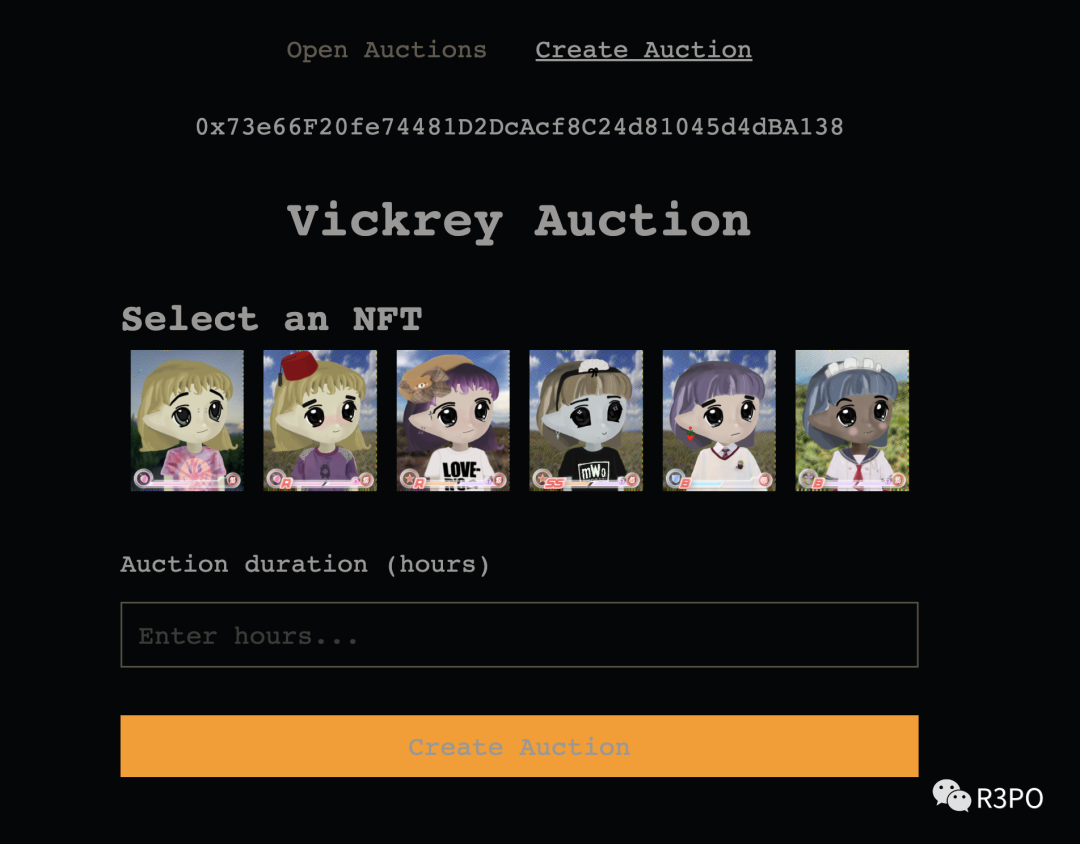
By utilizing CREATE2-based smart contract creation, we allow users to transfer ETH to future contract addresses to Hide bids. Submitting bids on-chain looks like a separate, simple transfer of ETH to standard wallets (EOAs). During the reveal phase, bidders reveal their bids, using ETH to deploy the contract to a pre-funded address. Unlike typical Vickery auctions based on a commit-and-reveal scheme, it is impossible to know which address actually bid in a given auction without relying on additional off-chain data. Vickery auctions are ideal for pricing non-fungible assets because game theory encourages parties to be honest and bid only based on what they believe the asset is actually worth - which allows more optimal prices to be found than in first-price auctions. To ensure that users cannot adjust bids during the reveal phase, a snapshot of the blockchain state is taken, and users submit proofs of their Merkle Patricia Trie account balances, along with proof that their bids existed prior to the reveal phase.

Production principle
We designed from scratch using Solidity, Huff and Assembly Our own smart contracts. We adapted Merkle Patricia Trie proofs from Goldengate to verify account ownership during a specific timestamp, fully on-chain. We use Assembly tricks to optimize gas usage, and some neat tricks to find on-chain MPTs faster. The entire process is automated and decentralized.

Supporting technology: Our contract is inspired by the Open Zeppelin template, deploying On Gnosis Chain, Optimism, Ethereum, and Boba, ENS names are integrated, and Metamask is used to log in.
10, diZKreet
Official link: https://ethglobal.com/showcase/ dizkreet-4rvz2
Project Description
< img src="https://image.blockbeats.cn/upload/2022-10-13/b57c49d6925c2806594a09b4d9746fd73e29c493.png?x-oss-process=image/quality,q_50/format,webp">
Privacy has become one of the most important parts of Web3 development. Today, it is very obvious that in the blockchain, not everything has to be public and fully traceable. Aztec provides a set of tools to ensure the privacy of individuals on the Ethereum blockchain. For this project, we created a ZK Rollup bridge to mintNFT collections in an anonymous and private manner, where the Ethereum mainnet will record that someone on Aztec bought an NFT, but no one knows exactly who until it is listed on the Ethereum mainnet. Redeemed online. While the NFT remains in the Rollup bridge contract, the owner of the NFT will own a virtual ZK NFT. This ZK NFT can be exchanged and traded privately, or redeemed on the Ethereum mainnet using the Rollup contract. Our ZK NFT shielded bridge is fully compatible with any ERC-721NFT on Ethereum. Any NFT is now available for private purchase through diZKreet.

Making principle
This project uses Aztec ZK Rollup to create a custom ZK shielded bridge. We use the Aztec ZK SDK to create a secure front end. All NFT metadata and images are stored on IPFS using Web3.storage. At the same time, we also use Ethereum as the base chain for protecting digital assets. We created a secure and robust ZKunk NFT using the Openzeppelin NFT contract.

11 ClubSpace
Official link: https://ethglobal.com/showcase/clubspace-cwzqx
Item Description

The project allows creators to import their Spinamp playlists, set up the Decent NFT they promote, set up a Lens post, and finally set up Free NFTs that partygoers receive (if they can provide ZK proof of their attendance) to create a live music party. On the Club Space page, connected Lens accounts can view each other's avatars, listen to playlists, and send their responses over the p2p pub/sub network.

Production principle
We use Lens as a social login and post party announcements. We use Streamr for live interactions in the club space. We use EPNS to send new party messages for ClubSpace subscribers to receive notifications when new parties are created. A neat nextjs app will tie everything together, with some APIs for data manipulation, impression logging, and finally we use Semaphore to provide users with ZK proofs that they are in a specific club space - By submitting their proof, they can earn NFT as a reward.

12 txn.xyz
Official link: https://ethglobal.com/showcase/txn-xyz-knbjw

Item Description

This transaction page allows the DApp to connect through any wallet and allows to request any transaction from the user. All of this can be achieved with a clean URL encoding system so there are no servers and no state. Say hello to txn.xyz!

Production principle
This project uses Nextjs and TypeScript to connect users to Polygon, Optimism and many other networks.
Conclusion
R3PO translated and organized the 12 winning projects from the ETHBogota Hackathon. R3PO found that these promising projects in the encryption world pay more attention to attracting more newer users to participate in the encryption rabbit hole.
Although the bear market is long, it is a good time for investors and project parties to settle themselves. Cold thinking is for the next round of bull market The heat wave is raging, I hope it can bring you more thoughts, find your own investment target and entrepreneurial direction, and do more about the future of Web3 together!
Welcome to join the official BlockBeats community:
Telegram Subscription Group: https://t.me/theblockbeats
Telegram Discussion Group: https://t.me/BlockBeats_App
Official Twitter Account: https://twitter.com/BlockBeatsAsia
 Related Articles