EthSign with Sequoia Global Participation: The new Web3 track triggered by WeChat "small agreement"
Original title: "We are a full-time team now! Let me tell you the story of EthSign first."
Original author: Yan Xin, founder of EthSign
In 2018, someone once created an application for the recording function on the WeChat applet. A sensation in the VC industry. But it only existed for 48 hours.
In this article called "Little Agreement In the application of , both users can confirm and bind an "informal agreement". User A writes a paragraph and shares it with user B. After B confirms, the small agreement will write the content together with the signature constructed by the WeChat IDs of both parties on Ethereum.
Using EthereumThe network cannot be deletedSex, a sentence that may be spoken, has become a certainty from a certain angle.
But such a simple application has resonated in the industry, even It's a completely unexpected out-of-the-circle scene. Overnight, the number of visits to the small protocol reached 120,000, and tens of thousands of people experienced it. It can affect tens of thousands of people within a few hours of its launch,Unfortunately, it was officially removed by WeChat after 48 hours.
Nowadays, in the Web3 wave, infrastructure is once again the leading target, those in Blockchain technology provides a new solution to the seemingly unsolvable problems in Web2.
On March 9, EthSign, a Web3 infrastructure start-up company, announced the completion of $12 million in seed round financing, Sequoia Capital It is the first time for China, the United States and India to participate simultaneously. Sequoia India and Mirana Ventures led the round, with participation from Amber Group, Circle Ventures, NGC Ventures, HashKey Group and Matrixport, among others.
In today’s DID and NFT environment, the story of EthSign can be told very big. Next, let’s Come back to April 2021 to see how the EthSign team is telling their story as they officially launch.
After a year Much preparation, we are excited to announce: EthSign is officially launched.

Introduction in one sentence: EthSign is a decentralized electronic agreement signing application
EthSign comes from real pain points
Electronic signature services that have been actually used in many business scenarios often make users uncomfortable due to their centralization:
· The user must verify the signature and retrieve the signed agreement with the permission of the service provider
· Agreements containing commercial secrets are uploaded and saved in cloud storage of internet giants
· Once the electronic signature service provider goes bankrupt, the data on the server will inevitably be deleted
After being familiar with and understanding the consensus and transparency that the blockchain can provide, we are no longer satisfied with the notarization from the authority. proved by nodes. The platform is no longer an intermediary between users and information, but more like a tool and a browser: we provide a user-friendly interface, but it doesn't have to be! Users can also look up or verify information directly from the blockchain - this is what we hope to do, reconstruct traditional scenarios with new protocols and networks, and try our best to promote automation and decentralization.
Now is a very suitable time to Web3 these familiar applications
In fact, applications that hope to reconstruct some daily life scenarios through new technologies such as blockchain have been common in the last round of bull market . The prosperity of applications depends on the maturity of infrastructure. Smart contracts are the biggest creation of Ethereum, but in the last bull market, the most used smart contracts may only be ERC-20. The application potential of smart contracts has actually been fully explored since DeFi Summer - it will take about two years for the infrastructure to mature, and then the application will explode.
In the entire Web3 technology stack, projects such as Filecoin, Sia, and Arweave in the storage layer are still in the At the initial stage, the network is still constantly upgrading itself; the Ethereum at the computing layer is striving to expand the capacity of the side chain by providing better interoperability; the smart contract Trigger platform, message push service, and cache service in the middleware have been in the past for a long time The development of neglected key modules has also begun to be claimed by various full-time teams. It is foreseeable that the fully upgraded Web3 stack after two years will bring the richness of application scenarios, the number of users, and the accumulation of assets to a new level.
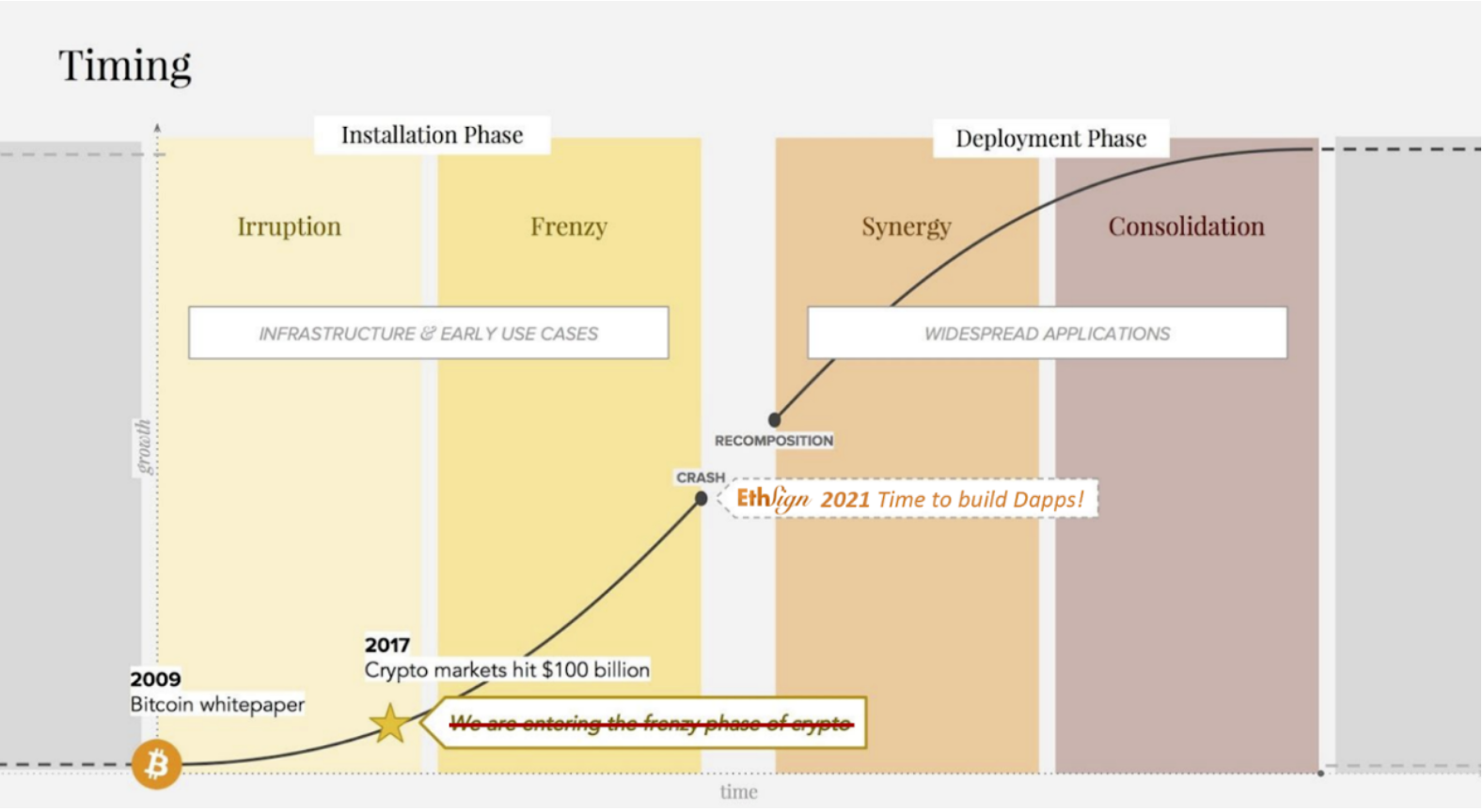
The picture is adapted from Placeholder's 2017 Investment Thesis, and now it's 2021!
Our application touches every layer of the Web3 technology stack. Many of these projects are still in the process of rapid iteration, and we will work with these projects to continuously track the progress and apply them. On the basis of full familiarity, we will strive to become the most competitive application development in two years team.
We are a full-time team
EthSign actually started in the second half of 2019 when I was working as an investment manager. Potter and I spent the summer discussing DeFi and decentralized storage. In October, Potter found Jack and several other very enthusiastic computer science students in the USC Blockchain Association to help write code. TA)! The part-time team's projects inevitably progressed slowly, coupled with the unfamiliarity of React and Web3.js at the beginning, we did not make the first usable version until June 2020 when we participated in the Hackfs Hackathon jointly organized by ETHGlobal and Protocol Labs.
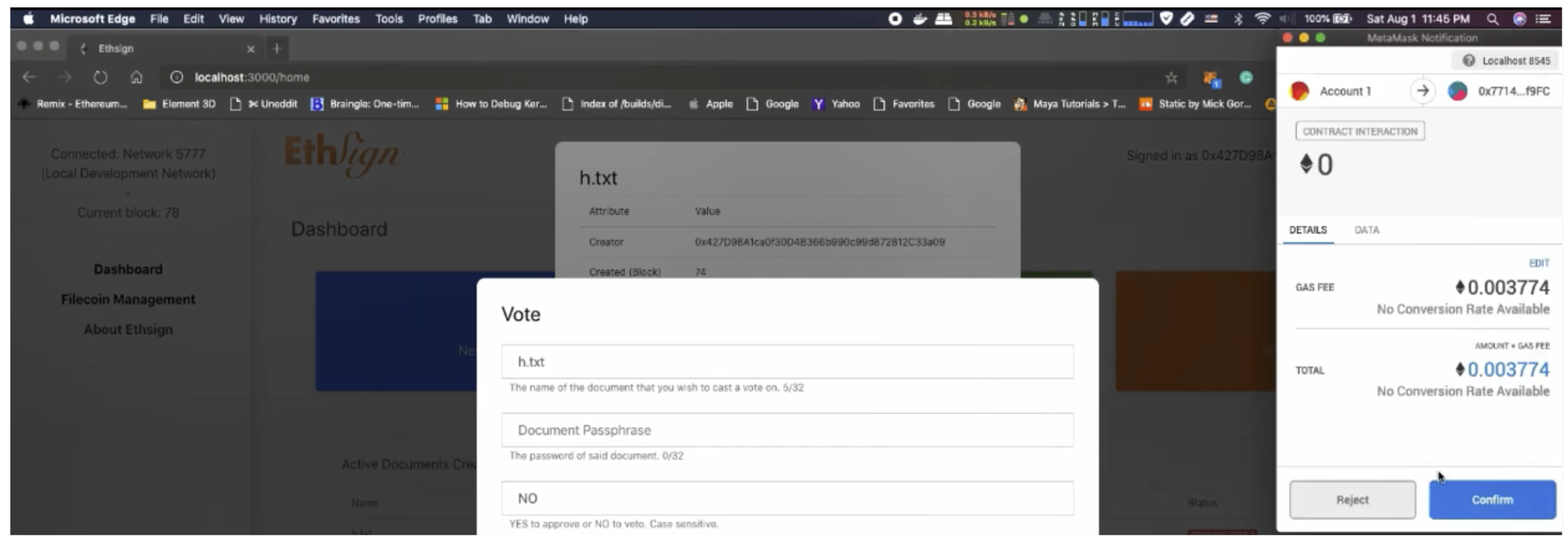
The front end of the first version was made by Jack who taught himself React within a month
Later, we found Nicole in the Philippines and Claire who majored in interaction design, and our front end became less Hackthon. Later, we finally showed the second version of EthSign at the Dorahacks Hackathon in February this year. At that time, we had begun to pay attention to integrating Magic to allow traditional users to establish cryptocurrency wallets through email accounts; and with the skyrocketing of Ethereum, we The smart contract had to be migrated to Matic to reduce the user's Gas fee consumption.
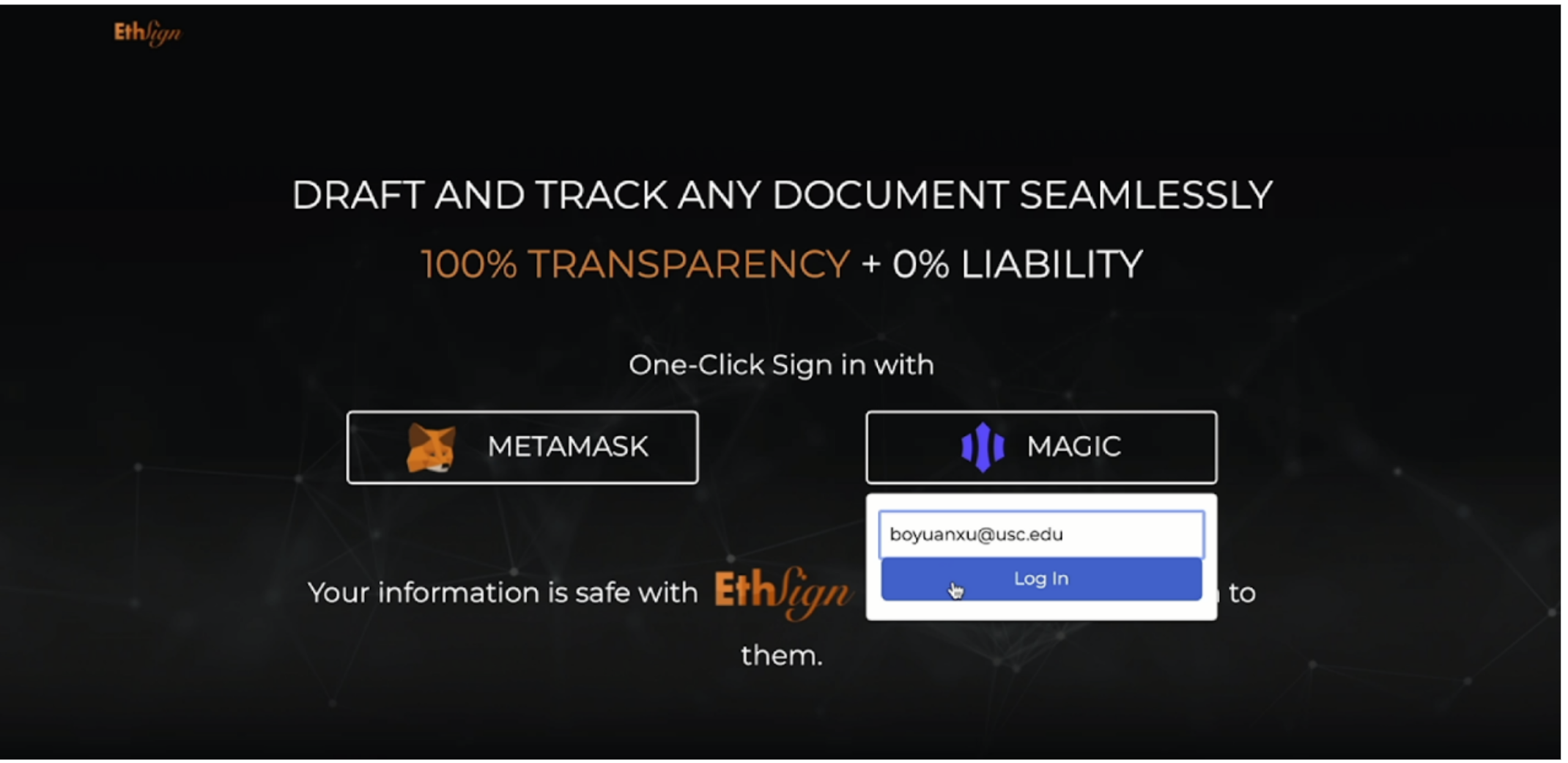
Version 2: We're finally thinking about user experience
After this Hackathon, we received a lot of positive feedback and suggestions. The NFT and Bitcoin craze has pushed the boundaries of Web3 to expand rapidly. We saw the possibility that the applications we designed could actually serve businesses, so we resigned and established Buildblock, a very young but clear goal engineering team. EthSign will be our first work!
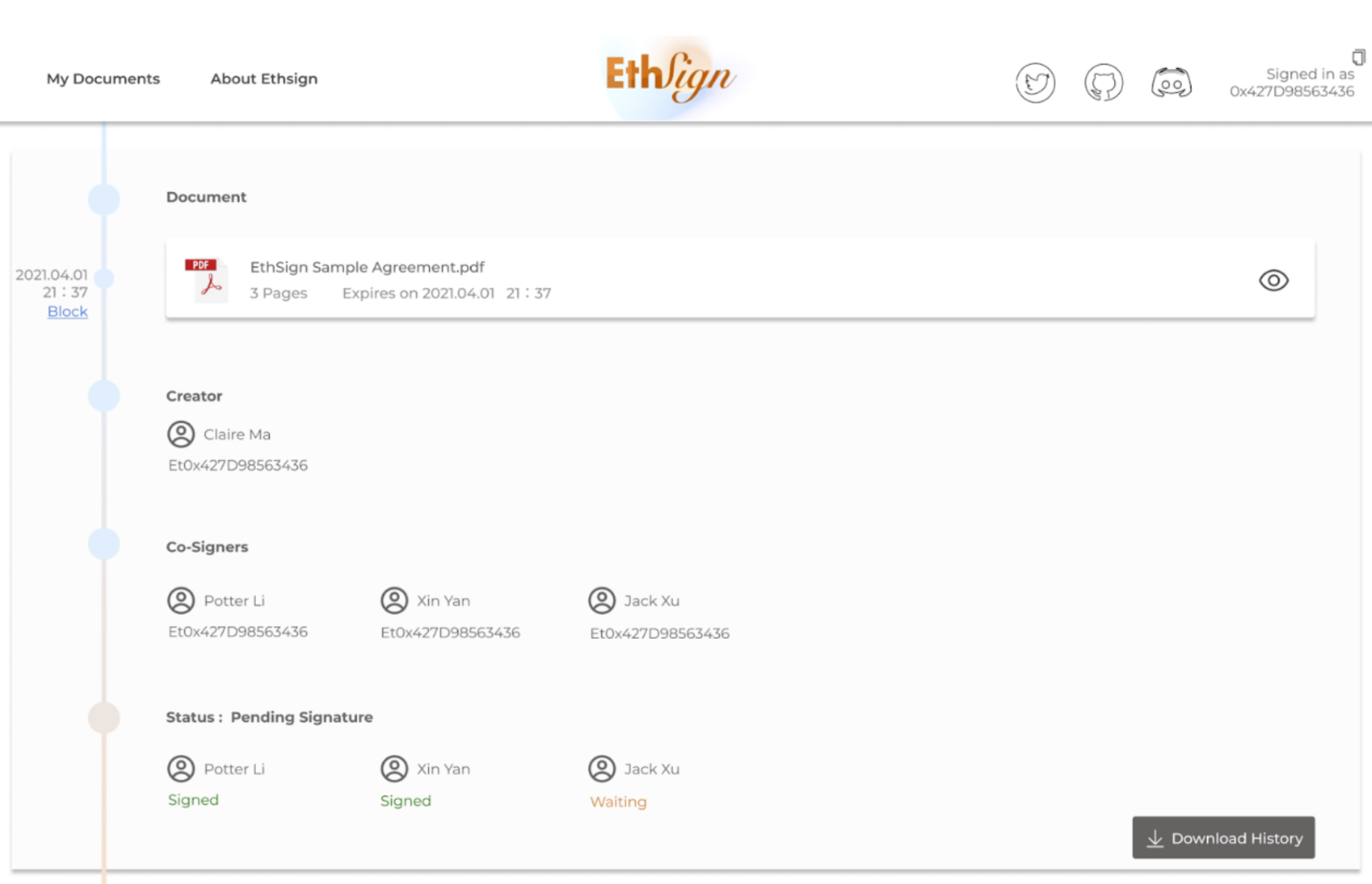
The new version, which is the real official version, will be launched in early May!
EthSign will have all the functions of the traditional electronic agreement signature platform, but we will not stop there
We have gradually clarified the layering of protocols and applications in the design. The front end of the project is an electronic agreement signature platform, but the smart contract can be abstracted as an interaction platform between identity and content, which can support or become:
· Credentials for off-chain assets on-chain
· Endorsement or certification platform
·The credit system construction of identity on the chain
Interface for DAO to interact with the off-chain world
We will continue to integrate other protocols or components, and will also be integrated into other application scenarios. When users gradually get used to using Web3 identity and storage in different scenarios, we will form our own network effects.
OK! We are already working hard! We will often update our project progress, research on some new features and daily operations on Medium.
Welcome to join the official BlockBeats community:
Telegram Subscription Group: https://t.me/theblockbeats
Telegram Discussion Group: https://t.me/BlockBeats_App
Official Twitter Account: https://twitter.com/BlockBeatsAsia
 Related Articles