Bad market? How to let ETH passively lie and earn
Original author: The DeFi Edge, DeFi researcher
Original compilation: 0x137
This article is based on the views of DeFi researcher The DeFi Edge on his personal social media platform, and Rhythm BlockBeats organizes it The translation is as follows:
Most people’s ETH is idle for a long time, here are some low-risk ways to use ETH to earn passive income:
Method 1: Store in a cold wallet
You don't have to earn money on everything, think of it like hoarding gold bars. DeFi has certain risks, and doing so can hedge against potential hacking and running away.
Risk: 1/10
Method 2: Lend your ETH to a centralized institution (CeFi)
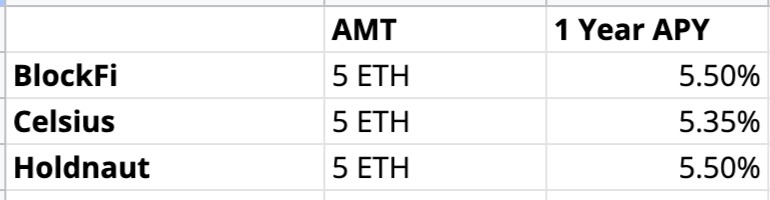
You can lend your ETH to companies such as Celsius Network, BlockFi, Hodlnaut, etc. They then lend it to hedge funds, trading platforms, institutional traders, etc., and that's where your income comes from.
I calculated the annualized return based on 5 ETH in the figure below.
Pros: It's easy
Disadvantages: First, KYC is required.
Also, while they do take security very seriously, CeFi is not FDIC insured like a bank. You know, BlockFi’s Token is managed by Gemini; and Celsius Network was also affected by the BadgerDAO exploit.
Risk: 3/10
Method 3: Pledge ETH directly
ETH 2.0 staking is the process of locking the holder Token to help maintain the PoS network. By staking ETH, holders can earn additional ETH. But this has a big disadvantage, you need to pledge at least 32 ETH (about 100,000 US dollars), and you can't unlock it until ETH 2.0 is merged.
Here are some alternatives:
1. Pledge through a centralized trading platform
Exchanges like Coinbase allow you to stake directly, with an APR of around 4.5%.
Advantages: very simple
Cons: Lower interest rates, requires KYC and you lose custody
Risk: 2/10
2. Liquidity pledge
Liquid staking solves the problem of directly staking ETH, it has no minimum pledge amount and lock-up. After depositing ETH, you will get a Token representing your mortgaged ETH, such as stETH (stETH is Lido’s version), this type of Token is linked to ETH 1:1, and you can get pledge rewards through rebase every day. In addition, you can also use this kind of Token for other DeFi activities, such as providing liquidity or lending.
The following are some liquid staking platforms:
• Lido Finance - Most Popular, Highest TVL
• StakeWise - uses a dual-coin design that separates staked ETH and rewards
• Rocket Pool - the most decentralized, users can run their own nodes for additional revenue
Risk: 2/10
Advanced operation:
You can earn extra income by using stETH in the liquidity pool on the Ethereum mainnet. The main platforms are Curve, Convex, Yearn Finance, etc. I'm not going to go into the details, because Ethereum's high gas costs will cost most people reading this.
Risk: 4/10

Method 4: Use Anchor Protocol on Terra
This is my personal strategy, when I first started the rates were much higher than they are now. On the one hand, Anchor is almost paying people to borrow money; on the other hand, I also hope to gain some exposure to LUNA.
Specific steps:
1. Convert your ETH to stETH at Lido Finance
2. Convert your stETH to bETH at Anchor
3. Deposit your bETH as collateral in Anchor
4. You can borrow up to 75% UST, but I recommend around 25% LTV
5. Deposit UST to earn 19.5% APY
Advantages: can earn UST, and aUST can increase production
Cons: Gas required for conversion; risk of using leverage and smart contracts; APY may not last forever
Risk: 4/10
Advanced operation:
When you deposit UST, you get aUST in return. At this time, you can obtain additional income through aUST without taking too much risk. For example, on Mirror Protocol there is a strategy called Delta Neutral, and Aperture Finance automates this.
Risk: 5/10

Method 5: Use the Nexus Protocol on Terra
Stake your bETH on Terra and deposit it with Nexus Protocol and earn 6.45% APR, very easy.
Risk: 3/10

Method 6: Use ETH in the liquidity pool
You can provide ETH as a liquid trading pair, for example, you can pair ETH - USDC on the protocol and earn income. But again, the gas for this operation on the Ethereum mainnet is too high.
Solution:
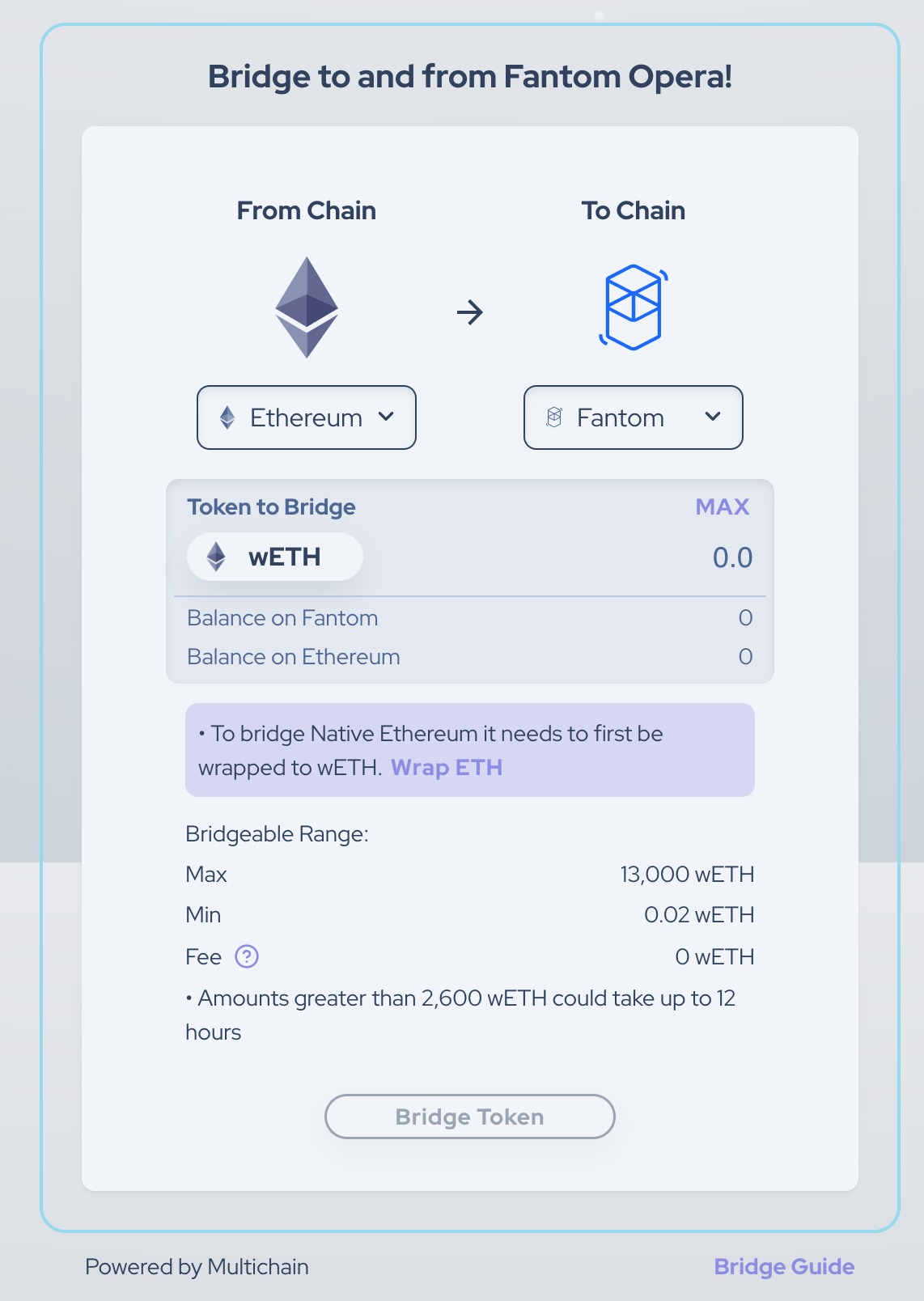
You can bridge ETH to different chains. By bridging it to other public chains, you not only maintain the value of ETH, but also significantly reduce your gas costs in the long run. These chains include: L2 chains such as MATIC and Arbitrum, and L1 chains such as AVAX and FTM. I think FTM has the most revenue opportunity right now.
You can use SpookySwap to convert your ETH to wETH and bridge it from the Ethereum mainnet to the FTM network. This way, you can use your own wETH in FTM’s liquidity trading pairs.
In the bridging process, not only the gas problem needs to be paid attention to, but also the risk of cross-chain bridges should be considered. Wormhole was hacked last week and most of the ETH was stolen, luckily people were compensated by the parent company. But not all cross-chain bridges are endorsed by "rich dads" like Jump Trading.
Method 7: Use T on FTM arot
Deposit your wETH into Tarot Finance for unilateral pledge, with an annual interest rate of 6.6%.
Risk: 3/10

Method 8: Provide liquidity trading pairs on FTM
There are two options here:
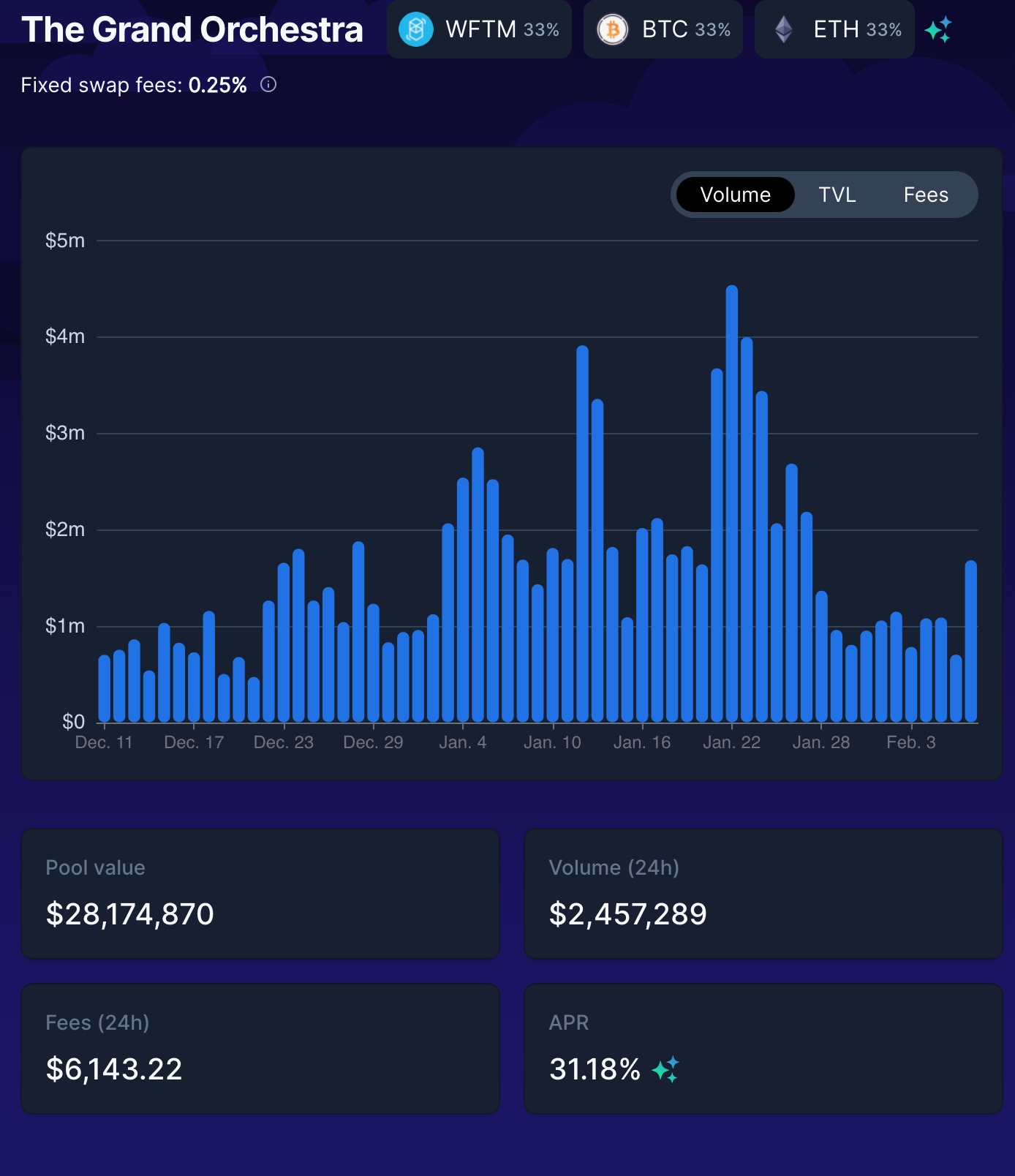
1. The Grand Orchestra strategy on Beethoven x, after providing three trading pairs of FTM, WBTC, and WETH, you can get BEETS as a return, with an annual interest rate of 31.18 %.
2. The FTM-WETH trading pair on LiquidDriver has a high annual interest rate of 48%. Likewise, you will receive LQDR in return.

advantages: you can Get high returns, especially when you get Tokens that increase in value
Risk: impermanent loss; the price of Token may fall; potential tax events; smart contract risk
Risk rating: 7/10
How should you choose?
In my opinion, users must find a balance between ease of use, risk level, yield, and decentralization. For ordinary friends, staking on platforms such as Coinbase is the most suitable; for junior DeFi participants, it is more beneficial to bridge and transfer to protocols such as Nexus and Tarot; and I personally adopt the strategy of Anchor plus Mirror.
Original link
Welcome to join the official BlockBeats community:
Telegram Subscription Group: https://t.me/theblockbeats
Telegram Discussion Group: https://t.me/BlockBeats_App
Official Twitter Account: https://twitter.com/BlockBeatsAsia
 Related Articles