Interview with Gyroscope Founder: How to Create a Yield Experience Beyond Uniswap for LPs?
In today's increasingly crowded DeFi market, becoming a "passive LP" is gradually becoming a silent sacrifice for retail investors. They seem to have joined a lucrative liquidity pool, but often have their capital consumed by high-frequency arbitrage, parameter misalignment, and volatility. Uniswap v3 was once seen as the technological pinnacle of AMMs, but actual data shows that most LPs are losing money. The issue lies not in the mechanism itself, but in the significant gap in complexity between the mechanism and the average user.
Gyroscope is attempting to rewrite this script. It is not another new AMM, nor is it another "stablecoin story," but rather a new type of liquidity provision system designed from the ground up specifically for passive LPs.
Gyroscope's Dynamic Liquidity Pool E-CLP provides real returns to LPs, outperforming the average LP on Uniswap V3 by 32 times and outperforming Aerodrome LP by 15 times. The upcoming Dynamic 3-CLP, set to launch next month, will pioneer a three-way liquidity concentration layout, expected to further double the performance. The newly launched Avalanche chain EURC/USDC; BTC.b/WAVAX, and Base chain WETH/cbBTC dynamic liquidity pools feature reward mechanisms with annual rates as high as 64%, details available in the article link at the end.
Recently, Lüdòng BlockBeats invited Gyroscope's Co-Founder Ariah Klages-Mundt for an in-depth interview. Starting from Gyroscope Dynamics' stablecoin mechanism, traversing the strategic evolution of Dynamic E-CLP, and finally arriving at the innovative edge of the three-asset pool. Along this route, we see a clear theme, replacing blind strategy selection with a structural approach, so that long-term returns no longer depend on luck and timing but rather on a design capability that can be replicated and amplified.
Following is the full interview:
BlockBeats: Please introduce yourself. Why did you initially decide to establish Gyroscope? Graduating from Cornell University, how did your academic research background directly influence Gyroscope's design?
Ariah Klages-Mundt: What we are doing at Gyroscope is actually akin to a scientific research project. My early research predicted many stablecoin off-peg problems, such as what happened with DAI on "Black Thursday," Fei's initial launch failure, and Terra's collapse. Our goal at Gyroscope is to do things differently, building products that not only bring good returns but are also truly practical and structurally robust.
Cornell's experience had a significant impact on me, and Gyroscope's design is built around the knowledge we gained during our research. Both my co-founder and I have PhD backgrounds, and we started conceptualizing Gyroscope during our doctoral studies. At that time, we observed certain industry trends and identified the issues that many people ultimately face. So, we decided to build a product from the ground up, aiming to avoid those structural pitfalls.

Bloomberg Data Science Ph.D. Scholarship Recipient, Ariah Klages-Mundt
BlockBeats: You've proposed that GYD is an "all-weather" stablecoin. What does this mean? For the average user, what is the key difference between it and stablecoins like USDC or DAI?
Ariah Klages-Mundt: Broadly speaking, Gyroscope aims to maximize liquidity efficiency while keeping user participation as simple and passive as possible.
This concept is first reflected in the design of the stablecoin product, namely GYD. GYD has many cool features, as you can see in the documentation, but its core value actually comes from its liquidity structure design—it almost always tracks the pegged price in transactions, making it one of the best performers in the industry in this regard. This makes it very suitable for trading, which is key to our envisioned GYD integration into mainstream product strategies.
Our product strategy has shifted from a mere stablecoin to a focus on more generalized LP tools and dynamic liquidity management.
Regarding Dynamic Liquidity Pools, the issue we observed is that most people who provide liquidity to high-volatility pairs like BTC-stablecoin end up losing money because they cannot actively manage their positions efficiently. What we're doing is flipping the script—through Gyroscope's dynamic liquidity pool mechanism, we offer a completely passive but remarkably performing liquidity provision method.
We believe that the future of GYD and the entire Gyroscope LP tool ecosystem will be closely intertwined and evolve together.
BlockBeats: I'd like to go back to the development history of Gyroscope and talk about how you went from the GYD model all the way to the current dynamic CLP. What were the key milestones or turning points that have brought this project to where it is today?
Ariah Klages-Mundt: We initially designed these liquidity pools to enhance the efficiency of the stablecoin client, with two core goals in mind. First, to build an on-chain stablecoin secondary market, and second, to create more effective revenue streams to support the underlying assets of stablecoins.
During the development of this product series, we identified a core issue. We found that the stablecoin business model itself is very challenging, similar to the sustainability issues many DEX projects face.
Most newly issued stablecoins today have expanded mainly through token incentives, but this model is fundamentally unsustainable. In order to attract capital, they must offer more incentives than they receive, leading to a vicious cycle of "the more capital, the higher the subsidy." Even stablecoins like Ethena heavily rely on token incentives to drive growth, with the incentive expenditure per unit often surpassing the actual earnings, making this model clearly difficult to sustain in the long run.
Therefore, as we built a series of products for Gyroscope, we also had to rethink what the best business model for this protocol really is.
We actually have many valuable components, such as some AMM modules that are inherently profitable, and a very innovative stablecoin. And now, we believe the most promising path is to focus on "these liquidity pools that are inherently profitable" for the protocol's growth. Not only do they solve the practical issues of LPs (such as position management difficulty), but they also bring in substantial revenue and have independent product value. This is why we now see them as the main focus of Gyroscope's business model.
At the same time, stablecoins can complement the value of these liquidity pools very well. As I mentioned at the beginning of the interview, GYD has very strong liquidity near its peg point. Once you adjust your position, it is more flexible than any stablecoin on the market, making it advantageous as a trading asset and complementary to dynamic liquidity pools.
We believe the best way to achieve stablecoin "sustainable growth" is to find a clear market position for it, such as a highly liquid trading asset, and integrate it into a profitable product system. This path can be independent of long-term token incentives, relying instead on the revenue-generating capability of the product itself for growth. GYD can leverage these dynamic liquidity pools for expansion and serve as a reference for another stablecoin we may introduce in the future.
Of course, at this stage, we are mainly focused on building the dynamic liquidity pools, which is still an exploratory process. We are expanding multiple profitable liquidity pool options, currently including trading pairs with assets such as USDC, USDT, and GYD. The core of this stage is to scale up and strengthen the product itself.
Next, we are also considering holding GYD long-term and continuing to expand its growth potential. We believe that integrating a DEX and a stablecoin client together as a business model will bring many benefits.
Two aspects, in particular, are worth emphasizing:
· First, as I mentioned earlier, GYD as a trading asset can be used to build a set of self-sustaining structured products. These products leverage the characteristics of GYD, do not rely on incentive subsidies, and can expand on their own.
· Second, if you have your own stablecoin product, it is easier to integrate it into other products within your ecosystem. For example, our current dynamic liquidity pools with USDC, USDT, etc., have a high yield rate, and many users want to further amplify these returns, with the simplest way possibly being to plug them into GYD's leverage mechanism.
This way, users can leverage GYD to achieve higher returns, and GYD itself can also benefit from it, creating a virtuous cycle in the entire product system.
BlockBeats: There are already many liquidity products in the market. What role do you think Gyroscope plays in the overall DeFi ecosystem? What is your positioning?
Ariah Klages-Mundt: We have noticed a clear gap in the market, especially in serving "passive LPs." Gyroscope's positioning is to make passive LP operations very simple—If you are a passive LP, then choosing us should be a "no-brainer" decision: better performance and easier to use.
In the long run, I believe the liquidity product market will gradually differentiate into two main directions: one is a simple and efficient solution designed for passive LPs, which is one end of the market; the other is highly customizable tools tailored to professional market makers, who often require extremely flexible architectures, such as the complex configurations seen in Uniswap v3, v4. However, for passive LPs, they actually do not want to deal with this complexity; they just want to access high yields through a simple product interface.
This is exactly the demand that the current market has not fully met. Although there are some passive liquidity solutions, they have not performed well, basically falling into the same trap of the traditional LP model as Uniswap.
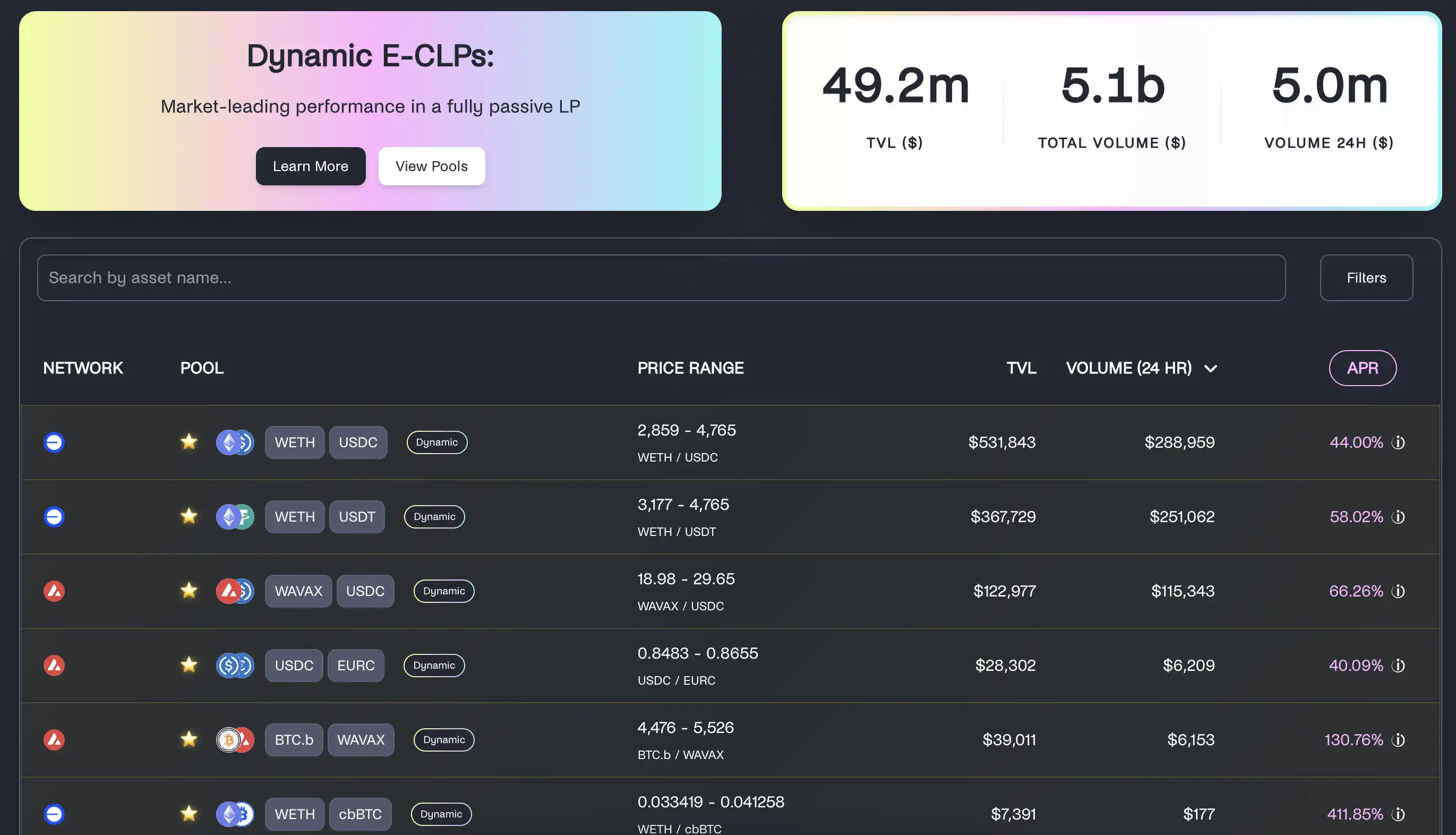
Gyroscope Official Website Liquidity Pool Page
Key Mechanism and Performance Highlights of Dynamic E-CLP
BlockBeats: Dynamic E-CLP is your most recent major innovation, now deployed on chains like Base, with the actual yield on ETH/USDC said to be 32 times that of Uniswap v3. What is the core mechanism innovation behind this?
Ariah Klages-Mundt: It is actually a centralized liquidity pool that uses an ellipse as the trade curve, hence the "E" in the name. The core design of this pool can automatically adjust with market fluctuations, aiming to help LPs (Liquidity Providers) stay within an effective price range at all times, earn more fee revenue, and without the need for frequent manual rebalancing or position adjustments.
This means that the entire liquidity strategy is directly written into the code, and LPs do not need to operate it themselves; the system will automatically execute this strategy. Since going live, our Dynamic E-CLP has outperformed the average LP on Uniswap V3 by 32 times.
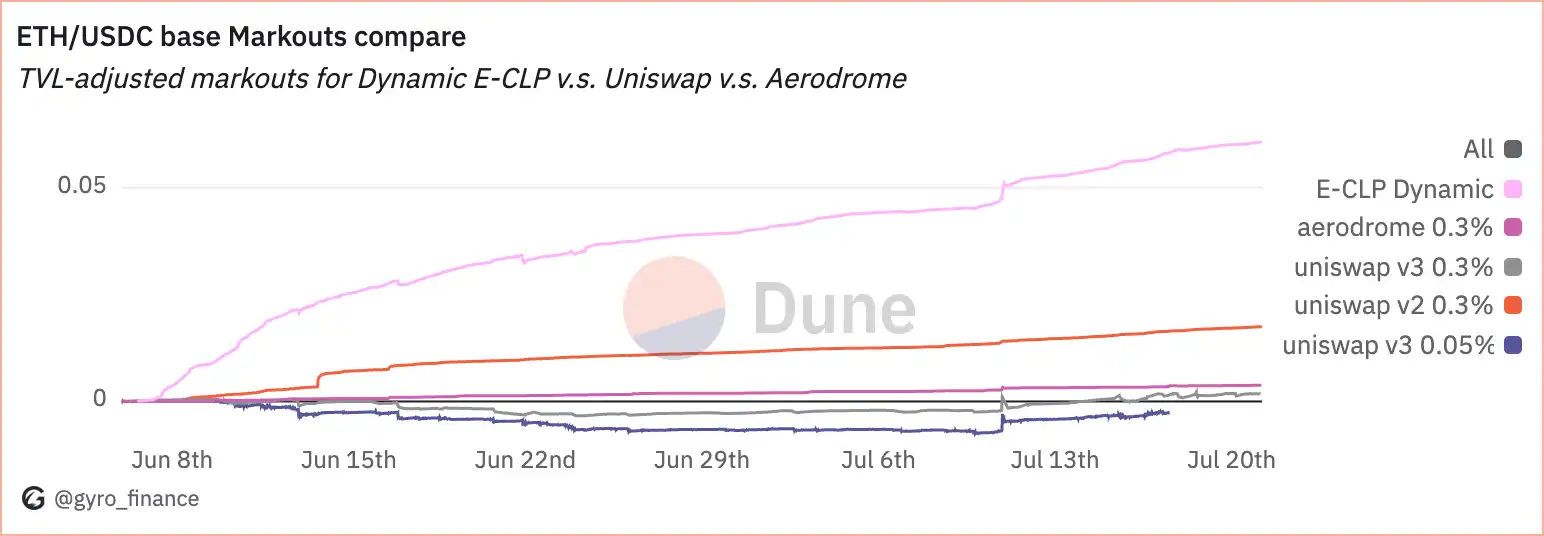
What does this mean? Simply put, most LPs on Uniswap V3 have suffered from manually managing their positions—either their liquidity runs out of the range and yields are lost, or they choose the wrong strategy and are repeatedly exploited by arbitrageurs, with ultimately unsatisfactory results.
The advantage of Dynamic E-CLP is that it helps LPs make strategic choices, and the effect is significant. We believe that Gyroscope's product can make being a "passive LP" very easy, requiring less operation, showing better performance, and all encapsulated in a simple and user-friendly module.
BlockBeats: For the average user, what does the so-called "LP's actual profit potential" actually mean?
Ariah Klages-Mundt: We use a method called markout to more clearly measure an LP's true profit situation.
Intuitively, it is actually measuring how much "arbitrage-resistant" and valuable trading flow an LP has earned while providing liquidity.
"Markouts" have become a widely adopted industry standard metric, with experts including Dan Robinson and Alex Nezlobin using it to evaluate project LP profit performance.
Because in the AMM mechanism, if your liquidity pool is frequently exploited by arbitrageurs, you will actually lose money; but if you are receiving "organic trading flow" (non-arbitrageurs' normal trading), then you have the opportunity to make money.
So Markout is used to assess whether you as an LP are making money from "high-quality trading flow" or being harvested by arbitrage flow.
Specifically, if the Markout is positive, it means that for example when selling ETH, the price was higher than the market price, or when buying, it was lower than the market price, indicating that as an LP, you are earning the spread;
But if the Markout is negative, it means that you are completing transactions at unfavorable prices, such as buying at a high price or selling at a low price, resulting in a loss.
The benefit of this approach is that it can separate an LP's true profit potential from the complex asset price fluctuations in the AMM mechanism. Because many traditional measurement methods struggle to differentiate whether profits come from trade execution or asset price movements themselves.
This is also why we place special emphasis on Markout.
From a more practical perspective, if your Markout is positive enough, then you can hedge against other asset risk exposures—meaning you can adjust to the asset composition you want to hold while still receiving positive returns.
So Markout is a very effective measurement metric. Taking Gyroscope as an example, we are market-leading in Markout performance, especially with our Dynamic E-CLP, which has performed exceptionally well.
BlockBeats: Can you specifically explain how you achieve this effect? What are the fundamental differences between your approach and Uniswap's method?
Ariah Klages-Mundt: What makes our Dynamic CLP special is that we have built a liquidity pool structure specifically designed around one goal: to create a liquidity pool structure truly optimized for passive strategies. We have finely tuned the entire mechanism to ensure that it starts off on a path that is friendly to LPs.
Many so-called "automatic liquidity managers" built on Uniswap are essentially just adding another layer and not really addressing the core issue — selecting an excellent, robust passive strategy for LPs.
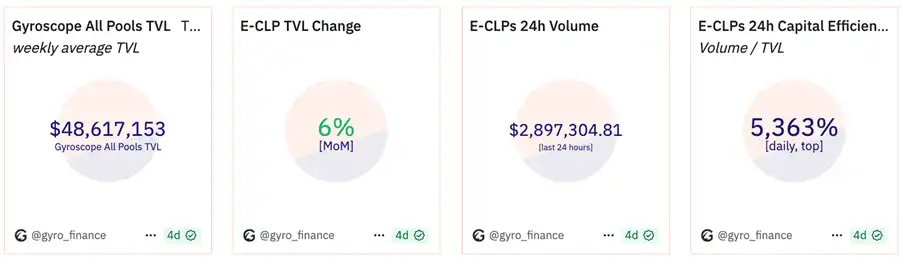
Our focus is on capturing sufficient real trading volume while effectively avoiding excessive arbitrage losses. This is Gyroscope's design philosophy: to enhance LPs' long-term yield stability through a structural approach.
At its core, there are two key questions: How do you design a good liquidity provision strategy? And how do you continuously update this strategy over time?
Another key aspect is how to control risk throughout this process. Our solution is built around a "wide-range liquidity strategy" aimed at reducing concentration risk.
More specifically, our design allows LPs to leverage "Volatility Harvesting," where they can profit from providing liquidity as prices fluctuate within a range.
A key point of this strategy is that it adjusts the liquidity range in a very passive way to avoid the high costs of frequent rebalancing.
Why are rebalancing costs high?
Because if you are constantly rebalancing, it is equivalent to trading against the market and the counterparty, meaning you incur slippage costs.
For example, as a Uniswap LP, the assets you have in the pool may incur slippage costs equivalent to several days' worth of earnings due to this rebalancing.
However, if you can adjust your position passively without frequent trading and crossing spreads, you can save a substantial amount of these costs.
BlockBeats: In practical terms, as an ordinary user, what would this experience be like?
Ariah Klages-Mundt: Our top-level design goal is to make being a "passive LP" extremely simple. You can achieve better returns than with a normal strategy, but with fewer required operations.
We use the term "Minimal Operation" in a literal sense. Users only need to do one thing: come to the pool and choose to deposit funds.
After completing this step, they can completely ignore it.
This liquidity pool will automatically adjust according to the market, operating efficiently and continuously.
From another perspective, Gyroscope is helping LP make optimal strategy choices, and it is built into the system, so you don't need to monitor the market, rebalance, or change strategies yourself.
The original vision of the AMM mechanism was actually to allow more people to participate in liquidity provision fairly and receive related benefits. We believe that Gyroscope's liquidity pool is continuing this vision.
In the early days of Uniswap V2, users only needed to use one type of liquidity pool, which was relatively simple to operate, and anyone could participate.
However, when "Concentrated Liquidity" was introduced, the situation changed—being an LP became a task that required a high level of judgment and parameter setting. You have to choose multiple parameters correctly to have a chance to make money; otherwise, many LPs actually end up losing money, either due to improper settings or failure to adjust strategies in time.
At the same time, particularly for some highly volatile trading pairs, the returns they offer are indeed very attractive. The issue is that it is difficult for ordinary people to seize these profit opportunities. This is exactly the core issue that Gyroscope aims to solve—we offer a pool that operates automatically after you only need to "deposit funds once."
The strategy is designed and calibrated in advance by the liquidity pool deployer, and can then automatically adjust with the market, continuously evolving. Users do not need to manually set parameters or intervene continuously.
By depositing funds, you can receive the returns that originally only the "experts" could earn.
BlockBeats: It sounds like your design has made market-making more accessible.
Ariah Klages-Mundt: Exactly, that is also one of our key goals. In the past, these market-making returns were difficult to obtain because they required complex strategies and tool support. The solution we have now launched significantly lowers the threshold, allowing ordinary users to participate in this type of profit generation.
BlockBeats: What is the most essential element in designing a sustainable market-making module in DeFi?
Ariah Klages-Mundt: When we talk about "sustainability," in the end, we need to answer two questions: What truly counts as sustainable? What does sustainability really mean?
Currently, the approach of many DEXs is more focused on trading volume rather than profitability.
The result is that if you look at the real yield of these pools, it is generally very low.
However, the problem lies in the fact that someone has to fill the gap between LPs' "minimum return requirement" and the actual yield.
For example, many DEXs are now promoting stablecoin pools like USDC/USDT, but the natural yield these pools can generate is very low, possibly only 2-3%, or even lower than the short-term U.S. Treasury bond rate.
However, when LPs participate in these pools, the "return threshold" they have in mind is often around 12%.
So, who will fill this 9%-10% gap? Usually, it's the project team using subsidies or incentives to support it. This model is ultimately unsustainable in the long term.
Therefore, the so-called "sustainability" is actually about whether you can rely on the product itself to generate enough natural yield so that LPs can profit even without external incentives?
If long-term reliance on subsidies, it is ultimately unsustainable.
And we believe that Gyroscope is a rare "positive case" in the current DeFi market—while most DEXs are still relying on token incentives to maintain LP returns, our dynamic E-CLP pool has been able to achieve positive returns purely based on transactions, covering the cost of incentives.
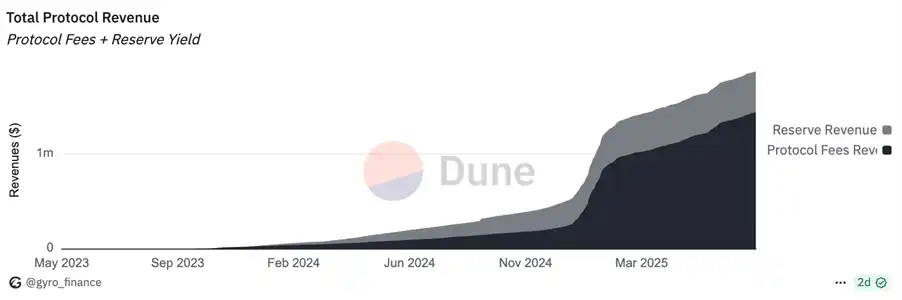
This indicates that it is a product with profitability and scalability. And we are currently in the expansion phase.
How to Understand the Upcoming Structured Market-Making Layer 3CLP?
BlockBeats: You are about to launch a three-asset concentrated liquidity pool, which is also the first to support three assets. Why choose three assets instead of two? What are the advantages of doing this? What is the underlying logic behind your thinking?
Ariah Klages-Mundt: Yes, we are very excited about this three-asset pool. This is a significant step for Gyroscope to showcase its technological advantage. We have already demonstrated a clear leading edge in the dynamic E-CLP (two-asset concentrated liquidity pool) before, and this three-asset pool will further solidify our leading position, something that currently no other DEX can achieve.
This product is called Gyroscope 3CLP, where 3CLP stands for Three-Asset Concentrated Liquidity Pool. It is the first product to truly achieve "three-way concentrated liquidity." Most centralized liquidity pools currently on the market are two-asset pools—providing a concentrated quote range between two assets; what we are doing now is putting three assets into the same pool and providing concentrated liquidity between them.
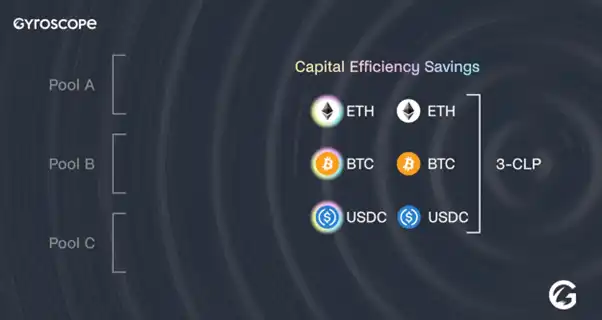
This way, a single pool can support three different trading pairs simultaneously.
If you calculate from a capital efficiency perspective, a three-asset pool theoretically can be 100% more efficient than a two-asset pool. In other words, if the trading volumes of the three assets are similar, a three-asset pool can achieve twice the trading volume with the same TVL.
For example, let's say you build a three-asset pool with BTC and a stablecoin. If Gyroscope's two-asset pool currently offers around 50% APY, then this three-asset pool could potentially reach double that, which is 100% APY. This difference is very substantial, especially in the current high-yield strategy-focused environment.
In the past, other projects have attempted "three-asset pools," but the results were mediocre, and many people were skeptical, thinking, "Another three-pool product." The main reason those products were not successful is that the returns were not high enough—for example, squeezing out a 0.1% marginal return from a Curve pool, which people were not very interested in.
However, Gyroscope's three-asset pool is different; we have already verified that our dynamic liquidity pool can generate actual returns. If the APY can be doubled, for example, reaching 50% to 100%, that is a completely different story. These are the kind of return levels that truly generate market interest, which is why we believe that this launch of 3CLP will not go unnoticed like previous "three-asset pools" but will be genuinely recognized.
BlockBeats: For the average user, this mechanism may still seem a bit complex. We would like to understand how you maintain the simplicity of the user experience?
Ariah Klages-Mundt: Gyroscope's philosophy has always been to make the user's choice simple and intuitive—users should be able to see at a glance where the performance is better and the operational threshold is also low, with no difference in this aspect for the three-asset pool.
The LP experience is actually as simple as previously discussed: users only need to enter the pool, decide whether to deposit assets, and then everything is automatically handled by the pool. It will take care of asset operation, yield strategies, etc., and the whole process is automated, requiring minimal user intervention.
This is also one of Gyroscope's design principles—whether it's ECLP or the current 3CLP, users do not need to manually set various parameters or perform complex configurations. These tasks are completed by the deployer during pool deployment. Once the pool is set up and running smoothly, LPs only need to understand the pool's strategy and performance, confirm their acceptance, and then deposit assets. Overall, for LPs, it is a "plug and play" experience.
DeFi Market Making Trends and the Future of Stablecoins
BlockBeats: Against the backdrop of the rise of modular AMMs, Layer 2, and Uniswap V4, how do you view the evolution trend of DeFi? What role will Gyroscope play in it?
Ariah Klages-Mundt: Gyroscope's current product can be deployed on any chain and has already validated its attractiveness to LPs in multiple scenarios.
We see the liquidity solution market differentiating into two directions: one focuses on serving passive LPs, enabling them to easily achieve high performance; the other provides highly customizable tools for professional market makers, which are often not suitable for regular LP use.
Gyroscope is focusing on the first direction, aiming to build products that are high-performing but also user-friendly for passive LPs.
It is worth mentioning that Gyroscope itself is designed with modularity. Many AMM solutions are now evolving towards modularity, and Gyroscope's pools also have highly modular characteristics. You can embed Gyroscope's liquidity pool into various concurrently developed feature modules, which may come from ourselves or other development teams in the ecosystem.
For example, you can integrate Gyroscope's pool with an asset rehypothecation module, a lending yield module, or integrate various hook plugins or dynamic trading mechanisms. This means that any new innovation in the DeFi space can be seamlessly stacked on top of Gyroscope's base pool.
We have already seen some exciting directions, such as dynamic transaction fee optimization, which still has a lot of untapped potential. The Gyroscope pool itself already has strong foundational performance and can further improve on this foundation, indicating that this architecture has significant room for expansion.
At the same time, we also welcome more teams within the ecosystem to jointly develop these modular components, not necessarily led by us. Any team developing excellent products can directly plug into Gyroscope's liquidity pool, thereby sharing the advantages of the entire system.
Of course, our flagship product at the moment is the Two-Asset Pool (2Pool), but what we really want to solidify our lead in is the Three-Asset Constant Product Pool (3CLP) we mentioned earlier. We believe that 3CLP will be the key for Gyroscope to consolidate its technological lead because currently, there is no other DEX in the market that can achieve the ability to have "Three-Asset Concentrated Liquidity."
We see 3CLP as a crucial piece in the future puzzle of DeFi liquidity, not only providing an attractive performance baseline for passive LPs but also serving as a powerful foundational architecture to accommodate more innovation, continuously enhancing performance as the ecosystem evolves.
BlockBeats: So, what are the main goals for Gyroscope in the next stage of development? This question aims to have you talk about a more macro level—what role do you hope Gyroscope will play in the entire DeFi ecosystem?
Ariah Klages-Mundt: Gyroscope is currently in a very favorable position because our products have already proven to have true revenue-generating capabilities, able to achieve "net profitability." This actually puts us ahead of most current DeFi protocols—many protocols are still struggling to find a path to profitability, whereas we have taken a crucial step forward on this issue.
Our current top priority is to have these revenue-generating products carry more AUM, starting with mainstream crypto asset pairs, such as the combinations involving BTC and stablecoins, the most traded pairs on-chain, which are currently the most profitable areas on-chain.
Our dynamic liquidity pool has already achieved good results in this regard, and we are particularly optimistic about the future development of the Three-Asset Pool. We believe it will become the primary source of income for passive LPs, a significant portion of the market. In other words, in the future, if you are a passive LP in the mainstream crypto asset market, 3CLP should be your preferred liquidity tool.
From a longer-term perspective, our grand vision is to further expand the on-chain transaction market space. Currently, the most profitable on-chain transactions are still the mainstream trading pairs of ETH, BTC, and stablecoins. However, we hope to drive the on-chain transaction volume of more assets, turning Gyroscope into a crucial infrastructure to carry out these transactions.
We believe that the most effective way to increase the overall trading volume of the DEX market is to introduce forex trading pairs on-chain. The foreign exchange market is one of the largest off-chain financial markets, and structurally, on-chain systems are potentially superior to traditional off-chain systems in some aspects, especially in terms of efficiency and transparency. Therefore, there is great potential to "on-chainize" these forex transaction flows.
However, currently, this area is nearly blank on-chain. For example, the daily trading volume of the global forex market is approximately $2 trillion, a volume that far exceeds the entire current DEX market — the latter's daily trading volume is roughly $8 billion. There is a difference of several orders of magnitude between the two. At the same time, the on-chain penetration rate of forex trading is extremely low, at only about 0.0005%.
So even if we only bring 1% of the forex trading volume on-chain, the total size of the entire DEX market could potentially directly increase by 2.5 times. This means that not only does Gyroscope have tremendous room for growth, but the entire DEX track also has the potential for a qualitative leap.
Of course, currently, cryptocurrencies like Ethereum, Bitcoin, and stablecoins are still the most active and profitable market. However, their growth will ultimately encounter a ceiling. At that time, there must be a broader range of financial assets that can operate efficiently on-chain, and we believe that forex is a particularly suitable breakthrough.
This is also why when designing liquidity pools, we not only considered serving crypto assets. Although CLP and 3CLP are currently built around mainstream crypto pairs, their underlying mechanisms can fully support FX forex trading pairs. We are very excited about this direction and believe that it will not only drive Gyroscope's further growth but also help the entire DEX ecosystem expand into a broader financial market.
BlockBeats: In your opinion, what changes are happening in the stablecoin space? What do you think the stablecoins of the future will look like?
Ariah Klages-Mundt: I will answer this question by dividing it into two parts: one part is "which type of stablecoin is more advantageous in different application scenarios," and the other part is "how the stablecoin's business model itself is evolving and which types of business models are more likely to support the long-term survival of stablecoins."
First, let's talk about the use case. Currently, stablecoins can be broadly divided into two categories—centralized stablecoins and decentralized stablecoins. In the past, many believed that decentralized stablecoins could achieve widespread adoption in some mainstream scenarios, such as on-chain payments and daily settlements.
However, the reality is that this vision has not been truly realized. With more and more centralized stablecoins being introduced, gaining regulatory support, and deeply integrating with the entire payment ecosystem (not just crypto payments, but even Web2 payment infrastructure like Stripe), decentralized stablecoins are actually increasingly disadvantaged in the competition for mainstream use cases.
In the current trend, decentralized stablecoins are finding it challenging to surpass the advantages that centralized stablecoins have already established.
Therefore, we see some decentralized stablecoin projects that were originally focused on "payment use cases" now shifting towards a profit-driven strategy, such as Sky and Athena. Sky, which used to emphasize on-chain payment use cases, is now clearly more focused on how to create on-chain earnings for users.
In my opinion, starting from now, the core direction of decentralized stablecoins will shift towards being a "yield tool" rather than competing in the "payment experience" battleground.
They may still leverage the circulation advantage of centralized stablecoins to embed themselves in various scenarios, but their own positioning will be more like a financial product that "helps users earn better returns on-chain" rather than a "universal payment currency."
Of course, if the market undergoes changes in the future, we are also happy to see decentralized stablecoins once again challenge the payment field. However, based on the current development trend, their focus has indeed shifted towards "yield-generating financial tools."
On the other hand, let's talk about the business models adopted by these stablecoins. If you look at stablecoin projects today, very few of them actually achieve "net profit," mainly just USDT, and to some extent, USDC.
Most other stablecoins are still struggling to gain enough organic adoption, meaning their growth often relies on external incentives rather than spontaneous market demand. This makes it very difficult for them to build a truly sustainable business model.
One key issue at present is that market returns are mainly driven by token incentives. If you are a new stablecoin project, you must bet on whether you can outlast your competitors, meaning whether you can continue to invest before their incentive budget runs out.
However, token incentives cannot last indefinitely; fundamentally, they involve the project team footing the bill to supplement revenue. At a certain point, stablecoins must be able to cover these costs through their own "organic revenue" to achieve a long-term, sustainable business model.
It's hard to say which stablecoins will ultimately achieve this in the future, but one thing is certain: not all stablecoins will survive.
And this is also where we believe Gyroscope has its unique advantage. Most stablecoins are isolated and do not come with a complementary DEX product; likewise, most DEX projects do not have a stablecoin that is inherently profitable.
Gyroscope's approach is to combine the profit potential of a DEX with the demand for a stablecoin, creating a synergistic effect. We believe that this integrated model may be a better solution for the future sustainability of stablecoins.
Welcome to join the official BlockBeats community:
Telegram Subscription Group: https://t.me/theblockbeats
Telegram Discussion Group: https://t.me/BlockBeats_App
Official Twitter Account: https://twitter.com/BlockBeatsAsia

 Related Articles