TornadoCash: the Holy Grail of privacy
Source: Generation view
Original author: Blanker
1. Introduction
The Internet has been nearly 50 years since TCP/IP was born in 1974. The much-hyped anonymity of the Internet has been undermined by tighter regulations and better Internet infrastructure.
Blockchain is similar to the early days of the Internet, with an emphasis on privacy and anonymity. In 1991, the concept of blockchain was first proposed. In 2008, Satoshi Nakamoto applied blockchain technology to bitcoin for the first time, which is only 13 years ago. As cryptocurrencies become more accepted, the infrastructure to regulate them will surely improve.
In fact, the Privacy mentioned in the White paper [1] of Bitcoin can only ensure that there is no binding relationship between the user's real identity and address to complete the transfer on the chain. However, as cryptocurrencies and trading platforms become increasingly compliant, authentication (KYC) has become an essential part of most cryptocurrency-to-fiat transactions.
Furthermore, in order to ensure the security of the source of funds in the process of cryptocurrency trading against fiat currency, both parties even want each other to participate in the transaction in the form of real names. As a result, the privacy features of cryptocurrencies are gradually unraveling.
But in reality, the demand for privacy in the cryptocurrency world continues to grow. The volume of KYC data stored on cryptocurrency trading platforms is growing exponentially, and the solutions to data security are not iterating in time. However, due to the high unit value of KYC data, it has inevitably become one of the main targets of hacker attacks. So far, user data of many trading platforms have been leaked to varying degrees.
Therefore, the privacy of cryptocurrency will also become an indispensable piece of the puzzle in the map of the crypto world.
A group of public chains, led by Menlo Coin (XMR), tried to solve this problem. However, with the booming development of Decentralized Finance (DeFi), smart contracts have become a demand in the field of cryptocurrencies, and EVM has therefore become the standard configuration of mainstream public chains. In order to give consideration to privacy features, Monroe and other public chains cannot run smart contracts, and the usage scenarios are very limited. In addition, due to the extremely high security of Menlo coins (the IRS offers a $625,000 reward for the decryption of Menlo Coins [2]), Coinbase and other exchanges cannot list Menlo coins for compliance purposes, thus limiting their circulation.
With Taifang as the public chain with the most complete DeFi ecosystem, all asset transfers between addresses have traceable links, which completely erase the privacy characteristics of cryptocurrencies and reveal the articulations between addresses.
Therefore, a project based on Ethereum (or any other public chain capable of running smart contracts) with private transaction features became a market demand, and Tornado Cash came into being.
2. Project Overview
Tornado Cash is a private transaction middleware based on zero-knowledge proof implemented on Ethereum. It uses ZK-SNARK (zero-knowledge Succinct non-interactive Argument of Knowledge) and is able to combine ETH and ERC20 tokens in a non-traceable manner (DAI is currently supported, CDAI, USDC, USDT, WBTC) to any address.
In practice, users need to deposit cryptocurrency in the privacy pool and obtain a deposit certificate, which can be used to withdraw the previously deposited cryptocurrency from any address in the future. Since the transfer data in the generation and use of the deposit certificate does not include the certificate itself, the two transfers of deposit and withdrawal can be guaranteed to be completely independent. And because of the relay service, the Ethereum address doesn't even need to have the ETH to pay for the transfer -- that is, the money can be withdrawn to a completely blank address.
According to Dune Analytics [3], Tornado Cash has the largest private asset pool on blockchain, with 156,000 ETH and $165 million in its mixed currency pool. Currently, more than 12,000 unique addresses have made about 48,000 deposits to the protocol and more than 17,000 unique addresses have withdrawn from the protocol, paying a total of more than $2 million in relay fees to the relay service.
3. Market opportunities
Private transactions are an integral part of the crypto puzzle. Not all users are willing to reveal where their money is coming from and where it is going, and the nature of blockchain has led to a complete disclosure of the interlocking of accounts. Tornado Cash, as an optional privacy component for users to transfer money on the Ethereum chain, solves to the greatest extent the exposure of the relationship between addresses during asset transfer. The Tornado Cash use case can be better illustrated by the following examples:
Private transfer of assets between addresses; Generate reports on the legitimate transfer of assets from sources (including deposit address, amount and date and withdrawal address, amount and date) through transfer vouchers; When trading cryptocurrency-to-fiat, avoid THE KYC process during the transaction by trading the certificate of deposit (rather than the cryptocurrency itself) to maximize personal privacy.
4. Competitive product analysis
Public chain of private transactions
Monero and Zcash are the two main players in the privacy coin space.
Monero coins combine anonymity and transfer efficiency by using Stealth Address and Ring Confidential Transactions (RingCT).
Zcash is the first cryptocurrency to use ZK-SNARK (zero-knowledge Succinct non-interactive Argument of Knowledge). Tornado Cash also uses this technology as a security guarantee for private transactions.
However, the privacy coin public chain has the same problem, that is, it cannot add support for smart contracts without guaranteeing private transactions. Oasis Labs' Ekiden has tried this, but we don't think it will have a strong impact for some time to come due to its immature product and lack of sufficient developer support.
Oasis Labs' Ekiden has made an attempt in this regard, but due to its immature product and lack of sufficient developer support, we believe it will be difficult to have a strong influence in the future. Secret Network is also designing the privacy calculation in the general smart contract. However, at present, only the on-chain trading platform is released on the chain, and the liquidity in the chain is very poor. Meanwhile, Secret Network needs to use Rust for development. However, the number of Rust developers is very small at present, and they are mainly concentrated in boca ecology.
Ethereum Virtual Machine (EVM) privacy scheme
There are few ethereum VIRTUAL machine (EVM) based private transaction projects, and there are three Tornado Cash competitors, namely Typhoon Cash, Typhoon Network and Cyclone.
Typhoon Cash is a project endorsed by Huang Lisheng [4]. It is built on Ethereum and reuses most codes of Tornado Cash. The total lock-in amount is only tens of thousands of DOLLARS. Typhoon Network was built on BSC and reused most codes of Tornado Cash. The total volume of lock-in was less than usd 40,000, and the relay service was completely provided by the authorities, which had a very strong risk of single point of failure. Cyclone, developed on the basis of Tornado Cash and deployed on Ethereum, BSC and IoTeX, requires additional on-chain base currency (such as ETH, BNB and IOTX) and governance Token CYC to complete deposit. In addition, users are required to use CYC to pay anonymous pool fees and relay fees. In addition, all relay facilities are directly provided by the authorities, so there is a very strong risk of single point of failure.
It can be seen that competing products have highly centralized products under the banner of decentralized privacy middleware.
As can be seen from the total lock-up volume of the above projects, Tornado Cash has absolute advantages and financial support.
To sum up, Tornado Cash has no strong competitor with original strength for the time being.
5. Token economics
On December 18, 2020, Tornado Cash released TORN as a governance Token for Tornado Cash. For specific rules, please refer to official Medium [5].
The following figure shows the Token distribution ratio and release rule:
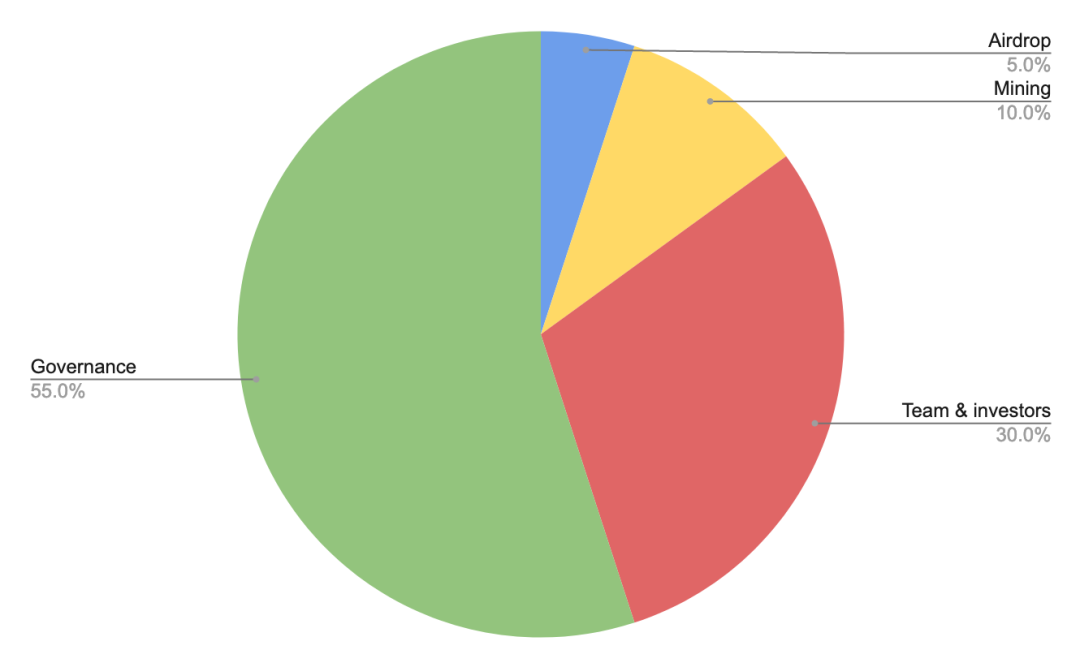
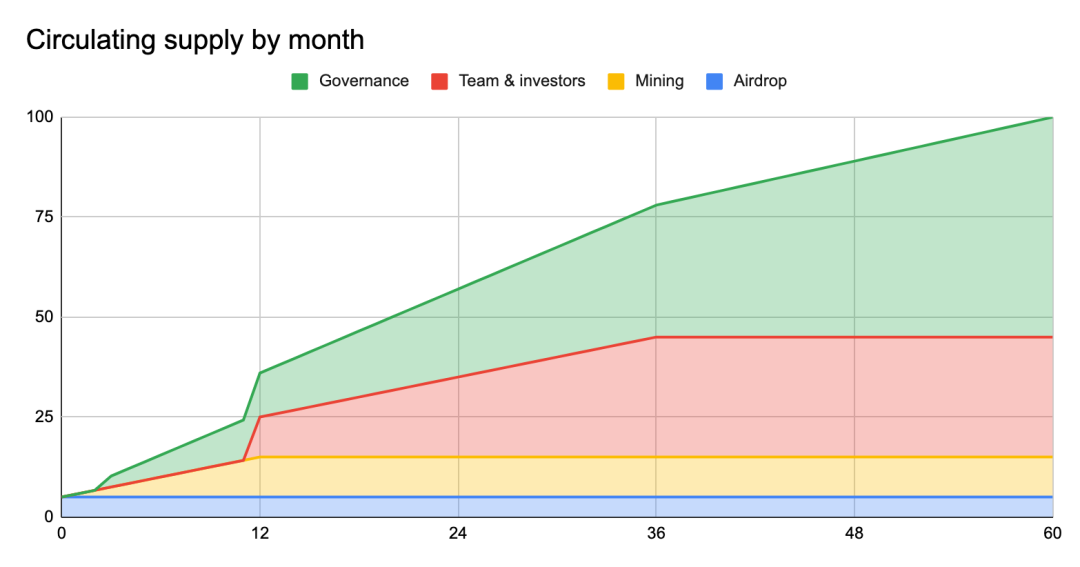
1Inch [6] and Tornado Cash community [7] proposed and awarded liquidity mining prizes successively to attract users to provide liquidity for tora-ETH trading pairs.
Currently, a TORN TORN with ETH liquidity on 1inch can earn an annual profit of 80% for 1inch, and an annual profit of 266% for the official liquidity bonus pool.
Since the mobile mining award is approved by the community voting proposal, and there is no front-end code developed, the mining entrance is accessed by the front-end of other tool products (such as VFAT [8]), which fully embodies the spirit of community autonomy.
6. The community
Governance and iteration of Tornado Cash follows absolute decentralization, so it has a good community atmosphere. In addition to the active Telegram and Discord communities, Tornado Cash's forums [9] already have 799 topics.
In addition, due to the nature of Tornado Cash's pluggable privacy component, other privacy projects on Ethereum can rely on Tornado Cash's private deposit pool for further exploration. For example, Blank Wallet [10] constructed a set of private Wallet based on Tornado Cash private deposit pool.
7. Governance
As a governance Token, TORN has more governance ability than other governance tokens. Tornado Cash has wanted projects to be fully autonomous by communities since its inception. After May 2020, Tornado Cash's team burned all the management rights of the deposit pool and could no longer shut down the project. In December 2020, the Governance Token went live along with the governance contract, and all future governance proposals can only be initiated and executed through the governance contract.
Governance and development of traditional projects are separate tasks. Any individual or organization initiates a proposal, and users vote on it before it moves on to further development. The rollout and deployment of the proposal remains in the hands of the team that controls the private key.
Unlike traditional projects, Tornado Cash users are required to provide a complete solution when they initiate a proposal. All proposals need to be developed in advance by the originator and deployed on the blockchain in the form of smart contracts for everyone to audit.
In order to initiate a proposal in a governance contract, the originator needs to have over 1000 TORN and point the proposal to a smart contract deployed on the blockchain. If the proposal is voted by enough TORN votes, anyone can call the execute() method to execute the executeProposal() function in the proposal to make it official, and no additional private key signature is required to complete the rest of the contract deployment, Token distribution, etc. Therefore, Tornado Cash may be the only project to achieve fully decentralized governance and development.
At present, a total of six community proposals have been completed.
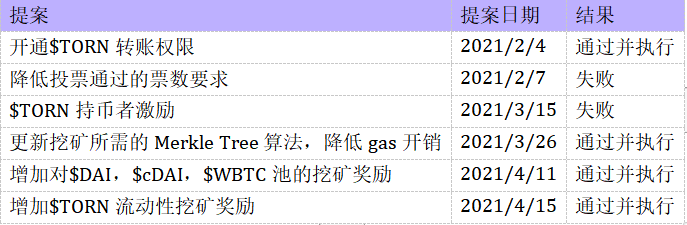
The community is currently discussing [11] the possibility of pledging TORN to register with relay nodes, which suggests that future TORN owners will be able to further decentralize and benefit from the deployment of relay node support programs. At the same time, the community is also discussing [12] adding support for algorithmic stablecoin Frax, with the view that privacy components and decentralized stablecoin should complement each other. There have also been calls for multi-chain (BSC, Solana, etc.) deployments, but few have responded.
Safety 8.
Tornado Cash realizes the privacy of on-chain transactions at the contract level. However, the privacy of on-chain transactions is not the whole of Tornado Cash.
Tornado Cash deployed the front-end of IPFS version and provided a full set of front-end source code on GitHub for users to deploy by themselves in order to prevent problems such as server disconnection, website access in some countries, and users who do not want to expose their access records to Internet service providers (ISPs). With the relay service, the user will make a request directly to the relay node, and therefore may expose his IP address to the relay node. Therefore, Tornado Cash suggests that all users make requests to relay nodes through VPN to protect their IP from being leaked.
In addition, Tornado Cash version based on Tor [13] is also provided. Tor version relay service is also provided by relay service providers. All network requests are forwarded multiple times to ensure absolute security. To avoid timing correlation between deposits and withdrawals, it is also recommended that withdrawals be made 24 hours after the deposit or after more than 12 other deposits have entered.
Therefore, Tornado Cash can achieve anonymous and stable access of users to the front end of webpage, relay server and contract end. As the number of relay service providers continues to increase, the stability of Tornado Cash service will be further improved.
9. Compliance risk
Although Tornado Cash has huge potential and market size as the only middleware currently available for private transactions on the Ethereum chain, it faces compliance risks that far exceed those of other projects.
Tornado Cash's Roman Storm has said that Tornado Cash is now autonomous and not controlled by developers. However, in order to meet the requirements of compliance, Tornado Cash still developed a report supporting the generation of legitimate transfer of asset sources through deposit certificates in V2 version, which includes deposit address, amount and date as well as withdrawal address, amount and date, etc. However, Coinbase, which is under strict compliance scrutiny, has also frozen accounts charged to Ethereum wallets that interact with Tornado Cash.
For Tornado Cash, how to ensure compliance and privacy at the same time is the most urgent issue to be considered.
Conclusion 10.
Tornado Cash, as the largest private transaction middleware on Ethereum, developers do not hold the project administrator authority and adhere to the implementation of community autonomy, which on the one hand protects the safety of the development team and on the other hand enables the project to fully realize decentralized governance and development and achieve long-term development.
We believe that as cryptocurrencies and trading platforms become compliant and regulatory regimes and supporting infrastructure improve, more and more people will take private transactions seriously. As the public chain with the most complete ecology, ethereum is bound to become one of the hot tracks for on-chain private transactions.
Tornado Cash will become an important part of the private transaction ecosystem, not only providing users with private transaction services directly, but also serving as the underlying asset of other privacy components. TORN as a governance Token of Tornado Cash, TORN has stronger governance ability and control over the agreement than other governance tokens, and has a good prospect in the future with the expectation of node election and dividend holding.
Note:
[1] Bitcoin White Paper:https://bitcoin.org/bitcoin.pdf
[2] The IRS is offering a $625,000 reward for cracking the Monroe coin:https://beta.sam.gov/opp/3b7875d5236b47f6a77f64c19251af60/view
【3】Dune Analytics:https://duneanalytics.com/poma/tornado-cash_1
[4] Huang Licheng:https://twitter.com/machibigbrother
[5] Official Medium:https://tornado-cash.medium.com/tornado-cash-governance-proposal-a55c5c7d0703
【6】1inch:https://blog.1inch.io/1inchs-joint-liquidity-mining-program-with-tornado-31077f65645?gi=18a1caeada35
[7] Tornado Cash Community:https://torn.community/t/proposal-6-torn-liquidity-mining-program/765
[8] VFAT:https://vfat.tools/tornado/
[9] Forum:https://torn.community
[10] Blank Wallet:https://www.goblank.io
[11] The community is discussing the possibility of pledging TORN to register relay nodes:https://torn.community/t/upcoming-relayer-election-mechanism/28/1
[12] The community is also discussing adding support for algorithmic stablecoin Frax:https://torn.community/t/proposal-to-add-frax-as-deposit-asset/328
[13] Onion Routing (Tor)https://www.torproject.org
The original source
Welcome to join the official BlockBeats community:
Telegram Subscription Group: https://t.me/theblockbeats
Telegram Discussion Group: https://t.me/BlockBeats_App
Official Twitter Account: https://twitter.com/BlockBeatsAsia

 Related Articles