Bankless: DeFi is eating the world, but users aren't hungry

The best Argument against encryption.
By Independent researcher Donovan Choy
The Way of Defi
In a classic 2005 essay, James Buchanan, a free-marketist and Nobel laureate in economics, argued that the predatory growth of the nation-state was largely driven not only by opportunistic politicians but also by citizens' desire to evade their personal responsibilities.
Politicians are empowered, Writes Buchanan, because freedom comes with more responsibility, and people fear it. Rather than face the spontaneous mandates and unpredictability of a free-market economy, they would embrace the "cocoon of protection" of a regulatory state, entrusting individual responsibility for civic life to a central guardian who will bind our wounds when we fall.

This is not a unique observation.
Almost two centuries ago, the French political scientist Alexis de Tocqueville made a similar observation when he left the French monarchy for the new American Republic. Tocqueville marveled at the new republic, but worried that the cost of democratic self-government might be prohibitively high. He thinks this could lead to a tendency for citizens to give up more and more of their freedom to a paternalistic and overreaching government.
In his 1835 magnum opus democracy in America, he wrote:
"The will of man is not broken, but softened, bent, and guided: Men are seldom compelled to act by it, but they are continually restrained from it; such power does not destroy, but prevents existence; it is not tyranny, but compresses, deprives, annihilates, and captivates a people, until each is reduced to a herd of timid and industrious animals, with the government as their shepherd."
In many ways, this is similar to the biggest weakness in cryptography today. It's a stateless system that needs to be autonomous, but it's hard to imagine that most users of today's encryption world have much interest in decentralization, or in having the discipline that decentralization requires.
Decentralization means self-management
DeFi's raison d 'etre is the democratization of the financial world. Thanks to the Internet and smart contracts, DeFi removes or reduces the influence of central entities -- governments, companies or, worse, a combination of the two -- over the banking sector. Think back to the Great Recession of 2007-08, and the combination was devastating.
Decentralization is desirable because it makes it difficult for organized groups to collude and manipulate rules in their favor; it is not a public good. DeFi promises to create a permissionless financial world where ordinary users are empowered to pursue their own financial freedom.
However, a stateless financial system is not the same as zero governance. This is an important point worth repeating twenty times. A common misconception is that no government is a synonym for no governance.
Many things in daily life are regulated by self-policing mechanisms generated by bottom-up spontaneous order and collective action, ranging from small things like social norms that regulate workplace behavior to informal rules that oversee the public communities in which we live.
Elinor Ostrom, an economist who won the Nobel Prize for her extensive empirical work, details how citizens govern themselves in forests, offshore fisheries, irrigation systems and policing without central intervention. A wealth of peer-reviewed social science research has shown that efficient self-government has a way of emerging in even the most unstable social environments, such as gangland prisons, impoverished authoritarian nation-states and the 17th-century Amsterdam stock market.
DeFi is no exception. The absence of political regulation only means that self-governance will become more of a self-responsibility. Rather than trusting politicians or centralised parties to regulate DeFi, it is a self-custodial responsibility that we choose to assume and develop.
Contrary to popular belief, DeFi is already full of mechanisms for self-regulation. These rules and self-adopted policies constrain blame shifting and prevent predatory behavior:
- The most common is the pattern of excessive capital pledging used in pledge and income farming to prevent debt accumulation.
- Another is the ubiquitous use of protocol tokens as a form of voting on protocol changes.
- Despite the lack of financial laws, many blue-chip DeFi protocols like Compound, Uniswap, or MakerDAO are willing to submit their smart contract code for audit.
- DeFi also offers insurance against smart contract hackers. The agreements in this submarket include Armor and Nexus Mutual, with TVL of $1.3 billion as of December 2021.
Mainstream media will continue to portray DeFi as the "wild West of finance". But the reality is far less turbulent or lawless than the metaphor suggests.
Self-discipline is universal.
Get used to centralized solutions
While formal rules and mechanisms will play an important role, they constitute only half the puzzle of governance. As Buchanan and Tocqueville point out, a system can be self-sustaining only if the users themselves are willing to participate in self-governance.
The indifference to decentralization is clearly visible. The best example of this can be seen in DeFi's attraction to centralized platforms and solutions.
Take Binance Smart Chain (BSC), the third largest blockchain, for example. Its verifier network has a total of 21 verifiers, which is very small compared to the tens and hundreds of thousands of verifier nodes in blockchains like Bitcoin and Ethereum.
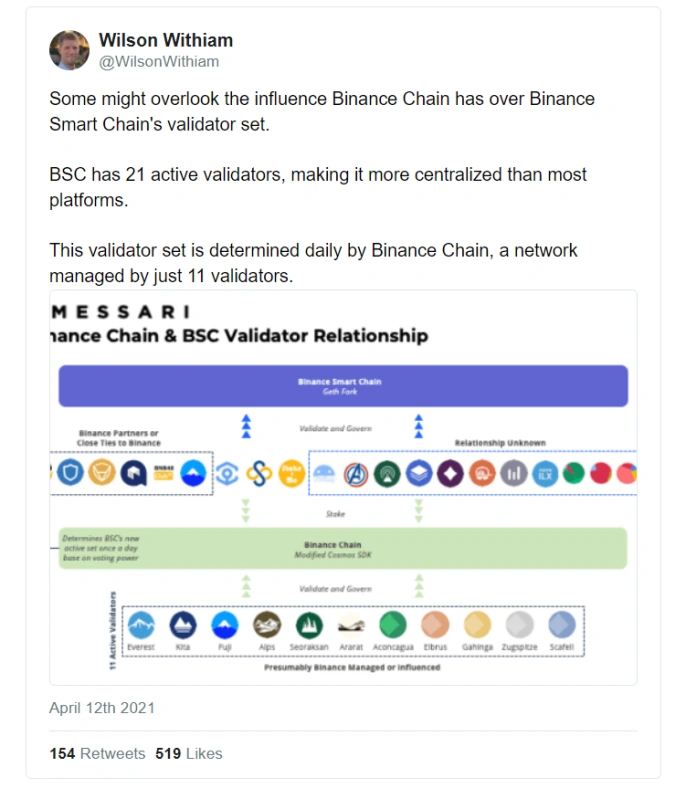
To be a verifier on BSC requires a whopping 519,000 BNB ($277 million) upfront pledge, compared to 32 ETH (about $80,000) on Ethereum 2.0 and 2,000 AVAX ($136,000) on Avalanche, Not to mention decentralized pledge pools such as Rocket Pool, which cost less.
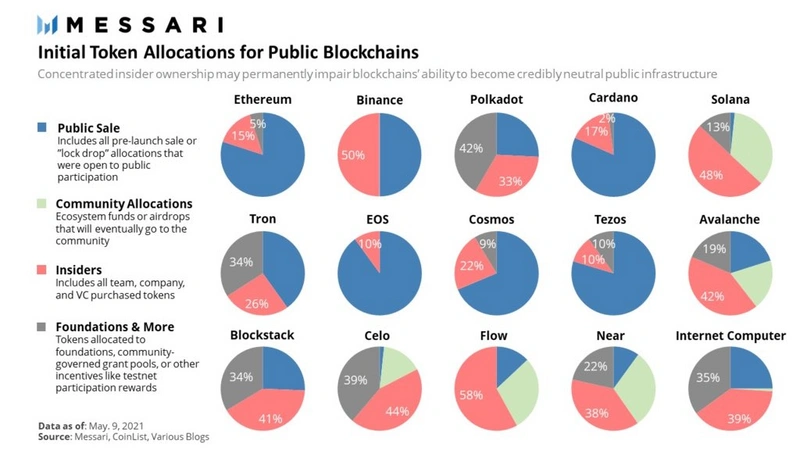
In addition, its native token BNB is also one of the fewest publicly issued tokens, with 50% allocated to insiders.
These are all red flags that are fine from a decentralization point of view.
However, the fact that the BSC network is relatively centralized does not affect most of its users. As of December 2021, the network's TVL was $16 billion, and subscribers continue to pour in, more and more.
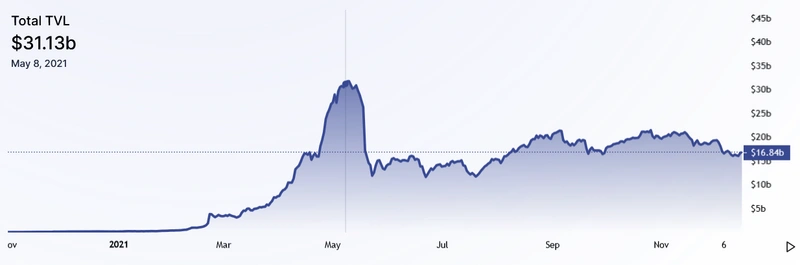
The appeal of the BSC is easy to understand. Because centralization allows for short-term scalability, users can avoid the high Gas costs associated with decentralized node validation. In the blockchain gaming space, where users often coin and trade NFT assets in games, a report by Dappradar found that BSC leads all other smart contract Layer-1, averaging over 750,000 unique users per day in July.
The trend towards centralisation is evident elsewhere. Take the insanely successful blockchain game Axie Infinity for example. To accommodate its explosive growth in June, it introduced a centralized Ronin side chain for scalability in the same month.
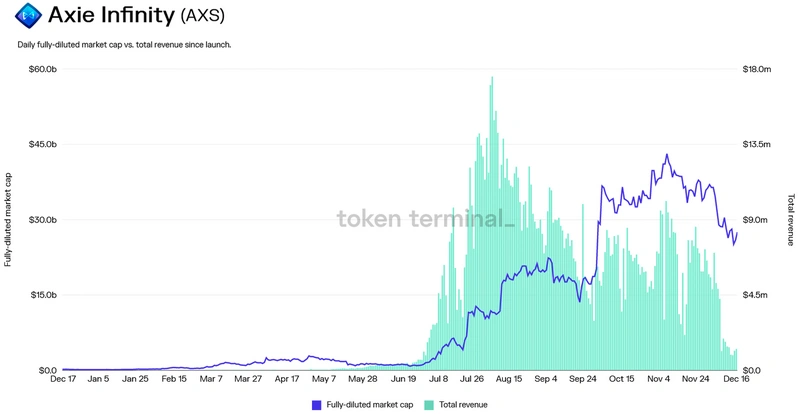
As a business decision, it proved ingenious and highly profitable. But from the perspective of encryption ideals, this is problematic. Centrally managed Bridges like Ronin's use a "trusted" model, which basically means that players don't rely on decentralization to validate their transactions, but on their reputation and the integrity of the developer. Axie's players sacrificed safety for short-term efficiency.
However, if developers have the power to remove or modify hard-earned assets, then game revenue (P2E) is no longer game revenue, but play-to-Hope-earn. This just takes us back to the traditional game world, where the big developer studios have too much control over how the economy in their games should work. When we consider that the majority of Axie players rely on the game as a respite from the economic devastation of COVID-19, the immutable economic ownership of their games is even more important.
Axie Infinity is not alone. Many other cross-chain solutions, such as BitGo's "encapsulated Bitcoin" (WBTC), have gone down the same tricky path of centralization, as encapsulated assets are fundamentally managed by a centralized entity that oversees the gateways and rules by which assets are locked and minted. As of December 19, 2021, about 259,000 bitcoins ($12.2 billion) were held by BitGo.
When asked about the future of multi-chain on a Messari mainnet panel, Terra co-founder and CEO Do Kwon joked that users trust him and that he "probably won't steal the $1 billion Shuttl bridge that Terra connects to Ethereum." (Kwon, to his credit, also acknowledges that this solution is too centralized to stand the test of time.)
Weigh security against cost
These are just a few examples of severe centralization, but there are many more that threaten the future of cryptocurrencies and DeFi's potential. It is perhaps ironic that there are so many successful centralized solutions in a world that claims "decentralization" as its biggest selling point.
Why does decentralization succeed in a space where decentralization is considered a core value? The most straightforward explanation is that users don't care. Maybe users do care, but they don't care enough to sacrifice cost/efficiency/economic benefits.
Users forget that Ethereum's Gas fees are simply a realistic price to pay as a replacement for the existing centralized financial system, which can afford to give us "free" transaction fees because it has achieved economies of scale.
We use blockchain products to dress and market in a decentralized, non-modifiable, user-owned language. But fake marketing belies the institutional reality that these products are centralized.
Ryan Watkins, an analyst at Messari, put it aptly: "Every cycle people get blindsided by the latest centralized solution to all blockchain problems."
The crypto world faces tension between DeFi's long-held philosophical ideals and DeFi's practical use here and now. Technology and developers are rapidly moving toward a decentralized world, but user needs and mainstream culture are still too accustomed to the speed and convenience that centralization brings.
Software may be eating the world, but users aren't hungry. This is an issue that the crypto world must confront sooner rather than later.
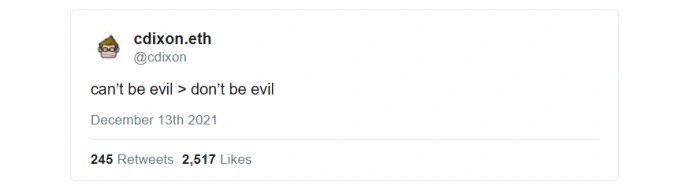
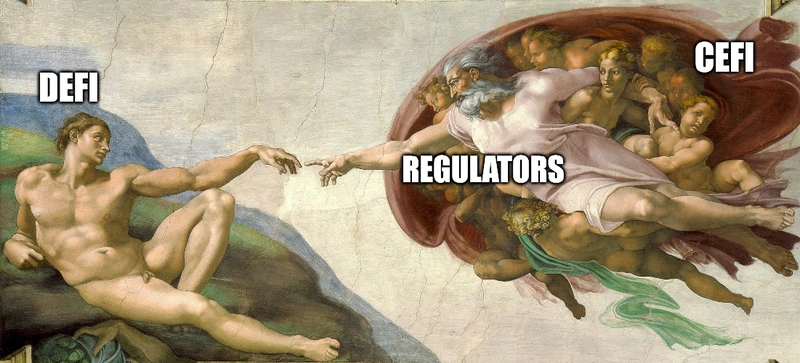
With each high-profile protocol hack, the arms of the state find more and more reasons to reach out to DeFi.
And how long before DeFi can get its arms back?
Influence and Conclusion
It is hard to blame centralised encryption products.
After all, companies are responding to user needs. If the user doesn't need them, they cease to exist. Until we reach nirvana of unmanaged, fully trust transactions and immutable assets, CeFi will inevitably play some role and DeFi's landscape will resemble an archipelago of CeFi, DeFi or CeDeFi solutions.
And then what?
We must not forget that decentralization is the key to the whole issue.
History is full of great societies that have taken disastrous turns when they made short-term trade-offs for profit. The path to decentralization isn't easy, and it shouldn't be. It will be fiercely resisted by rent-seekers, who exploit the apathy of ordinary users to try to keep their share of centralised profits. As long as users are not interested in self-governance, they will continue to be victims of protocol hacking, Rug pull, exploitation, and constant unrest from predators.
From a free-market perspective, this is not necessarily a bad thing. Attacks expose flaws, disrupt complacency, stimulate a trial-and-error discovery process, and lead to new knowledge. That's why banks pay white hat hackers millions of dollars a year. Mistakes and failures are only the price of innovation and progress.
The cryptocurrency community that cares about decentralization needs to support and nurture developers who are pushing these frontiers. In exchange for packaged Bitcoin products that rely on centralized custodians, we should support protocols and developers like renBTC that have decentralized networks. Instead of centralized stablecoins, decentralized stablecoins like Dai and Frax should be utilized whenever possible.
Artists and developers need to rethink the benefits of decentralized platforms like Genie, NFTX, or Rarible, rather than the centralized NFT marketplace by FTX or Coinbase. Users in their own DAOs must be hyper-sensitive to centralization trends, such as the possibility that their native tokens will be allocated.
It's going to get harder before it gets better, and the crypto space needs a lot of user education.
Most users who jump on the cryptocurrency bandwagon are attracted first by the high yields and then worry about security. The lessons of decentralization and the dangers of decentralization must be reiterated for newcomers and constantly reminded of ourselves. After all, betraying the ideal of decentralization would only defeat the whole point of DeFi.
The original link
Welcome to join the official BlockBeats community:
Telegram Subscription Group: https://t.me/theblockbeats
Telegram Discussion Group: https://t.me/BlockBeats_App
Official Twitter Account: https://twitter.com/BlockBeatsAsia
 Related Articles