Why do all future projects need to release Stablecoin?
Original title: stablecoins as Weapons
Author: Rywang-Signifier, Meta-cosmic Capital
We expect that releasing our own Stablecoin in the future will be a key to the success of a project. Stablecoin will be an offensive blade in bull markets and a defensive shield in bear markets.
Currency originated from the division of labor in trade
It was discovered long ago that trade brings The Wealth of Nations. Therefore, there are people who specialize in trade. They are called merchants. More trade required a more complex division of labor, and the expansion of that division led to the use of money.
Early humans everywhere chose a commodity as their currency at some point in time, because without it, the cost of calculation and the cost of trust in trade would be high.
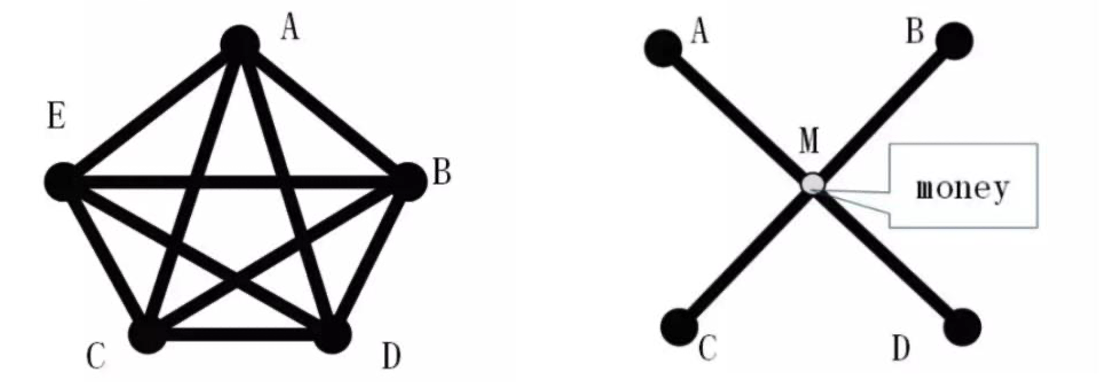
Figure & have spent 1 With money, there is only one price for each commodity to be traded
But pre-modern societies were not all about happiness. There were also endless natural disasters, poisonous snakes, and even wars among humans. As a result, families, governments, armies, religions and other closed organizations based on discipline have been organized, and division of labor has also emerged in these activities.
This division of labor is very different from the division of labor based on free market trade. The latter division of labor competition is the quality of goods, cost-effective and so on, the ultimate goal is the profit denominated in money. And the other kind of bureaucratic discipline organization, where resources are allocated by force and by rule, that is, the more violent, invented rule the group that has more adherents is allocated more resources.
Before the industrial revolution and global trade, the division of Labour discipline class dominated the human society, they also in the trade and participate in the market, but their goal is not to expand the market and expand the division of labor, but to gain power and paying subordinates, so they prefer natural scarce, the demand for their currency in order to control, such as gold.
Merchants were oppressed for thousands of years to organize and open markets, and were forced to use these scarce commodities as money.
Let's say there's a market. 10 Trade and division of labor activities, the income of each activity is respectively & NBSP; 10 Yuan, 9 & have spent Yuan, 8 & have spent Yuan... 1 Yuan.
The marginal cost consumers pay is the cost of using money, which is high when the money is scarce. 7 yuan, then income & NBSP; 10 The activity of the yuan will get 3 Yuan profit, revenue & NBSP; 9 The activity of the yuan will get 2 Yuan profit, when revenue is 7 Yuan activities are not profitable, income is lower than & NBSP; 7 The activities of the yuan can not enter the market division of labor, they are either eliminated, or can only be attached to the commandment organization, because the commandment organization can reduce costs by autocracy, obedience, faith, taboo and so on.
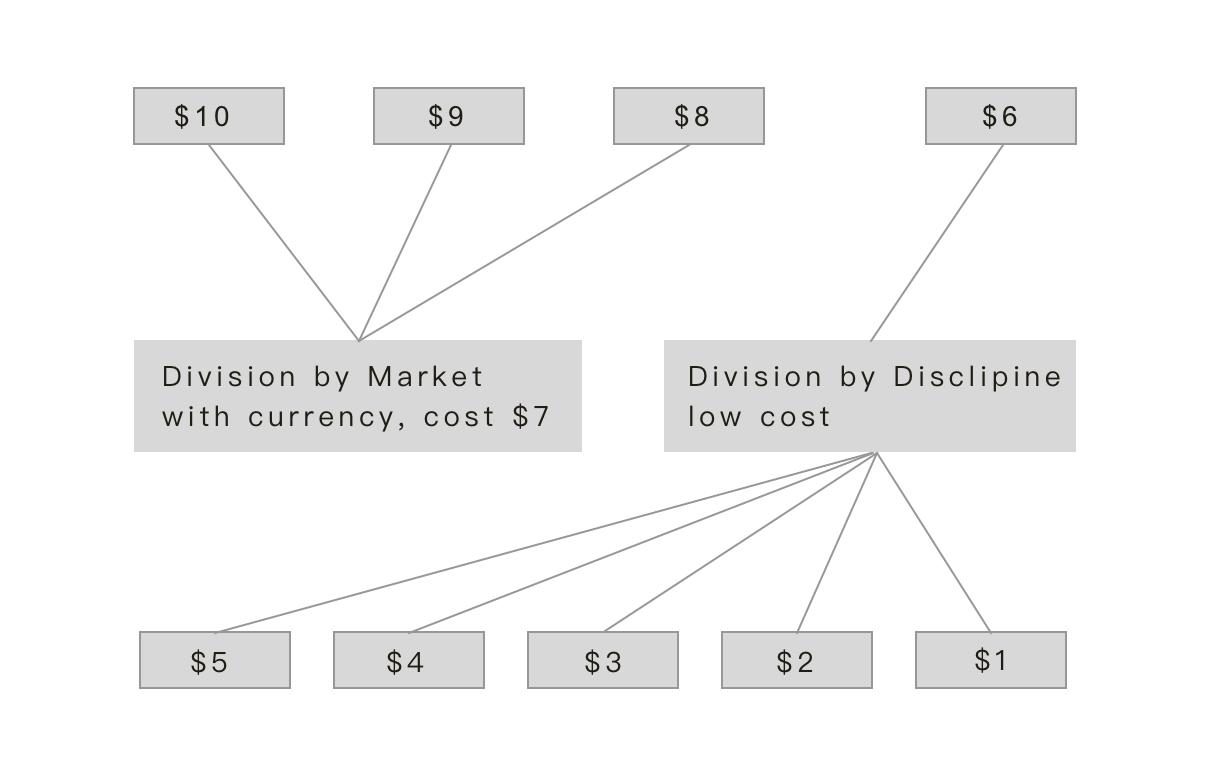
Figure & have spent 2 A shortage of money means that only some transactions can be market-based
Most people now realize that organizing and dividing labor with money is much more efficient on average than division of labor based on commandments.
In history, merchants and the bourgeoisie also regained the power to issue money through various struggles such as revolution and maintained it until today. But even going back to the previous case, suppose money is no longer scarce, and the cost of money goes down to NBSP; 3 dollars, so the result is a bigger market, a bigger division of labor, and a smaller division of labor based on precepts.
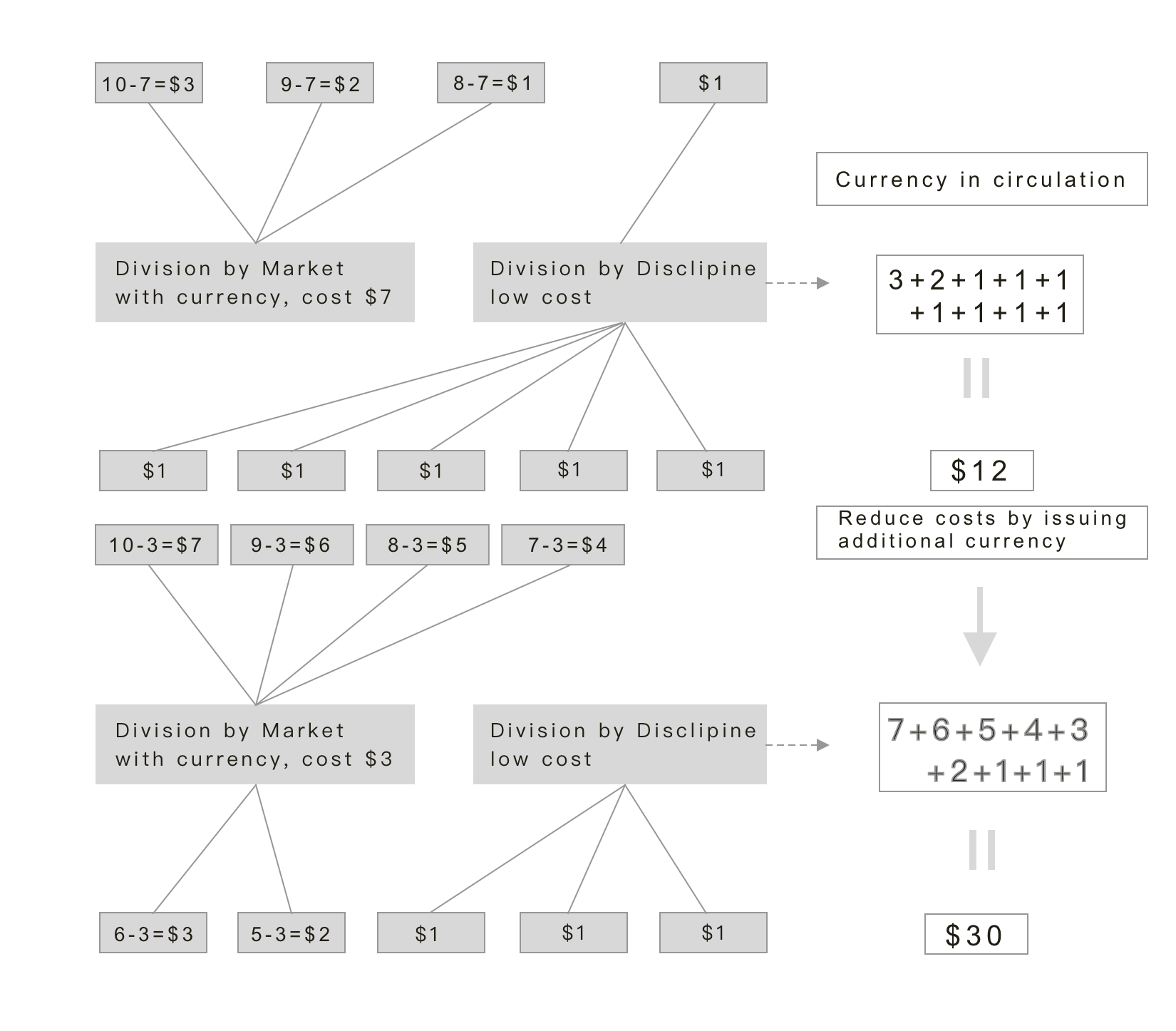
Figure & have spent 3 The increase of money brings about the expansion of market division of labor
It should be added that the increase of money here comes from the existence of the demand for division of labor, not from the increase of money by the rentier class in order to plunder the wealth of the masses.
In short, money based on slavery and reward simply could not compete with money based on the division of trade, leading to a shift in the right to define and issue money throughout history.
Credit money replaces commodity money
If use & have spent M Represents the market size. Represents the size of the transaction (i.e. the breadth of the market). Represents the type of transaction (i.e. the depth of the market). Represents the demand for money resulting from the size of the transaction. Represents the demand for money resulting from the type of transaction. The formula is as follows:
M = Qx Vy
When the amount of money is fixed, i.e. X + y = 1, then there is a "trade off" relationship between transaction scale and transaction type, which means that an economy with a larger transaction scale (breadth) will have a lower level (depth) of division of labor. It also explains why, in times of monetary scarcity, small countries -- Portugal, Spain, the Netherlands in the Age of the Great Voyages, and even Venice before that -- often acquired state power that did not match their size. Large countries, on the other hand, cannot become high-income economies. 200 The Ottoman Empire and the Qing Empire were called the sick man of West Asia and The Sick man of East Asia.
And when the amount of money can expand, that is. x + y > 1 , then the market size & NBSP; M, Market breadth & NBSP; Q, market depth & NBSP; V It's going to be multiplied. Therefore, in the era of credit money, the influence of small countries with a population of one million gradually decreases, while that of large countries with a population of one hundred million gradually increases.
Businessmen, bourgeois gain currency power did not immediately realize this problem, although the issue of paper money, but still is given priority to with the gold standard, in essence or commodity currencies, still exists the phenomenon of lack of money, while the expansion of the market no longer subject to the interference of discipline organization, but the merchant's own savings and wealth across generations pass has hindered the market demand expansion: As merchants made more money, they hoarded more and more money, leaving a shortage in circulation. The direct result of the decrease of money is the "internalization" of market competition: the level of division of labor decreases rather than increases, and the groups that have failed in competition fall back into the discipline organization, and even eventually bring about economic collapse.
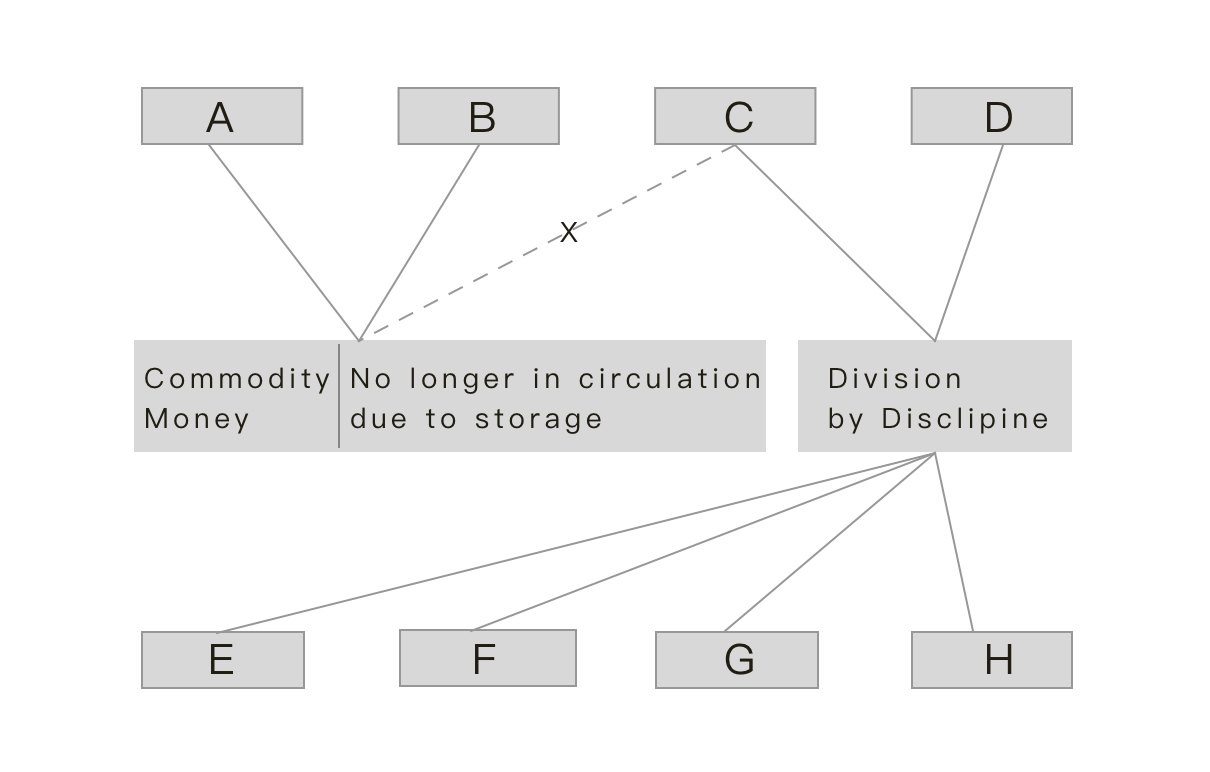
Figure & have spent 4 Due to the decrease of circulating money due to savings, some businesses have retreated to division of labor
Later, people solved the problem of money shortage by credit money priced according to "future earnings", and "future earnings" also separated from real objects and became a special commodity: capital, such as bonds, stocks, real estate, etc.
Competition between credit currencies
Behind credit money are "future returns", and good "future returns" mean more money can be created, which means more bubbles. Therefore, the competition for credit money is against common sense.
If use & have spent C Represents the capital created, i.e., "future earnings". Represents expected cash flow earnings. Is the discount rate, then:
C = d * R
There are two separate discount rates for any capital: the real discount rate & NBSP; d And the critical discount rate & NBSP; D. The former is the discount rate corresponding to the actual "future earnings" of capital; The latter is the discount rate at which "future returns" are maximised. If the critical discount rate D And true discount rate & NBSP; d The difference between d=D-d Defined as credit redundancy, risk can be written as D/d . The higher the critical discount rate, the lower the risk; The less credit redundancy there is, the greater the risk.
Critical discount rate & NBSP; D It can only really be confirmed in the event of a credit collapse, because credit cannot be infinite, so the critical discount rate. D There must be, but there's no direct confirmation.
When the expected cash flow returns are the same, different discount rates will produce different "future returns". If the market allows arbitrage, the credit with high discount rate will drive out the credit with low discount rate. Therefore, from the point of view of money quantity, the optimal real discount rate & NBSP; d As close as possible to the critical discount rate. D) to create more capital.
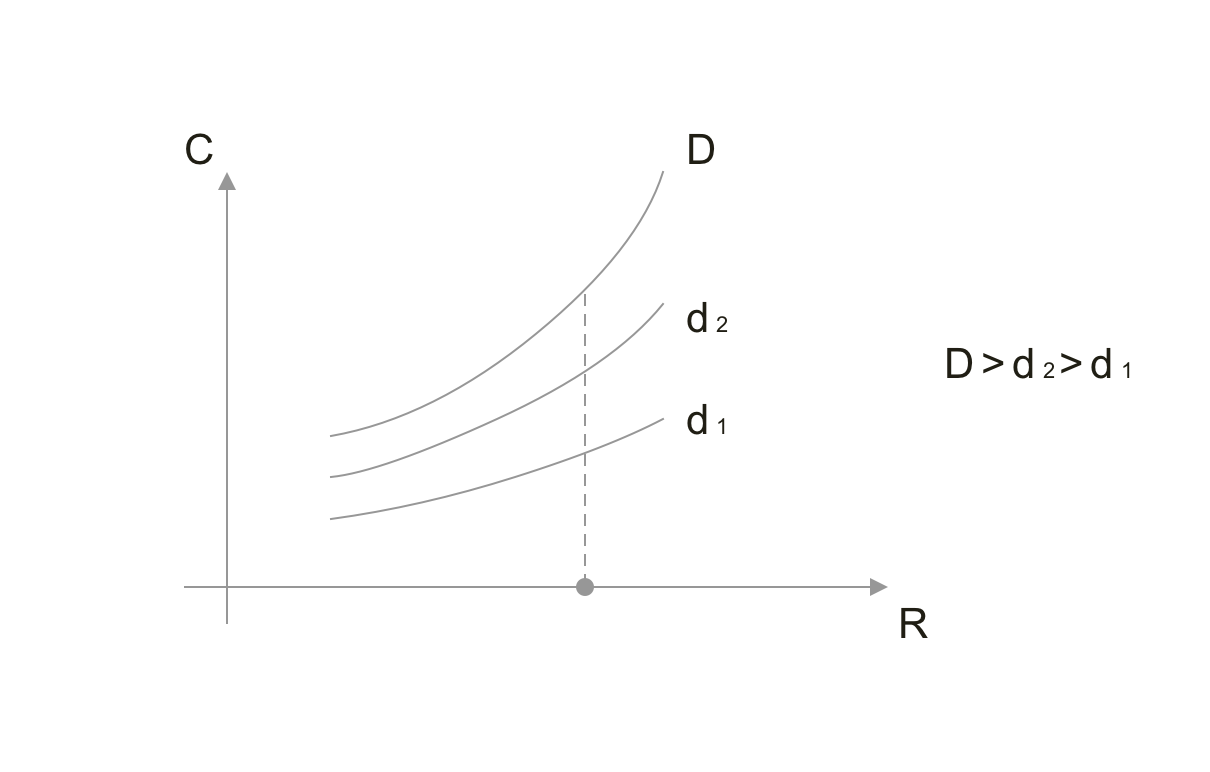
Figure & have spent 5 For the same cash flow, a higher discount rate creates more capital
On the other hand, from the point of view of risk, when. d Close to & have spent D When d Close to zero means risk. D/d Goes to infinity. If the pursuit of minimum risk, the optimal real discount rate & NBSP; d Should be close to & have spent Zero, that is, go back to commodity money, or cancel the market.
So there is no "optimal discount rate" that satisfies both maximum quantity and maximum risk; it implies a trade-off between efficiency and risk. So competition among credit currencies really depends on the critical discount rate. D) higher & NBSP; D It means not sacrificing. Can also get a higher real discount rate. d .
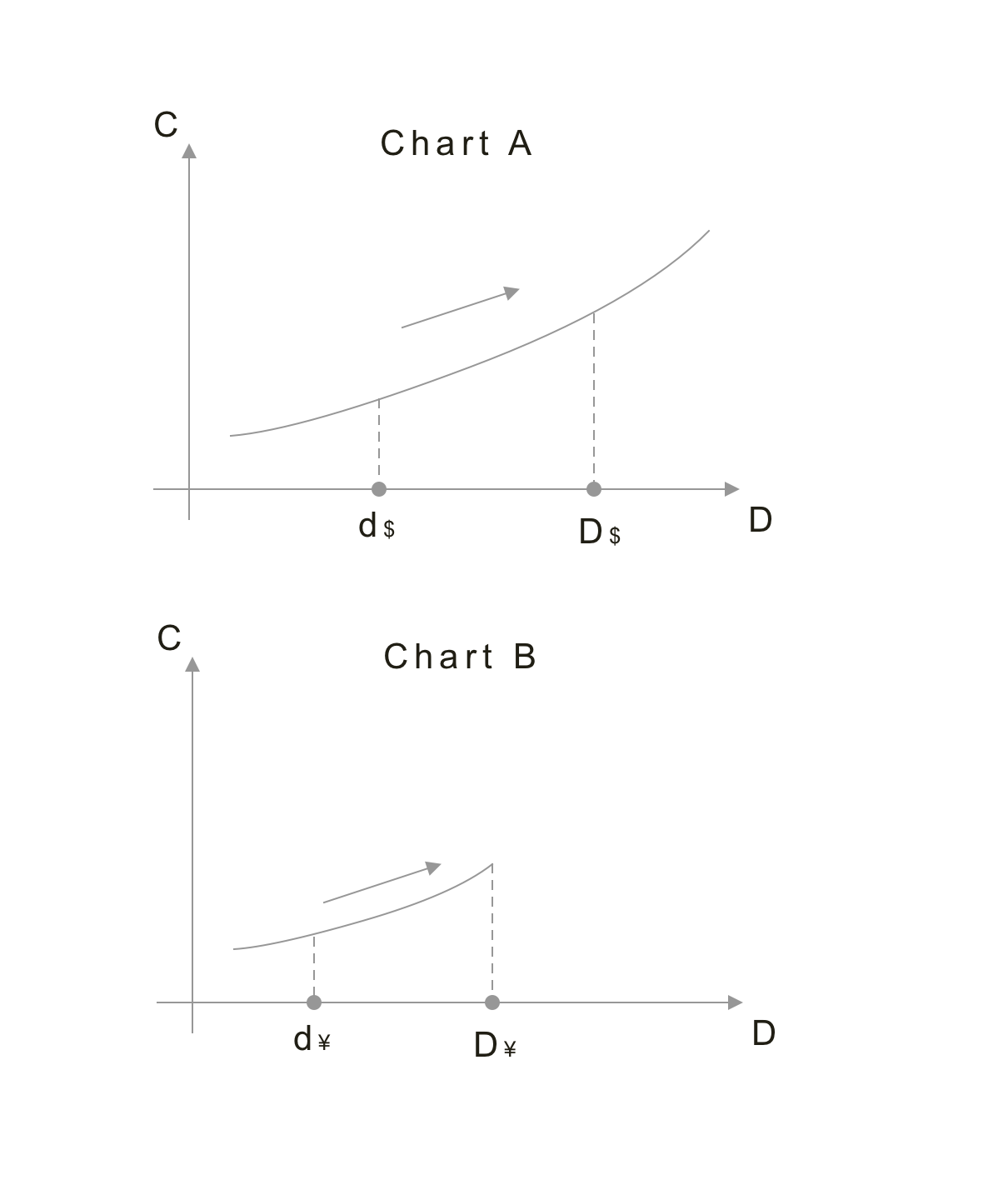
Figure & have spent 6 Currency $& have spent Money when it expands. Selections & have spent Will also expand
Suppose money. $ By & have spent A National credit generation, its critical discount rate & NBSP; D$ For & have spent 100; Currency & have spent Selections & have spent By & have spent B National credit generation, its critical discount rate & NBSP; D selections & have spent For & have spent 50. When two currencies are in open competition, as long as. $ Real discount rate & NBSP; d$ Up, because of arbitrage, then. Selections & have spent Real discount rate & NBSP; D selections & have spent Can only follow up.
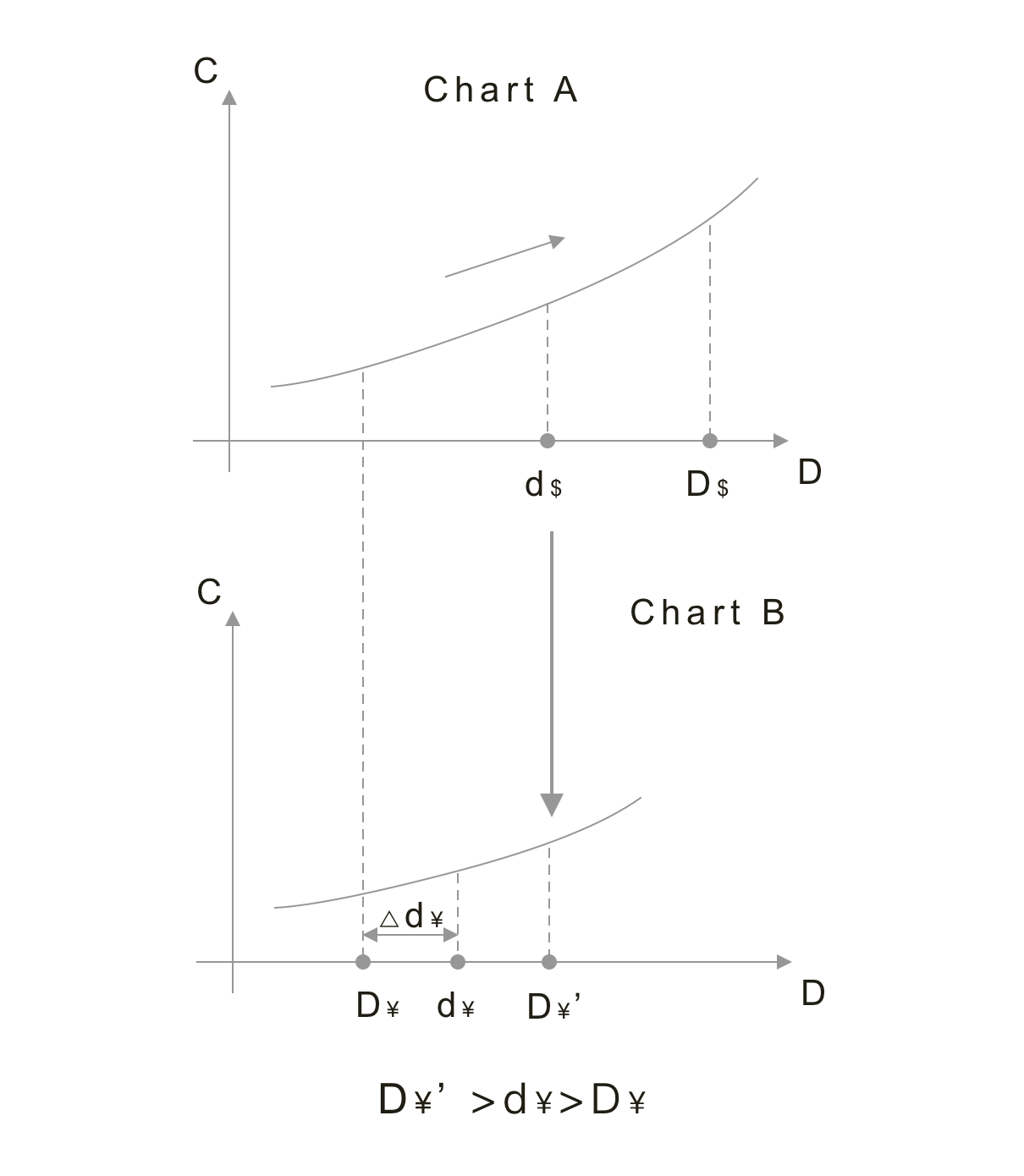
Figure & have spent 7 Currency & have spent Selections & have spent - D selections & have spent With money & have spent $ The & have spent d$ Synchronous process
Once & have spent $ The & have spent d$ Over & have spent 50, selections & have spent Further follow up will be close. D selections & have spent , cause & have spent D selections & have spent Close to zero, that increases the risk. Selections & have spent The best choice is with currency. $ Hook. Currency & have spent $ Real discount rate & NBSP; d$ It became money. Selections & have spent The critical discount rate of D selections & have spent .
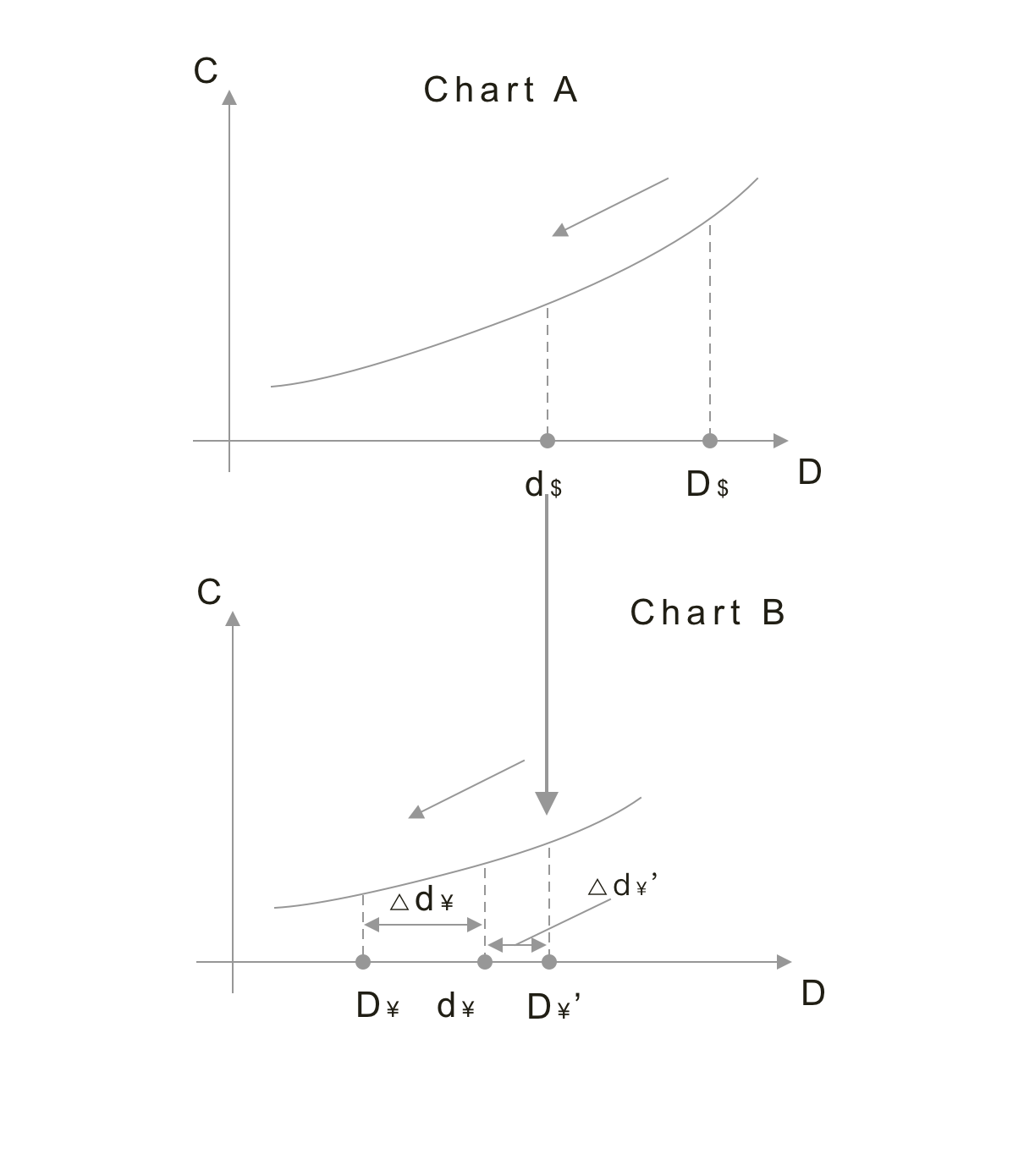
Figure & have spent 8 Currency & have spent $ The contraction of... D selections & have spent D ¥ And & have spent D selections & have spent There's going to be one close to zero
In a cycle of interest rate cuts and monetary expansion, currencies. Selections & have spent The real discount rate & NBSP; D selections & have spent Raise to own critical discount rate & NBSP; D selections & have spent (& gt; 50); But if you enter a cycle of interest rate hikes and monetary contraction, currencies. $ The real discount rate & NBSP; d$ Down to currency. Selections & have spent Real discount rate & NBSP; D selections & have spent Below, in currency $& NBSP; Real discount rate & NBSP; d$ As its own critical discount rate & NBSP; D selections & have spent The & have spent B In China, there will be credit redundancy earlier. Approaching zero, the debt crisis ensued.
In short, the competition between credit currencies is more about who can reasonably create a bigger bubble. Critical discount rate & NBSP; D The difference of is an advantage for the state subject issuing the fiat currency. It depends on national credit.
Four, from entrepreneurship to operation
All business models can be decomposed into two stages of capital growth and cash flow growth, i.e. start-up and operation, cryptographic and & NBSP; Web3.0 & have spent The industry is no exception. Can be expressed by the formula:
Entrepreneurial stage: C -- I = S, S & GT; = 0
Operation stage: R -- V = S', S' > = 0
Capital creation: C = R * D
Among them,
C Is capital, is the discount of "future earnings", expressed as the valuation of assets;
I Represents one-time investments, such as early-stage investments by VCS and funds;
S Represents capital surplus, that is, the part of market value greater than investment;
R Represents real revenue, such as platform pumping, on-chain; gas Consumption;
V Stands for variable costs, such as salaries, dao Incentives for community members, rent for office space, etc.;
S "& have spent Represents cash flow the excess of income over expenditure;
d Is the discount rate.
Most of the industry; Web3.0 & have spent Many ecological projects of application and new public chain are still in the start-up stage. In the future, they may face direct and strong pressure rather than a bear market. Web & have spent Companies compete.
They need to issue their own Stablecoin to get a higher valuation on the one hand. C, because Stablecoin has a higher discount rate, on the other hand, using Stablecoin will be faster to enter the market, actively acquire users outside the industry, and accumulate potential for future refinancing or entering the operation stage. Instead of waiting. "Once the crypto industry takes off, a lot of people will use our app," and it will be too late.
For Defi with large scale in the industry; Agreements and centralized trading platforms have entered the stage of operation. In the future, as long as they issue their own Stablecoin and use it as settlement and expenses, they can more easily create positive cash flow for themselves, consolidate their advantages, and explore new markets as planned without worrying about market fluctuations. At present, Amazon and Tesla, which have already formed the advantage of scale, do not issue Stablecoin themselves, but they can continuously earn fiat cash flow through their own operation, so they are not affected by the negative impact of stock price decline not caused by their own reasons.
For more mature projects, whether to issue Stablecoin is not a matter of choice, but a matter of order, because the project of Stablecoin will form an advantage to the project of no Stablecoin in the operation stage, the former & NBSP; Persistently greater than zero, with the latter accompanied by loss of power. Will be less than zero and eventually abandoned by users and capital.
Five, the conclusion
The human race has gone through thousands of years in the first chapter of the text, and the covenant in the second. 200 At present, it is going through the stage of chapter 3 of this paper, and the time so far is about 50 Years.
Cryptocurrency industry with & NBSP; 2015 Years & have spent bitfinex Online & have spent usdt Trading shanzhai coins has replaced. BTC As the time point of the shanzhai currency transaction, it marks that the industry has walked out of the stage of the first chapter; Now & have spent binance The exchange launched its own. Busd Terra Ust, as well as other issues such as The mim, ohm Stablecoin algorithm, marking the industry gradually into the second chapter of the stage; We can expect the industry to move into phase 3 of this article, no matter how tight the regulation is, when all projects will be asked "why not Stablecoin".
The original link
Welcome to join the official BlockBeats community:
Telegram Subscription Group: https://t.me/theblockbeats
Telegram Discussion Group: https://t.me/BlockBeats_App
Official Twitter Account: https://twitter.com/BlockBeatsAsia

 Related Articles