Dissecting 7 common design architectures, why is there no perfect decentralized Stablecoin?
Exploring the Design Architecture of Decentralized Stablecoins
By Joe Kendzicky
H.frost Ventures,Nevermind
Writing in the front
In this paper, the author makes in-depth analysis of DAI, MIM, alUSD, UXD, FRAX, FEI and UST Stablecoin series respectively, and analyzes the advantages and disadvantages of the above Stablecoin design architecture respectively. The author points out that the current Stablecoin mechanisms all need to make certain trade-offs and trade-offs among stability, capital efficiency, censorship resistance and scalability, and there is no perfect decentralized Stablecoin.
Due to the author's highly refined summary of each Token mechanism, the following parts require certain basic knowledge of relevant projects.
The text start
introduce
The decentralized Stablecoin track is currently one of DeFi's hottest tracks, with the USDC and USDT alone locking in around $100 billion. The current & have spent The Stablecoin ecosystem relies heavily on centralized systems, which contradicts the spirit of the industry, and creates huge opportunities for Stablecoin protocols that provide truly decentralized solutions. In this report, we will highlight some of the leaders in the decentralized Stablecoin field and analyze their design architectures. In addition, similar to the trilemma between throughput, security, and decentralization for L1 ecosystems, Stablecoin systems must also balance four key attributes: stability, capital efficiency, decentralization, and scalability. There is no perfect Stablecoin architecture.
PART.01 MakerDAO (DAI Stablecoin)
MakerDAO, one of the oldest DeFi projects to date, is a decentralized credit agreement that collateral various crypto assets and mints debt. The debt is in the form of Stablecoin DAI, which Maker uses a system of external market forces, incentives and policy tools to maintain a 1:1 peg to the DOLLAR.
Like a bank, a user lends money against collateral. In a banking environment, borrowers can pledge their houses, cars, accounts receivable, etc., as collateral for loans.
For loans against digital assets, the value of the loan must always be below the value of the collateral to protect the creditor from default risk or liquidation risk, which is closely linked to the liquidity of the collateral. To guard against this risk, borrowers can choose to deposit various collateral assets (ETH, UNI, LINK, YFI, etc.) to create debt, and each asset will have different margin requirements according to its degree of risk. Large liquidations of illiquid, volatile assets are more difficult, and larger buffers are needed to smooth out positions if the collateral falls below margin requirements.
Let's take a simple example of margin requirements.
Currently casting DAI in ETH-A pool requires A minimum mortgage of 145%. Suppose you deposit 1ETH, 1ETH = $4,000, and then you take out a 1,000 DAI loan. Your mortgage ratio is 4,000/1,000 = 400%. If ETH starts to crash and falls below $1,450 /ETH, then your vault will be liquidated. During liquidation, the agreement will sell your collateral below the market price, giving arbitrageurs an incentive to come in and pay off the debt.
How do we pay off our debts?
我们无法真正收回那些发给借款人的 DAI(DAI 是受用户私钥保护的 ERC20 Token ,而且借款人可能已经将其转移给其他人)。我们在公开市场上出售其 ETH 抵押品以换取 DAI。然后,我们将这 1,000 DAI 发回协议以销毁,同时关闭其未偿债务余额。与此同时,套利者执行此清算过程的动机是他们在清算过程中将收到一小部分抵押品作为奖励。
What's really cool here is that the protocol is permission-free. No credit check, no KYC process, no certificates of any kind; As long as you meet the margin requirements, the system doesn't care who you are, nobody can stand in your way.
Another cool feature is that, due to the permission-free nature, the borrower acts as both creditor and borrower. There is no real direct counterparty at the other end of the agreement (as opposed to traditional finance, where banks act as direct counterparties in the event of a loan default).
Different from the traditional lending system, the default risk is shared by the whole system participants, as shown in the figure below:

If the agreement cannot be reached in the Treasury debt > The system mints MKR out of thin air and sells it to the market until the outstanding Treasury debt is refunded. If for some reason MKR liquidity disappears and no buyer is willing to buy MKR and the liabilities in the vault remain, then DAI holders end up bearing the cost as their DAI is no longer fully supported and the market reprices them accordingly.
PART.02 Abracadabra (MIM Stablecoin)
Fundamentally, the Abracadabra protocol looks very similar to the system mechanism of the MakerDAO protocol.
Debt (MIM) is created without permission through an overmortgaged vault. If the collateral: debt ratio falls below a certain threshold, the Treasury is closed and the debt repaid by liquidating the borrower's collateral in the open market and using the repurchase MIM.
MakerDAO 和 Abracadabra 之间的主要区别在于 Abracadabra 保险库是通过存入 yvYFI、yvUSDT、yvUSDC、xSUSHI 等计息 Token 来获得资金。计息 Token 只是存放在货币市场协议中的普通对应物或者说是某种凭证(YFI、USDT、USDC 等),该类凭证可产生持续的利息。利息 Token 只是一个会计 Token ,代表在货币市场协议中用户所拥有的抵押品权益。

因此,我们可以使用它们来制造 MIM 债务,而不是简单地将这些利息 Token 被动地放在 Yearn 或 Compound 中。
One advantage Abracadabra offers is that the loan-to-value ratio tends to decline over time, since the collateral in the vault generates income over time.
From a user's point of view, this is great. This means that their debt is reduced over time, and users can mint more MiMs as their debt is reduced without having to post additional collateral (and keep the same loan-to-value ratio as in the first place). Alternatively, they can choose to keep their MIM debt unchanged, and their actual debt repayments when they close their vaults will be reduced.
Abracadabra offers fixed rates, unlike MakerDAO, which charges variable rates. Abracadabra also exists on multiple chains, allowing users to native MIM across chains. However, one of the drawbacks of MIM is the introduction of additional smart contract risk, since the collateral is ultimately held in a revenue generation protocol other than Abracadabra, and the associated external protocol risk has a direct impact on the user of that protocol.
PART.03 Alchemix (alUSD)
Like Abracadabra, Alchemix is a debt agreement that allows users to pledge collateral to a vault and to cast corresponding Stablecoin debt. Both agreements involve the use of income-generating assets (various income certificates) as collateral. The main selling point that Alchemix offers is loans that do not require liquidation. Let's explore how the protocol provides this functionality:
Upon Alchemix initialization, users overpledge Y assets to the Alchemix agreement against which alUSD debt is created (a minimum collateralized debt ratio of 200%). The only collateral accepted by its foundry alUSD is yDAI. This creates a one-to-one correlation between the volatility of collateral and the volatility of debt.
The only reason agreements like MakerDAO or Abracadabra exist that lead to liquidation is to prevent negative equity in the system. If I deposit $200 ETH in the Maker vault to make $100 DAI, and the ETH value subsequently drops to $95, now each DAI is backed by only $0.95 collateral, The system no longer has enough credit to warrant a $1 peg for Dai.
This is the inevitable dilemma of any debt deal using volatile collateral to back non-volatile debt.
But if we remove the volatility of collateral, we no longer face this challenge and can remove clearing requirements, reassuring users that there is no longer a need to monitor the margin of the vault.
Furthermore, since our collateral is a productive asset that generates income for us behind the scenes, we can use this accrual to actually repay the basic principal of the loan!
This is the nature of Alchemix's ability to "self-repay loans."
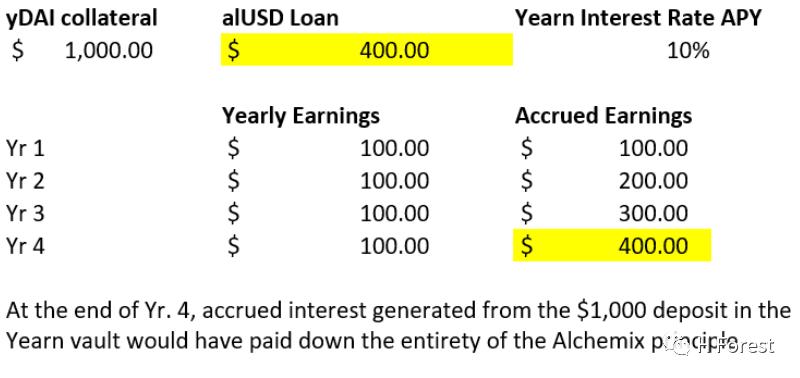
If there is no need for clearing, why overmortgage?
Without overmortgaging, we would be stuck in a recursive loop where depositors could issue debt indefinitely. Such as:
1. The user deposits 100 yDai into Alchemix and casts 100 alUSD debt
2. Sell 100 alUSD plus 100 Dai on Curve.fi
3. Deposit the new Dai profits into Yearn and receive 100 yDai
4. New yDAI are brought back to Alchemix and 100 alUSD are cast
5. An infinite loop
A 200% excess mortgage limits the total recursive leverage to 1 times the deposit. This means that if a user deposits $100 of yDAI into an agreement, they will never be able to mint more than $100 of alUSD debt.
PART.04 UXD protocol (UXD)
UXD is a Solana-based Stablecoin protocol that provides a novel combinational structure unlike any previous decentralized Stablecoin alternative. The key innovation here is that UXD uses an on-chain perpetuity futures contract (also known as a perpetuity contract) to create an on-chain market neutral derivative position to avoid the risk of one-sided market movements and generate a stable $1 value.
Let's take a closer look at its design architecture:
Derivatives markets such as Bitmex, Binance and FTX allow users to trade synthetic contracts that mimic the spot market, known as perpetual contracts. For example, Bitmex's XBTUSD allows traders to gain exposure to the BTC/USD price without actually owning the bitcoin spot asset. Perpetual contracts are widely used in cryptography mainly because they are simple, convenient (there is no expiration date, so there is no need for rolling contracts), and most importantly they offer leverage products. While many have scaled back in recent months, 100 times leverage has been common at some point for exchanges in the sector.
Every synthetic contract faces an inherent dilemma - how can our instruments keep the price of our derivatives at the same level as the spot market price?
While the goal of the XBTUSD contract is to mimic the price dynamics of BTCUSD as closely as possible, ultimately the two prices will never perfectly align unless there is a perfect supply and demand balance between spot and derivative order books, which is an impossible assumption. What happens if Bitmex's buying pressure explodes, but remains relatively stable on the spot? In this scenario, the price of XBTUSD contracts will rise while the BTCUSD index will remain flat. Derivatives will deviate from the base price predictor.
To overcome this, Bitmex has introduced an incentive mechanism called a "fund rate" that naturally links the two prices. The capital rate shall be paid every 8 hours, and the premium long short party shall pay the corresponding capital cost.
If the capital rate is positive (i.e., derivative price > Spot price), the bulls will pay a short premium. If the capital ratio is negative (i.e., derivative price < Spot price), then the short will pay a long premium.
Example: Suppose the spot index is trading at $50,000 /BTC and the derivatives are trading at $55,000 /BTC. In this case, the capital fee is positive (derivative price > Spot price). Thus, XBTUSD bulls will pay interest to maintain their position and the proceeds will go to their short XBTUSD counterparty. Bulls are paying for counterparty liquidity. If short demand exceeds long demand, the relationship will be in the opposite direction; The short will pay the long.
The greater the difference between the price of the derivative and the spot price, the higher the interest paid. As interest rates rise, it encourages more counterparties to step in to balance the long and short sides.
But what happens if bitcoin's price rises rapidly? Sure, you set it up to pay marginal interest every 8 hours, but what if the short's principal loss greatly exceeds your accrued capital payment?
1. Enter arbitrage & NBSP;
There is an interesting arbitrage opportunity - traders can hedge directional risk and insulate the cost of capital from the risk of asset volatility. Here's how it works:
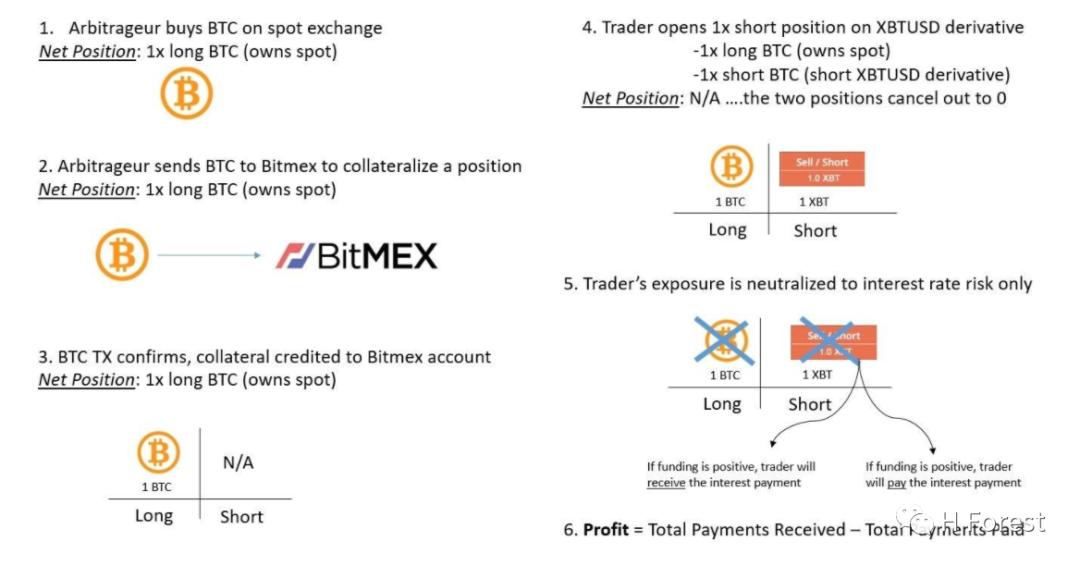
Suppose the trader buys $100,000 of BTC and uses it to open a 1x short position. To calculate how much interest he will earn/pay, we simply multiply the interest rate by the nominal size of the trader's position. Assuming the "default" funds rate is 0.01%, within the 8-hour window traders will receive:
$100,000 * 0.01% = $10
This may not seem like much at first, but what if we annualized this value?
$10 * 3 = $30 / day
$30 * 365 = $10,950/ year
$10,950/ $100,000 = 10.95% directional risk-free trade
0.01 per cent is the benchmark default rate, but in many cases the payments can be much higher. Historically, such deals have grown at an annualized rate in the 20-30% APR range. It can be even higher during bull markets, as demand for leverage soars and participants are willing to pay a large premium for counterparty liquidity.
2. UXD mechanism & have spent
Simply put, the UXD protocol receives funds and automatically executes this arbitrage strategy on behalf of its users. If a user sends 1 BTC to the agreement, UXD will transfer this 1 BTC to a decentralized derivatives trading platform (currently starting with Mango Markets, with plans to expand to other Markets in the future) and then use this platform to execute 1 BTC short collateral as margin for the trade.
Assuming a market price of $50,000 for BTC, this effectively locks in a $50,000 Stablecoin position. If the spot price of BTC increases, our short position will generate negative PnL(profit and loss), but this will be offset by a linear increase in the value of BTC's spot collateral. Similarly, if the spot price of BTC falls, our short position will generate positive PnL, but this will also be offset by the BTC value loss supporting it.
我们衍生品头寸的总价值保持在 50,000 美元。然后,UXD 向用户发行 50,000 个 Token ,代表他们从该头寸获得抵押品的权利。要赎回他们的抵押品,他们只需将 Token 发回铸币合约,协议将解除 Mango Markets 上的衍生品交易,将 BTC 抵押品返还给用户,然后销毁 UXD Token 。
Now, neutral derivative positions in the market have typically been accumulating interest rates. What about the funds?
社区治理流程仍在处理该模块,但预计这些收益的一部分将累积到 UXD 保险基金,以便在发生清算危机时提供系统保护(稍后会详细介绍)。另一部分将归 UXP 持有者所有,这是 UXD 协议的原生治理 Token 。因此,UXP 对通过 delta 中性利息产生的协议现金流提供准股权要求。此外,还有人谈论直接向 UXD 持有者提供部分应计利息,让他们能够自动收集其持有的 Stablecoin 的收益,类似于将其存入 Compound、AAVE 或 Yearn。
3.FRAX
Frax in its current state can best be described as a hybrid of centralized and decentralized Stablecoin. The core innovation of Frax is that it is a Stablecoin built using a credit model based on external market forces.
In short, the protocol uses an algorithm to perform the following three functions:
- Raise mortgage rates
- Lower mortgage rates
- Maintain current balance
Each FRAX is backed by a percentage of USDC collateral. To cast one FRAX at system startup, the user must deposit one USDC into the protocol. Over time, however, the price of FRAX will fluctuate around $1. The exchange rates of the centralized Stablecoin USDC and USDT also fluctuate, but eventually the arbitrage process converges the Stablecoin price back to $1.
The following is the arbitrage process under the centralized Stablecoin mechanism:
If the price of the USDC = $1.05, the arbitrageur mints the USDC by depositing $1 into Circle's bank account and selling it on the market for a risk-free profit of $0.05. Each time arbitrageurs send more USdcs to the market, they increase their supply to drive down the price. This cycle repeats until the 1 USDC price returns to the base peg price.
If 1 USDC = $0.95, there is reverse arbitrage. They will buy the USDC on the open market, send it to the USDC contract for destruction and redeem dollars from Circle's bank account for a difference of $0.05. As USDC destruction is caused by arbitrage, supply will decrease and price will be pushed up until 1 USDC price returns to base peg price.
FRAX takes a different approach to these mechanisms. When the price of FRAX deviates from $1 and stays there for a certain amount of time, an algorithm kicks in that increases or decreases the mortgage rate required to create FRAX.
For example, when the price of FRAX reaches $1.05, this signals to the algorithm that demand is greater than supply, because market participants are effectively buying assets at a 5 per cent premium to face value. The USDC centralization model allows arbitrageurs to increase the total supply of USDC to bring the price closer to $1 and gain risk-free profits through arbitrage.
Frax works differently. This agreement not only increases the supply of Frax through arbitrageurs, but also reduces the collateral rate of Stablecoin Frax (lowering Stablecoin pledge rates helps to further suppress demand growth to achieve a balance between supply and demand).
To use a simplified analogy, suppose a restaurant is faced with a 5% increase in food costs, and they are faced with several options to pass those costs on to the end consumer:
1) Increase meal prices by 5%;
2) Reduce portion sizes by 5%.
Or both.
FRAX responds to changes in supply and demand in a similar way, with arbitrageurs increasing their supply by a certain percentage (increasing the cost of meals) when the price is above the target price, while agreeing to reduce the pledge rate (making meals smaller).
Frax 协议的协议治理 Token 是 FXS,该 Token 在促进系统信用方面发挥着至关重要的作用。FXS Token 在信贷扩张期间积累价值,在信贷压缩期间流失价值。
FXS 本质上是该生态系统中的一种信用支持机制,可确保 FRAX Stablecoin 的充分抵押价值。尽管支持每个 FRAX 的 USDC 数量可能只有 83%,但这并不意味着 FRAX 的抵押不足,其剩余的 13% 价值差被 FXS Token 背后的隐性信用担保所取代。如果市场开始要求更高的 USDC 抵押率(表现为 FRAX 在一段时间内交易低于 1 美元),那么该协议将通过通胀的方式铸造更多的 FXS,并通过这种方式在公开市场上获得更多的 USDC,以此加强 FRAX Token 的 USDC 抵押率。
* the translator penReporter:
The agreement adjusts the mortgage rate by 0.25% per hour. The function reduces the mortgage rate once an hour when the price of FRAX is $1 or more, and increases the mortgage rate once an hour when the price of FRAX is below $1. To reconcile the contractually-adjusted mortgage ratio with the actual total collateral-to-value ratio, the agreement provides remortgage and repurchase capabilities.
Mortgage:
Anyone can call the Recollateralize function and check whether the total value of the collateral in dollars across the system is lower than the current collateral ratio. If so, the system allows the caller to aggregate the amount needed to reach the target collateral ratio in exchange for newly minted FXS at a certain reward rate. This is approximately equal to that when the mortgage rate increases, the system will purchase the corresponding USDC in the market by casting new FXS to increase the required reserve assets.
Example A: There are 100 million FRAX circulating at A 50% guarantee ratio. The total value of collateral for the entire USDT and USDC pool is $50 million, and the system is balanced. When FRAX's price falls to $0.99, the agreement will raise the collateral ratio to 50.25%.
It now takes $250,000 of collateral to hit the target ratio. Anyone can call the Recollateralize function to pool up to $250,000 of collateral and get the same FXS as the 0.20% bonus rate.
再抵押的过程,就是 FXS 通胀的过程,将增长市场上的 Token 抛压。
Redemption:
The reverse occurs when the amount of collateral in the system exceeds the amount needed to maintain the target collateral ratio.
Example B: There are 150 million FXS floating at a 50 percent collateralized mortgage ratio. The total value of USDT and USDC collateral is $76 million. FXS has $1 million worth of excess collateral available for repurchase.
Anyone can call the repo facility and burn up to $1 million worth of FXS to obtain excess collateral.
与之相反,赎回过程,就是 FXS 的通缩过程,将超额抵押品用以购买 FXS,将增加市场上的 Token 购买力。
When the agreement is pro-cyclical, that is, the demand is greater than the supply, FXS will continue to be repurchased by agreement with the continuous decrease of mortgage rate. On the contrary, the mortgage rate keeps rising, FXS will continue to inflation, and the market selling pressure increases.
Throughout the life of the agreement, we often see FRAX trading prices. $1, which allows the protocol to be algorithmically free of USDC over time.
Only 83% of every FRAX currently in existence is supported by the USDC. As mentioned above, this value can change instantaneously (although there is an inherent time delay...... built into the algorithm That is, it can't flip to 100% USDC collateral in a few minutes).
The main risk FRAX faced was a liquidity crisis at FXS. If buyer demand for FXS vanishes for some reason, the agreement may keep minting more and more FXS to try to raise the collateral ratio (and thus restore the peg), but without a buyer, it has diminishing marginal returns. In this case, the agreement would be in a bind, unable to obtain additional USdcs to increase reserves. Market participants may realize this and start selling their FRAX and holding other types of Stablecoin, driving FRAX prices below the peg level and further magnifying the problem.
4.Fei
Fei 是另一种算法 Stablecoin,与 FRAX 有一些相似的特征。然而,与 Frax 不同的是,FEI 渴望成为一个完全无需信任的 Stablecoin,而不依赖于中心化中介(USDC、USDT 等)。与 Frax 协议一样,Fei 协议在其设计架构中引入了 2 个独立的 Token :FEI(Stablecoin)和 TRIBE(治理 Token )。
原始机制通过使用协议控制价值 (PCV) 来维持汇率的挂钩。PCV 只是出售其原生 Token (FEI) 以换取一些外生资本 (ETH) 的一个花哨术语。该协议现在拥有 ETH 抵押品,并且可以根据需要进行部署。这于大多数 Defi 项目典型的流动性挖矿模式不同,那些协议本质上是以昂贵的价格租用流动性,并被迫支付高额的 APY 以吸引流动性。一旦这些补贴消退,流动性就会蒸发,协议便无计可施了。
In the initial design, the user would deposit $100 ETH, and the protocol would cast the corresponding 100 FEI in return through the joint curve. However, this process of casting FEI through the joint curve is a one-way channel; If you want to switch your FEI back to ETH, you have to trade through secondary markets like Uniswap. The system uses something called direct incentives to maintain price pegs.
1 FEI = $1 ETH collateral is market equilibrium, but what happens if ETH collateral falls below $1? Uniswap pool has a custom parameterization, which creates penalties for underwater price selling FEI transactions. The penalty is double the difference between the current FEI price and the $1 price (the bigger the difference, the bigger the penalty). Therefore, if FEI's price is $0.98, a penalty of ([1.0-0.98]*2) = $0.04 will be charged.
Similarly, if you buy FEI at a lower rate than the fixed exchange rate, you will receive a reward from the above seller's surcharge. So, in this case, if you cast a FEI for $0.98, you'll end up with a value worth $1.02. These are the infrastructure of direct incentives.
These mechanisms have proved inefficient in maintaining price exchange rate stability, with Stablecoin prices breaking anchor many times and failing to converge to equilibrium positions. Since then, a v2 version has taken a completely different approach to fixing FEI at $1.
5.V2
该系统取消了直接激励作为维持挂钩的主要模块,取而代之的是 PCV 收益分配和 TRIBE Token 支持。该协议将风险敞口从仅 2 个狭窄集中的资产(ETH 和 FEI)增加到现在的 7 个(FEI、ETH、DAI、RAI、INDEX、DPI、LUSD)。此处的目标是在更广泛的资产基础上分散风险,以减少下行波动率以及在 ETH 价格崩盘时 FEI 的脱锚威胁。此外,PCV 正在各种货币市场协议(AAVE、Compound、Lido、Tokemak)中部署,以持续获得抵押品利息,从而提高抵押比率。在某种程度上,FEI 协议几乎看起来像一个投资 DAO,其投资任务是保持系统 PCV > 用户流通的 FEI。
If the agreement fails to unanchor under V2, the TRIBE holder will give the system support to keep the price pegged to $1. In the event of hypocollateralism (i.e. PCV $value < Users circulate FEI's $value), and the TRIBE will be cast and sold on the market to raise money to fill the gap.
同样,如果 PCV:流通 FEI 比率继续扩大,TRIBE Token 将受益,因为一部分 PCV 将用于在公开市场上购买 TRIBE 并随后被烧毁,从而推高价格。
PART.05 Terra(UST)
UST 是一种去中心化的 Stablecoin,其价格由 Terra 区块链的原生 Token LUNA 支持。Terra 生态系统的核心是算法市场模块,该模块平衡系统激励以稳定挂钩汇率。
由 2 个 Token 组成:
- Terra UST: DOLLAR linked Stablecoin
- LUNA:Luna 智能合约区块链的底层 gas Token (即以太坊中的 ETH)
LUNA Token 本质上吸收了 UST Stablecoin 的波动性。当 UST 的价格在其挂钩价格之外交易时,这就是激励措施发挥作用的地方;算法模块将激励套利者铸造更多的 UST 供应,从而将价格推回平价。无论 UST 的市场价格如何,1 UST 总是可以铸造/赎回价值 1 美元的 LUNA。两者的价差 (UST 市场价格与 1 美元的价差) 为套利者提供了无风险利润,同时有助于维持 1 美元的挂钩平价。
As an example, assume that the UST is trading at $1.05.
- 套利者将价值 1 美元的 LUNA Token 发送到协议
- 协议将烧掉这 1 美元的 LUNA Token ,同时铸造 1 个 UST
- The arbitrageur then sends this UST to Binance and sells it for $1.05, making a 5% spread
最终结果:UST 通胀,而 LUNA 通缩。UST 扩张与 LUNA 收缩同时发生,导致 LUNA Token 持有者随着价格上涨而增值。LUNA 持有者是 UST 增长和 DeFi 生态的啦啦队长,因为他们是这些生态发展价值的直接受益人。
Now, assume that the UST is trading at $0.95.
Arbitrageurs will buy 1 UST on Binance for $0.95 and send it to the agreement
The agreement will always honor $1 of UST regardless of luna price. Arbitrageurs swapped 1 UST for 1 dollar LUNA.
Arbitrageurs then sell their LUNA for $1, making a difference of $0.05.
最终结果:UST 通缩,而 LUNA 通胀。UST 供应收缩推动价格回升至 1 美元。LUNA Token 持有者在此过程中遭受价值稀释,因为他们当前的持有量被新的 LUNA 稀释了。
UST/LUNA interchange is influenced by a highly reflexive feedback loop in both directions. UST has proven a relatively strong track record and it will be interesting to see how it performs in a bear market when increased pressure threatens to unanchor prices. The biggest worry is the death spiral scenario, when LUNA dries up.
PART.06 Comparison and analysis
1. Stability & NBSP;
Stability can be described as the effectiveness of the agreement in maintaining its $1 peg price. When the price & gt; Staying at par at $1 is easy. Staying at par when prices are below $1 is the hard part.
Having an efficient arbitrage process is the most critical component of stability. The faster this arbitrage process is completed, the more robust the protocol, because it reduces the time price range outside the hook. Ideally, even with the slightest deviation, we want professional arbitragarists to come in and take profits, immediately pushing prices back to where they were. Long-term deviations out of range increase protocol risk, cause users to lose confidence in market mechanisms, and exacerbate downward reflexivity.
Instead of trying to rank stability (too subjective), we will discuss the strengths/weaknesses of each project in terms of stability:
Dai: The Keeper robot is incentivized to fight against under-collated vaults by invoking clearing functions. Overmortgaging keeps DAI prices from going below $1, but historically, it's hard to stop prices from going above $1, because when DAI & GT; There's no direct arbitrage at $1.
2.MIM: The same as Dai & NBSP;
AlUSD: There is no arbitrage mechanism for rebalancing when alUSD price is unanchored, so alUSD is particularly challenged.
Under normal circumstances, when the selling pressure is greater than the buying pressure, it pushes the price below $1, regardless of whether there is collateral to back its intrinsic value of $1. This is because alUSD is primarily minted to gain leverage, and immediately after minting the user will sell their alUSD to obtain selected X assets. At the same time, buyer demand for alUSD is relatively low and there is little support for DeFi applications for alUSD, meaning there is little demand to hold alUSD in the market. As a result, prices will continue to fall slowly. To overcome this problem, liquidity rewards at the protocol layer are directed at 3Pool LP vaults, which provide liquidity between alUSD and DAI, USDT, and USDC.
UXD:UXD 可能具有所有非超额抵押 Stablecoin 中最强大的稳定性保证,其独特的结构甚至可以与超额抵押模型竞争。然而,与任何其他去中心化协议一样,UXD 在剧烈波动期间会受到挂钩不稳定的影响,在这种情况下,衍生协议可能无法正常清算,协议被迫承担损失。然而,这种风险的很大一部分是由各种系统利益相关者(包括 Mango Markets 衍生协议和 UXD 协议)在传递给 UXD Token 持有者之前便开始了。Mango Markets 保险基金提供第一道防线。如果第一道防线基金被耗尽,则 UXD 协议保险基金是第二道防线。最后,如果这两种资源都被耗尽而未偿还的债务仍然存在,则在支持协议风险的 UXP 治理令牌持有者中存在第三条防线(协议将凭空铸造 UXP 并在公开市场上出售以获取额外的抵押品填补空缺)。如果所有 UXP Token 的流动性完全蒸发,那么 UXD 本身将相应地在市场上被重新定价。我们认为所有 3 条防线都失败的可能性非常小,并且可能只会发生在行业终结事件中(例如,秘密机构开发了一台未公开的量子计算机,该机构通过每个加密协议窃取每个人的资产)。
FRAX:FRAX 在支持其 Token 的外生 USDC 中具有「强」稳定性。如果价格低于 1 美元,则有直接激励措施,有助于重振挂钩,但其中一个固有问题是,这些激励措施通过协议设计需要一段时间才能生效。
In addition, FXS holders guarantee the "undercollateralized" gap when market forces signal demand for higher USDC collateral. If no buyer is willing to come in and buy FXS and sell USDCS at the same time, the system is essentially undermortgaged because of the invalid value of FXS.
FEI is probably the weakest in terms of stability, because a) the collateral assets supporting FEI are themselves highly volatile, unlike stable assets such as USDC/USDT, b) lack of excess mortgage buffers, and c) lack of direct arbitrage mechanisms
UST: Unlike some other decentralized Stablecoins, UST has a very robust and well thought-out mechanism that directly incentivizes arbitrage when prices break parity and, just as importantly, this arbitrage can be executed very quickly. However, the system shifts UST volatility to LUNA to support price pegs. If LUNA's liquidity dries up, all sorts of reflexive downward loops occur. However, the event of a liquidity crisis is an inherent risk that affects all Stablecoin agreements and is therefore not a unique risk isolated only from UST.
3. Censorship resistance;
When talking about blockchain systems, people often conflate the qualities of censorship resistance and decentralization. But decentralization for decentralization's sake makes no sense. Instead, we use decentralization as a tool to implement a function: that function is censorship resistance. Centralized systems are not objectively better performance engines. They are cheaper, faster and more scalable than their decentralized counterparts. But because of their authoritarian nature, they create a central point of failure, which opens the door for certain users to exploit by those who control said power. Once a system has dispersed its design architecture enough to achieve censorship resistance, further decentralization will have diminishing marginal benefits.
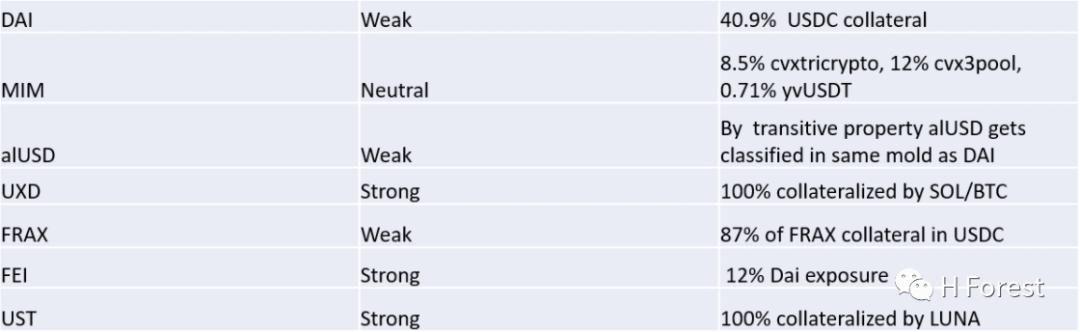
4. Capital Efficiency & NBSP;
An agreement that requires excess collateral is essentially a loss of capital efficiency, which makes the casting of new Stablecoin less attractive to the average user. In fact, the only real function of casting these forms of Stablecoin is to facilitate credit, that is, someone holds these existing spot assets and wants to repay these debts in the future.
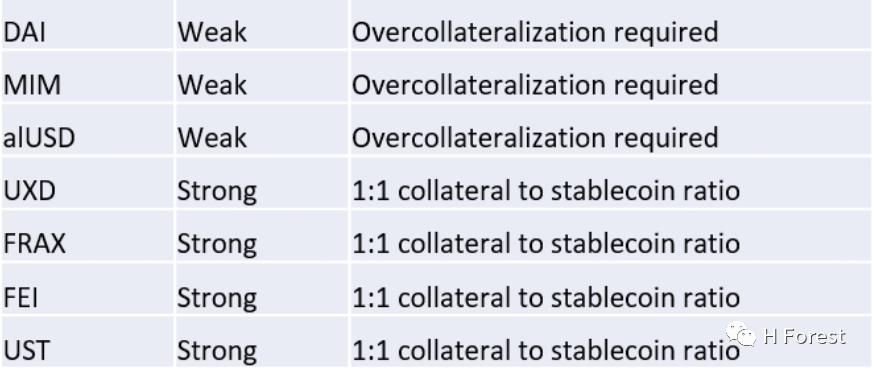
5. Scalability & NBSP;
Stablecoin 的优秀供应需要扩大,以应对需求的增加。如果与不同 DeFi 服务集成,相关 Stablecoin 的增长和采用率继续上升,但总供应量保持不变,则通过基本经济学我们可以得出,在这种情况下价格将不得不上涨。然而,这从根本上违反了 Stablecoin 令人垂涎的特性——实现与美元平价。因此,我们需要一种机制,让套利者和其他各种市场参与者可以通过向协议中存入新的抵押品并铸造新的 Token 来满足增长的市场需求(反映在价格 > 1 美元)。
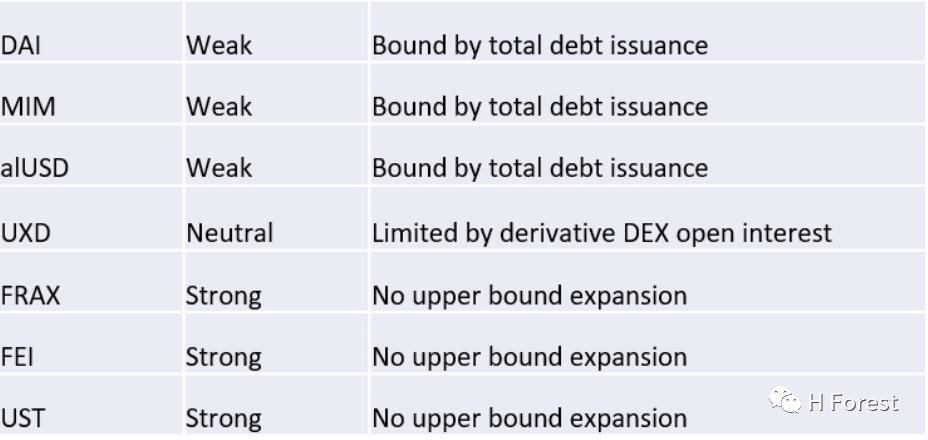
In 2021, we saw the emergence of many new decentralized Stablecoin models and witnessed the rapid development of this market segment. Each market makes trade-offs in the trilemma of capital efficiency, censorship resistance, and scalability, and no solution can be the "perfect" decentralized Stablecoin. While few have demonstrated that they have achieved product/market fit, the market value of decentralized Stablecoins is only a fraction of the market value of legally supported Stablecoins such as USDC and USDT, and given its stated goal of targeting a larger TAM(90T+) fiat money supply, We believe the space for decentralized Stablecoin will only expand as the native Internet successfully reaches a multi-trillion dollar supply.
* Translator's Notes:
不同于中心化 Stablecoin(如 USDC 和 USDT),去中心化 Stablecoin 机制目前主要是两种方式,一种是超额抵押+清算的模式;另一种是结合项目 Token 信用的流动性填补模式。后一种模式提高了资本利用效率,账面资产抵押率通常低于 100%,直接或者间接的通过治理 Token 公开市场操作来维持 Stablecoin 系统的阶段性稳定。Stablecoin 的流动性是非常关键的部分,当前的 Stablecoin 机制都有巧妙的通过各种方式去控制阶段性的稳定。但译者认为,从长远来看,成功 Stablecoin 的根本,是需要足够强大的生态支撑。就像 Alchemix,即使是 100% 的 Stablecoin 资产抵押保障,但如果其生成的 alUSD Stablecoin 没有相应的生态建立,也只会面临长期被抛售的情况。从这个角度来看,Terra 为 USTD 提供了其背后的一整个公链生态作为支撑,反而是基础支撑力最强的 Stablecoin。
The original link
Welcome to join the official BlockBeats community:
Telegram Subscription Group: https://t.me/theblockbeats
Telegram Discussion Group: https://t.me/BlockBeats_App
Official Twitter Account: https://twitter.com/BlockBeatsAsia