Ethereum developers: 2022 Layer2 to achieve mass market growth and launch tokens as soon as possible
Next year will be a key year for L2 vs L1 competition chain
The tao of the meta-universe
原文编译: Yangz
Note: Ethereum developer Ryan Berckmans posted his thoughts on Ethereum L2 on December 29th.
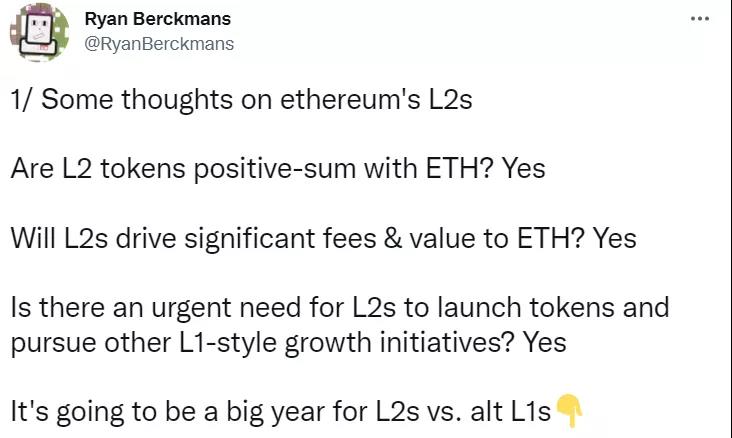
Some thoughts on Ethereum L2
· Is L2 Token positive sum with ETH? Yes.
· Will L2s bring huge cost and value to ETH? Yes.
· Is there an urgent need for L2s to launch tokens and pursue other L1-style growth initiatives? Yes.
This is going to be a big year for L2s vs L1 competitive chain
There have been some recent claims that seem to cast doubt on whether L2 and L2Token really could have a positive relationship with ETH. But the answer, in my view, is very positive, and I'll explore it through some of those claims.
For example, one argument is that L2 Token and ETH will compete in zero-sum. I don't agree with that. In my opinion, L2 Token and ETH are positive-sum. L2 Token can maintain premium from L2 network effect, confidence, etc., and pay ETH from premium. It's a win-win situation.
Another argument is that L2 does not end up paying huge fees to ETH because by bundling many L2 TXNS in one lot, L2 only needs to pay a small ETH settlement fee for a small amount of gas. In my opinion, this is also wrong. L2 will bring great cost and value to ETH for the following reasons:
· When L2 is successfully deployed on ETH, L2 gains a de-trust bridge from L1 to L2, including applications, tokens and liquidity. As ETH grows, these Bridges will accumulate a network of assets, allowing any L2 to access any other L2 or L1's assets in untrusted form.
· Each L2 growth increases the value of all gas in ETH's asset network as growth helps to channel applications, tokens and liquidity networks that are untrusted and programmable on Ethereum...
· As the ETH asset network grows, the average value per user will increase, the willingness to pay for block space will also increase, and the value of gas will increase as the total cost increases due to the fixed supply auction of L1 block space.
· The fact that the bridge is "trusted" is very important in the ETH asset network. By trusting the bridge between two mature L2s, your ownership of the assets on the bridge is as strong as the ETH in your L1 wallet. The bridge to L1, by contrast, is oversigned.
· What about the above statement that L2 for large volume transactions only pays the uniform ETH fee? If StarkNet can settle 80,000 transactions with a relatively low, uniform ETH fee, is that good or bad for ETH?
· This is definitely a good thing for ETH as StarkNet pays a high price in US dollars per unit of gas, and as StarkNet grows, so does their contribution to ETH's asset network. As ETH grows, there will be 100 other StarkNets coming in to do the same thing, and the total gas bill will be huge.
In short, I think the L2 ecosystem seems likely to work well and help Ethereum grow and accumulate a lot of value for L2 Tokens and ETH.
Given my general optimism about ETH and our L2 ecosystem, I would also like to address some of the growth challenges we may face next year.
Today, Ethereum doesn't seem to be doing very well in terms of user growth and is (temporarily) obsolete. Mass market users are flocking to the lower cost centralized L1, and some businesses/governments are building on other L1s due to the hard sales efforts of some organized commercial development teams.
I think the most critical milestone for ETH next year, aside from the q2 merger, is for the single L2 to truly deliver mass market growth. But how do we get there? To try and answer that question, I want to look at the question, "What is L2?"
What is L2? From the user's point of view, L2 is just a public chain. It has the disadvantage of being newer than ALT L1, but it has ETH first-class property, cheap Opex, and the support of the Ethereum community and the benefits of entering Ethereum to trust the bridge asset network.
I think it is more correct to think of the market for L1s and L2s as a single market for the public chain. Therefore, I feel that L2s of Ethereum may urgently need to consider exploring growth strategies that work for Alt L1s, including possibly launching tokens as soon as possible.
By the end of 2022, I am optimistic that our L2 will launch tokens, run incentive programs, and attract new mass market users and groups. Hopefully we'll see ethereum begin to mature and become the preferred benefit of the new public chain.
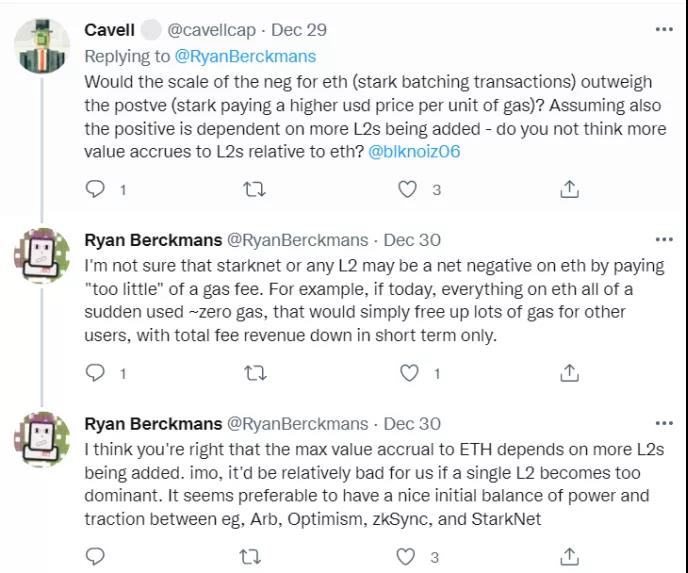
One Twitter user commented:
Will the negative effects of ETH (Stark transacting) outweigh the positive effects (Stark paying a higher dollar price per unit of gas)? Assuming the positive side depends on more L2 being added -- don't you think L2 has more value than ETH?
Ryan Berckmans replied:
I'm not sure Starknet or any L2 could have a net loss to ETH by paying "too little" gas. For example, if today, everything on ETH suddenly goes without gas (0 gas), then this will simply free up a lot of gas to other users, while total fee revenue drops only in the short term.
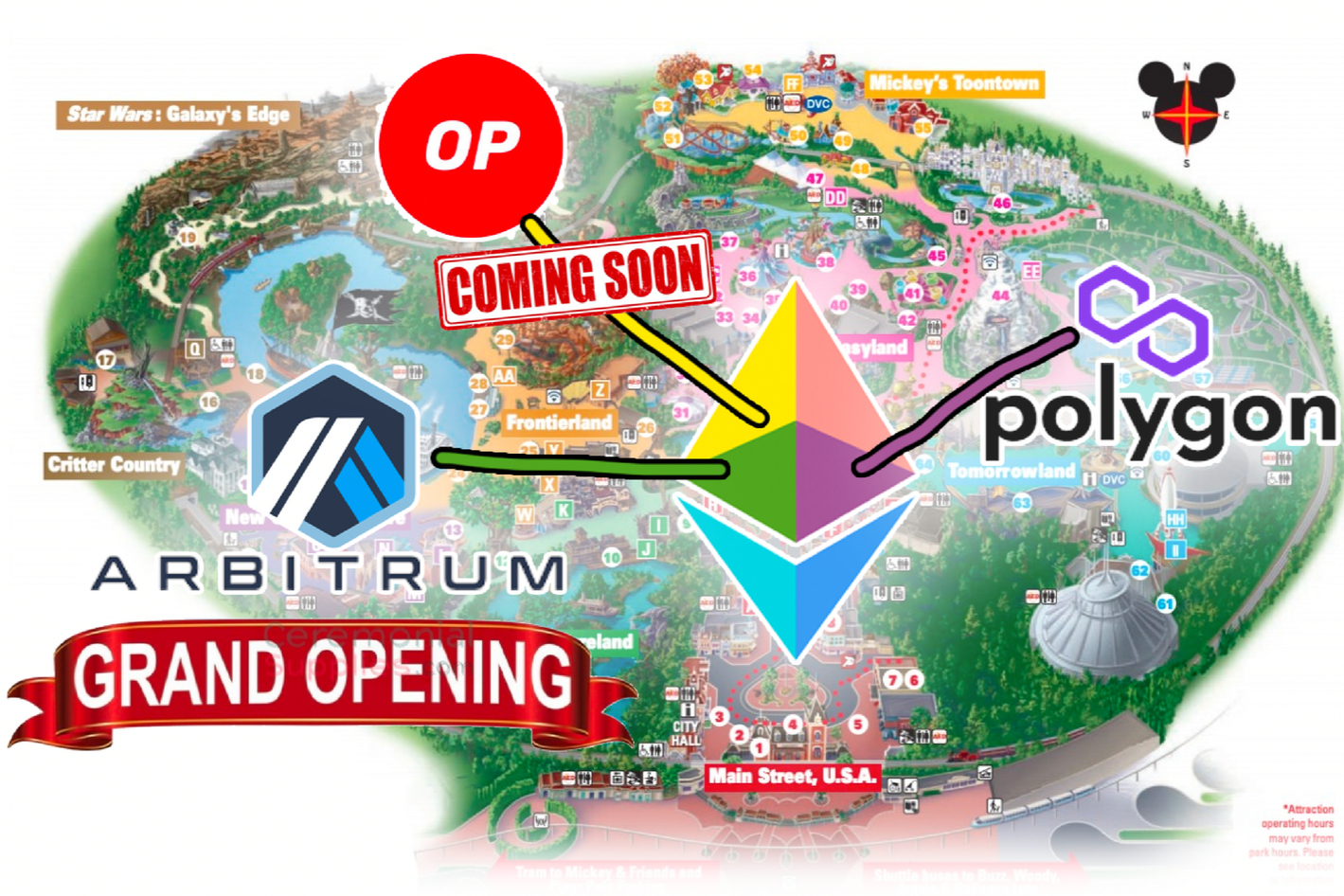
I think you are right that the maximum value of ETH is accumulated by adding more L2. I think if an L2 becomes too powerful, it's relatively bad for us. It seems best to have a good balance of initial power and traction between Arb, Optimism, zkSync and StarkNet.
Welcome to join the official BlockBeats community:
Telegram Subscription Group: https://t.me/theblockbeats
Telegram Discussion Group: https://t.me/BlockBeats_App
Official Twitter Account: https://twitter.com/BlockBeatsAsia
 Related Articles