The pattern is opened, so that the narrative leverage is full

Project fundraising is getting easier, yes, because there is more and more money in the market.
However, how much can your valuation get? The variance varies widely from project to project.
The price-earnings ratio is the most common relative valuation method in traditional finance. Indicators compare different projects. Tesla, as a representative of technology companies, has a price-earnings ratio as high as 315 times, while the top investment bank Goldman Sachs is only 6 times. In contrast, Goldman Sachs is 20 times that of Tesla in terms of earnings per share.
Is Tesla a bubble? You can say he is, you can say he is not. Goldman Sachs is so profitable, what is the difference between him and Tesla?
The key point is the narrative.
A narrative is a vision, an expectation, and a promise for the future. Some people will say, who can't draw cakes? Who wouldn't brag? Who can't fool people? The answer is that most people will just magnify everything that exists, instead of thinking about the world from another dimension. When the founder blows a bull that can impress investors, he has already succeeded in half, and the other half is whether he can blow the bull to the sky and let the world see it. Even if you can't realize your narrative, don't be afraid, you have provided a new way of thinking for the world, and this is not a bad thing.
This article is from the independent content blog Kowkchain, which tells the importance of narrative and the importance of narrative How to use various resources as a lever to achieve the next enterprise that changes the world. Rhythm BlockBeats translated the full text:
The changes in the IPO of technology companies
If the IPO process is like an icebreaker dance for college freshmen, then a top investment bank is like a professional training institution. They help companies dress up, teach them how to keep accounts in accordance with GAAP, take them to visit potential investors, and eventually launch an IPO and make their presence known.
For decades, investment banks have played this role, but in recent years, this situation is slowly changing. While the role of investment banks is currently unchanged in most industries, the importance and role of investment banks has shrunk significantly in the technology industry.
Looking back at history, it has always been very difficult to raise funds. Investors in the public market have not yet fully understood the companies seeking to be listed, nor have investment institutions Pay more attention to technology companies. This is especially true for start-ups, which retail investors are not familiar with or have no contact with at all. In this case, whether the company itself is unique enough is no longer important. On the contrary, investors have formed relatively standardized expectations about the benefits of their investment, and it is important whether the company can meet investors’ expectations. . So a company may have great potential, but they don't know how to present themselves to investors in the public market, which is a difficult problem they face when raising funds.
As much power as people have, the value added to their transactions will be as high as it is in every market. Although investment banks think they can ensure that public companies are high-quality and that there are no mistakes in the listing process, by now, this view is somewhat outdated. In the past, banks acted as gatekeepers. At that time, information was relatively closed, and investors needed to know which companies were good companies; however, people now have more access to information and companies are more famous. The role of "gatekeeper" is greatly reduced. And, as more and more investment banks now only handle the logistics of a company's IPO process, they have less say in dictating the terms of an IPO.
The best entrepreneurs have realized that good storytelling can get them twice the result with half the effort. More and more entrepreneurs and companies can tell their stories directly to investors, and the stories will be passed on among more investors. In the process of investors understanding the company's development, planning, and values, roadshows are less and less helpful. What makes companies go public through backdoor or direct listing and attract investors' attention is not only their own cost structure, but more importantly, they directly convey the company's philosophy to investors.

Since then, the company has been able to Create more direct connections with investors in the public markets. Many tech equity funds are now making both public market investments and private pre-IPO investments (even earlier). Investors like Tiger, Coatue, Durable and D1, or even T Rowe Price or Fidelity, no longer need to be introduced to companies by investment banks. They have followed the company's development for many years, and have learned about entrepreneurs and their companies in a more direct way. Entrepreneurs now have the ability to connect directly with investors who will be the backbone of their IPO phase. What's more, if the role of investment bank is added between the two, it will increase friction and the effect is not ideal.
Most tech startups go public with a big name, and this is especially true for consumer startups. Things like Airbnb, Roblox, Robinhood, and Coinbase were widely known and used before they went public. When your product is often used by investors (or their families) and is often covered by the media, there is no need to go on a roadshow to spread awareness for yourself. Getting your product used by users every day is a better marketing tool than any road show. There are also more and more well-known non-consumer companies. When companies go public today, they have more traction than companies that went public decades ago. Where once investors only cared about the technology itself, the company itself becomes more important and better known as it can IPO at a valuation of $50 billion instead of $500 million.
Another characteristic of the current market environment is that the range of earnings multiples that companies can obtain in the open market is very wide. It can even reach 2000 times. This is true for small backdoor companies and large IPOs, and what makes the difference is whether the stories they tell public market investors are compelling enough.
When the income is only a few times, we will say that this is just an ordinary IPO; when the income is as high as 2000 times, we will say that this is an IPO Amazing IPO. Such a significant difference also reflects people's confidence in the company's future development potential. This is the result deduced from the results. It may be based on the traction force, or the entrepreneur's ability, based on how he thinks about the company's current development, and how he will develop and continue to create more value for the company in the future as expected. plan.
Nowadays, capital is easy to obtain, and for entrepreneurs, if they want to get investment, they need to introduce themselves to investors in the public market Introduce the company's development plan and values, so that people have a correct understanding of your company.
Narratives have driven venture capital funding
This description of the public markets sounds like Not very familiar, and it is true.
The direction the public markets are headed today is actually not surprising, as this is exactly what the venture capital ecosystem has been doing since the early stages.
Over the past decade of startup funding, the size of the rounds has grown and, more importantly, the assortment of companies has grown The more detailed. Some companies with similar income levels have valuations that are not even in the same order of magnitude. Some companies can raise capital at 5x ARR (annual recurring revenue), while others can raise financing at 300x+. For pre-revenue companies, the valuation gap will be even wider.
More importantly, in the venture capital ecosystem, it is widely believed that founders should actively promote the financing process and recommend their companies to investors. Half a century ago, companies often hired investment banks to help them raise capital; today, if companies still do this, venture capital firms may not pay attention to it anymore.
It is the job of the CEO to clearly communicate the development and planning of a start-up to investors, and the CEO should communicate these things to investors every day or not just for show during fundraising.
There are three ways to raise funds: narrative type, turning point type and traction type.
The narrative style is driven by a compelling story.
The inflection point type is driven by a "secret" that will affect the company's development. When a company has reached an inflection point, savvy investors realize it's time to invest in venture capital.
Travel is driven by results already accomplished. Investors may not understand what the company does and invest entirely based on indicators.

And a secret thing is that the traction type is no longer re-existed. Because every company knows that our future will always be better than the present.
Ironically, those companies with the best traction tend to most want to be recognized for their future potential. No one wants to lie on military medals and granaries forever. If you want to get more profits, you need a perfect narrative to tell investors why the company can make more profits in the future.
For some companies, fundraising and IPOs just come naturally, and they choose to take a step back to tell their own stories well. These companies tend to get bogged down in the day-to-day chores that reflect on years of development experience. Fundraising allows these companies to think about how they can perfect their narratives, and it also makes more and more people understand the importance of extracting core information from the company's narrative.

Narrative leverage in an abnormal world
If the world stagnated or normalized, narrative would be less important. Historically, most companies have followed the old path pioneered by their predecessors. Let's say I'm opening a restaurant, and I already know the range of potential revenues and costs by heart. Without so many surprises brought by unexpected events, people can more easily see the current situation of the company, and it is also easy to calculate what the company will look like in a few years.
And those tech start-ups fundamentally broke that mold. They only need five short years to undergo earth-shaking changes, or they will be called industry unicorns, or they will be submerged in the torrent of the times.
Compared with other industries, one of the characteristics of the technology industry is that technology companies can choose a very segmented track and determine their position in the ecosystem. And this will make a huge difference to its future development.
From the actual situation, the larger difference is due to the continuous growth of the company's valuation. Every week we see a company raising money at a high valuation and importantly doubling their revenue. ARR growth of 100 times or even 200, 300 times or more is very common in the process of financing series A and B. However, this is not a normal thing, most companies will not be like this. However, such madness does exist. Some companies can raise funds at valuations that have increased several times, and the revenues of companies are also several times different, and the gap continues to widen. The valuation difference between companies with the same income level is also becoming larger and larger. This is the power of narrative, a good narrative is enough to promote the rapid development of the company.
There are several reasons why narrative is becoming more and more important:
Future development There is a large dynamic range. What this means is that a startup can start out worthless, but be worth billions of dollars a decade later. And the trend is expanding, with the biggest tech companies now worth trillions of dollars. And more importantly, over the past decade, most tech IPOs have increased by an order of magnitude. For example, corporate investors used to assume that, apart from a few once-in-a-lifetime opportunities, most corporate IPOs would be worth billions of dollars, and the entire business model of corporate venture capital was built on that assumption. We have all seen it now, and it is completely different. And when the dynamic range for a company's future development is so large, the level of confidence people have in the company's future becomes all the more important.
Backward weighted loan-to-value ratio. Most tech companies don't make money from the first interaction with customers, such as Saas, open source, free subscriptions, etc. This is common in many fields. This is one of the biggest trends in tech over the past few years, and well worth exploring further. It's not a bad thing that revenue is a lagging indicator, but it means that investors need to properly understand the value of a company and need to have a clear understanding of what is the main indicator driving future revenue. And this means that the company needs to clearly explain to others how the company's business should be viewed, and to convince people that based on current product indicators, it can extrapolate higher future revenue.
Expand into multiple products, or become a platform. After the scale is large enough, modern listed technology companies have reached a consensus: focusing on one product is not a long-term solution. If you want to gain a foothold in the industry for a long time, you need to expand multiple products or develop into a platform. This is almost the only way for every successful company. If the company only has a single product and never tries to expand multiple products or become a platform, it is difficult to say whether it will succeed in the end. The valuations of good companies will continue to increase, which will also provide sufficient funds for their future development, which in turn puts the onus on companies to explain why they can expand multiple products or call it a platform, and explain this to them. what it means.
Forward cycle. As a final note, our understanding of how to quantify and predict how much a forward cycle can pay off is still at a very early stage. Network effects, economies of scale, and some law that we have yet to name can all have a huge impact on a company's long-term value, but there is no easy way for us to extrapolate from a company's early performance. Companies must articulate the positive loops they are trying to build, which leading indicators reflect their potential, and why they are capable of growing.
Self-Fulfilling Prophecy: When Narratives Are Proven
Narrative levers are best in tech An example of this is Steve Jobs' "Reality Distortion Field".
I personally like to think of this narrative leverage as a form of the PE ratio (Price Earnings Ratio), which I sometimes call the PR Ratio (Perceived vs. actual ratio).
How do we determine if narrative leverage is good? We often see that the actual development of many companies is not as good as they boast. They are defrauding investors, such as Theranos. And those who have made exaggerated promises still need to act confident in order to marshal all the resources to make the rhetoric a reality, which is only a fine line from a lie. While there is no perfect way to tell the difference, we also need to understand how should we think about narrative leverage? What degree of leverage is reasonable?
We should also know that not all company narratives are unrealistic stories fabricated by entrepreneurs. Excellent entrepreneurs will extract the beliefs within the team and tell investors to give them confidence.
I think the analogy between narrative leverage and P/E ratios is apt.
In the public market, a stock's price-to-earnings ratio is the ratio of its market value to its earnings. This reflects how high investors value a company relative to its current earnings.
And if the value of a company is the net present value of future cash flow, then its price-earnings ratio roughly represents how much investors have for its future high cash flow Confidence. To put it simply, if two companies have similar earnings, the one with a higher P/E ratio means that its investors believe that the company will develop better in the future and have higher cash flow in the future. Over time, rapid earnings growth will allow it to grow as expected, the ratio will fall, and if investors continue to be optimistic about its prospects, the high price-earnings ratio will continue to remain high.
The revenue multiple of a start-up financing round is equivalent to the price-earnings ratio of the private equity market.
What are the benefits of a high price-earnings ratio? is the cheap cost of capital. It can be understood as a loan that a company borrows from the future for its future development while raising funds.
Is a high P/E ratio a good thing? The answer is not that simple.
If they have a high ROIC (Return on Invested Capital) on their use of funds, then they will have a good P/E ratio. And if your future prospects can take out a loan for your company, and you can use those funds very efficiently to make your predictions about the company's prospects come true, then this deal is very worthwhile. Investors' expectations of the company help your company move firmly in the right direction and ultimately realize the vision.
It's like magic, you can create something out of thin air. Also like ouroboros, devouring its own tail but somehow continuing to grow. How about borrowing money from future success to ensure our future success and call it "time travel"?
The price-earnings ratio is a continuously updated commitment to the future, it may be reasonable, and it may exist Bigger problem. If the company's earnings miss expectations, this will be reflected in the valuation and P/E ratio decline, and when the company does not have the ability to use its P/E ratio and investors' high expectations to improve the status quo, it will fall into the reverse cycle.
An outright fraud like Theranos certainly fails to live up to its expectations. Their price-to-earnings ratios are terrible, and regardless of the fact that once rapid growth has done them a lot of good, it's also impossible for them to grow to their valuation.
Complicating things are companies like Tesla. Over the years, there has been an extremely heated debate about whether Tesla is overvalued or undervalued, with extremely pointed views on both sides. And the reason they kept arguing about it was that both of them were right. The industry that Elon Musk works in, with the improvement of the industry cost curve, many new methods have been developed, but it also needs a lot of cheap capital to allow them to continue to do their work. Elon Musk is not alone in this trend. Likewise, similar trends are also emerging in areas such as artificial intelligence.
Therefore, it can be said that Tesla's price-earnings ratio is realized by itself. If Tesla can continue to get capital through more channels for a long time, it can succeed; if it can't, it will collapse. Ironically, instead of losing investor confidence, Elon Musk's antics have allowed Tesla to maintain a high price-to-earnings ratio, and this ability of Elon Musk may be the most important driver of Tesla's success.
But this concept is not unique to the public market. In a sense, the social capital of ordinary people also has the concept of price-earnings ratio. The price-to-earnings ratio in the public market is just one example that is easier to understand. This concept also represents a view of a certain future prospect, and allows companies to benefit from a bright future now.
Narrative leverage refers to a company's price-to-earnings ratio. Not just for lower future capital costs, but for everything else the company cares about, making recruiting, customer outreach, and internal coordination all the easier.
Venture investment as a social bet: the future is dominated by entrepreneurs
Modern venture capital itself is not just a matter of money and the cost of capital. Most entrepreneurs give top VCs a discounted price. Today, top VCs are paying more than money and lending their brands to start-ups. Doing so can lower the cost of capital, staff and customer acquisition for start-ups.
LP may be concerned about whether a company has good returns, but this has nothing to do with entrepreneurs There is no intrinsic relationship. What matters is whether these returns translate into stronger brand equity or the entrepreneur's personal reputation. This is why venture capital today presents a pyramidal power structure, with institutions at the top of the pyramid receiving most of the returns.
In today's ecosystem, however, companies have more and more narrative leverage Many, even more than venture capital institutions. Top companies and their founders are sometimes better known than their capital. Patrick Collison, the founder of payments provider Stripe, for example, attracts investment, customers, and employees far better than any venture capital firm. More and more entrepreneurs are beginning to have stronger brand influence than VCs. This is both due to the increasing importance of entrepreneurs and the stagnation of VCs in addition to helping companies improve their brand network effects.
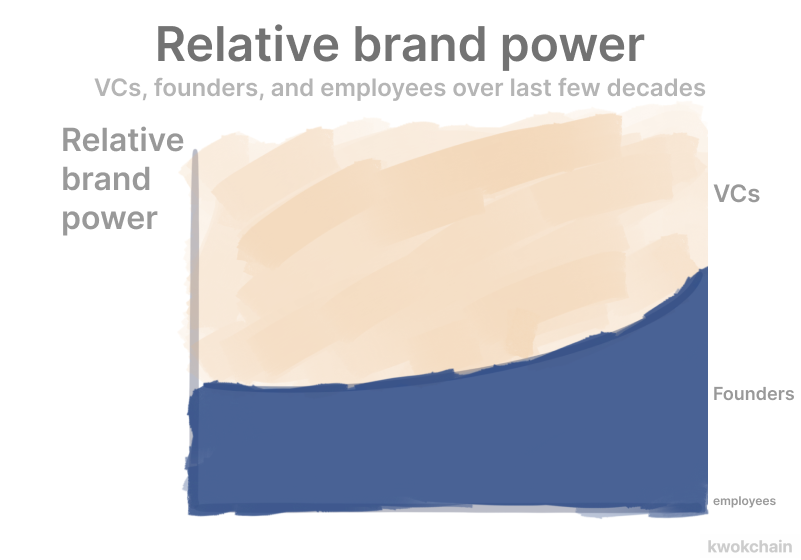
Entrepreneurs are better able to enhance brand leverage than investors. Entrepreneurs can build their company while refining their narrative so that it is compelling and resonates with all potential investors, employees and customers. In addition, they have all the resources of the company to make the story they tell come to life.
Narrative sublimation is the core of company construction
Every functional department in the company is going on Internal construction, among which, the engineering department is definitely the top priority. The sign of the formation of modern software companies is that they realize that the engineering department is by no means a back-office department that the company wants to outsource, and should not be a mere outsourced product, but the core of the company's development.
In today's era, any company that wants to succeed is increasingly dependent on internal compound development. Not only that, but in today's environment where it is difficult to achieve something but it is also difficult to remain unknown, arbitrage through external channels has become the norm. Whenever you explore an emerging market or a promising acquisition channel, other competitors will immediately swarm in, and the excess returns you have obtained in a short period of time will be restored to their original form in an instant.
However, internal compound development is a powerful means to counter this situation, so we have been emphasizing the importance of network effects and economies of scale. If the company's development is compared to a polynomial equation, then when the scale continues to increase and eventually approaches infinity, only the size of the highest order term can play a decisive role, and only the internal organization or ecosystem of the company can not be affected by the outside world Continuous compound development.
While engineering is central to the company's growth, it's not all that different - a non-commoditized function with high returns per iteration will follow the same path of development.
The process from marketing to profitability also follows this path. In the traditional model, marketing is carried out after the product has been developed, that is, the company generally chooses to hand over the product to the marketing team before it is about to go live. To know whether a functional department is the core of the company's development or an outsourced product, the simplest basis for judging is: 1) whether the function has something special in the company that distinguishes it from other companies; 2) whether it has a feedback loop within the company, or Rely solely on external channels to complete.
It is impossible for the company to remove the modern growth team from its core process, but in fact, the company's core product development and engineering construction are all done by them Finish. Because if this kind of team is not included in the core development of the product, how can the company ensure stable growth?
Brand marketing is also essential, but is dwindling in relative importance compared to paid acquisitions and, more importantly, distribution of core products. If you think about bottom-up, product-driven SaaS companies or viral social networks, you can see why traditional marketing cannot compete with the product itself. And those successful companies know the importance of product distribution. They don't wait until everything is completed to check the completion, but choose to plan from the beginning.
In the article "Why Figma Wins", I also mentioned how the design team went through this transformation. In an excellent company, design cannot be a work that is directly handed over to designers after the company decides on its own, and designers must also participate in all core processes and decision-making of design. Design is not only the task of the company, but also a responsibility that designers need to take on. A good designer will take on this responsibility voluntarily, and understands that he must not only ensure the creativity of the design, but also consider his own How the design process and design products will affect the core business of the company. A good designer can not only do this, but also have fun doing it.
Nowadays, the narrative cannot just stay on the external framework of the company, let alone something that is done after all the work is done.
What Adobe has done over the past few decades has amply demonstrated to us that corporate narrative is critical to maintaining How important is the trust and support gained from investors and employees. Whether it's adding new products, transitioning to the faster internal work cadence of a SaaS company, refactoring to a cloud-first infrastructure and pricing model, or growing from a print software to its current size, Adobe is at every step of the way. They all pay great attention to corporate narrative, which has achieved today's achievements.
Those who build a corporate narrative must fully understand how employees, investors, and customers perceive the company. The improvement and supplementation of the narrative is inseparable from the development of the company and the upgrading of processes and products. Likewise, better narratives can in turn lead companies to focus more on the continuous improvement of their processes and products.
The founder needs to lead the narrative
We tend to focus on how much a company can raise Funds, but in fact, obtaining funds is not the ultimate goal of the company. On the contrary, funds are just a type of resource that can help companies reduce risks. From a historical perspective, capital has always been the scarcest resource. The venture capital industry was built on the scarcity of capital, and it is also the biggest obstacle to the development of companies.
But today, capital is no longer a scarce resource, nor is it a major obstacle to growth for many top companies. After communicating with today's top technology companies, we found that, ironically, raising funds has become the easiest operation in company development and risk management. On the contrary, how to recruit and retain a strong team, coordinate Good team work is the biggest headache for many companies.
The CEO of a company not only needs to raise and allocate the capital needed for each project, but also establish a team. At the same time, he also needs to fully understand the development direction of the company and guide the team to work in this direction.
The advantage of narrative leverage is not only reflected in the cost of financial capital, but also in the price-earnings ratio of the financial market. Not only that, but the effect works on all external and internal stakeholders. It can help you recruit talents in an environment where technology companies compete for talents, and it can also give customers full confidence that you will continue to develop surprising products.
More importantly, it not only allows the team to understand the current development of the company, but also helps them imagine the development of the company five years from now. At the same time, it can also allow employees to jump out of their current self-perception and think about what role they should play in the company's overall strategy.
So who will build this narrative? The answer is complex and will vary depending on the audience.
For employees, it is internal communication; for customers, it is marketing, or the product itself; for investors, it is investor relations.

But in most companies, these groups are mainly responsible for the narrative The management of dissemination and sharing, and the construction and change of narratives are often not done by them, especially when the narrative will affect the development direction of the company.
However, neither of them can own these narratives, nor can they determine the underlying philosophy, which is why we can see how companies see themselves internally There are often huge differences.
Among them, it is natural that some differences will appear, because after all, the company's customers and investors will care about different things, and they are in the Employees in different positions will naturally focus on development goals with different time spans. But most of the rest of the time, these disagreements are completely unplanned and detrimental to the company.
In most companies, only the CEO or founder can shape and reshape the narrative.
Top companies have recognized the importance of founder-led narratives.
We recommend that CEOs make narrative enhancement a top priority and go directly to their audiences instead of guesswork. The CEOs of top companies are already doing this and spend a lot of time and energy on it.
Stripe was the first company to do brand building, and it's been a great success. Arguably, no company has better narrative leverage than Stripe and its founders, the Collison brothers, because Stripe has done so well since its inception.
Stripe is not the same today, but in its early days, its value is still mainly reflected in the fact that it allows excellent engineers to work on payment integration and International work. Today, people would scramble to work at a developer-first API company, but that wasn't the case in the past. In the past, if a company wanted their best engineers to work on paid internationalization, they would simply say no, or even quit. Therefore, Stripe's ability to let their excellent engineers work in areas that were not optimistic at the beginning is already quite commendable.
Of course, the Collison brothers didn't deliberately make plans to build their brand, corporate culture or personal reputation in order to attract developers to work at Stripe. The real reason they've been able to attract developers is that the brothers have filled a structural hole in payment services. Only a developer-first, engineering-oriented company can provide better payment services, and only founders like the Collison brothers can build such a team. Without them, these engineers simply cannot choose work in the field.
Note: Even today, being able to get good engineers to deal with problems that engineers are usually unwilling to deal with is still an effective way to get high returns.
The Collison Brothers may not have started with the issue of corporate narrative, but they quickly realized its importance and made a big splash on it. As a result, Stripe has a fairly high level of brand leverage on potential employees across the tech landscape.
Stripe's slogan is "Increasing the GDP of the Internet", its goals and vision are much higher than ordinary payment services, and Patrick Collison is on the Stripe platform This is well-documented by the many projects that have taken place outside the Web and initiatives such as Stripe Press.
And if Twitter is the main channel for tech startups to acquire users, then Stripe is the most dominant brand among tech Twitter accounts. On Twitter, new Stripe employees posting about their onboarding experience is so common these days that it's almost a genre.
In the future, more and more top companies will start to invest in building their own corporate brand or founder brand. Shopify and its CEO Tobi Lutke are a good example example.
In the past few years, Tobi has entered the public eye more and more frequently—participating in podcasts, appearing in Clubhouse, broadcasting games, and participating in AMAs, etc. series of activities. His efforts to attract users' attention can fully explain how much he pays attention to the establishment of personal brand and the shaping of corporate narrative.
True leverage can only be achieved by increasing brand awareness and expanding the influence of the CEO. Strengthening Shopify's corporate image as a technology company won't hurt its performance in the public markets, but the low cost of capital isn't a limiting factor either. For a tech company the size of Shopify, talent acquisition is a long-standing constraint. Of course, having a strong brand and easier access to capital helps, but all of their competitors have those advantages too, so the war for talent will never stop. Shopify has expanded its hiring from Canada to the U.S., where its company is relatively unknown, in an effort to recruit executives.
In terms of brand building, founders can always show their talents, but the establishment of the company's brand cannot completely rely on its founders, it must have its own ideas and ideas. Shopify has a host of other initiatives, like starting a studio to make TV shows and movies about entrepreneurship, and launching an esports team.
Shopify isn't the only company doing this. Spotify is now doing a podcast about how they build their product, Daniel Ek is doing interviews on podcasts and blogs, and Twilio is doing a magazine for clients. Of course, Elon is still doing what he loves.
This is an advantage today, and it will become a bargaining chip for the company in the future.
Final thoughts
Narrative sublimation and functional de-risking complement each other and are Two sides of one coin. If a company is a series of functional de-risking loops, then narrative is the leading edge of the future.

Founders not only want to take credit for what they have already done, but also What they will do in the future: launch new product lines, adjust business models, and become a platform. If they attribute these future achievements to themselves in advance, then these achievements will naturally become reality in the future.
More importantly, they want the team to be aligned in terms of priorities and trade-offs based on the future direction of the company.
Positive investors and employees of the company perceive the company as weak and unfocused, as opposed to seeing its direction as unwavering and clear. What's the difference? The difference is that in the latter there is more coherence in the thinking behind each decision and the corporate narrative is clearer to investors and employees alike.
In today's market, more and more founders can refine and manage the overall corporate narrative. With the expansion of the company's scale and the change of business model, the capital market will regard start-ups more as a kind of homogeneous assets, and this situation will only increase.
Refining customer-facing narratives can match product and market, and this refining process should also benefit investors and employees equally important. Just as we’ve spent so many years emphasizing the primacy of product-market fit in a founder’s job and how companies evolve toward that goal, so too must founders refine their narratives for all audiences with the same attitude.
Appendix: Building a Company of Real Value
Recently I said on Twitter that I Glad to see that Discord isn't sold, and I hope some platforms never get sold. While I do think it would be cheap if sold, that's not why I don't want them to be sold.
However, companies like Discord are actually not important, because they are just making normal profits, and there are already too many companies that can do this raised. At the same time, there are very few companies that can really affect the development of the industry, and this is true for companies in the development stage such as Discord, such as Figma, Canva, Flexport, Benchling, etc. Make some achievements in the industry. (Note: Although I'm not worried about any of them being sold. But I still want to remind you that if you are the founder of any of these companies, please do not sell the company)
In a previous article I wrote that we judge venture companies not by how much they earn, but by how much they add value above their replacement cost. The same is true for companies, which should be worth as much as they add on top of their replacement cost.
Many companies simply fill a structural hole in the market, and where they are or are not, others will take their place. These companies tend to have higher profits, but they are not really important companies. In a sense, companies make a profit anyway, and the amount of profit doesn't reflect how much they contribute. The truly valuable and great companies are those that lead the future, introducing solutions or business models that we could hardly achieve after years of hard work.
And the most influential companies can even change the trajectory of an entire industry and propel its ecosystem to unprecedented heights.
There are only a dozen such companies in an era, which is of course related to their profitability, but profitability is not what allows them to do this The decisive factor is their strong ability to lead the development of the industry in essence. These companies can reshape the industry structure and order of their industries, and can explore and practice new business models for other companies to imitate and learn from.
For a founder, the most convincing corporate narrative should be: Compared with business success, they have more ambitious goals, and They have the power to change the nature of the business itself. For a few, this isn't just a dream, it should become a reality.
Original text Link
Welcome to Rhythm BlockBeats Official Community
Telegram subscription group: https://t.me /theblockbeats
Telegram communication group: https://t .me/theblockbeatsApp
Discord: https://discord.gg/Q8wuCmzKNk
< /p>

Welcome to join the official BlockBeats community:
Telegram Subscription Group: https://t.me/theblockbeats
Telegram Discussion Group: https://t.me/BlockBeats_App
Official Twitter Account: https://twitter.com/BlockBeatsAsia

 Related Articles