What is a16z's take on New Media? New Media is a power shift
Original Title: "What is a16z's New Media? New Media is a Power Shift"
Original Author: Julie Chen, Content Creator
a16z raised $15 billion, what exactly is their bet on New Media?
In the era of X, everyone is a KOL, monthly traffic reaches millions, and traffic is no longer valuable. What's valuable is attention, the power of "belief," and the right scarcity.
An article explains a16z's New Media, agency, how Twitter can make traffic meaningful, and ICM.
a16z announced a New Year's funding of $15 billion, dominating various platforms. With so much money raised, they told a story of being "All in America, believing in AI+Crypto and technology."
Just 2 months ago, they specifically established a New Media team to help a16z itself and their portfolio companies in doing "New Media."
In Silicon Valley's AI/Web3 companies, they have been actively hiring for a "Storyteller," offering high rewards for someone who can write Threads, Shitpost, and tell stories.
a16z's New Media partner directly stated: Marketing majors have now overtaken computer science majors and become the "hot cakes."
What a16z has truly emphasized in recent years is not the content itself, but the reconfiguration of power.
New Media is just a manifestation.
The real change is: who has the authority to make people act (agency).
Why has "New Media" been elevated so much in the past two years?
Because the attention economy has almost run its course.
· Content is extremely abundant
· Distribution costs are close to zero
· Being seen no longer provides an advantage
What is truly scarce now is not exposure.
But two things:
· Whether your judgment is worth believing
· Whether you can turn "belief" into "action"
This is also why you will clearly feel a change:
Before, the media was more about storytelling, establishing a narrative; now, the media is starting to directly influence decisions, trigger actions.
When content is no longer scarce, what truly holds value is no longer "what you said,"
but rather — what will happen next.
This is the core meaning of a16z's repeated discussions on New Media.
It's not a matter of format such as Threads, podcasts, or short videos,
but rather the distribution structure has changed, and the power structure has changed along with it.
A simple comparison:
Old Media
· Centralized distribution (TV, newspapers, platforms)
· Value concentrated in institutions
· Creators fundamentally are employees
New Media
· Decentralized distribution (X / YouTube / Substack / podcasts)
· Individuals themselves become nodes
· Creators directly accumulate influence and bargaining power
The real change can be summarized in one sentence: Media, from institutional asset, has turned into personal capital.
And once media becomes personal capital, it is no longer just an "exposure tool" but starts to become a tool of power.
When media belongs to an institution, it is your exposure tool; when media belongs to individuals, it becomes your ability to influence others' decisions.
And influencing decisions is power.
Agency
The endpoint of New Media is not just viewership,
but agency.
Agency, means others are willing to act with you, believe in your judgment, and support your ideas.
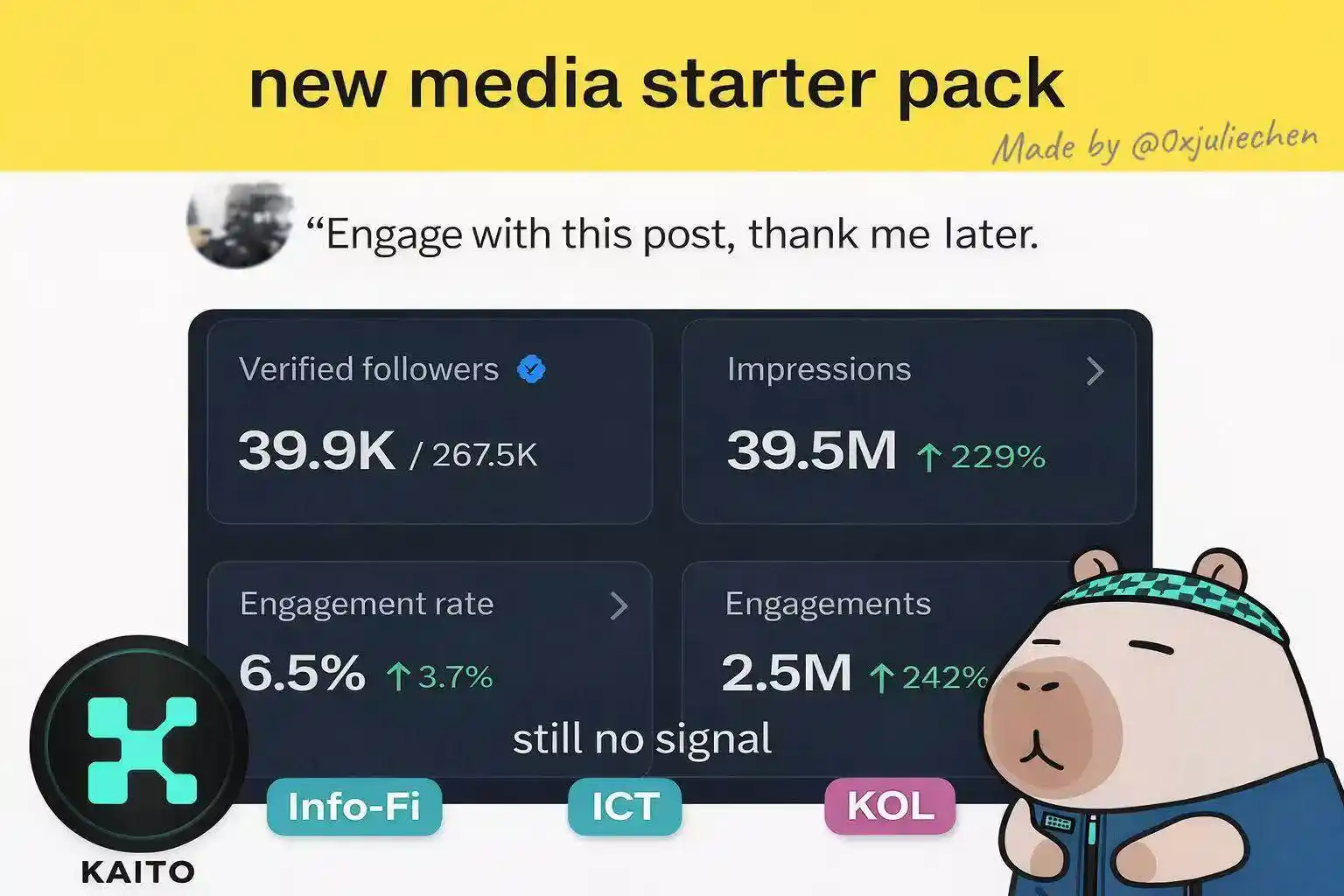
In "The Power Brokers," Packy mentions:
"The goal of the fund is to earn carry with as few people as possible in as short a time as possible.
The goal of the Firm is to achieve long-term advantage through scale and continuous stacking.
This distinction explains one thing: why in traditional VC, media prowess has always been a "nice-to-have"; whereas at a16z, this has been directly turned into infrastructure.
For a long time, our default sequence has been:
Money → Company → Market
Money comes first, determining everything.
But in a media-saturated world, this sequence has now been reversed:
Actionability → Community → Market → Capital
Why is it now "a lot of money, but hard to make things happen"?
Because money no longer automatically translates into action.
· Distribution is not scarce
· Attention is extremely noisy
· Trust cannot be bought with a budget
We have seen this many times in the crypto space (not naming names to avoid offense):
A lot of money, but the project still fails to bootstrap. High valuation, but no one is really willing to participate. A coherent narrative, but no one follows through with execution.
It's not because there isn't enough money. It's because there is no actionability.
Now, the truly scarce resource is not capital.
It is:
· Can you make a group of people believe the same thing at the same time
· Can you make them act at the same time.
Whoever can do this holds the real leverage.
So I am not praising, but using a16z to explain a structural shift that is taking place.
What has New Media solved? What is still missing?
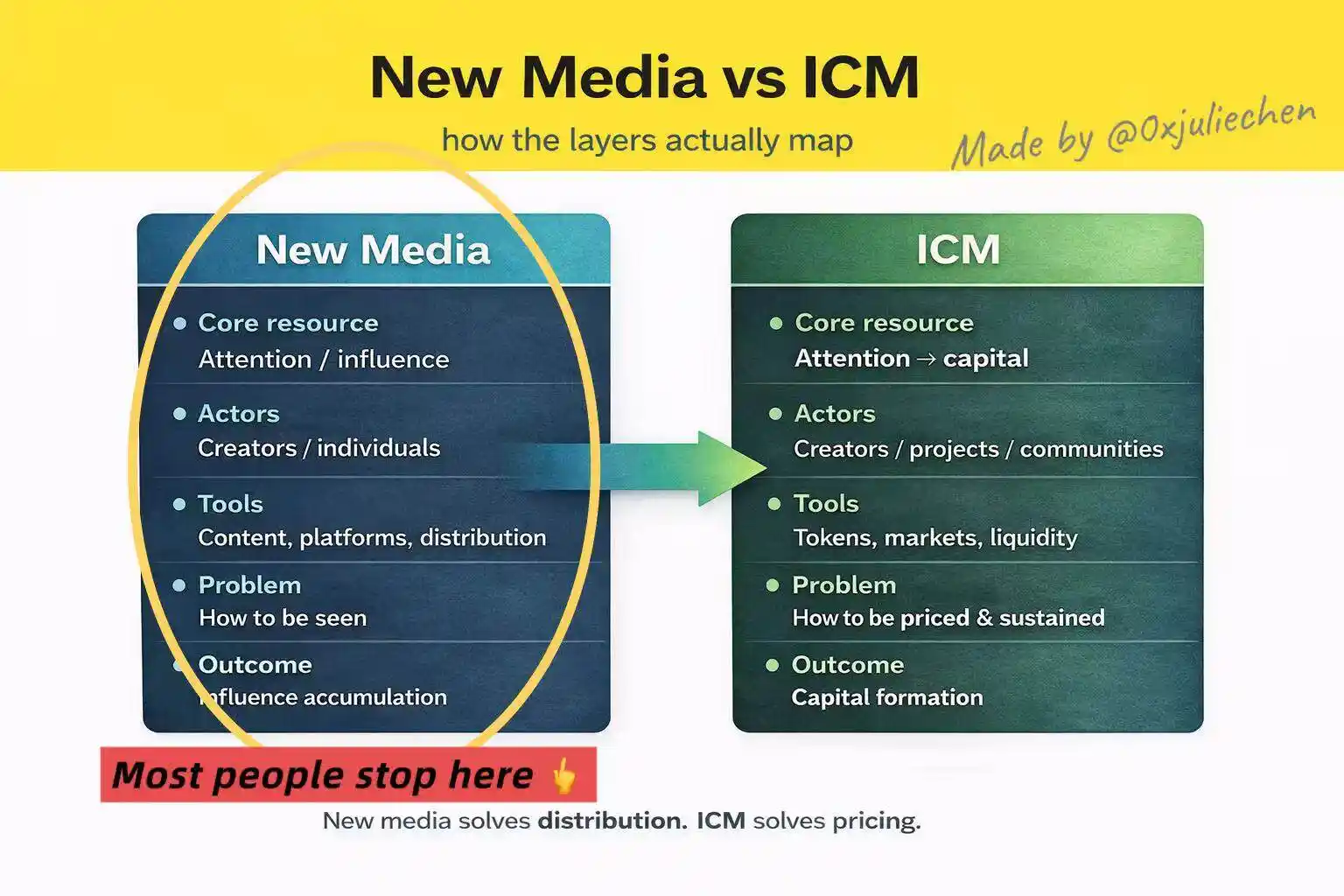
If media can form consensus, and consensus can drive action, then the market is the settlement layer of consensus.
Why are Internet Capital Markets (ICM) bound to emerge after New Media:
Because New Media has a natural structural flaw:
· Influence ≠ Ownership
· Traffic can be monetized, but cannot be bundled or held long-term
· Creators still rely on platform revenue sharing, brand partnerships, and ad cycles
The ICM concept was first proposed by Solana, filling in this gap: transforming narrative/consensus/culture into a tradable, holdable, collaborative capital structure.
ICM addresses the next challenge of New Media:
How is influence priced, traded, and made sustainable?
To differentiate in one sentence:
New Media: → Who can capture attention
ICM: → How attention transforms into a capital structure
Conclusion:
New Media solves “right to broadcast,” ICM solves “right to price.”
Essence of ICM:
· Turning attention → agency → pricing → capital formation
· Not a speculative tool, but a coordination infrastructure
Lastly, I’d like to quote my favorite saying by Naval to echo this point and conclude the article.
“Naval says: Code and media are leverage behind the new rich.”
Indeed, over the past 10 years, Silicon Valley's new elite and big tech (internet/software/AI) have fundamentally relied on “code leverage” to create wealth.
And with the proliferation of Cursor and Claude, everyone can now Vibe Coding, the ability to code is gradually becoming less scarce; some even predict that within the next 10 years, all entry-level programming jobs will be replaced by AI.
The truly scarce leverage in the next cycle is new media:
That is, scalable dissemination of narrative × judgment × taste. Good leverage can continue to compound while you sleep, influence others in your absence, and help you build “trust + reputation + opportunity access.”
Code is law.
New media is the law.
Welcome to join the official BlockBeats community:
Telegram Subscription Group: https://t.me/theblockbeats
Telegram Discussion Group: https://t.me/BlockBeats_App
Official Twitter Account: https://twitter.com/BlockBeatsAsia

 Related Articles