Into Discord: This is the Real Meta-Universe
原文标题:《 Discord: Imagine a Place 》
Not Boring, The Generalist
Tanker, the janitor, deep chain finance

Today, we want to talk more about Discord. What is it? Discord is like a mash-up of social topics. It's also like a Web 3 interface. It's more like a "third space," where more and more people come together and spend more and more time.
Now, let's get started.
Discord: Imagine a place

Imagine a website with a full human touch.
Imagine a space filled with stem diagrams.
Imagine a space where potatoes thrive.
Imagine a space where humans and robots live in harmony.
In short, all of the Spaces you imagined above can come together in one place: Discord.
For those of you who have never used Discord before, in its latest AD campaign, Discord has taken a new tack by asking its users to try out marketing. What does it feel like? It's like Lucy and Edmund trying to explain Narnia to you, or Harry Potter trying to explain the wonders of the wizarding world, or Neo trying to explain the Matrix to you.
Imagine opening a closet to a talking animal kingdom.
Imagine walking through a wall to find your new school.
Imagine taking a pill and being transported to the harsh reality of the world.
Frankly, they tell us a subtle and profound truth about Discord -- that Discord is not just a platform for communication, but a magical world.
Although Mark Zuckerberg thinks he's best placed to make his home in the Metasomes, he may suddenly find that one thriving "metasomes" -- Discord -- has long established itself in the marketplace.Compared to other companies that have embraced the concept of the meta-universe, Discord is truly a "primitive meta-universe" and has built an amazing "future world" without even realizing it.At first, Discord was designed only for gamers (admittedly, games were the forerunners of the metasomes), but over time, more and more educational groups, investment communities, and avid fans came to rely on the service for communication and dialogue.
Discord, of course, is also becoming the platform of choice for many new entities, from protocols to NFT projects to DAOs, and more and more people are trying to BUIDL (build) in the Web 3 world.
Yet the fact that we use such rich, complex metaphors to describe Discord suggests that its identity is uncertain. Unlike any other social networking company, Discord feels fluid and biological, like an organism that hasn't fully evolved. While the company has managed to achieve a $15bn valuation and hundreds of millions of dollars in revenue, it is thought that its current performance may not be up to expectations. In order to maximize their potential,Discord CEO Jason Citron may have to embrace new technologies, consider finding different revenue streams, and be inclined to explore new Paradigms for Web 3.
Discord has the opportunity to become the natural social infrastructure of the metasomes, an area with so much potential that if you try to quantify it now, you'll likely find yourself "small" in the future.
Discord needs more than imagination to build such an important business. In today's post, we'll dive into the Discord story to unravel many aspects of the company, including:
1. Initial Startup Story: Compared to other businesses, Discord's startup story was probably a "beautiful mistake."
2. Confusing Discord Products: Discord products can be hard to understand, especially for millennials, but in this article, we've tried our best to dissect the Discord products as they seem.
3. Bifurcated User Base: While Discord started out as a tool for gamers, it's now becoming more widely used, and we'll talk about that in this article.
4. Conservative monetization methods: Despite Discord's rapid growth, they were conservative when it came to extracting money from users.
5. Potential Opportunities for Web 3: Discord has become the platform of choice for Web 3 entities, but it doesn't seem to be winning hearts and minds yet, so they need to use their lead to build a "moat," which we'll talk more about in this article.
6. Great Online Games: How did Discord become an "Internet home" where people can study, live, and play?
Well, with these questions in mind, let's get down to business.
The story of the birth of Discord
Jason Citron is probably one of the greatest founders of all time, and it's clear that Discord is a product-market fit story that he's built (albeit occasionally). But Discord wasn't Jason Citron's first project. Jason Citron's startup story begins with Aurora Feint.
On July 10, 2008, Apple launched the APP Store, and among the first 500 apps released was an indie puzzle game: Aurora Feint, The Beginning, was created by Jason Citron, then 23, and a little-known startup incubator called YouWeb.
YouWeb, founded by Former Webvan CTO Peter Relan, was founded around the same time as Y Combinator, but their incubation strategy is very different. YouWeb only works with a small number of entrepreneurs and incubates a small number of them. "Instead of incubating hundreds of companies, we've incubated about 30 in the last 15 years," Peter Relan told TechCrunch in a recent interview.
In fact, YouWeb incubators were popular in the market at the time, often taking a 50% stake in a startup and helping the founder with business planning, marketing and recruiting. At the time, Jason Citron was a fresh college graduate looking to make a career in the games industry, but couldn't find a clear direction, so YouWeb helped him find his co-founder and YouWeb entrepreneur in residence, Danielle Cassley, Together they launched Aurora Feint, The Beginning.
Aurora Feint, The Beginning is critical to its success. The game, which borrows the player mechanics of Tetris and Puzzle League and the aesthetics of World of Warcraft, is considered one of the most thoughtful new games to hit apple's APP Store.

One industry critic called Aurora Feint, The Beginning, "the most fun and addictive of early iPhone games," comparing it to better-known hits like Super Monkey Ball. (Remember Super Monkey Ball?)
The problem is, industry acclaim doesn't always translate into revenue. Despite a flurry of updates and upgrades to Aurora Feint, The Beginning in the months following its release, there was no commercial explosion, even after Jason Citron dropped the price of the game from $8 to $1, There is little difference in income.
Jason Citron had a rough start, but Aurora Feint, The Beginning had a lot of features that were really forward-looking, especially the social aspect that Jason Citron incorporated into the game, Including chat rooms, profiles, asynchronous multiplayer and leaderboards, it provides Aurora Feint, The Beginning with a sense of community that other larger games lack.
With this, Jason Citron made his first fulcrum.
While discussing the future of Aurora Feint, the Beginning, the young entrepreneur made an off-the-cuff comment:
"No one was building anything like Xbox Live on top of games at the time, and I wondered if I could add some chat and video content to the game, and we wanted to be Xbox Live on the iPhone... so we released the game to see if people really wanted that type of game."
Citron sees a future in which almost all game developers will want to build stronger social elements into their products. Instead of building them from scratch, they will have the option to buy social tools directly and integrate them into their products.
As it turns out, Jason Citron was prescient and game developers did want to incorporate social tools. Aurora Feint (now Known as OpenFeint) attracted a lot of attention after being featured on TechCrunch, with clients coming in to work with the company.
"Duh," Jason Citron said with confidence. "Our ideas have huge potential for the future."
After that, everything seemed to happen at breakneck speed:
1. OpenFeint is seeing more and more customers and larger inflows;
2. OpenFeint adds a separate mobile application to manage social interactions across games;
3. OpenFeint and AT& T struck a deal to pre-install their apps on phones issued by the mobile operator.
Soon, OpenFeint was attracting acquisition interest from big companies. In 2011, Japanese social network and game maker GREE made an acquisition offer that was too good to refuse. OpenFeint was bought for $104 million, and Jason Citron, his investors and, of course, the incubator YouWeb made a handsome return.
Perhaps unaccustomed to the culture of big companies, Jason Citron sent an email to Peter Relan, founder of YouWeb, after a few months at GREE, saying, "I'm back."
Discord
The Discord story may sound familiar, too.
A young founder was accepted into an incubator with no fixed business plan and a deceptively simple goal: to make a difference in games. The founder built a polished multiplayer game that was loved by industry critics, but never managed to reach a large enough audience. Looking for the right product for the market, he discovered an infrastructure feature that eventually became a standalone hit.
The Discord story is basically a copy of the OpenFeint story. It's almost on the same beat and hits the exact same notes. When you first hear the Discord story, it feels like a drunk talking nonsense, but the second time you hear it, You might think that this might actually have a lot of potential in the future.
Unlike their first venture, Jason Citron and Peter Relan had better conditions. They teamed up to form Phoenix Guild, a game company for hardcore gamers, which was quickly renamed Hammer & Amp. Chisel. Not only that, but Citron's successful OpenFeint background helped him successfully raise A $1.1 million seed round and A $8.2 million Series A round. Jason Citron attended the Demo Day event at TechCrunch Disrupt 2013 and drew the attention of Mitchell Lasky, a venture partner at Benchmark, Benchmark led an investment in Hammer & AMP; Chisel's second round of financing.
2014 Hammer & Amp; Chisel released the first product: Fates Forever, an arena game designed for tablets, was a bit of a disappointment that it didn't have the success Jason Citron and his investors had hoped for, but Citron wasn't disappointed. Because he's exploring another powerful addition in this game: communication.
"We have a hunch that there's a huge opportunity for people to build services before, during, and after playing games, but we don't yet know how this idea will change the industry," Citron said.
Now, it's time for Jason Citron to transform again.
In considering the company's next move, Hammer & AMP; Chisel CTO Stan Vishnevskiy spoke:
"I don't want to do mobile games anymore, we've been talking about building chat services, and I've got a good idea of how to do that."
In the coming months, Hammer & Amp; Chisel's team designed a chat service for gamers, and the idea didn't seem too difficult for them to build something like an "alway conference call" or an "online coffee bar for users' private games".
Jason Citron launched Discord in 2015.
However, the product didn't make much of a splash in the market when it was first released. Only a few dozen people visited the Discord server a day, and it didn't seem like the gamer audience was really unified. This may have been because gamers were using other channels of communication, such as Teamspeak and Skype, but Discord began to push harder and try to win over more of its early customers.
In fact, the Discord "tipping point" came from the Reddit forum.
By chance, Discord connected with a member of a Final Fantasy subforum on Reddit and asked them to try Discord and post a few mentions of Discord when they were talking. According to Jason Citron, they did post something about it, like: "Has anyone heard about this new communication IP application called Discord?"
Soon, several Reddit community members were joining Discord, not only to try out the product but also to talk to the development team via the platform. One user replied, "I just talked to the developers and they responded, it's really cool, go check it out."
The comment caused a stir in the community.
The more Final Fantasy gamers flock to Discord, the more you see that Discord has chosen a "grassroots" mode of promotion that works well.
Over the next few years, Discord grew faster and faster, amassing hundreds of millions of users and nearly $1 billion in funding. Perhaps even more impressively,Discord has managed to capture the culture of gaming and has done a great job in spreading it.
product
One of the best things about Discord is that it's a product that gamers build for gamers. While the company has opened its arms to a variety of new user groups since the novel Coronavirus outbreak began, the product still hasn't given up on some basic elements, like game speed and player enthusiasm, but at the same time, it may not feel very good to those who aren't familiar with Discord.
So, what is Discord?
Let's take a look at how the two media outlets define it --
Quartz tried to capture the magic of Discord's many facets by analogy, writing, "Imagine Slack, AOL Instant Messenger, Zoom, and a simple chat room combined, and you might get a feel for Discord."
PCGamer detailed all the things That Discord does for users, writing that Discord lets us do a lot of things today for free, such as:
1. Talk to as many friends as possible with high sound quality, almost zero latency, and unlimited time;
2. You can broadcast your game live to anyone on the server with just two clicks without any delay (up to a point);
3. Use a separate volume slider to watch multiple streams at once (and again, without delay);
4. You can create almost unlimited text chat rooms, even files dating back years;
5. Share small files with friends;
6. Incorporating robots that can broadcast music to everyone;
7. Oh, yes, and one more thing: Discord supports adaptive phones, including features like video streaming and screen shots.
Discord, however, has higher standards for itself, and they don't want to be bogged down in any of these features, let alone become something that looks like other apps.
So Discord wants current and future users to imagine a space...

In Discord's first branding campaign, they asked people to think of their product as a blank canvas on which they could project any digital space they could imagine. No matter what industry you're in, you can do this on Discord.
Since the Novel Coronavirus outbreak, users from all walks of life have flocked to Discord, attracted by its chat capabilities, high-quality audio and video chats, privacy, and the ability to connect directly and quickly, as well as its free service (Slack charges a fee).
There's no doubt that the outbreak seems to have provided a "better time" for Discord to open its arms to non-gamers, and as different types of communities move online, they'll be faced with two choices:
1. Slack pays $6.67 a month per user, a feature you might be more familiar with.
2. Set up a Discord server and invite an unlimited number of free members.
For most people, choosing between these two options is pretty straightforward. Who doesn't like free? Of course, Discord has its own advantages. More and more people are finding Discord to be more than just a chat tool for gamers.
In 2019, Taylor Lorenz wrote an article on The Atlantic about The influx of influencers into Discord.Unlike Facebook and Twitter, which use algorithms to maintain relationships between influencers and followers, Discord has become more connected and more used.According to Forbes, the post, and the growing number of non-gaming users that followed, surprised Jason Citron and Stan Vishnevskiy.
The idea of letting users' behavior dictate their own direction is not new, but Discord has taken it a step further.
Discord then launched a community survey and sent out 23 questions. It found that more than 30 percent of its users didn't use the product for games, hosting book clubs, group chats with friends, fan communities, and even starting companies. Discord has become the "third space" of the Internet. As Jason Citron put it in an interview with Patrick O'Shaughnessy:
"I read Ray Oldenburg's famous book, The Great Good Place, which was done in The '80s, and he actually talked about The idea of third Spaces and started labeling them and writing about how these third Spaces worked. When I read the book, I was like, "Oh my God, this is what we're building, except we're building it in the digital world, this is amazing."
To their credit, Jason Citron and Stan Vishnevskiy were not conservative people. They heard their users and acted quickly to try to transform the company. It quickly became clear that the transformation was "on the right track" and the company's mission was further developed...

Next, they redesigned the brand and homepage.

Pictured above is the 2019 page on the left and the current home page on the right.
In May, they followed up with an "Imagine a Place" campaign, the company's first ever brand marketing campaign, with a six-minute video starring Danny DeVito and Awkwafina:

Although the video is fast paced and slightly chaotic... But it perfectly captures the essence of Discord.
On the surface, Discord looks like A clone of Slack, but Discord is much better organized -- each community has its own space -- and can be contained within a server, where you can set up channels (including voice channels), There's also the option to share videos with a group of people (up to 25 at the moment), and a voice channel that stays open all the time, allowing users to jump in and out as easily as jumping on the couch with friends.

In the sidebar, as shown above, users can see and easily click through to all the servers they belong to. In the screenshot above, you can see the number of unread message ICONS for the Packy user, which shows how many servers he has joined and how hard it may be to keep up with them all.
Getting started on Discord is relatively easy. Starting a server is easy, and inviting friends to join is even easier. Each Discord server has a unique link -- Discord. Gg /name -- that you can spread across the Internet, Twitter profiles, Reddit forums, and Telegram chats, as opposed to the old "subscribe button," "Joining Discord" is becoming a new trend.
Joining into Discord is also easy: You just set up a Discord account and can join the server (there's no limit to how many users can join), which is actually one of the biggest differences from Slack.
Slack is clearly better suited to enterprise users, and it's like a well-designed "home for the Internet" for businesses and employees, but it's a chore to join -- every time you're invited to a new Slack workspace, -- Discord is built for "light social." Users can jump from server to server, and they can send private messages directly to any other Discord user.
It's worth noting that there's another major difference between Discord and Slack: architectural differences. In Slack, employees can send messages to each other across a company's workspace; In Discord, users can send messages to anyone, as long as they know their username (and as long as that user receives messages from others). While the differences between Slack and Discord may not seem that great, they are fundamentally different because Discord adds a "social layer" on top of allowing in-group socializing. As a user, you can communicate within your own inner circle, have ongoing conversations with your closest friends, and reach out beyond your comfort zone to other people (even "meeting" strangers).
It's important to note that while Discord adds social elements, it also gives up many others. Discord isn't a traditional social network. It doesn't have "follow counts" or algorithmically determined post recommendations. Users can show off their avatars and whether they pay to "upgrade" their servers, but there are few other ways to gain influence. That said, if you want to make a difference in Discord, you have to do it on your own.
Beyond the chat feature and social architecture, perhaps the most notable part of the Discord platform is its burgeoning bot ecosystem.In a 2020 blog post, Discord announced that it had created more than 3 million bots, some of which were already being used on millions of servers.Slack, by contrast, has about 2,400 registered apps. (Of course, this isn't a fair comparison, as there are many bots deprecated on Discord as well, but it's still interesting to compare orders of magnitude.)

As you can imagine, the types of bots used in Discord vary widely. Some focus on providing memes, others can easily play music from Soundcloud and YouTube, others focus on relieving emotions, and so on.

Next, let's look at two typical Discord bot applications.
1. MEE6 is a particularly popular bot app, used by more than 14 million servers to create custom welcome messages, proactively channel bad actors, assign community roles, and award "XP" (" experience points ") to users who actively participate in the community.
2. LdleRPG is a robot app that offers more creative services. Once it is integrated with the server, community members can participate in a role-playing game that is similar to Dungeons & Dragons and can be played through chat commands. Given Discord's popularity among gamers, it's not surprising that IdleRPG bots are often used.
What's more, Discord's bot ecosystem has expanded into encryption. The Generalist recently published an article on DAOs that outlined some of The more popular applications in The Web3 space, In particular, products like Collab.land -- which allows holders of unique tokens or NFT access to private channels -- have become essential. In fact, Discord has more interesting bot apps in the crypto vertical, like Tip (which accepts cryptocurrency tips) and Piggy (a role-playing game that offers cryptocurrency rewards).
From a user perspective, Discord's robot ecosystem is actually very important because it extends functionality and adds a sense of play, while from an enterprise perspective, the robot ecosystem provides support on a business level because it allows developers to build on top of their application programming interfaces (apis) -- obviously, Discord is targeting a new audience.
Let's look at another example: If you're going to start a decentralized autonomous Organization (DAO), Discord might be a good choice because you can leverage bots like Collab.land, MEE6, Tip, and others that offer "superpowers" to your community that aren't available anywhere else.
So Discord began to focus on the bots. In 2020, the company announced that it would seriously build robot capabilities, validate established programs and expand possible uses. That's a good start, but it's not clear that the plans have actually materialized. Next, Discord needs to focus on "service discovery," "monetization," and "usage.
So how does Discord do this? The answer is by creating the Discord Bot Store: the Discord Bot Store.
In the past, if you wanted to find the right bot app for your server, you either searched aimlessly on Google or visited third-party platforms like Top.gg. But now, the Robot App Store allows Discord to catch up and become a starting point for "discovering" bots.
In turn, the Discord Bot Store will be even better for Bot developers because Discord gives them a trusted place to showcase their work and generate new business revenue. Like other app store owners, Discord had a platform to promote the most promising bot products and eventually became the "king" in the space.
Over time, Discord will also be able to offer a "Smart Recommendation bot" service to help users quickly find the bot they need. For example, if Discord notices that more people are joining the "Crypto" server, it can recommend Collab.Land or a similar tool for people in the related group. If you have a developer who builds a Discord server for anime fans, recommend the comic robot Mudae.
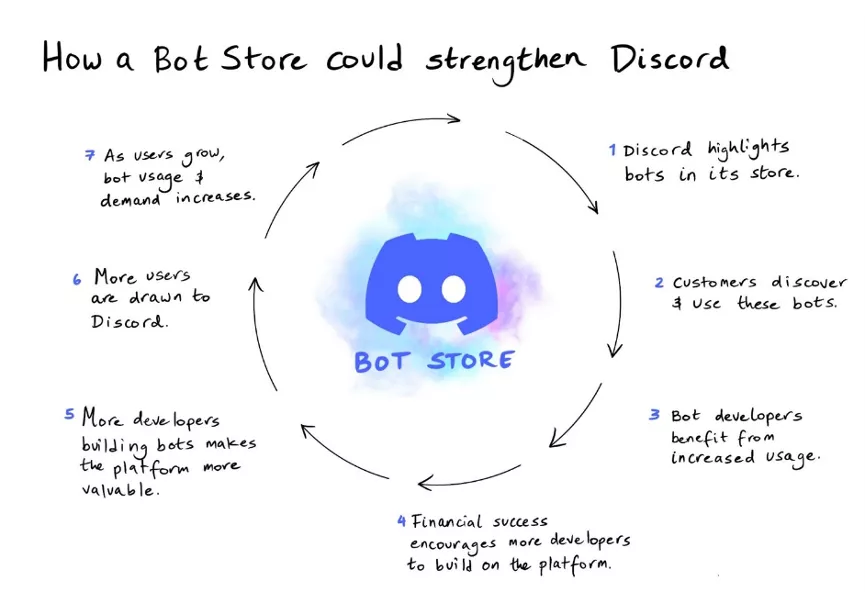
As developers make money from Discord, there's no doubt that more people will flock to the platform, and more people will realize the potential of Discord to create money. In this case, Discord creates a benign revenue loop:
1. Discord gives great robots a chance to shine;
2. Customers see the robots and start using them;
3. Robot developers can make more money.
4. Success of bot developers on Discord attracts more developers to join the platform;
5. The more developers there are on the Discord platform, the more powerful it becomes;
6. The more powerful the Discord platform, the more users it attracts;
7. The more users there are, the more demand there will be for robots, which will also stimulate a large increase in the use of robots.
For Discord, on the other hand, the bots could be just the beginning, bringing Discord closer to its original vision of making money from the game store. You'll notice that the entire Discord product line is now built inside Discord, and you're starting to see Discord as an infrastructure on which to build BUIDL. Discord bots can expand beyond gaming. Stir's Newsroom, for example, doesn't seem to take Discord's complex interface for granted, So they tried to build a clean and organized collaboration interface on top of Discord's conversation pipeline (see the figure below).

Rather than trying to replace Discord, Stir has improved it and given users a way to easily leverage the product's strengths while minimizing its weaknesses.
This, perhaps, is what a quality platform should look like when entrepreneurs start evaluating strengths and weaknesses and decide to build complementary tools to compensate for weaknesses rather than replace them with competing tools.
There's no question that Discord's trend is just beginning. A new wave of entrepreneurs is already building tools to help decentralized autonomous organizations function more smoothly by improving features like user guidance, project coordination, and contribution tracking. While many of the tools are aimed at decentralized autonomous organizations, they can also be used by the broader community, by anyone who wants to create groups and communicate in Discord. For Discord, these tools can be supported by seamlessly integrating and extending the Bot Store to accommodate more Discord based applications.
If Discord can do that, it has a lot more potential in the future. The Discord team is focused on making its core product more powerful and reliable, which is fine, but building an ecosystem of developers allows Discord to adapt to all types of users.
Users & have spent
At present,Discord has an estimated 300 million users, including 150 million monthly active users, and 19 million servers across gaming, investing, politics, anime and more.
As you know, given that The Discord company started with games, the largest group of users on Discord are still gamers. Anyone who navigates to the Explore TAB can see that Discord is serious about gaming and clearly shows a preference for the gaming market (note: Discord's Explore can search for new servers).
Nine of Discord's top 10 featured servers focus on gaming:

So, what's the one exception left? It is Anime Soul Discord, a community of 500,000 Anime lovers. Interestingly enough, half of the community also paid attention to Genshin Impact. That's not surprising given the strong cultural overlap between gamers and anime fans, but it's also a sign of Discord's growing reach. With gaming at its core, Discord has been able to expand organically into other game-related subcultures, including anime and tech. Starting with a big niche and growing outward has been a key part of Discord's success.
In addition to these topics, Discord seems to be building communities around education, investing, encryption, and Web 3. The success of Discord in these communities can be understood through a similar lens -- because these audiences are essentially Internet native.
First, we know that one in five American gamers is under the age of 18, which makes school an essential part of their lives, so it's natural for them to use tools like social networks to learn. Of course, this is not to say that all Discord education community service for high school students and the students to many of the most popular server can cater to people of all ages, such as learning English, you can join a server to another server to learn Korean, then use the third server to practice your favorite games. (In Discord, the line between gaming and education can get very blurred.)
Other educational communities on Discord focus on providing accountability or assistance services. Here are two examples:
1. Study Together is a Discord community with more than 280,000 members that claims to improve individual productivity.
2. Homework Helper can provide personalized education service: help users complete Homework through community efforts.
These types of groups and servers make Discord magical -- a group of like-minded people getting together to talk, learn, and help each other, and everyone can move up.
Discord also seems to encourage mutual use cases, and you'll find that when trying to start a new server, two of the first three suggestions are educational and prompt users to start a "school club" or "study group."

Another recent addition to Discord is the Student Center. These Discord servers are only available to high school or college students. You can only access these groups if you have a school email account to prove your identity, and Discord highlights this feature in the Explorer TAB, so it shows that Discord takes it very seriously.

Facebook and Instagram have lost a lot of their premium resources to younger users, while Discord has gained a lot of traction and interest among young people. Because Gen Z doesn't like platforms like Facebook and Instagram, Discord might benefit.
Unsurprisingly, the most popular servers in Discord mostly show the tone and cultural references of the gaming community, which is full of memes (like Pepes), and clearly these groups aren't value investor clubs. On the other hand, WallStreetBets (WSB), a prominent investment group on the Reddit forum, chose Discord to synchronously host its community conversations, which is significant -- no other platform can handle such a large volume of real-time communication information, The WSB server group has 570,000 members and is one of the largest on the Discord platform.
The WSB server's prominence also reflects Discord's position in the social space. Specifically, Discord seems to be downstream of asynchronous message broadcasting platforms like Twitter and Reddit. For example, the Discord platform has attracted a number of Reddit subforums to start and communicate with each other on the Discord platform. As you can see from the "Explorer" function, the Discord subforum has 399 servers associated with it. Includes r/Memes, R/Teenagers, R /Pokemon, and R/Dogelore communities.
Not only that,Discord is also moving into another area: Web 3. Discord is, without a doubt, the preferred communication platform for various Web 3 projects, including NFT, DAO, Crypto Investments, crypto startups, and more.Somewhat surprisingly, this trend seems to be quickly becoming the norm in the Web 3 space. For now, if you're an NFT project leader, inviting supporters to join a Slack group is obviously inconvenient. For encrypted users, it's like asking them all to use Hotmail or Microsoft's Bing search engine.
Let's take a quick look at which well-known Web 3 project communities are in Discord. These include: Axie Infinity (800,000 members), Sushi (150,000), Solana (86,000), Loot (83,000), Uniswap (72,000), and Bored Ape Yacht Club (69,000 members).
In addition to these categories, Discord inevitably spawned an NSFW crowd. NSFW is an English Internet term, short For "Not Safe For Work" or "Not Suitable For Work", meaning that certain web content is Not Suitable For viewing during working hours.) While exploring the top-level Discord channel, we found a name appearing at or near the top of two different servers: "Sinful 18+."

As the name suggests, this is Discord for "colored" content, which includes 24/7 video chats, selfies, and looking for a date. (To be honest, I thought of Tiger Global when I first looked at the 24/7 Active VC server.) Sinful is just one of many communities dedicated to romance and fun. There are also dating lounges, game rooms and other popular resources on Discord, which shows just how diverse Discord is.
In addition, Discord has launched DiscordMe, a tool to categorize server and note usage. DiscordMe allows you to display a breakdown of the servers on Discord by industry. As you can see in the following chart, the crypto industry doesn't seem to be very popular on Discord.

Of course, the number of servers is not necessarily the most useful metric, and there are other metrics to look at (such as the number of members of the category). Similarly, the DiscordMe tool doesn't have much authority. Still, getting this information gives us some insight into how the Discord platform is doing, and how it's generally being used. From art to fitness, meme to mature content, Discord has gone from gaming to devouring every aspect of culture.
The leadership
Discord is a difficult company to read, and in writing this post, we tried to engage in conversations with leadership, employees and investors -- with no luck. Of course, we're not criticizing them.
Concentration is a valuable resource, and Discord probably felt they had told enough stories. In this case, our analysis of their leadership had to rely on escrow accounts and other sources. Here's a map of the group's key players:

As mentioned earlier, Jason Citron himself is an entrepreneur who started out as an ordinary Discord user. He is also a true gamer and has a genuine love for the industry, as evidenced by his previous startup OpenFeint.
The key to Discord's success has been their real connection to the gaming industry. While writing this article, we spoke with Mac Reddin, CEO of Commsor and an early user of Discord. In Mac Reddin's opinion, One of the reasons for Discord's rise is that it understands gamer culture better than its competitors, he observes: "There aren't a lot of products that talk to gamers, and even though there are similar services on the market, the functionality is clunky. No one thinks of Discord as a billion-dollar company, but it's not."
Discord uses the gamer language, which Is Jason Citron's strong suit.
Stanislav Vishnevskiy is also very experienced in gaming. He previously worked with Jason Citron at GREE, which acquired OpenFeint, and is now cTO of Discord. When he was in GREE and Discord (then called Hammer & Amp; Chisel), Stanislav Vishnevskiy also founded Guildwork, a social network for massively multiplayer online role-playing games (MMORPGs) that supports games such as Final Fantasy, World of Warcraft and Aion.
With the exception of Steve Lin, a member of the original OpenFeint team, the rest of the leadership doesn't have much industry experience in gaming, but they have a lot of resources and can guide Discord in other ways, such as:
1. Tomasz Marcinkowski, cfo, joined Pinterest in March from where he was responsible for managing future acquisitions and potential ipos in the coming years.
2. Chief People Officer Heather Sullivan, who previously held the same position at Udacity, and while Discord is a universal tool, it has seen strong growth among student users of all ages.
So,Are there any missing pieces in the Discord team? The answer to that question is Crypto.Yes, no one in Discord's executive team seems to have any experience in the crypto industry, which is perhaps to be expected, and the crypto industry is still growing rapidly, given that it's now easier to find a Google employee willing to jump than a Coinbase senior executive.
But Discord also seems to have been caught off guard by the rapid adoption of the Web 3 movement. Prior to 2021, if you didn't know much about the crypto industry, it probably wouldn't be a problem to get into Discord and work there, but that seems to be a different story now. If Discord wants to expand its presence in the Web 3 ecosystem, it should at least include someone with a background in encryption on its executive team.
However,Perhaps the most unique attribute of Discord's leadership team is that they don't seem to like monetizing so quickly.
Business is growing fast but earnings are growing slowly
In August, after rumors surfaced that Discord would be valued at $15 billion in a new round of funding, Packy McCormick tweeted his support for The company, offering to buy every Discord share he could get at that price.
Packy McCormick is unquestionably supportive of Discord. Driven by the Novel Coronavirus outbreak, gaming, and Web 3, Discord has become one of the fastest growing products in the world and one of the most important community gathering places in the world.
Discord decided to open its arms to all types of people, and for the first time began a serious marketing effort. From the perspective of many users who see Discord as their home, Discord could reap the rewards
1. In 2020, 6.7 million Discord servers were active each week, and there was basically a weekly conversation on a given topic.
2. In 2021, Discord's weekly active server data grew to 19 million -- almost three times as many as last year -- and don't forget, 2021 isn't over yet.

In fact, with more and more new NFT projects, DAOs, and DeFi protocols being launched, we shouldn't be surprised if the number of servers on the Discord platform hits 20 million by the end of the year.
More servers means more users. In 2017, Discord reached 10 million monthly active users (MAUs) on its platform. In 2021, four years later, the number of monthly active users on Discord's platform reached 150 million, which is a 15-fold increase in four years and a 96.8 percent compound annual growth rate.

So how does it compare to the tech giants? Facebook... Well, they're called Meta now, Meta has 3 billion monthly live users, Snap has about 347 million, Reddit has about 430 million. Twitter stopped disclosing monthly active user metrics in 2019, but reported 211 million profitable daily active users (mDAU). At last count, Twitter had 396 million monthly active users. That means that even though Discord is only six years old, it's not that far from those social media giants, and it's growing its users far faster than any of them.
Additionally, Discord's revenue growth is even outpacing its user growth. Discord's revenue grew from $5 million in 2016 to $130 million in 2020, a four-year compound annual growth rate of an impressive 126 percent.

But even after that incredible growth, Discord doesn't seem to be "too intent" on making money from its users, and Jason Citron seems more like Jack Dorsey than Mark Zuckerberg.
At $1.30 in average revenue per user (ARPU) in 2020, Discord ranks very low among public social media companies.

That's not surprising, because The company's only real monetization engine is "voluntary upgrades." Instead of devising a subscription service or charging for memes, Discord's only real monetization engine is "voluntary upgrades." He will surely sharpen his head and make billions of dollars out of them.
Jason Citron's current focus on product and community over advertising and revenue has helped Discord create a strong, engaged and loyal user base that is also highly valued. Keep in mind that the global average revenue per user for video games is in the $20- $60 range, depending on the platform (mobile is highest),And cryptocurrency traders typically pay more for gas in a single transaction than Discord collects from regular users in its lifetime.If Discord is focused on monetization, money should flow.
Discord had time to figure it out. For now, investors seem more focused on Discord's huge potential than on their ability to make money from users. Frankly, there aren't many opportunities to invest in a true social platform, but Discord is definitely one of them.
investors
For early investment of VC, they like to say most of a words be: in the early stage of development of a company, you should support the founder rather than ideas, although this view is up for debate, but there is no denying the fact that good entrepreneurs can from the twists and turns right direction on the road to success, Discord is a typical example.
In July 2012, Phoenix Guild announced a $1.1 million seed round from startup incubator YouWeb and two top venture capital funds, Accel and General Catalyst, The goal was to create a "post-PC Blizzard" because Jason Citron felt the market was flooded with "crappy F2P SIMS" and he wanted to change that.
Phoenix Guild changed its name to Hammer & AMP in 2013; Chisel then successfully raised $8.7 million in Series A funding, led by Benchmark, led by Mitch Lasky, who launched Fates Forever, the first multiplayer online battle arena game for tablets.

February 2015, Hammer & AMP; Chisel raised another $4.5 million Series B round from investors Benchmark and Tencent, valuing the company at $45 million, and Jason Citron says that thanks to this round, they are launching a flagship game, And "build a meaningful games company."
In fact, at the time of the Series B funding, Jason Citron realized that Fates Forever wasn't going to be the future of the company. Just three months later, on May 13, 2015, Discord hosted an informal birthday celebration.
Fates Forever was a major success but struggled to monetize the game, leaving Phoenix Guild and Hammer & Amp; Chisel's early investors were deeply involved.
But Benchmark and others bought series A shares at $1.95 A share, according to Pitchbook. In December 2020, Discord's Series H stock price valued the company at $7 billion. By then, the price per share had risen to $280.25, a return of 143 times. With the company recently raising $15bn, that means series A investors are getting A 300x paper return... This is somewhat implausible, since the game they originally invested in no longer exists.
Discord first raised money as Discord in January 2016, raising $20 million in a Series C round co-led by Greylock and Spark Capital that valued the company at $100 million. From there, Discord officially took the stage.

Over the next three years, Discord raised multiple rounds of funding, including a $50 million Series D round from Index and IVP, followed by a $50 million Series E round from existing investors, making the company a unicorn with a valuation of $1.65 billion. In a $150 million Series F round led by Greenoaks, Discord passed the $2 billion valuation mark.
But Discord did not raise money during an 18-month period in 2019 and early 2020.
In June 2020, Discord raised a $100 million Series G round from Index at a $3.5 billion company valuation, and another $100 million Series H round from Greenoaks for $7 billion in December 2020.
In March 2021, Microsoft tried to buy Discord for $10 - $12 billion, but the deal fell apart after four months of negotiations. Discord does fit perfectly with Microsoft's strong gaming portfolio, which includes XBox, Minecraft and the recently acquired ZeniMax. Discord is certainly a technical upgrade to Microsoft Teams, the most important strategic weapon in the metasverse competition, but Microsoft's $12 billion price tag is a bit low. Just a few months later, the decision to reject Microsoft's offer paid off for Discord.
In September 2021, Discord announced that it had closed a $500 million round of funding led by Dragoneer and led by Baillie Gifford, Coatue, Fidelity, Franklin Templeton and other crossover investors, That round valued the company at a staggering $15 billion, and the next IPO may be coming soon.
At this stage, Discord is valued at $15 billion, 115 times its 2020 revenue, which seems a little unrealistic,But compared to Discord's growth potential, that valuation should make sense because Discord still has a lot of room to grow.In the social world, Discord is able to capture that rarest of assets: attention. "Whoever controls attention controls the universe."
If Discord can keep growing at more than 50 percent monthly active users, or reach a Level of average revenue per user similar to Pinterest's, then the future looks promising, not to mention the endless possibilities of Web 3.
Web 3 Opportunities & NBSP;
If you want to attract investment, you need to have a core business and a clear target to invest in, and a bit of bullish expectations or option benefits would be the icing on the cake. Meta, a social media giant, is moving into the meta-universe; Tencent has developed the most widely used app in China, invested in one of the best venture portfolios in the world -- Discord -- and is a strong competitor in the meta-universe.
Discord is a social platform with a rapidly growing user base and a recurring revenue subscription product that occupies the most strategic position in the Web 3 value chain. The question now is: will it seize the opportunity presented by Web 3? If so, how will it leverage Web 3?
In fact,The company has been coy about its Web 3 strategy, but they did leave a clue.In August, some Discord users received this prompt:

In recent years, the act of "doing research" has played a very important role in Discord. In 2019, a survey prompted the company to change its strategy and broaden its horizons to all types of users. So this new survey, recently posted on Twitter by HsakaTrades, may hint at the next change for the Discord company:

The survey wasn't very detailed -- only one was for their specific product, the "Discord Native Encrypted Wallet" -- but it shows that Discord is aware of the growing use of its product by the Web 3 community and how it is being used.
That's all, so we're going to have to stretch our imaginations to the Max. Here are some of the ways we can think of Discord leveraging Web 3.
Discord wallet
In a Web 3 survey conducted in August, the only product Discord surveyed users directly was the Discord Native Encrypted Wallet. Discord will definitely launch a crypto wallet in the future and move into the space quickly. If it doesn't, the company will miss a lot of opportunities.
The idea is simple: Assume that each Discord account has an encrypted wallet. The wallet could potentially support ethereum ecosystems like MetaMask, Rainbow, or Solana's eco-wallet Phantom. Ideally, given Discord's neutral role, it would create a cross-chain work wallet, and given Discord's large non-encrypted user base, that wallet might not look like an encrypted wallet at all on the surface. While this idea sounds simple, there are real technical and UI (interface design) challenges, but it's worth a try.
Probably no company will be able to quickly bring a fragmented user base into the Web 3 community based on their trust (sorry Meta). Therefore, integrating wallets into Discord's core product has certain benefits for users and community leaders:
1. Let users send funds and tokens to each other as easily as they send messages.
2. Make it easy for the community to airdrop tokens to its members.
Having your own wallet is also good for Discord itself:
1. Allow Discord to monetize transactions, swaps, lending and pledging processes.
2. Act as a Discord token to give it access to the wider Internet realm.
3. Gain experience with your wallet.
In Web 3, the wallet will represent your identity and account; Having your own wallet is a key strategic move to keep Discord with users at all times.
Easier said than done, though, the Discord team doesn't currently have cryptowallet talent, but it could hire an experienced team to develop the wallet.If Discord wants to take advantage of Web 3, developing its own wallet would be a bold entry point,Bolder action can follow.
DAO_OS
Earlier this week, Mario Gabriele posted a silly emoji on Twitter:

It's no coincidence that Discord is at the top of the DAO Starter pack. It has become an essential part of DAO communication and coordination, rooted in DAO culture.
Earlier, we discussed Discord's position downstream compared to platforms like Twitter and Reddit. But it's interesting that Discord goes upstream when it comes to Web 3.

For example, if you wanted to build a DAO today, how would you go about it?
First, you might connect with some friends via Twitter and Telegram. Once you find that the idea piqued a friend's interest, you quickly move into Discord to have a flowing conversation, discuss details, and make plans.
It's likely only after that that you can set up a multi-signature wallet, raise money through on-chain sales, and then begin formal governance on platforms like Snapshot. We've seen this happen in the social DAO and NFT communities of Web 3. Often, the best way to hype a project is to start in Discord and build it up.
As you can see, creating the DAO presents a unique opportunity for Discord. As a kind of parallel operating system for the DAO, Discord can take on some downstream functions. This is probably best done through integration, but it can also be driven by Discord's internal product team.
In particular, users can hold forum discussions and vote on Discord. By doing so, off-chain democracy can be centralized and formed as an on-chain result. Similarly, Discord can better integrate with the DAO money management tool, allowing community managers to schedule spending without leaving their own communities.
Although Discord was very influential in the DAO world and had a place in the value chain, it was not widespread. Here's what Jon Gold had to say in response to one of our tweets:

In a way, Discord and DAO were like a marriage without love.To enhance their relationship and ensure that Discord doesn't get replaced, Discord may consider expanding its own features.
trading
Discord's business model was an afterthought. According to Citron, the company initially planned to monetize through game stores like Steam. (It didn't work out.)
Prior to the launch of the game store, Discord had no monetization model -- something that worried its users. Many assumed the company was selling customer data or preparing advertising models; To quell user concerns, Discord launched a paid subscription service called "Nitro." Once subscribed, users get special perks such as having multiple avatars, customizing emojis and improving video resolution.
The move proved very successful. Because Discord is so popular with users, what seems like a relatively weak product managed to achieve amazing results. Mac Reddin, a longtime Nitro subscriber, pointed out that by subscribing to Discord and becoming a member, you are simply supporting the company. Remember, not many companies can make billions of dollars solely on the goodwill of their users.
Discord can also consider acquisitions and investments to diversify its revenue. You can imagine a world in which users sell each other music, pictures, labor, or something else on a Discord forum. (Or push to Discord Market.)
Given Discord's unique status and the amount of money floating around, it's going to be interesting to introduce cryptocurrencies. Can you imagine Bored Ape holders buying and selling on a Discord conversation channel? What about Bankless DAO members buying new tokens while having a discussion on Discord?
(Of course, anything you buy can be saved in your local Discord wallet.)
Discord is where speculation begins, so to speak. It's where people start wanting to buy. Now, once a user decides to buy an asset or make an investment, they leave the platform for a trading platform or an NFT platform.
While it may be technically complicated to develop a cryptowallet -- and no problem straying from its core product -- Discord could become very powerful and profitable once it's added. In the end, Discord might look like a crypto asset platform like OpenSea or FTX -- except that the transactions on Discord begin with a discussion that leads to agreement.
Gradually complete decentralization
So far, investors have bought more than $1 billion worth of Discord equity, so the chances of getting the decentralization thing done are slim, but imagine all the difference with Token's participation...
As mentioned earlier, there is a love/hate relationship between Discord and Web 3. There are many reasons, including:
1. There was too much server chaos on Discord
2. Discord private messages are filled with fake messages from scammers
3. Discord is a centralized company.
It may seem odd to start a decentralized revolution from a centralized chat application. As a result, many people are calling for a Web 3 Discord:

Phelps himself, however, doesn't foresee Web 3 Discord as a product. Instead, he predicts that Discord will be broken up into components that can be used to build composite products using specific Web 3 tools, much like transformers.
这是一种选择,不过还有另一种选择:假如 Discord 本身就是去中心化的呢?假如 Discord 不公开发行股份,而是发行 Token 又会怎么样?$DISCORD 这个 Token 看起来似乎就很不错啊(下图是一个 Token 符号示例,并非最终发行的 Token )。

To be sure, Discord represents a fulcrum of innovation that traditional enterprises have never seen before, and the rudiments of Web 3 seem to be on Discord already. It's an enviable dream, if at all possible, and if any billion-dollar company can pull it off, it's Discord.
First, it's obvious: Jason Citron and Stan Vishnevskiy are not afraid of transformation, they have a unique vision for the market and the industry.
Second, there are other, more profound reasons for the Discord transformation.
你会发现,Discord 平台上的许多行为已经非常像一个去中心化的协议,它现在是互联网上最真实、最大规模的用户生成社区,依靠选择在其数字围墙内运营社区的人们的创造力、热情和内容传播而蓬勃发展。用户可以体验 Discord 上丰富的内容,而无需支付一分钱,也无需为单个广告提供服务。要知道,该公司推出 Nitro 产品就是为了向其社区证明它不会引入广告(但同时也好像放弃了发行治理 Token 和探索智能合约赋能的力量)。
Decentralization will allow Discord to be both defensive and proactive.
在防御性方面,$DISCORD Token 可能有助于解决困扰 Discord 的问题。例如:该 Token 可以用来奖励帮助调节频道并移除困扰服务器不良行为者的社区成员;在给非好友用户发送私信时需要支付一小部分 $DISCORD Token ,以减少平台垃圾信息泛滥。
在主动性方面,$DISCORD Token 能让用户在 Discord 平台上发展更多功能和作用,比如可以鼓励更多社区在 Discord 上开店,而且 Token 也能用作为一种「用户保留」工具,要知道,用户情绪说变就变,他们很可能会快速跑到其他更有吸引力的平台,而 Token 是一种挽留他们的手段。此外,$DISCORD Token 还能支持和激励蓬勃发展的平台经济,不仅可以让用户之间相互奖励,还可以激励更多用户为社区提供基础设施。
此外,如果可以结合钱包并向 1.5 亿月活用户(相比之下,Coinbase 拥有 6800 万客户)空投$DISCORD Token ,那么立刻就能让 Discord 成为世界上最大的 Web 3 平台,并吸引数以千万计的人加入 Web 3 领域,$DISCORD Token 空投也许会变成互联网历史上最重要的举措之一。
对了,Discord 告诉我们要想象一个空间,所以我们让自己的想象力变得足够疯狂。但也有另一种结果——该公司 99.999% 不会去中心化和 Token 化。
But we firmly believe that the Discord company should follow its users' lead in making changes to the appeal of Web 3. Discord has been a huge success because it has built a communication infrastructure for gamers; Now they have a chance to build a more complete set of tools for Web 3, the "game" that many people play on the Internet.
Massive Online games
Surfing the Internet is becoming more and more like playing a massive online game in which players gather in a place that was originally a chat application built by gamers for themselves.
If Twitter is the Internet's town hall, Discord is a secluded place with cosy lounges, dark basements and smoke-filled secret rooms. Here you can create companies and DAOs (decentralized autonomous organizations), issue bonds, incubate projects, launch products, and gain or lose wealth. If you think this feels familiar, you're right. Usually, we don't spend a lot of time in big gyms. Instead, we spend more time in comfortable classrooms, crowded dining rooms, and friends' living rooms. Humans didn't evolve to live on stage.
As the Internet evolves itself, from Web 2 to Web 3, from the Internet to the metasomes, Discord's architecture will likely inspire more and more new things. The meta-universe is not controlled by anyone, but rather is a connected space, built and managed by like-minded community citizens.
But that new world will be confusing for some time. While the beauty of decentralization is that everyone knows where to go, and the decentralized Internet requires maps and places to gather, Discord has built a product that no one else can match and that is well prepared for this new world.
Today, it's as if Internet people are going through a funnel: from Twitter to Discord to their final destination. Whether Discord ends up being a heavyweight and highly valuable company, or the most influential and valuable company of all time, may depend on what it ultimately wants to accomplish. Is it trying to merge with Twitter and get a foothold in the big online gaming space? Or do you want to integrate downstream, splicing Web 3 products into your own products and creating a world that users can physically navigate? Discord is now making acquisitions in the augmented reality space. Imagine... In the future a server will be a small world.
Today,Discord has become such an integral part of the Internet that people forget it's a six-year-old product and are still finding themselves.Perhaps Discord itself didn't know what it wanted to be.
But perhaps this is Discord's greatest strength. Because only through continuous innovation and self-breakthrough can we flourish in the era of decentralization. Discord is flexible, stable, chaotic but organized. It is willing to follow its users and build infrastructure on their trajectory.
Discord is also actively looking to monetize, and is expected to make billions of dollars a year over the next five years, but that's probably the least interesting thing about the company.
Finally, yes, Discord offers a space for participants in a large online game that is just getting started.
The original link
Welcome to join the official BlockBeats community:
Telegram Subscription Group: https://t.me/theblockbeats
Telegram Discussion Group: https://t.me/BlockBeats_App
Official Twitter Account: https://twitter.com/BlockBeatsAsia
 Related Articles