Detailed explanation of GameFi: DeFi is fully compatible with Metaverse
Original title: "GameFi: DeFi in the Metaverse"
Original author: DAOrayaki, DoraFactory
Original compilation: Nanfeng, Unitimes
< br>
Since Facebook changed its name to "Meta", many investors have followed the rabbit hole of the Metaverse. But it's not just Meta, Microsoft and Nvidia are also adding to the Metaverse, and so is Disney.
Gemini invested $400 million to compete with Zuckerberg's Meta, other players like Epic Games spent a total of over $4 billion in Meta's walled garden Engage in construction.
Gemini has invested in several metaverse builders such as Alethea, Somnium Space, Recur and The Sandbox (SAND).
There is money to be made in virtual worlds, with investors acknowledging the seriousness of the metaverse phenomenon after the worldwide social shift brought about by the past two years.
As, a business recently purchased virtual land in Decentraland for $2.5 million, the largest transaction on record (to be discussed later). The company plans to showcase digital goods in the metaverse in response to the growing demand for digital fashion and luxury goods.
I'm not exaggerating, someone recently sold a Gucci bag on the online game platform Roblox for a higher price than the physical bag. Morgan Stanley estimates that the Metaverse luxury market will reach $50 billion by 2030 (10% of the luxury market).
Virtual land sales and luxury NFTs are just part of a larger upward trend that also includes Play-to-Earn -Earn, P2E) and increasingly complex decentralized finance (DeFi), these strategies all take place in the Metaverse, an industry known as "GameFi".
Before we delve into GameFi, let's try to define the "Metaverse".
What is the Metaverse?
The Metaverse means so much to people. It's a virtual world where you can interact with friends, family and colleagues, a place where you can experience a sense of immersion that you'd never experience in the physical world. Many will strongly associate the metaverse with VRChat and Second Life of the VR (virtual reality) world, while others assert that cryptocurrencies, DeFi, NFTs, and Web2 are all part of the metaverse. Putting aside augmented reality and the Internet of Things, we can also say that it is all of the Metaverse.
This definition from @pierskicks poetically covers all Foundations:
“The Metaverse: A Timeless, Dynamic Digital Universe for Individuals Provides a sense of agency, social presence and awareness of shared spaces, and the ability to participate in a broad virtual economy with far-reaching social impact.”
If this definition is too literal, @MarioNawfal offers a more generalized version:
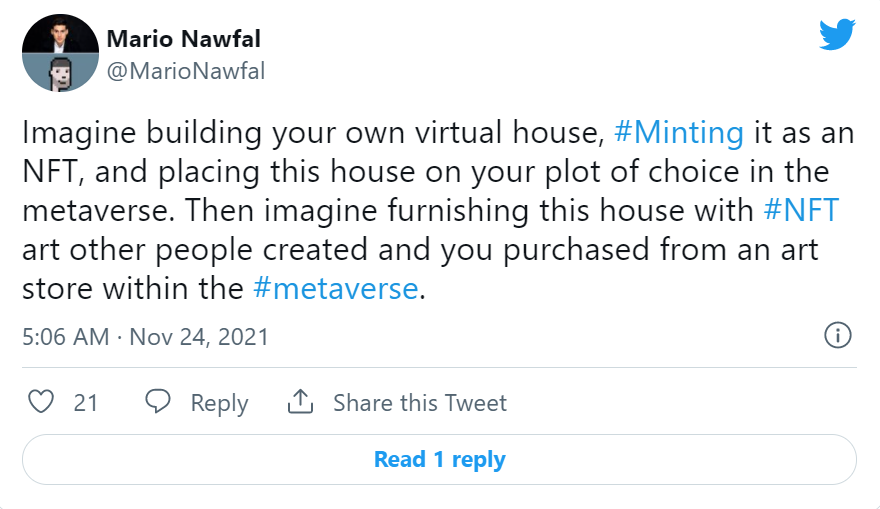
Anyone who has played Runescape, The Sims Online or Minecraft long enough to feel like this is their Anyone in Second Life can imagine the implications of the world envisioned in that tweet.
In Anthony Bardaro's article on Disney's endgame build on the metaverse, he cites prolific metaverse authority Matt Matt Ball's words:
Matt believes that the metaverse contains a "fully functional economy" that never closes. It will span the physical world and multiple digital worlds, with "unprecedented interoperability of data, digital items/assets and content". The Metaverse economy will be developed and managed by many contributors, from independent builders, to DAOs, to commercial enterprises.
Badaro sums up the true size of the Metaverse:
"Call it the Pure video games, virtual reality (VR) or augmented reality (AR) all underestimate the grandeur of the Metaverse concept. It's not just a replacement for idle screen time, though it has all the bases covered - from live streaming to entertainment , to escapism, education, information, and socializing."
We may be far from "Player One We're still a few years away from the virtual worlds depicted in movies like The Numbers , or books like Snow Crash (and haven't even ventured down the rabbit hole of The Matrix). Still, innovations in VR, high-speed internet, hyper-realistic game engines, and blockchain technology have grown to levels that surprise most of us.
I mean, what is this video?

Who is building meta universe?
In addition to the Big Tech data giants, there are dozens of companies and teams building various mobile parts of the Metaverse:< /p>

 < /p>
While the tech giants are creating the tools for us to interact and do business in virtual worlds (and researching what to do for our data and wallets) value), but companies like Decentraland ($MANA) have developed a Metaverse with community-first intent:
“Decentraland is a blockchain-based virtual world that allows users to build their own tools, games, content, markets, etc. The land of Decentraland is owned by the community, giving them control over their creations ’ – Decentraland Whitepaper
Quoting Metaverse web leader @pierkicks again: “Cryptocurrencies The foundations are being laid for a self-governing financial system, an open creator economy, and a universal digital representation and ownership layer via NFT.”
Let me explain why this is so important.
Games like World of Warcraft and Runescape Features impressive in-game economies, but these are limited by game-specific parameters and tightly controlled by a central authority.
For example, it is against the rules of the game to obtain resources in Runescape in exchange for legal currency from friends next door. It also lacks the checks and balances provided by blockchain and NFTs, which makes it very easy to run bots to game the system. It is also easy to buy enhanced accounts on the black market to cheat other gamers of their resources.
The company behind Runescape (The Carlyle Group) could change overnight to curb bad behavior Make major changes to in-game mechanics and economies without any input from the user.
All the hours you put into the game are worth very little sadly, other than bragging rights, because you don't really own any in that world thing.
Breach the terms of service and lose everything!
Despite top-down pressure to stay in our lanes and pay-to-play, Venezuela Many economically disadvantaged groups in countries such as , rely on the Runescape gold black market to stay above the poverty line.
This brings me to GameFi, one of the funniest examples of how blockchain technology and NFTs can revolutionize in-game economies mechanisms, while also linking them to the real-world economy.
What is GameFi?
GameFi is the DeFi and "Play and Earn" (P2E) blockchain in Metaverse The intersection of games.
This is an ecosystem that includes An economy made possible by transferring to players and incentivizing greater loyalty, engagement, and active governance of these gaming communities.
To understand how GameFi significantly enhances player incentive alignment, we must understand NFT, P2E , game guilds and some key players in the industry.

Source: https://messari.io/article/explain- it-like-i-m-5-gamefi
The role of NFT in GameFi
One of the core components of P2E and Metaverse is the ubiquity of NFT use.
A World Economic Forum article stated: " NFTs can take many shapes in virtual worlds: characters, items, land, decorative personalization features such as digital clothing.”
In In P2E, players earn the most valuable NFTs for their in-game feats, which they can then sell for real money. This innovation breaks down exclusive, escrow ownership of game assets while preserving security and proof of ownership.
It also draws a logical conclusion: DeFi is fully compatible with Metaverse.
The World Economic Forum continues: "Play to earn The greatest potential of games lies in their potential to decentralize markets for the creation, ownership and exchange of digital assets, and the potential created when these markets are connected to traditional economies and fiat currencies - allowing players to channel their digital time, energy and income into real-world disposable income.”
Naturally, P2E still relies on some Form centralization to limit what is ultimately released as an NFT, but there will always be fringe communities that allow anything.
One day we may reach a point where technology is so completely decentralized that meta The universe is so vast that it's nearly impossible to police how players present themselves or what business they do there. However, we are far from that reality today.
The creation of NFTs has also quickly become a commodity, and it is precisely around the impressive creation The communities that emerge will get the highest valuations and survive the bear market.
Luxury art and collectibles have traditionally served as non-correlated stores of value during times of economic stress Strong performance. Metaverse projects will benefit from producing luxury assets and experiences to compete or collaborate with high art cult communities in the NFT industry such as BAYC as well as individual creators and collectors building a following around marketplaces such as Art Blocks.
NFT-Based Blockchain Game Experiment
< /p>
NFT-based projects like Loot and Rarity are revolutionizing game development by putting the entire project in the hands of users. These "games" quickly built a cult following, and game development was emerging from their game economy.
Communities like loot will be in highly composable blocks The blockchain world thrives so that owners can use them in different virtual worlds.
This means that a flaming sword in one world may be a wet sword in another Noodles, but the real value is breaking down the walls between these worlds and bringing their economies together.
Games built to integrate Loot may attract game guild investment and scholarships (I will will discuss guilds, since they are at the heart of GameFi).
Rare communities with few restrictions on NFT creation may benefit from NFT aggregation like Genie device, which allows volume listings in various markets and simplifies the sweeping process.
A Brief History of GameFi
GameFi represents a decades-long shift of power from game studios to gamers. Starting with paid games (Pay-to-Play, P2P), users will pay to play games created by game studios.
Later, Free-to-Play (Free-to-Play, F2P ) appeared, users could start playing the game for free and then decide if they liked the game to pay for the premium experience. The main source of revenue for F2P is advertising and add-ons (such as player and item "skins"). F2P games are more accessible and help shift power from game studios to players.
Then it is Play-to-Earn (P2E), which implements Blockchain and NFT, fully democratize user ownership of assets. P2E was pioneered by today's popular names such as Axie Infinity and Gods Unchained.
The first P2E games were inspired by the in-game economy of F2P games such as Runescape and World of Warcraft (WoW). However, most successful P2E games today are more like evolutions of games like Solitaire or Farm Town than WoW-style MMORPGs (massively multiplayer online role-playing games).
The future of P2E is a GameFi-centric interactive metaverse that connects market participants from Edge pulls out and rewards gamers and developers through the creation and financialization of in-game assets.
However, not all areas of the Metaverse are open to building bridges. Meta is unlikely to offer the level of ownership, decentralized governance, and data privacy that Decentraland will.
However, Meta is more likely than the latter to change the underlying technology. To be honest, Decentraland still looks a lot like LEGO Island (circa 1997).
Even if Big Tech aims to get as much of the pie as possible, there are still nearly 3 billion people are actively gaming, even if 1% of them switch to P2E, that's huge for GameFi.
By the way, those who find the way to blockchain games and metaverses may end up Will indirectly contribute to GameFi without even realizing it, as the fees collected in these games may end up in the DAO treasury and be redirected to DeFi strategies.
Source: https://grayscale.com/wp-content/uploads/2021/11/Grayscale_Metaverse_Report_ Nov2021 .pdf
Fast forward to now, Facebook's move to Meta appears to be a way to legitimize the Metaverse Important milestone, despite its origins in thriving online communities even in the late 1990s (such as Second Life).
If Meta manages to activate its global idle user base of over 2 billion, in its Meta Interacting with regions of the universe and then making Libra the core token, the company could become unstoppable. Meta may consume or affect all competition, including other concentrated areas of the Metaverse such as Roblox, Minecraft, and Fortnite.
These centralized virtual worlds can be built with blockchain technology, and users can What to do on the platform, from self-expression to participation in the virtual economy, remains highly centralized.
It's not what everyone wants, but Meta could be the future of Web 3.0.
How big can GameFi be?
It is difficult to calculate GameFi's current and future scale, but here are some numbers to ponder:
- Grayscale Think $400B in revenue for virtual game worlds and $1T for the entire metaverse by 2025.
- BITKRAFT Ventures values the entire gaming industry at $336B, while Grayscale values it at $2T.
- Goldman Sachs values esports at $3B in 2022, even though esports audiences have already surpassed the NBA.
- Morgan Stanley believes NFTs will be worth $300B by 2030.
- According to DeFi Llama, the ATH of DeFi TVL exceeds $273B.
- The venture capital and big tech companies involved are all worth trillions of dollars, which means there is no shortage of money and resources from a top-down perspective.
While gaming is only a subset of the Metaverse, I imagine an uptrend like GameFi will Put the final category in the $100B+ range (blockchain games are at least $50B). I think the industry will greatly exceed all of the above estimates within a few years.
Where can I find the alpha in GameFi?
This section covers infrastructure leaders, gaming guilds, metaverse land sales, and NFT financialization.
Leader in Advancing GameFi Infrastructure
< p>Axie Infinity
Axie Infinity remains the leader in P2E and GameFi.
The company recently deployed a Ronin sidechain to reduce transaction costs. Axie’s Katana DEX surpassed $1.18B in liquidity within a week of launch, and over 175,000 users have already interacted with the DEX.
Axie is second only to Ethereum in revenue generation, supporting an active user base in the millions.
Polygon
< br>
Polygon leverages the security and network effects of Ethereum and the significant efficiency gains of zkRollups to support multiple blockchain games. They have allocated $100 million to gaming and NFT projects.
Flow
< br>
Dapper Labs (creator of NBA Top Shots and CryptoKitties)'s Flow aims to provide parent company with staying ahead of blockchain gaming jobs expandability required by the room.
Immutable
< br>
Immutable X ($IMX) is a well-funded infrastructure leader in the NFT and blockchain gaming space. Their extensive research and development into Layer 2 technologies should yield sizable windfalls for the regions of the Metaverse under their umbrella.
Also, Immutable is powering TikTok's first NFT (probably nothing) .
GalaGames
< br>
GalaGames aims to build a blockchain game hall and a decentralized Steam competitor through a unique ERC1155 architecture.
RedFOX Labs
RedFOX Labs ($RFOX), a metaverse company based in Southeast Aria, is developing RFOX VALT, “a shopping, retail and A virtual world for entertainment experiences.”
Part of the VALT transactions flow to $VFOX holders (available at RFOX.Finance DEX), RFOX can be used on multiple chains.
With RFOX Games, the company aims to be a leader in P2E and blockchain games. Their partners include CoinGecko.
In an interview with RedFOX Labs CEO and Founder Ben Fairbank, Ben affirmed A huge industry that most people don't realize: online celebrity e-commerce streaming media, Southeast Asia is already a huge industry.
Ben thinks a strong model for the Metaverse is to use the existing audience to dominate that niche market. The fastest way to gain traction there is to buy a media company, which is what this company did.
In this way, RedFOX Labs differentiates itself from most Metaverse companies, These companies are going it alone in the wild west of freelance influencers.
Ben also suggested working with Polygon to lower fees, DeFi staking programs and DAOs are all on the roadmap superior.
Enjin
< br>
Enjin ($ENJ) is an Ethereum-based PaaS (Platform as a Service) and blockchain gaming giant. Enjin supports over 300,000 gaming communities and 19 million registered gamers.
Partners include Unity, PC Gamer, NRG eSports, Efinity (a Polkadot parachain that supports Cross-chain compatible with NFT, reducing network congestion) and Microsoft (yes, GameFi already exists in Minecraft).
Solana
< br>
Solana ($SOL) is building an NFT infrastructure called Metaplex where users can launch storefronts and issue NFT collections for royalties. They recently partnered with Lightspeed Ventures and FTX to fund a Web 3.0 game studio ($100M funding deal).
The Sandbox
The Sandbox ($SAND and $LAND) is "a virtual #gaming world where players can build, own and Monetize their gaming experience.”
Sandbox hosts game assets as NFTs on Ethereum, As well as plots that users can monetize by renting them out or through P2P experiences, built using Sandbox Gamemaker.
The land and assets in The Sandbox are NFTs that can be bought and sold on its market, with SAND pricing.
SAND is an ERC-20 on Ethereum and an in-game currency, users can use Staking for extra rewards. The Sandbox has two tokens (SAND and LAND), both of which give holders governance rights.
Sandbox has changed from a 2D mobile game to a virtual world built on Ethereum, Has over 40 million users and over 14,500 virtual landowners. Snoop Dogg even built a mansion there and threw a party there.
Adidas' recent collaborations with The Sandbox and Coinbase suggest we may be seeing Seeing more retail interest in the Metaverse.
Sandboxes are backed by names like Softbank who have raised a lot of money by selling land. Some of the lots in the sandbox are owned by companies like Binance, Gemini, CoinMarketCap, and Atari.
However, the leader of the Metaverse raises centralization issues due to its reliance on AWS servers. In contrast, Decentraland lacks centralization. After four years of hype, the virtual world has only just launched.
Game Guild
DAOs and other groups are forming "guilds" to pool resources to get the most out of GameFi, whether it's P2E, Staking and DeFi strategies, flipping NFTs, managing launchpads for new games, Or invest in other guilds.
These guilds work together to unlock alpha in the Metaverse, while Also contribute to the community that resonates with them the most, adding to the cake for everyone.
The main value creator of guilds is engaging players who would otherwise be excluded from the market Come in. Guilds do this by buying games to earn in-game assets for games and lending them to players in exchange for their share of in-game rewards.
For example, in the popular Metaverse game Axie Infinity, users must obtain at least three " Axies" to participate in the P2E element of the game. Because Axies are so expensive, many people have little chance of participating. Gaming guilds can lend Axies to other players, who in turn can earn enough money to buy their own Axies.
By lending the assets required to participate in P2E to "scholars" in exchange for a certain percentage of their Income, guilds have the potential to generate substantial income while also funding thousands of people around the world to participate and earn money in multiple virtual economies.
The Guild has contributed to improving the living standards of thousands of economically disadvantaged people in the Philippines.
As the guild expands, they also acquire various in-game assets such as NFT and game tokens), investing in other guilds and game seed investments to generate income.
It is not difficult to imagine that these guilds will also promote DeFi strategies other than blockchain games, such as Staking or liquid staking of other blockchain protocols, NFT fractionation, and issuing your own tokens. Naturally, tokenization opens the door to staking and various DeFi strategies.
For example, the Yield Guild is creating options for participants to stake in a granular way, which means This means that you can invest in a specific sector or region of blockchain games or the entire index of the guild according to your preferences.
From start-up capital to expanding the moat of active players, it is clear that guilds are blockchain games A valuable resource for the industry. They may play an important role in the future governance of the Metaverse and the various projects within it.
Some examples of game guilds include:
- @YieldGuild ($YGG) - pioneered the concept of P2E DAO, investment round led by a16z and Delphi. By creating child DAOs, Yield Guild can quickly scale across different regions and games. Guild’s token has reached a fully diluted valuation of $7.5B+.
- @MeritCircle_IO (backed by Yield Guild).
- Blockchain gaming guild Avocado, valued at over $200 million, is backed by heavyweights like Animoca Brands, Solana Ventures and Three Arrows Capital.
- BlackPool - a more quant-focused DAO whose main source of income is Sorare, which recently partnered with Ubisoft.
Guild scholarships are one of the more interesting income generating strategies. It incorporates new types of DeFi and governance that have emerged with the success and proliferation of DAOs emerging in the digital asset space.
In other words, gaming guilds are a shining example of how GameFi can move people from the current Pulling the fringes of the game economy into the real economy while getting more people into these games and improving people's lives.
This is a win-win situation, and it is also a combination of the Web 2.0 closed corporate A key component that differentiates the open crypto-metaverse.
Metaverse Land Sales
According to the working paper on Decentraland land prices, people buy virtual land with high potential for commercial application. Packages near popular landmarks and easy-to-remember addresses can drive up prices significantly.
In addition to the aforementioned record-setting land sale in Decentraland, the Axie Infinity parcel recently sold for $2.48 million.
Many other players in the digital asset space are jumping on the bandwagon. Digital asset startup platform @Polkastarter ($POLS) recently announced a Metaverse land sale for some of the best projects in the industry.
Parcel and WeMeta Are Competing with OpenSea to Become the First Choice for Virtual Real Estate, the "Zillow of the Metaverse" ".
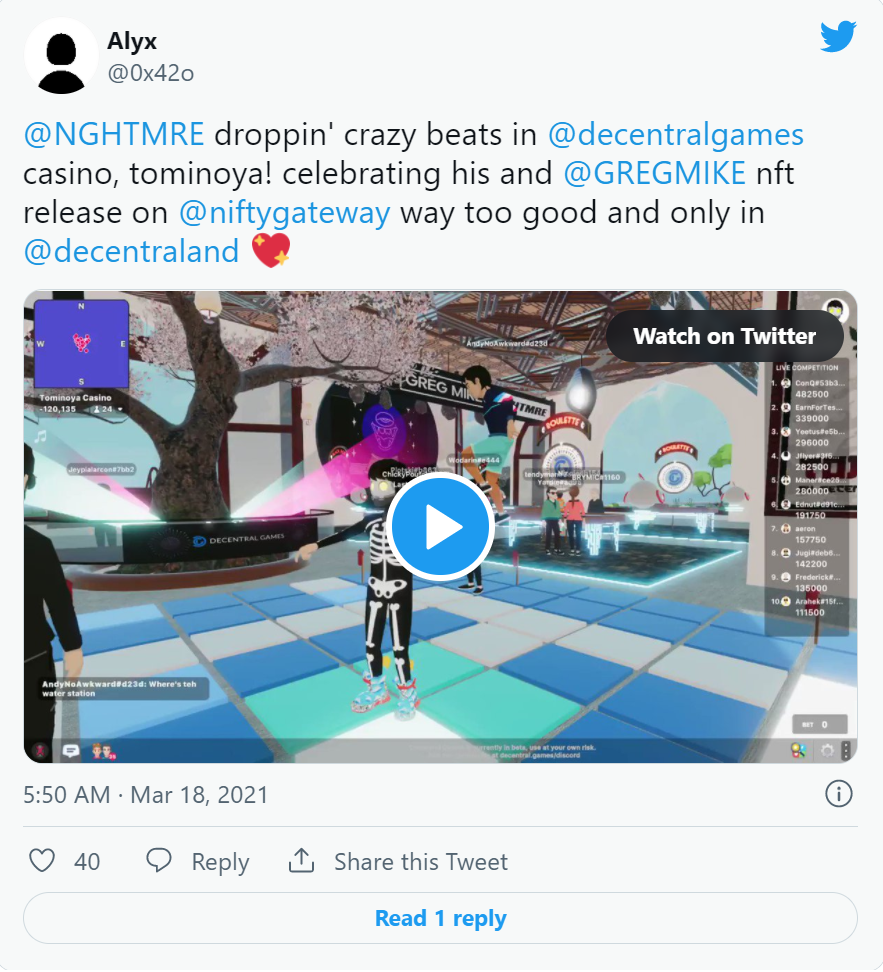
Imagine the digital real estate managers, event organizers, casino employees and ambassadors of the downtown Metaverse of the future The workforce of museum staff is not farfetched.
< /p>
NFT Financialization - Liquidity Protocol and Aggregator
NFT transaction volume on Ethereum recently topped $13B, but total NFT sales have plummeted.
Market saturation is to be expected, only the coveted Items gain value - a similar phenomenon occurs in the realm of physical collectibles, such as trading cards.
The NFT Liquidity Protocol solves the NFT liquidity problem by providing the following solutions:
- Create a liquidity pool similar to NFT. See NFT20 and NFTX.
- Fragmentation of NFTs (i.e. turning one NFT into 10,000 fungible tokens). See Unicly and Fractional. In contrast, Robinhood has followed a similar path by segmenting stocks.
Liquidity Protocol holds over $80M in combined TVL. I imagine that number will go up as the hype dies down and people want their non-fungible products to be more fungible.
NFT aggregators can solve the problem of insufficient liquidity between markets caused by asset fragmentation . The only aggregator I know worth mentioning is Genie, which allows users to buy and sell multiple NFTs across multiple markets in one transaction. Users can purchase NFT through a combination of ETH and NFT.
I imagine some DAOs and gaming guilds plan to use Genie to effectively sweep away some desirable NFT projects floors, which may include virtual land.
Social Networking
While it's beyond the scope of this article to list all the various GameFi-related data, news, and intel troves, I'll say some of the best network-discoverable alphas .
The connections you make in this industry are instrumental in helping understand the The value factor helps a lot.
Discord and Telegram group consisting of well-known NFT, Play-To-Earn and Metaverse projects , is a good place to find topics. Find out if they have any DeFi-focused partners or their own DeFi initiatives.
Centralization vs. Decentralization and the Fate of Pioneering Virtual Worlds - Discussion
Lacking the potential threat of a central authority, residents of the Metaverse can more easily know where their assets (and likely their livelihoods) are on-chain and in private wallets. safe.
Furthermore, the decentralized Metaverse due to its decentralized nature (assuming its server is also decentralized) may be resistant to malicious attacks, and theoretically so is its economy.
The DAO behind this metaverse can also use the funds generated by the GameFi economy of the world as insurance The treasury provides funds.
However, the viability of the decentralized metaverse depends largely on whether the DAO Manage its funds appropriately.
As a side note, I think once industry players find the best product-market fit, Insurance for the Metaverse and GameFi would be great.
Due to its large capital reserves and resources, the centralized Metaverse may have a better Opportunity to weather market downturns. It also means that residents of such metaverses can enjoy a higher level of security in terms of insurance should something go wrong.
Decentralized or otherwise, if the game creator fails to integrate the in-game economy with the The company's revenue structure is tightly coupled, and the viability of the game ultimately depends on the two extremes of the player base: new players and addicts.
@adamscochran is in this thread with games like Decentraland and Axie Infinity and nation states Interesting comparison:
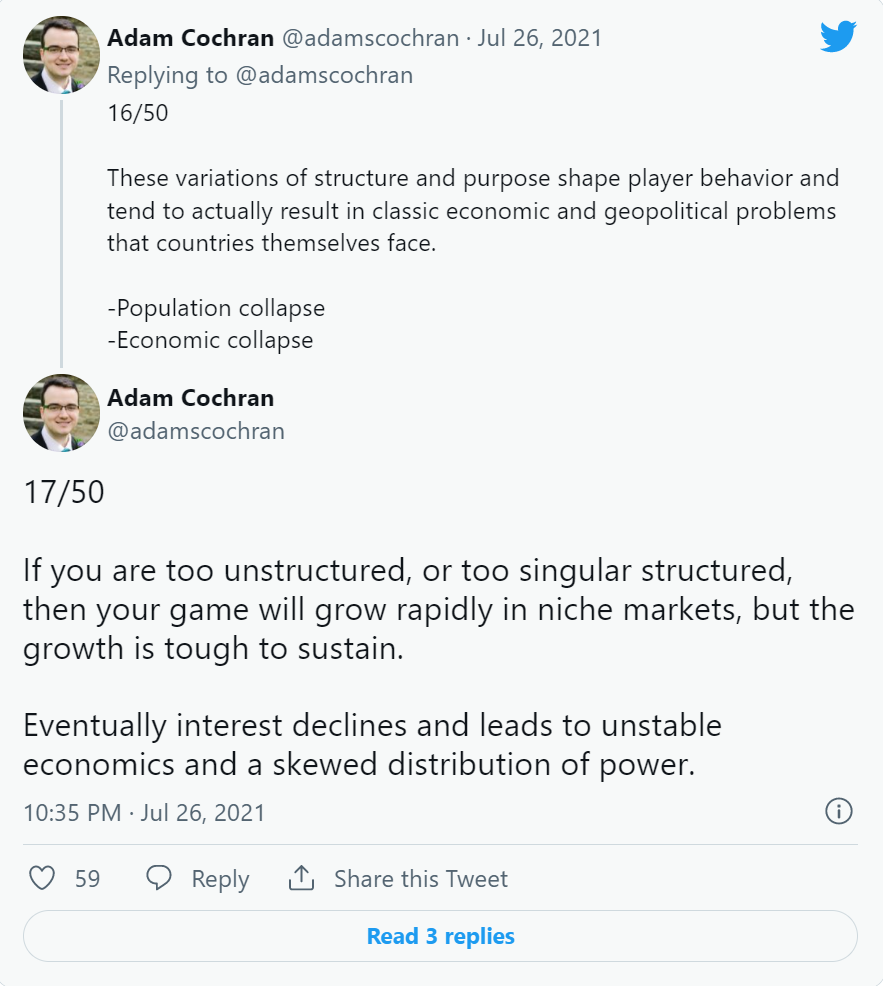
I think this is the case with games like Runescape, and blockchain games like Gods Unchained seem to follow a similar path.
As Adam points out, the middle of the curve stabilizes the gaming experience and increases its popularity to attract users from both ends.
Blockchain games must solve the problems of population, profit and economic collapse and inflation. The Metaverse as a whole should be able to survive, but the games within it may rise and fall quickly as the fun or financial incentives fade.

< /p>
WAGMI!
Original link
Welcome to join the official BlockBeats community:
Telegram Subscription Group: https://t.me/theblockbeats
Telegram Discussion Group: https://t.me/BlockBeats_App
Official Twitter Account: https://twitter.com/BlockBeatsAsia
 Related Articles