Conversation with Solana Asia Pacific Head: Talk about Solana's first China Hackathon, focusing on NFT, DEFI and WEB3
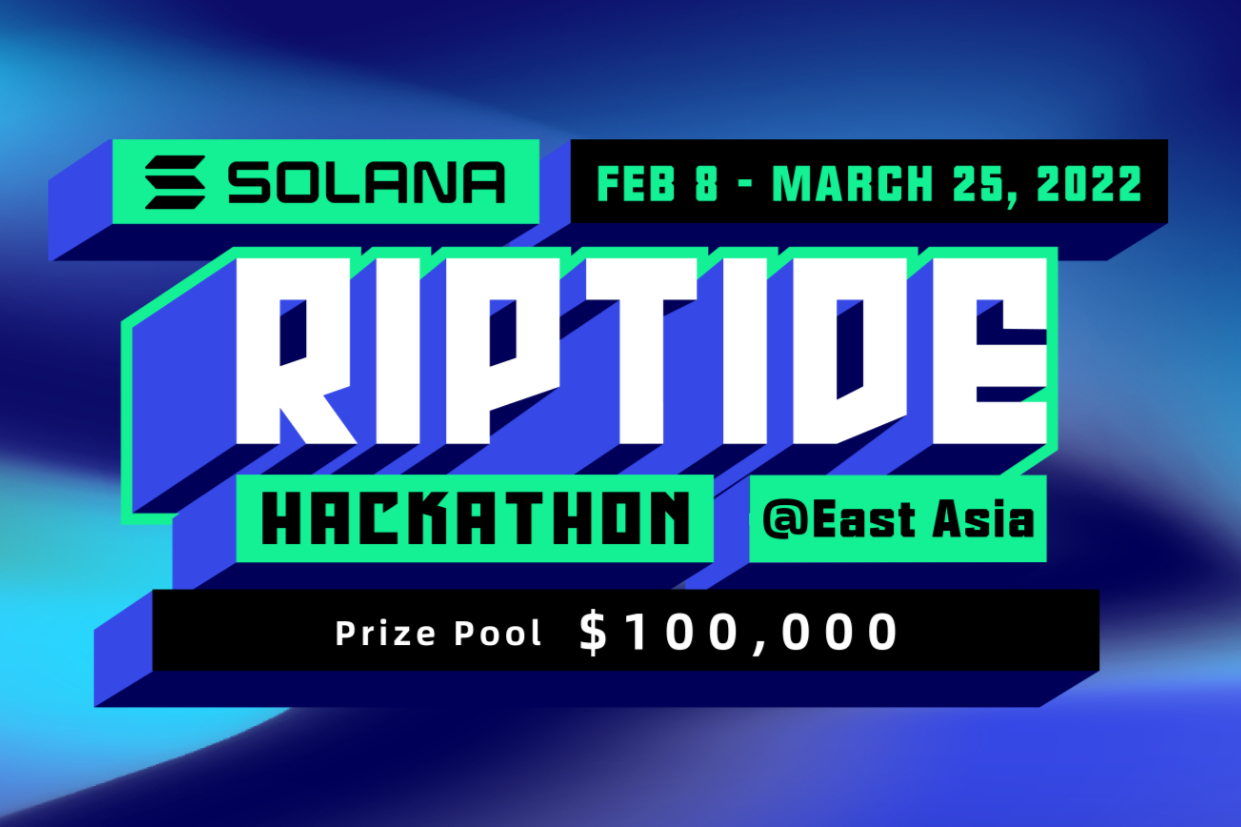
On May 13, Cristobal, head of Solana Asia Pacific, was at Ru BlockBeats AMA to answer questions for developers and readers about Solana's first hackathon in China. He also commented on some of the current projects in Solana Ecology.
The following is the content of the AMA:
Welcome to Cristobal. This is the first time Solana has held a hackathon in China. Are there any requirements for the team to register? What is the status of registration at the moment?
Cristobal:The Solana Hackathon is completely open, and there is no requirement for teams to sign up. Its Slogan in English is "Anyone with an Internet Connection Can Participate." As long as you have ideas and talents and think you can create projects that contribute to Solana's ecology, you can participate.
In addition, while the race has a wide range of entries, divided into three main tracks: NFT, DEFI and WEB3, the subdivision includes almost all the popular events, with the general requirement to "incorporate Solana Public Chains into their events in some way".
We have also prepared a detailed project idea, Solana Season Hackathon Project Creative List & NBSP;https://mp.weixin.qq.com/s/FEJxe6aOpThLh5qQWhVhFw"Developers can also look to them for inspiration.
At present, we have received more than 7,000 registrations globally. In China, the total number of four WeChat signup groups is nearly 800. The specific project submission number needs to wait until May 15th when HackerLink is launched. According to the feedback from Dorahacks, the enthusiasm of the hackers is quite high so far, and it is expected that many high-quality works will be submitted from China.
Rhythm BlockBeats: Hackathons have become extremely active this year, with Solana already hosting a Defi hackathon in February. Why did it happen again so soon?
Cristobal:At Solana & AMP in February; During SERUM's hackathon, over 3,000 applications were received, with over 100 submissions from developers around the world. Ten of SERUM's entries stood out, one being: Mango Markets, Psyoptions, Parrot, Synthetify, Solrise, P2P asset management and trading, Tax Tools SerumtaxTime, asset management and investment protocol DTF, game Sushi Warrior, liquidity solution Tenderize Me, voting tool COPE.
A full list of winners can be found in theSolana X Serum Defi hackathons winners list".
These award-winning projects have basically won the favor of investment institutions and obtained funds for sustainable development, and many of them will be launched in the near future. The reason for the short duration of the event was an outcry from the community, with many developers calling for Solana to do it again because it was "not good enough". At this time, when Ethereum Gas soared and ordinary users were "overwhelmed", the public gradually discovered Solana's low handling fee, fast and high performance features and flooded into our ecosystem. In this case, the team decided to hold a larger, localised hackathon.
At present, in addition to China division, we also have Eastern Europe, India, Brazil, Africa, Vietnam and other divisions, each division is very generous awards. In China, we've teamed up with SERUM and Raydium to create a $1 million pool of awards to reward outstanding projects. In addition, any project submitted by June 7th through Dorahacks Hacklink can also be considered for the Global Award and have a chance to win the Double Award of China + Global Award.
Rhythm Blockbeats: We saw a $75,000 jury special award. What are the criteria? The previous hackathons focused on the Defi track, so will there be more focus on which track?
Cristobal:Hackathon judges will be judged on the following criteria: functionality, technicality, potential impact, novelty, design, composability. After the judges have completed their individual evaluations, the organizer will discuss with the judges and distribute the judges' prize pool to the winners based on the weighted score of the project.
By the way, our panel of judges is very luxurious, covering a number of well-known projects, investment institutions, wallet parties, etc. :

The main racetracks for this hackathon are NFT, DEFI and Web3, but as mentioned earlier, any project that is important to the Solana ecosystem and good enough has a chance to stand out -- it's possible to avoid the main track and build something that the developer knows/is good at, perhaps not as competitive as that.
Rhythm Blockbeats: Projects that stood out in the last hackathon, such as Mango Markets and Psyoptions, don't seem to have much noise yet. How are they doing? What new projects will be announced in the near future?
Cristobal:"No voice" should be because we haven't started to promote the Chinese market. The impression may be that as a foreign project, their main channels of voice are Twitter, Telegram and Discord. There is no community in China for the time being, so users think they have no follow-on, but in fact they are building all the time.
Mango Markets is in Alpha testing and has just released the second version of the new UI, with a TVL of over $20 million. PsyOptions revealed recent progress in its latest weekly report, including bug fixes, an update to the position management interface, an alpha release and targeted invitation testing to active community users, and a change to PugOptions. More hackathons are on the way, so keep your eyes open.
Recently, there have been many new projects, including but not limited to the following:


You can also follow through Twitter, Rhythm and other channels to find early opportunities! In fact, if you want to hear, I can talk about a few projects that I am optimistic about:
Pyth
Prophet solutions based on the Solana ecosystem platform emphasize the link of high-frequency real-world data to the Solana blockchain. The project is currently under development. Dave Olsen, president and chief investment officer of high-frequency Trading firm Jump Trading, said on The Jump Off Point podcast, "is involved in The development of Pyth, which aims to provide high-performance and accurate data sources for The market, The Prophet project will be built on the Solana blockchain."
Mercurial
Mercurial Finance aims to be the first on-chain dynamically stable asset vault, offering a low sliding-point stablecoin exchange and trading service, while leveraging dynamic charging mechanism and flexible capital allocation to improve the returns of liquidity providers. Officials say it will start with an AMM Vault, offering dynamic fees for native and wrapped stabilins (USDC, USDT, WUSDC and WUSDT) on Solana, with the goal of helping to improve liquidity for these assets. The main design principles of the Vaults include composability, fluidity and safety. Mercurial Finance recently announced that it has completed financing, with investment from Huobi, Alameda Research, Solana Ecological Fund, OKEx, Hu, Blockfolio founder Edward Moncad and others.
Jet Protocol
Jet Protocol is a Solana-based lending agreement created by ConsenSys former developers Wil Barnes and James Ryan Moreau, which will focus on innovative loan products and cross-chain interest rate arbitrage. In the coming weeks, the Jet Protocol team will release detailed information about platforms, governance, and tokens. Website:https://www.jetprotocol.io/
Pyth is done by Jump Trading, Mercurial is done by Kyber engineers, and Jet Protocol is done by MakerDao engineers, all based on Solana's SPL format.
As a popular crowdfunding method recently, Ethereum usually uses high Gas fee to prevent some scientists from attacking. Then, as a low fee, Solana, when users conduct ID0, how will it prevent "scientists" from maintaining the fairness of the transaction?
Cristobal:First of all to state that Solana Foundation will not be holding any ID0, I can only comment from a retail perspective on the previous three ID0 within the ecosystem.
Solana is known for its low cost (0.00005 SOL for each transfer), high performance (TPS up to 50K+) and fast speed (block confirmation time 0.4 seconds). In most cases, the TPS of Solana blockchain is around 1000. Far from reaching the limit of full load.

From Blockchain Browserhttps://solanabeach.io/
When conducting IDO, I think most project parties will not interfere with "scientists". Scientists are also participants in the project, and the rules of participation have been set in advance. As long as they participate within the rules, there is no problem.
From the point of view of the average user, since there is no need or adjustment of Gas charges and miners (validation nodes) cannot sort transactions, all participants are on the same starting line and it is more about physical conditions such as hardware devices, network speed and so on. So before IDO, ordinary users in the community can snap up the generation share for the first time. Later, he said that he participated with mobile browser and Sollet wallet, which is a very rare thing in other blockchain.
Rhythm BlockBeats: Expectations are high for Solana. Will there be any barriers for users to use Solana compared to other public chains that support EVM?
Cristobal:I don't think EVM incompatibility matters to users as much as Rust, a more difficult language, does to developers. Solana's app is accessed in the same way as any other blockchain: you create a wallet, then connect it to the wallet and authorize the app to interact with it.
There may be some work to be done on the current wallet experience (currently the most widely supported wallet is the web/plugin wallet Sollet) and the lack of hardware wallet support, but it should get better as more developers join the Phantom wallet as it gets ready to launch. End users will enjoy the convenience of the Little Fox wallet + the fast silky Solana user experience, and I hope everyone will grow to love this feeling.
Blockbeats: How do you see the current development of the public chain? There is a view that Ethereum is a product incubator, while other public chains are doing layer2?
Cristobal:That's a great question. Ethereum, as the Whampoa Military Academy, has indeed produced a large number of quality projects. Defi, NFT, Web3, many excellent teams and projects have come from there. Admittedly, many of Solana's current projects are somewhat inspired by the Ethereum project. After all, imitating a proven business model is always easier than creating and proving a new one.
Will Solana be constrained by the existing ecosystem of Ethereum? Personally, I have actually seen a significant divergence from the Ethereum ecology at the High level and the actual ecological development level. My boss said to me at the beginning of the year,
"Solana's goal is to reach one billion users in two years."
Solana's Moore's Law expansion (doubling every two years) is not just about carrying the traffic of Ethereum today. As an Internet-class expansion project, our technical team is constantly improving: performance, decentralization, composability, and security
At Solana, the vision is to break the rules and apply them to a wide range of applications, not just to today's blockchain users.
We can look at some data:
-Audius, decentralized netease cloud, more than 4.4 million live months;
- Maps, the world's fourth largest mapping app with 140 million users, will offer them blockchain transfer, exchange, and transaction capabilities via Oxygen on Solana;
-Kin 1.4 million monthly live, will migrate over 60 application account addresses to Solana;
-- Star Atlas is a large-scale Metaverse MMO universe exploration game that combines state-of-the-art blockchain, real-time graphics, multiplayer video games, and decentralized financial technology.
It uses Virtual Engine 5's Nanite real-time graphics technology to provide movie-level video game visuals. Blockchain technology enabled by the Solana protocol provides a serverless, secure gaming experience. Inside the Star Atlas game, players earn and trade NFT tokens and create an economy that replicates real world assets and ownership tangibles.


Rhythm BlockBeats: Is operation more important than technology for a public chain now?
Cristobal:I think both operations and technology are important, but the emphasis is different at different stages.
First of all, a strong technical background is the foundation for building a fast, efficient and low-cost blockchain, which is a fertile ground for upper-level applications to flourish. If a blockchain is limited by the complexity of limited TPS, high interaction costs, and sharding, would you, as a developer or project partner, feel comfortable building applications on it? Obviously not, right? In the early stages, technology will be more important, to lay a solid foundation.
However, if there is a lack of necessary operation and market strategies, users and developers may not know about this wine. Even if a public chain is niubi, no one will interact with it, and then no one will use it in niubi. This is the stage where the operation is very important. When the technology is solid, it is necessary to do a massive publicity campaign to say to the world, "We have a better product, let's try it." Solana's numerous hackathons, community events, and efforts to integrate partners are examples of this type of marketing.
Finally, as more and more projects in the chain of a male was set up in succession, the agreement can be combined each other at random between/project number and freedom to grow, mass explosive growth stage, the male chain team, it is necessary to "deep work with name" spend more energy in technology upgrade, expansion, development tools, improve the block chain stable performance, etc. Safety and stability are the most important at this point, and it is enough for the public chain to do this well - since the project will grow spontaneously, the operation is not the most important.
Rhythm Blockbeats: Any new plans for Solana in the future?
Cristobal:In addition to improving performance while ensuring centralization and security as mentioned earlier, Solana will spend more time and build/improve more tooling to save developer cost-based and enable innovation.
On the ecological side, we will continue to encourage more quality projects through hackathons, Grants, workshops, and the Ecology Fund. At the same time, we will also follow up and improve the technical documentation to record our tool innovation.
Solana takes China very seriously, and we recently established seven eco-funds with Huobi, OKEx, Wheat Wallet, Hashkey, MXC, GATE and NGC, hoping to help fuel Solana's Chinese ecology by working with these leading organizations. (Six of them are reported to have completed their Solana investment)
On the technology side, we will promote a series of activities to expand the developer base in China, and possibly collaborate with industry mentors and technical support to help shape projects and make them available to the public.
If you want to participate in hackathons, please add your official Weibo account and comment hackathons. We will join Dorahacks and our sign-up group, Shout Out to Dorahacks to do Hackathon is very powerful, thank you for organizing this activity.
Welcome to join the official BlockBeats community:
Telegram Subscription Group: https://t.me/theblockbeats
Telegram Discussion Group: https://t.me/BlockBeats_App
Official Twitter Account: https://twitter.com/BlockBeatsAsia
 Related Articles