On Reflexivity and Imitation
Original title: "On Reflexivity and Imitation, Deribit Insights"
Original source: Deribit Deribit Trading Lesson
Games How is it different from the financial system? When did games become real finance? As software-based speculation eats up the world, the line between reality and gaming can become blurred. Imitation and reflexivity fuel this process.
This article hopes to introduce readers to several philosophical frameworks in an interesting way, offering different analyzes of the current market situation. The results of this survey surprised even the author and required a new perspective: this may be describing some form of oracle attack.
The first part introduces the basis of reflexivity and imitation theory, and how they are related. Readers may consider this an interesting thought experiment, discussing why in more detail:
Some objects are more reflexive than others.
The amount of money in the system affects the reflexivity of financial assets.
Memes and marketplaces are very similar - both compile information. They're both nuance-reducing machines, and they're at odds with each other.
Consciousness tells the market how to move, and the market tells consciousness how to bend.
Asset prices can be overshadowed by memes; "prices are news".
Highly reflexive assets are subject to simulation.
I want to use Lucre I edited this poem to start thinking about the nature of things:
< /p>
Nothing is static, everything is fluid.
Pieces stick together; things grow
until we know and name them. Gradually
They melt away and are no longer what we know them to be.
Reflexivity and Reflexive assets
According to Soros, thinking has two functions:< /p>
One is understanding the world in which we live; cognitive functions, or states of belief in consciousness.
The second is to change the situation in our favor; to manipulate a function or a preferred state of consciousness.
The two functions connect our consciousness and the world from opposite directions.
In terms of cognitive function, Reality determines the participant's perception; the direction of causality is world → consciousness
In the manipulation function, the participant's intentions have an effect on the world. The direction of cause and effect becomes consciousness → world
When these two functions run simultaneously, they can interfere with or interact with each other. The views of the participants affect the course of events, and the course of events affects the views of the participants.
Influence is continuous and circular; this turns it into a feedback loop. Hence the famous flywheel metaphor. Price drives desire, and desire drives price.

Anything that needs to be described, other than its physical properties, is the subject of reflexivity. Something highly reflexive needs a narrative to be understood. Additionally, reflective assets are prone to volatility because narratives tend to be capricious.
Are you seeing shoes or coconut shoes?

Do you think it is a pyramid scheme, digital gold or an alternative currency system?

Are you seeing a pre-planted hoax or a world computer?

Let me demonstrate reflexivity with the following statement:
Bitcoin is a revolution. (Highly reflexive) → We will see that (expensive inquiry)
It's raining outside. (non-reflexive) → I can easily verify now (cheap inquiry)
If I believe Bitcoin is revolutionary, then the costs associated with validating that statement include time, money, and perhaps other resources . Assertions about reflexive assets will take time to resolve. Such inquiries are costly because the results are inherently malleable.
And if I'm in a room with a window, checking my assertions about the weather is relatively simple. To tell if my statement is true, just stick your hand out the window, which is cheap (and not malleable).

Memes and markets
In a recent passage In the video, Jeff Bezos defines a property of information with high viral potential:
Eliminate nuance
Add emotion (preferably conflict)
That's the secret to creating a successful meme. Memes measure the distribution of information.
The meme was first described by Dawkins, who defined it as an evolutionary aspect subject to a selection process that "expresses the notion of a unit of cultural transmission or a unit of imitation" (Wikipedia).
Memes have similarities to marketplaces. The output of the market is also very concise. It comes in the form of a price.
Markets (Hayekian terms) and memes both compile information by removing nuance and giving us a succinct output, a very specific message. Memes are similar to price tags. Memes and marketplaces are machines for reducing nuance.
Considering that they operate in similar ways and both contribute to the scaling of information, these forces may be in competition. The output of the market is physically limited (eventually). Memes are just narratives, memes themselves have no physical boundaries.
In the context of market reflexivity - prices are supposed to represent conscious belief states, while memes are more of a preference state of the conscious category, as they can distort facts or obscure reality. As Hasu6 pointed out; in oracle attacks, the line gets blurred. Distorting market prices can trigger behavior in the real world.
Price is a coordinated data point that tells us the true state of the world. Memes, while measuring the distribution of information, do not necessarily convey the true state of the world. This misrepresents the feedback loop. Preference pretends to be a belief (like real performance).

When does an asset (and its price) become a meme
Tesla is a meme. But $TSLA owns the price.
$BTC has a price. Bitcoin is also a meme.
A very powerful Schelling point is formed when asset prices become memes, or memes become prices. Schelling points are the result of imitation. (Schelling point, also translated as Xuelin point, or focus point, is the tendency of people to choose in the game theory without communication. This choice may be made because it seems natural, special, or it is related to the choice. or related.)
What is the difference between a meme and a parody?
Memes compile information to provide a concise narrative. Mimetism (discussed in more detail later) describes the process of meme reproduction; you want something because someone else wants it. Memes spread by imitation.
Money printing and reflexivity h4>
From the perspective of the market, the conscious preference state is an innovative mechanism. A conscious belief state is a coordination tool. Our assumption is that the two serve separate purposes and should be in a delicate balance for markets and societies to function properly.
We coordinate through price feedback to create something new by introducing our preferences for the status quo. When we flood the market with money, we are effectively launching an oracle attack.
Central banks are distributing assets as the monetary base expands. The market becomes freer in defining what is desirable and valuable. In other words, when the coordination signal becomes weaker or less precise, the market's output is distorted.
Participants begin to freely manipulate the world around them as it becomes more malleable due to the lack of corrective signals. Memes replace prices.
When the output of the market becomes blurred and the definition becomes vague or vague, we not only lose the ability to coordinate effectively, but also lose the ability to truly innovate. How can we build what we need if we don't know what we really need?
In this system, more soft money allows us to broaden our definition of things, with the desire aspect strengthening as numbers go up. Desire and malleability are intimately linked, and without any ground truth signal, they can hijack consciousness.
Shoes become coconut shoes, $TSLA becomes more than just an automaker – the narrative aspect is more important than face value. The manipulative function of insanity causes people to desire those things in the market that become valuable because of the lack of corrective signals.
When the amount of soft money increases, people are willing to make more expensive explorations of highly reflexive assets. Lust intensifies. Overwhelming conscious preference states (over conscious belief states) give market participants too much power to define what is desirable. So they allocate money into reflexive assets.
$TSLA is barely profitable, does it matter? Is it a car company? Is it a technology company? Is this the idea of a genius or a madman?
Are you seeing an automaker, a scam, or the "future"?

Ultimately, it is the sum of active observers that determines what a reflexive asset will become. But physical constraints come into play. Bitcoin has abandoned its original narrative of a peer-to-peer payment network because its (physical) properties, such as low transaction speeds, do not allow it to support that narrative.
As far as markets are concerned, soft money appears to be exacerbating the reflexive effect. In a highly reflexive environment, things are not worth what they are, but how good their memes are.
With more money, the vision will be projected further into the future, and few people care what the future is. Many people (and money) care about what might happen. Memes blur reality and shape visions of the future. Price becomes a meme.
Reflexive assets as a side effect of imitation

Girard describes humans as lifelong children who long for the toy someone else just picked up. People who cannot choose what they want turn to others to find it.
Girard's theory of imitation states that desire arises from the contemplation of another who desires something and assigns the object of desire to another. Another person now considers this object desirable.
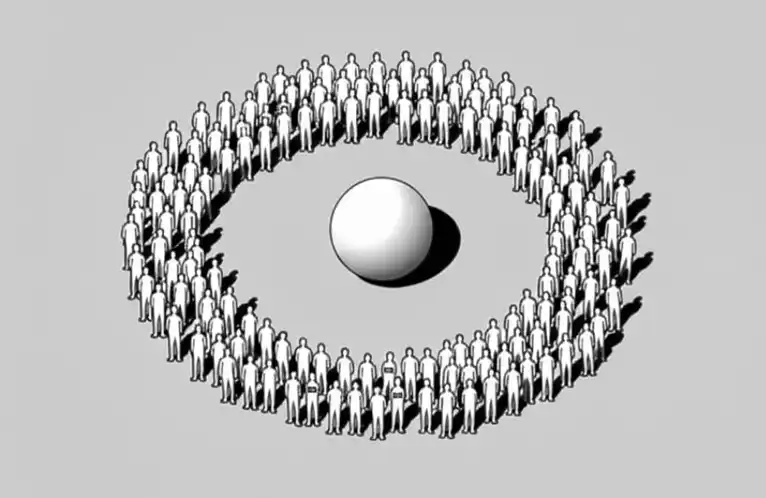
There is a triangular relationship (see diagram below) between the following: (i) the speculator (or subject), replicates (ii) his desired model, to obtain (iii) the object.

We mimic other people's desires, but when we all desire the same object, conflicts arise because desirable objects exist in subjective 8 scarcity. Thus, the mimetic nature of desire leads to conflict.
People are polarized in what they want. Once the subject becomes aware that his desire is being imitated, his desire deepens, triggering the reflexive cycle 9 . Conflict is a natural consequence.
The collective evil that boils beneath the surface requires a sacrifice – a scapegoat – to resolve the conflict. According to Gillard, people need to reconcile with the scapegoats they killed in order to unite them.
Desire not out of need but out of insecurity awakens greed. It is not a coincidence that many people explain greed as the driving force behind markets11, or markets as a system for taming destructive greed in productive ways.
How is imitation reflected in the market?
A market is a collection of desires. Think of the market as a general model (in a triangle) that people can imitate. The reflexivity of assets is actually an epiphenomenon of imitation.

How startups became decacorns, in terms of fandom and imitation:
There are people with apparently crazy ideas like selling Basic to computer geeks in 1975, Or selling books online in 1994.
They sell the idea like crazy to investors and early employees - it's common for startups to give sales forecasts in the early stages, but rarely meet them initial numbers.
The investor's money and talent mix make the idea less crazy, though still ambitious.
On this basis, the founders raised more funds and recruited more talents.
Over time, either because expectations are watered down and reality catches up, reality converges on these crazy expectations; The only way possible, founders are constantly deceiving themselves and others until they hit a breaking point.
Every step of the way influenced by the market. Investors want to join because other people join. Activating the reflexive nature of imitation helps ideas become reality. Reflexivity is a good thing because it helps to change our environment. The problem is when the balance of desires is distorted.

Desire Balance
Eric Weinstein extended the theory of reflexivity by describing opposing momentums represented by two sets of back and forth equations, suggesting that this is similar to that described by Einstein's gravitational field theory .
Wheeler's interpretation of Einstein:
Matter tells space how to bend, and space tells matter how to move.
Weinstein's interpretation of Soros:
Consciousness tells the market how to move, and the market tells consciousness how to bend.
Questions Asked by Weinstein; Answers to "What's Crooked?" :imitate. To explain these "equations" in Girard's terms:
Consciousness tells the market how to move, and the market tells the conscious what is desirable (what to want).
The manipulation function enables an individual to interact with the market, thereby causing a change in market behavior. Cognitive functions work in reverse, causing individuals to change their thinking, creating a feedback loop between conscious belief states and conscious preference states.
Think of the desire balance as two back and forth equations:
Speculators tell the market what individuals want (specific assets), which is essentially "consciousness telling the market how to move" (conscious preference state) .
Markets provide feedback to individuals about what they want through asset prices. "The market tells the consciousness what is desirable" (conscious belief state).
Then the individual changes his initial desire and now injects this changed desire into the market. The cycle continues in an infinite loop. Mimicry regulates these feedback loops.

This equalization should be a delicate balancing act, So that the market will not become a deceptive mirror. Usually we experience a market crash when things go too far, we find a scapegoat (e.g., banks), the market corrects, and a new cycle begins again.
Reflexivity works in both directions, unraveling on the way down. A market crash may provide a moment of clarity. But a clear picture is too naked for the impossibility that we are all at fault. To achieve a new equilibrium, the community looks for a scapegoat to clear itself of its sins and move on.
Prices tell us the true state of the world, usually when things hit a physical barrier and reality (beliefs) collides with narrative (preferences). There are obstacles to scalability, and the community should be informed in a timely manner.
These days, the price signals have weakened. Narratives or memes are taking hold because it's nearly impossible to run out of cash. Thus, the conscious preference state stays in misrepresentation, entangled in escalating imitation.
The price itself became the news and the ending. The world has become extremely uncertain in nature. Reflexivity reigns supreme in a world devoid of intention. Everyone took part in the imitation dance.
In an uncertain world, people actually prefer unlimited options; money is worth more than anything you can do with it. Only in a certain future will money become a means to an end rather than an end in itself.
Speculation is eating the world.
Welcome to join the official BlockBeats community:
Telegram Subscription Group: https://t.me/theblockbeats
Telegram Discussion Group: https://t.me/BlockBeats_App
Official Twitter Account: https://twitter.com/BlockBeatsAsia

 Related Articles