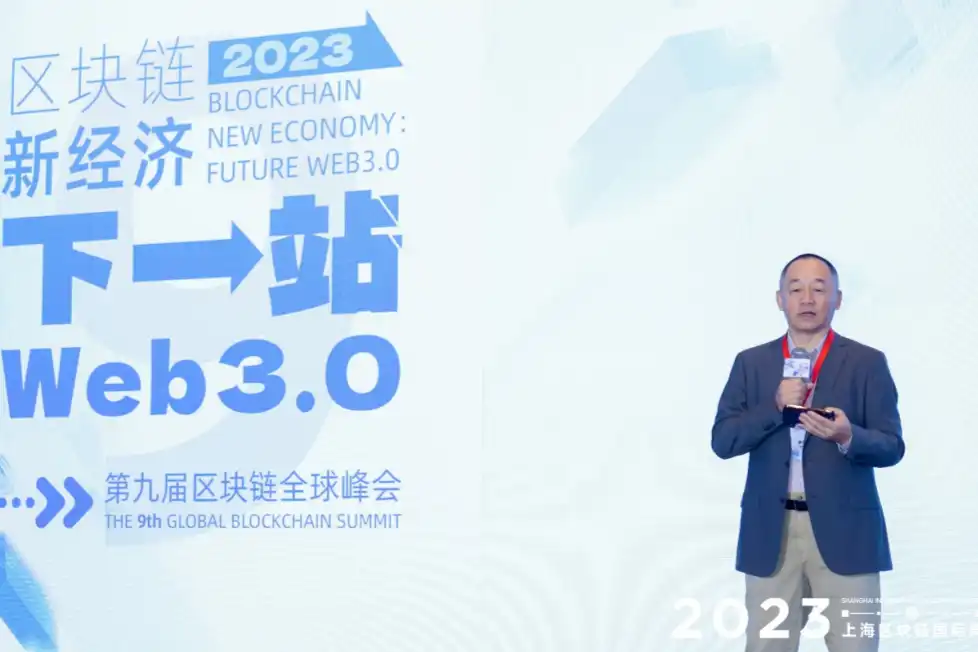
Xiao Feng: Blockchain is the trust mechanism of global digital migration
Original title: Wanxiang Holdings Xiao Feng: Globalization after 2020 is called "Digital Migration"
Source: Morning Sentinel Acquisition
Speech: Xiao Feng, chairman and general manager of Wanxiang blockchain and founder of PlatON
In early 2020, a sudden outbreak disrupted people's lives and had a huge impact on business. In this epidemic, the digital economy, represented by the Internet, has provided a strong buffer for people's lives in special times, while also providing some new opportunities for economic development. New opportunities are in the making. Whoever takes the lead in the transformation will seize the new round of strategic opportunities. In the morning of May 28 morning post group sponsored by "the 7th global mergers and acquisitions investment summit" conference on "looking for the next globalisation", wanxiang holding company vice chairman Dr XiaoFeng published titled "new era of digital economy changes bring opportunities" speech, he thinks, the outbreak of the digital revolution to make a new round of globalization forward for 3 to 5 years, and that a globalization will bring social and economic aspects of change, "all business will be to re-do it, all the business is worth to do a". & have spent & have spent

Xiao Feng & NBSP; vice chairman of Wanxiang Holding Company; & have spent
From May 28 to 30, the 7th Global Investment and Merger Summit and the 6th Golden Whistle Award Ceremony with the theme of "Crossroads of Economic Globalization -- How Capital, Industry and Data flow" were successfully held in Hongqiao Fund Town, Shanghai. This meeting is directed by The People's government of Minhang District, hosted by Chenshao Group and co-hosted by Shanghai Hongqiao Fund Town. There were more than 200 entrepreneurs and investors brainstorming at the scene. New globalization, new industries, new capital and new investment attraction became hot topics.
Guest Introduction:
Dr. Xiao Feng, vice chairman of Wanxiang Holding Company, has nearly 30 years of experience in securities industry and asset management. He served successively as Deputy Director of Securities Management Office of Shenzhen Special Economic Zone Branch, Director of Shenzhen Securities Management Office, Deputy Director of Securities Management Office, President of Boshi Fund Management Co., LTD., etc. He is currently vice Chairman and executive Director of China Wanxiang Holding Co., LTD., founder of Wanxiang Blockchain Lab, and partner of Distributed Capital, China's largest blockchain investment fund.
Golden words of the
1. Globalization is divided into pre-2020 and post-2020 periods. That watershed might have come a few years later, but the epidemic has thrust it forward by three or even five years.
2. The globalization after 2020, called "digital migration", is no longer a re-manipulation of physical structure, but a transition from the physical world to the digital world. In the digital world, first, there is no national boundaries, second, across time and space, that is the real globalization.
3. 2020 can be seen as the beginning of the end of the last globalization, and the year after 2020 can be seen as the end of the beginning of the next globalization.
If you can work from home, does the company care where the employee is? It's the same in Shanghai, New York, San Francisco or Bangalore. If so, the company does not need to apply for a U.S. work visa for the employee, and the labor relationship between the company and the employee changes. Thus, the gig economy has obtained the soil for development.
5. Digitization also brings a huge impact on the organization management and control system of the company. The original vertical management system of control and control becomes less important in the company, while the horizontal collaborative system may become the most important management structure of the company. So now, KPI management is moving to OKR management.
The use of chemistry to develop drugs has come to a complete halt over the past 20 years. All the new drugs in the last 20 years have not been made chemically, they have been made biologically. A billion dollars spent on chemistry over 10 years has diminishing marginal returns.
7. The same is true of automobile manufacturing. For more than 100 years, Mercedes and BMW have followed the principles of Newtonian physics to make the most valuable motor in a car. In the last 20 years, even if you invest billions of dollars to optimize the efficiency of the motor, you can only improve it by 1%, but that's not perceptible to the user.
8. The Internet of Things links devices together, and these two networks provide the first opportunity for human society to collect massive amounts of data at very low cost. Without the Internet, the Internet of Things, data cannot be collected or collected at a commercially viable cost.
9. As far as data is concerned, only Internet companies have actually used our behavioral data. The rest of the data has not started to be used on a large scale. So the future prospects of this market are many times bigger than they are now.
10. All businesses deserve to be redone. With trillion-dollar companies emerging in the digital age, why isn't it worth redoing? Ge, the most valuable company in the industrial economy, reached nearly $600 billion before collapsing. Why is that? Because the marginal cost of a company in the digital age is zero, it cannot be zero for any industrial company to process a physical structure. In economies with zero marginal cost, trillion-dollar market caps will be the norm.
The following is the full text of Xiao Feng's speech:
Thank you morning Sentry for giving me this opportunity to share with you. My share can basically be regarded as the annotation of Chairman Ong Zhongmin's speech, I strongly agree with his change of the underlying logic of digitization.
I closely follow the theme of Yunfan - the new round of digital economic change brought by the opportunity of The Times. I look at 2020 as a watershed year for globalization, which is pre-2020 and post-2020. That watershed might have come a few years later, but the epidemic has thrust it forward by three or even five years.
2020 - A watershed for globalization
Before 2020, globalization is the globalization of industrial chain. I read a book about container is how to change the world, after container costs plunged, the layout of the industrial chain in physics was broken, so there is no need for the entire industry is concentrated in a city or a country, can completely like apple mobile global production parts, even after half parts produced in a country, through the container shipping to another country and then finish machining, eventually transported to a place to assemble into the iPhone. In terms of cost, there is no problem at all. It is a physical globalization, which rearranges the industrial chain globally according to the principle of cost effectiveness.
After 2020, globalization, called "digital migration", is no longer a re-manipulation of physical structure, but a transition from the physical world to the digital world. In the digital world, first, there is no national boundaries, second, across time and space, that is the real globalization.
Many people will benefit from globalization before 2020, including China. But there are victims of globalization. Who are the victims? Middle class, industrial workers in the United States or other developed countries. Because the middle class and workers are not globalised, economics is called "non-tradable goods". It is impossible to say that industries moved to China from the United States and that American workers came to China to work and earn money. It's true that the multinationals on Wall Street have enjoyed the great benefits of globalization, and it's true that we in the developing world have enjoyed the great benefits of globalization in the last one, and many people have suffered.
But in digital space, non-tradable goods become tradable. So the second globalization is something to look forward to.
Moving from the rearrangement of physical space to digital space may solve the problems of the last globalisation. In fact, we now have examples of non-tradable products becoming tradable, such as children learning English online, teachers in the United States or the United Kingdom, because of the Internet, digital tools, technology, online classes, learning English, teachers do not need to come to China. This makes up for the shortcomings of the last globalisation.
Therefore, I firmly believe that a second globalization driven by the epidemic after 2020 will surely bring a better future for the world.
The famous slogan of the first globalization was "The world is flat," a physical concept; The second globalization also has a famous slogan, "Through parallel universes," in which the digital earth, the digital world, outside the physical earth we live in, is parallel to us. That should be the mantra for the next 10 or 20 years.
So,2020 can be seen as the beginning of the end of the last globalization, and after 2020 can be seen as the end of the beginning of the next globalization. We have seen the last globalization, because of some disadvantages, it is now "deglobalization".
Ever since the advent of the Internet, humans have been migrating digitally. In 1996, MIT professor Nicholas Negroponte published a book called "Digital Survival," which basically sounded the trumpet of human digital migration. Today, in fact, the beginning of the stage has ended, the discovery of the digital continent of the ship docked, has entered the mainstream. That's my first opinion.
Then we can look at it from two perspectives, two phenomena. Why is globalization 2.0, or globalization beyond 2020, the beginning and the end? During the outbreak, for example, many companies announced permanent home-based policies. Twitter has announced, on behalf of Silicon Valley, and Goldman Sachs has announced that more than half of its employees work from home. So whether it's high-tech companies in Silicon Valley or financial institutions on Wall Street, they're doing it.
Digitalization of organizations
At the end of March, I had a videoconference with an executive at a $100 billion domestic company who told me he'd been home for two months. Over the past three months, I have asked executives at at least three Chinese Internet companies with a $100 billion valuation whether their work-at-home work is hurting productivity. All three of them said, one, no impact, and two, more efficiency. It is also reasonable, Ma Yun said before to "996", was scolded completely, but now work from home, become "997", even 24 hours in the work, efficiency can low? So this is the epidemic pushing back what might have happened in five years, and you see,The rate of digitalization of organizations has changed dramatically because of the impact of the epidemic.
If you can work from home, does the company care where the employee is? It's the same in Shanghai, New York, San Francisco or Bangalore. If so, the company does not need to apply for a U.S. work visa for the employee, and the labor relationship between the company and the employee changes. Thus, the gig economy has obtained the soil for development.
I recently read an article that summarized 15 models of the gig economy. The gig economy will grow very quickly on the digital soil, the employee-company relationship will change a lot, and physical space won't matter at all. As I said before, the biggest victims of the last globalization were people and labor force. Because people could not be traded, it was impossible to move Americans to Work in China. But with these things, it was possible to trade.
In addition, digitalization also brings a huge impact on the organization management and control system of the company. The original vertical management system of control and control becomes less important in the company, while the horizontal collaborative system may become the most important management structure of the company. So now, KPI management is moving to OKR management. KPI management is the vertical dominance and control system under our key performance assessment, OKR is horizontal alignment. You do one thing together in different places, you have to be transparent, you have to align your goals, so use OKR's tools. A new generation of companies is pushing OKR. Google is the best in this respect. The best domestic OKR is Bytedance.
When we introduced the developed countries in Europe and America, we described the United States as a country on wheels, which was the result of the industrialization of the United States. Industrialization brought great changes to the American society, and the whole country was on wheels. Now, with the advent of digital age, organizations become "online organizations", which is also a very big change, a new trend. How much change the digital world brings depends on how much it becomes an online organization. When the company becomes an online organization, the digitization of the organization may be close to complete. On the one hand, and on the other hand, in terms of the management, the structure, the people, the way the organization operates, actually the digitization has already started.
Digitization of business
From a business perspective, Chairman Wang zhongmin just mentioned a word: "diminishing marginal effect". We can say with certainty,After more than 200 years of industrial revolution transformation, any business has entered the stage of diminishing marginal effect.
At that time, Yang Zhenning was opposed to the government spending hundreds of billions of yuan to build the Large Collider. He believed that modern physics had already entered the stage of stagnation, and it was unnecessary to spend hundreds of billions of yuan to build something with diminishing marginal effect. Fortunately, he opposed success. Because a 100 billion yuan investment in the LHC will have a crowding out effect, the country cannot provide unlimited funds for scientific research, which will have to be saved elsewhere. Therefore, it may not only waste 100 billion yuan in the end, but also waste a lot of directional research and strategic problems.
What about chemistry? Chemistry, too, is at a standstill.Over the past 20 years, the use of chemistry to develop drugs has come to a complete halt. I talked to the CEO of a healthcare company, and he said, all the new drugs in the last 20 years have not been made chemically, they have been made biologically. A billion dollars spent on chemistry over 10 years has diminishing marginal returns.
The same goes for cars. Mercedes and BMW have followed Newtonian physics for more than 100 years to make the most valuable motor in a car. In the last 20 years, even if you invest billions of dollars to optimize the efficiency of the motor, you can only improve it by 1%, but that's not perceptible to the user. So if you keep going down this road, developing motors, improving efficiency, it's not going to work.
The car industry is facing a big revolution, a Silicon Valley software engineer came out: Why do cars have to use motors? So electric cars were born. The invention of the electric car is a process of software redefining the car. You can't build a new car until you declare the motor dead. If you look at the annual reports of Mercedes, BMW, Volkswagen, Ford, or General Motors, you'll see that each car company spends tens of billions of dollars a year on r&d. But do car motors really get much better every year? Is very small.Since the advent of driverless cars, it is data that determines whether a car will run, turn, slow down or accelerate. The data collected by millimeter-wave radar finally tells the car whether to drive, slow or fast, turn or not. Software redefines the car, data drives the car and becomes the most valuable thing in the car, rather than the architecture of physics.
There are more than 30,000 parts for traditional cars, while there are only 3,000 parts for electric cars. Therefore, cars are no longer about physical architecture, but about software and data. Business has changed a lot. With the development of 5G and 6G, more and more non-tradable goods will become tradable.
With the help of digital technology, labor can be traded, and employees don't need to move from the United States to China, even though industries move to China. Then there is education, where the Internet has turned the non-tradable into the tradable. In the sports industry, the development of VR glasses will increase the current $1 billion worth of teams to $10 billion, because spectators can sell as many as 80,000 tickets at home as they do at the stadium, and very few of those 80,000 tickets are in good positions. But with VR glasses, sitting in the living room will still give you the feeling of being in the best place in the room, which at that time could sell 100 million tickets for $100 each. So the development of 5G, 6G, VR and AR gives you the feeling of being in the living room, and the teams that regularly make it to the European Championship and World Cup finals, are they worth 1 billion or 10 billion dollars? I think it's worth $10 billion because they can make a lot more money, and digitization opens the borders completely.
The digitization of business is already happening, and it is bound to happen, because the industrial revolution, physical and chemical methods have inevitably reached the stage of diminishing marginal effect.
Digital migration tools
Such a digital migration requires many tools to help us. 5G is for sure, and ICT (Information and Communication Technology) is the most basic thing in the whole digital migration. I once read a book about the development of INFORMATION and communication technology in the United States. After reading the book, I came to the conclusion that the industrial development of the United States was completely synchronized with the development of communication technology and later information and communication technology, and the development of the railway was synchronized with the development of the telegraph system. Because to make the railway run safely and efficiently, it is difficult to schedule without a communication system. From the railway's telegraph system to the telephone system to the radio system, step by step to the combination of ICT, information technology and communications technology, America is leading the way. That in turn explains why America is so sensitive about 5G.
So the tools of digital migration, in general, are around AI. We can think of the Internet as connecting people together through cell phones. The Internet of Things will connect devices together, an order of magnitude larger than the number of people connected. There may be hundreds of billions of devices that need to be connected.
The day before yesterday, wanxiang blockchain and one of its Internet of Things module companies signed a cooperation agreement with Unisplendour. Unisplendour is working with us on blockchain, Internet of Things, chips and modules. We are committed to exploring in this field.The Internet of Things links devices together, and the two networks give society the first opportunity to collect vast amounts of data at very low cost. Without the Internet, the Internet of Things, data cannot be collected or collected at a commercially viable cost. From the AI point of view, it is called "data". Data, algorithms and computing power can be changed into data. Data, algorithms and computing power can be put together. What does blockchain do inside?
Blockchain is a digital trust mechanism. Due to its irrevocable, unerasable and unmodifiable nature, when we move this data onto the blockchain, it becomes untamable.
Cloud computing is also a very important tool in the whole digital migration. Finally, artificial intelligence is also very important. With these digital tools, there are great opportunities for investors in every direction.
As far as data is concerned, only Internet companies are really using our behavioral data, and the rest of the data has not started to be used on a large scale. So the future prospects of this market are many times bigger than they are now.
So here's the final conclusion: First,Moving from the physical world to the digital world, all business will have to be redone. The reason is that the industrial revolution has reached a degree of diminishing marginal effect, and we have to discuss, we have to think.
Second, all businesses deserve to be redone. With trillion-dollar companies emerging in the digital age, why isn't it worth redoing? Ge, the most valuable company in the industrial economy, reached nearly $600 billion before collapsing. Why is that? Because the marginal cost of a company in the digital age is zero, it cannot be zero for any industrial company to process a physical structure. In economies with zero marginal cost, trillion-dollar market caps will be the norm.
That's my speech today. Thank you!
Original link:https://mp.weixin.qq.com
Welcome to join the official BlockBeats community:
Telegram Subscription Group: https://t.me/theblockbeats
Telegram Discussion Group: https://t.me/BlockBeats_App
Official Twitter Account: https://twitter.com/BlockBeatsAsia

 Related Articles