Multicoin Capital: Analyzing the invisible ceiling of DeFi development from three major application scenarios

Original title: "The Invisible Ceiling of DeFi"
Original author: Kyle Samani, co-founder of Multicoin Capital
The decentralized finance (DeFi) ecosystem has made great progress in the past two years, and I have been thinking about the competitiveness and market size at the protocol level. I analyzed the former in April, and this article will focus on the latter.
My biggest concern about the current state of DeFi on Ethereum is that it is subject to one or more invisible ceilings (which I will explain below). According to Eugene Wei's definition, an invisible ceiling is an invisible upper limit - it cannot be directly measured and only appears in analysis that violates the facts - but it actually limits growth.
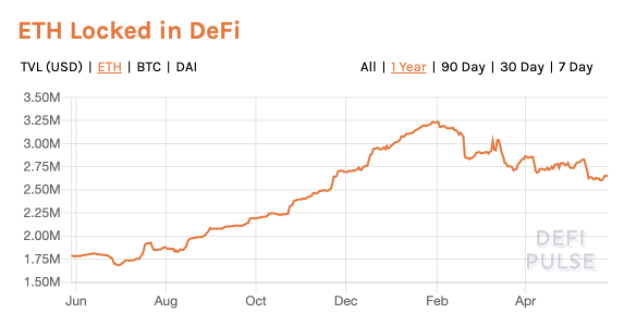
While it’s too early to tell, the DeFi ecosystem has likely already hit these limits. For example, the highest value of ETH staked in DeFi protocols is about 2-3% of the total ETH.
In this article, I will evaluate the pros and cons of the current DeFi system relative to CeFi (centralized finance). I will then try to explore some of the invisible ceilings that limit DeFi’s growth and propose solutions.
Application Scenarios of DeFi
Although DeFi has a wide range of application scenarios (including zero-rake lottery, prediction markets, staking, identity, etc.), its current main uses are the following three:
Leverage (e.g., staking lending in Maker, Compound, or margin trading on dYdX)
Trading (e.g., 0x, Uniswap, Kyber, IDEX, dYdX)
Getting synthetic asset exposure (e.g., Synthetix, UMA)
These three applications account for the vast majority of DeFi activity.
Each of the above decentralized financial protocols is in direct competition with centralized alternatives. Next, we analyze the dynamics of these application scenarios one by one to understand the invisible ceiling of DeFi.
Leverage
For most traders, the two most important features of leverage are leverage multiples and costs. But in these two aspects, DeFi is not as good as CeFi.
DeFi has lower leverage. Due to system latency (15 seconds for Ethereum blocks), leverage cannot be too high. So why does higher latency reduce the maximum leverage? Given the volatility of crypto assets and the risk of a chain of liquidations within a 15-second block time, it is difficult for DeFi to offer high leverage products. dYdX launched a 10x leveraged BTC perpetual contract in April, but in comparison, the average leverage of BitMEX users is 25-30x.
CeFi has lower borrowing costs. CeFi businesses do this by extending credit (banks like Silvergate), reducing trust-based collateral requirements (such as the size of lending desks that work with trusted customers), or by providing a large number of customer deposits (such as Binance and Coinbase's lending desks). Although DeFi protocols currently offer lower lending rates in some cases, they are structurally flawed. While it is theoretically possible that traders slowly start trading Compound's cTokens - a protocol that effectively replicates the advantages of Binance and Coinbase's centralized ledgers - this would disperse liquidity between cTokens and the underlying assets.
So can DeFi protocols provide more leverage? Given the volatility of cryptocurrencies and Ethereum's current flaws (15-second block times), it is difficult to imagine a platform offering more than 10x leverage, and the horrors of Black Thursday on March 12 are still fresh in people's minds.
However, there are some Layer 2 solutions (such as Skale) that can achieve a block time of 1 second, reducing network latency (note that the vanilla optimistic rollup architecture cannot reduce block time, so it does not solve this defect). However, it is not clear whether decentralized exchanges (DEXs) and traders like dYdX will move settlement to Layer 2 solutions such as Skale.
So in the long run, can DeFi protocols offer more competitive lending rates? The answer is: probably not. I expect that as more and more banks (who can provide credit through fractional reserve loans) enter the crypto space in the next few years, the cost of capital provided by centralized financial institutions will gradually decrease. In addition, because DeFi protocols cannot underwrite trust relationships, they require higher collateralization ratios, which further increases the (opportunity) cost of capital.
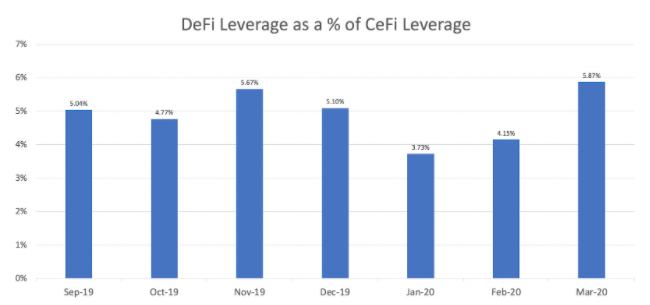
In the foreseeable future, I don't think DeFi protocols can beat traditional leverage providers. Although DeFi protocols can provide some customers with marginal profits that traditional providers cannot provide, their share of the market is very small. The vast majority of market participants want to optimize for the cost and availability of leverage, and DeFi protocols have difficulty matching CeFi in both aspects.
Today’s market data also clearly shows this: the vast majority of leverage in the crypto ecosystem today is provided by traditional trading platforms.
Source: DeFi Pulse, Skew
It is worth noting that if all trading activities are transferred to a certain, public, trusted, neutral DeFi standard protocol (such as a single Layer 1 I mentioned a few weeks ago), then DeFi will be able to eliminate basic risks and thus improve capital efficiency for all market participants. However, this possibility is very low in the foreseeable future.
Trading
DeFi protocols are far inferior to centralized alternatives in several major ways. In general, the following factors prevent DEXs from taking market share from CEXs.
1. Latency and probabilistic finality. Because Ethereum uses Nakamoto consensus, which comes with high-latency probabilistic finality, buyers and sellers cannot know their exact position in real time. Due to the lack of precision, their trades must be more conservative (e.g., use wider spreads). Any solution with shorter block times can alleviate this situation. 2. Miners front-running. As the crypto ecosystem matures and traders move more transactions directly to the chain for settlement, block producers will begin to maximize the benefits (MEV) available to miners themselves. When this happens, miners will start to front-run transactions, which is very disadvantageous to liquidity providers. 3. Full leverage and offsetting positions. Currently, Binance and FTX provide users with full positions of different types of products (for example, a bullish perpetual position to cover call options). Over the next year, I expect them to gradually provide offsetting positions (for example, through ETH short positions, users extend BTC long positions), and then other centralized trading platforms will follow suit. Although a decentralized environment can theoretically provide full leverage, the actual operation is more difficult due to the immaturity of decentralized trading venues.
4. Lack of fiat currency channels. It is difficult to transfer users from the fiat currency world to the crypto field on a large scale in a decentralized way. There are indeed several teams working on this problem, but they have not yet found a solution. Until then, stablecoins are a good stopgap for users who already hold cryptocurrencies.
5. Throughput and gas fees. Traders want to settle transactions quickly, readjust collateral ratios, and then quickly open new orders. These operations require a lot of gas fees.
So, can DeFi protocols reduce latency and provide faster finality? On low-latency Layer 2 (such as Skale) or Layer 1 (such as Solana), the answer is yes.
Can DeFi protocols mitigate the threat of miners seeking profit? Some Layer 1s do have theoretical solutions, but they lead to higher latency, complexity, and gas fees. For some Layer 2s with permissioned validators, the answer is yes.
Can DeFi protocols make up for the lack of fiat currency support? Through stablecoins, the answer is yes.
In the foreseeable future, it is difficult for us to see decentralized trading platforms surpass centralized trading platforms. While there are relatively clear solutions to address latency and finality issues, experienced traders 1) do not want block producers to front-run their trades, and 2) want to be able to fully margin trade and offset positions to improve their capital efficiency.
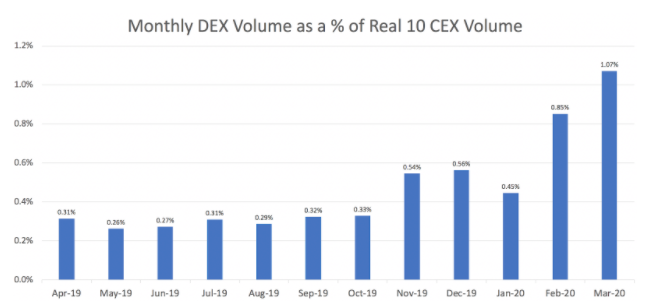
This is also very obvious in the data: traditional trading platforms account for the vast majority of trading volume, and almost all price discovery relies on CeFi.
Source: CoinAPI, Bloxy
Synthetic Assets
In order to trade synthetic assets, exchanges must provide 1) a mechanism to manage collateral and pay winners/losers, and 2) a reliable price oracle.
Currently, traditional exchanges do both of these things very well: they manage collateral and run centralized price oracles for perpetual contracts (perps). Additionally, FTX has launched ingenious synthetic assets for the 2020 US presidential election, such as TRUMP and BIDEN contracts.
While DeFi protocols could theoretically offer arbitrary synthetic contracts (e.g. via Augur), they don’t appear to have any execution advantages beyond inheriting the inherent features of all DeFi protocols — self-custody and permissionless oracles (but this may be a bug rather than a benefit, depending on the case).
Centralized exchanges are in a favorable position to compete in the synthetic market, and they have proven this through perpetual contracts.
Break through the invisible ceiling of DeFi
Among the defects mentioned above, the most common is latency. Latency is critical because the price of crypto assets fluctuates extremely violently. Its price may fluctuate by hundreds of points in a few seconds, and the 15-second block time and Nakamoto's consensus make the systemic risk even worse.
Centralized finance operates in nanoseconds; decentralized finance operates in seconds. Currently, almost no DeFi can run on a nanosecond time dimension, but with solutions like Solana, which is the only blockchain that decouples global state updates from time changes, DeFi's operating time may be reduced to microseconds.
On the Ethereum 2.0 side, it will produce a new block every 12 seconds. DeFi is the current highlight of Ethereum, but Ethereum 2.0 is not optimized for DeFi.
Similarly, throughput is an obvious problem. While the Ethereum network runs smoothly most of the time; on Black Thursday, March 12, its problems were exposed - Ethereum simply could not withstand such a large volume of transactions. This is despite the fact that DeFi transaction volume is only 1% of CeFi. On the other hand, crypto CeFi transactions only account for 0.1-1% of traditional asset classes (excluding foreign exchange). DeFi has a long way to go.
Investing in DeFi
While DeFi protocols face structural disadvantages for most users and traders, they still serve certain market segments better than CeFi, and these market segments may contain multi-billion dollar opportunities. For example, I think there is a huge market for non-custodial perpetual contract trading. Given the reasons mentioned above, DeFi perpetuals will not replace CeFi in the short term, but I think a platform that offers DeFi perpetual contract trading will have a very significant market share. Considering that the total market value of mainstream CeFi trading platforms is about $20 billion and the market is still growing rapidly, a trading venue that offers non-custodial perpetual contracts may be a good investment opportunity.
As DeFi's underlying technical infrastructure continues to improve, it will gradually take over CeFi's market share. At some point in the next two years, as all the necessary infrastructure becomes more complete, I expect DeFi's growth rate to change as a step function.
So how do people judge when DeFi wins? The answer is: when price discovery moves from centralized trading platforms to decentralized venues.
Original link: https://multicoin.capital
Welcome to join the official BlockBeats community:
Telegram Subscription Group: https://t.me/theblockbeats
Telegram Discussion Group: https://t.me/BlockBeats_App
Official Twitter Account: https://twitter.com/BlockBeatsAsia
 Related Articles