Why is ethereum irreplaceable
Original title :& NBSP; Why ETH is irreplaceable: from the perspective of ethereum economic bandwidth classification
原文作者:Ryan Sean Adams、Lucas Campbell
An, blue fox notes
This paper argues that from the perspective of open financial development, not all economic bandwidths are equally important. Among them, ETH and BTC are totally trust-free economic bandwidth, which have trust-free distribution and trust-free settlement. Based on the two dimensions of issuance and trust, three other different quadrants of assets can be distinguished: anonymous trust assets, legal trust assets, and national trust assets. But in the end, the best match for open finance is a completely untrustworthy asset, which is why ETH is irreplaceable. The authors are Ryan Sean Adams and Lucas Campbell, translated by "An" from the blue fox notes community.
Economic bandwidth is the fuel that enables open, decentralized financial applications. In ETH2, economic bandwidth is also used to secure ethereum as a global clearing layer. The more economic bandwidth on the network, the larger the capacity of its financial application and the higher the security of its network. To drive a decentralized, permissive financial economy, ethereum will require trillions of dollars in economic bandwidth. But where does it come from? Yes, economic bandwidth comes from the total value of network assets. But we need more detail... Because not all economic bandwidth is created equal.
Economic bandwidth without trust
Today Ether (ETH), the native token of ethereum, is a major reserve asset that provides economic bandwidth for its monetary protocols and financial applications. Importantly, the ETH provides the most valuable form of bandwidth -- economic bandwidth without trust. ETH is the trust-free value that provides the economic bandwidth for ethereum's licence-free monetary protocols. In order to build an economy without trust, you need value without trust. Imagine that the USDC is the primary reserve asset of ethereum. The system will be limited by Coinbase, Silvergate and the fed's thinking. Not decentralized enough, same as the existing system. The trust-free value can be achieved only through encrypted native assets settled on a fully decentralized chain (such as BTC and ETH without centralized support). The total flow value of untrusted assets on a network is the untrusted economic bandwidth of the network. Ethereum's total trust-free economic bandwidth in USD is the liquid market value of its network's trust-free assets, which is the market value of ETH. But can ethereum tokens also be a source of economic bandwidth that requires no trust?
Scrip assets as economic bandwidth
Although a token asset on ethereum provides economic bandwidth, it is not necessarily an economy bandwidth that does not require trust.
Example: Synthetix is a synthetic asset distribution agreement that is built on ethereum and has a value accrual asset, SNX. Although Synthetix's introduction of an eith-based collateral would greatly increase the economic bandwidth of its synthetic assets, Synthetix's synthetic assets now rely almost entirely on the economic bandwidth provided by SNX. Can other DeFi protocols use SNX as economic bandwidth? Yes, but they have to trust Synthetix. Even though SNX has proven itself to be a form of economic bandwidth in the Synthetix ecosystem, it lacks the most important characteristic when it comes to the broader economic bandwidth of the permission-free economy: it is not trustless. When SNX is settled on the chain, the Synthetix team has enough control to supplement its distribution. SNX has trust-free clearing because it is done on ethereum, but its token issuance is not trust-free because its supply can be manipulated by a selfish third party. SNX is not as trustworthy as ETH.
There seems to be a variable range of trust between the issuance and settlement axes. Can we apply this to a broader asset classification?
Trust quadrant

Let's define the level of trust associated with the asset in two parts: trustless issuance and trustless settlement.
An issue without trust means that the asset issue policy is not dependent on and cannot be manipulated by a selfish third party.
Untrusted settlement means that the finality of an asset transaction is not dependent on and cannot be manipulated by a selfish third party.
Having assets that require neither trust issuance nor trust settlement is the best form of economic bandwidth for a decentralized system. Zero trust assets (assets that require no trust at all) are assets in the upper right quadrant.
Zero trust assets (T0) : no trust issue & No trust settlement
Bearer fiduciary asset (T1) : fiduciary issue & A settlement without trust
Legal trust assets (T2) : issue without trust & A trust settlement is required
National trust asset (T3) : must be a trusted issue & A credible settlement is required
In today's world, ETH, BTC, and gold are the three least trusted forms of economic bandwidth. Unfortunately, because gold's trust-free nature is limited to its physical form, it has less bandwidth available in the digital native economy.
Here's how we map these assets:
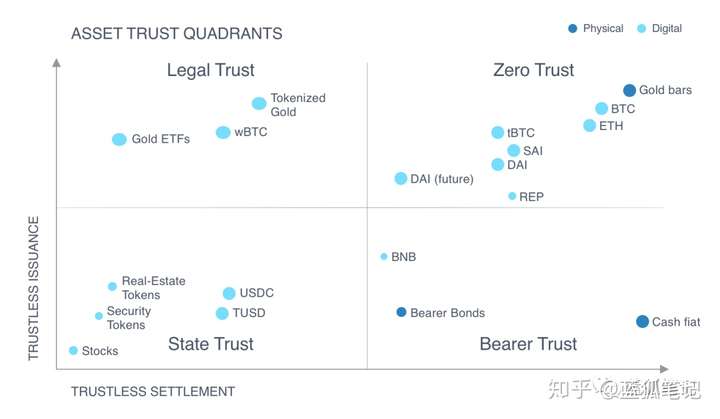
Let's look at the reasoning process: the first completely untrustworthy asset:
BTC: a completely untrusted asset & payment on the bitcoin network;
ETH: similar to BTC, but released & And clearing the trust level is slightly lower than BTC
DAI: supported by the ETH, but with its predictor & Governance causes it to be less trusting than ETH
DAI (future) : if the asset to be trusted is added to DAI's collateral type, then DAI will move to the left
The bearer must trust that the asset is about ownership:
Cash fiat currency: settled by title, but issued in trust of the US government
A legal trust asset is usually a neutral issued asset wrapped in a legal guarantee:
Token gold: you can't manipulate the issue of gold -- but if the gold in the vaults that support PAXG disappears, all you can do is track it down through the legal system
WBTC: bitcoin certificates held by a legal entity and settled by the legal system
The national trust assets contain almost everything else in our traditional financial system:
Shares: additional shares are issued by shareholder vote and settled by the company law & payment;
USDC: it doesn't actually settle on ethereum, it settles dollars on the banking system
Treasury bills, derivatives, bonds, CDs: all of these are national trust assets.
You might change the position of some of these assets in the diagram, but do you see how the model works? Assets in the lower left quadrant need military and government support. Things in the upper right quadrant don't need to be supported by these forces.
Why are gold bars completely trust-free? The issue of gold is determined by physics. The cost of increasing the supply of gold on the ground is high (unless there is a technological leap in the exploitation of gold in the oceans or asteroids). The settlement of gold also does not need trust, in the physical transfer of a unit of gold from one person to another person's physical possession, the ultimate is achieved. Ownership is final.
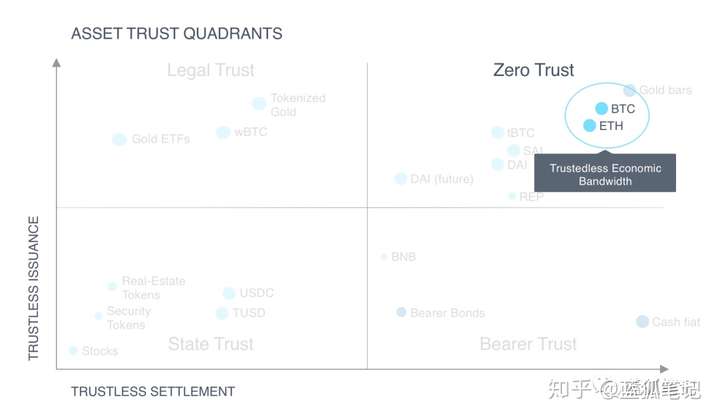
ETH and BTC are the only two multi-billion dollar digital assets in the completely trustless quadrant. DAI, tBTC may become an untrusted asset only because of ETH and BTC. This is why cryptocurrencies are so important.
But bitcoin has its problems.
BTC settles accounts on its network in a non-trusted manner, but if deposited on Coinbase, the settlement is up to third parties. BTC has changed from a completely untrusted asset (zero trust asset) to a legally trusted asset (legal trust asset).
Because bitcoin is limited by its network capabilities, it ACTS more as a peer-to-peer value transfer network than a programmable currency network. Most of bitcoin's currency verbs rely on trusted cryptographic Banks.
That's why ETH is so important. Ethereum's performance means that we can create a complete monetary system in the zero trust quadrant.
This is why the ETH is irreplaceable.
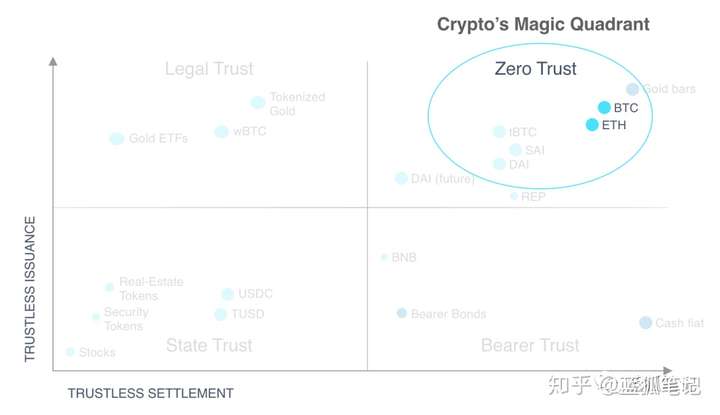
Above: have you heard of Gartner's magic quadrant? The top right corner is the magic quadrant of the crypto world.
Ethereum economy bandwidth type
Figure out the Numbers. How much economic bandwidth is available for zero trust (T0) compared to other forms on ethereum?
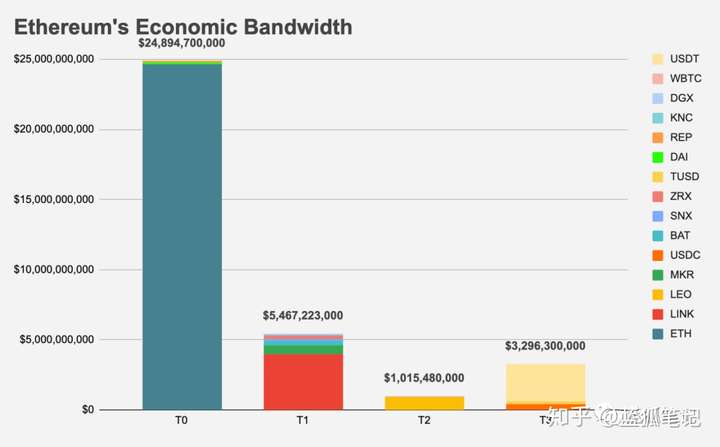
Not surprisingly, ETH is by far the largest provider of T0 economic bandwidth, providing more than $24.6 billion in economic bandwidth to ethereum. Other forms of trustless economic bandwidth include DAI and REP.
T1 economic bandwidth forms $5.4 billion of total available bandwidth, as it includes most token items such as LINK, SNX, BAT, and so on. These liquid assets have settlements that require no trust, but their issuance requires trust. The releases must be trusted because their respective teams have enough control over the agreements to change the releases. In other words, if these T1 tokens can minimize the influence of individual entities and institutions in the ecosystem, it is entirely possible that they will become untrusted economic bandwidths in the future. BTC used to be in the T1 quadrant! T2 and T3 provide more than $1 billion and $3.2 billion of economic bandwidth, respectively. Recall that T2 assets have issues that require no trust, but require settlement in the form of trust -- wTBC and scrip gold are examples. T3's assets include the USDC, TUSD, and USDT, which are stable currencies backed by legal currency and have trusted settlement and issuance, making them largely dependent on the success of the legal financial system. The USDT offers the highest volume of T3 economy bandwidth, with more than $2.7 billion, including $4.3 billion of ethereum's token supply in circulation.
The economical bandwidth consumed by DeFi
We also measure the economic bandwidth consumed by the DeFi protocol. Today, ethereum's DeFi consumes more than 3.27% of the available T0 economy bandwidth. This is the most decentralized DeFi activity on taifang.
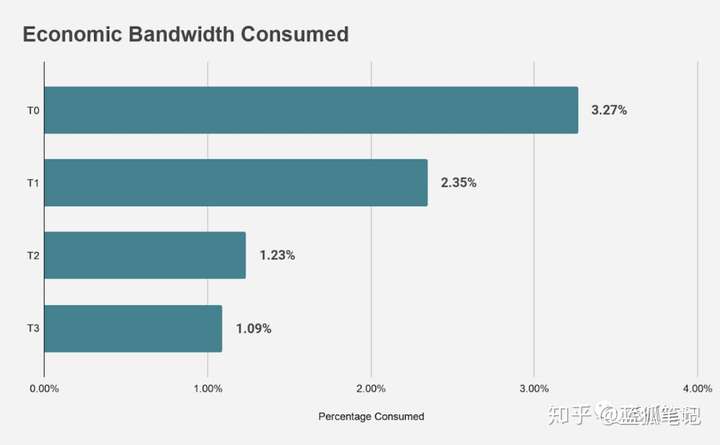
However, of course, the DeFi protocols (e.g., Compound, Uniswap, Maker) are not strictly limited by trust-free economic bandwidth. For example, Compound has a permission-based lending market that includes a range of etherea-based assets, as well as the USDC.
Even though USDC has a relatively high usage in DeFi, overall T3 economy bandwidth consumption is still low due to DeFi's lack of adoption of Tether. USDT is the largest T3 bandwidth provider in our data set. Ultimately, you can see that ethereum's currency protocols not only consume untrusted economic bandwidth. It also makes it possible for liquid, non-trusted assets to act as economic bandwidth for a wider ecosystem.
Focus on the end goal
While the DeFi protocol can take advantage of the economic bandwidth required in the form of trust to improve financial products, it is essential that we remain focused on the mission of open finance: to minimize trust. Untrusted economic bandwidth is the fuel of a minimum trust in an open economy. Combine it with an unlicensed monetary agreement, and it is an unstoppable force for money and finance. Unless our goal is simply to restructure the same old financial system, we need untrusted economic bandwidth. This is the most important thing to remember as we pioneer this financial innovation.
conclusion
The purpose of this paper is to propose a classification method for economic bandwidth. By analyzing assets in the trust quadrant, we build a framework to understand the importance of untrusted assets for decentralized finance.
Trustless economy bandwidth has two core components :(1) trustless issuance and (2) trustless settlement. Assets (such as the ETH) in the zero trust quadrant (which requires no trust at all) have both properties and form the basis of a cryptocurrency system that minimizes trust, and they cannot be replaced by assets in other quadrants.
Of course, any token asset can take advantage of the permissive, programmable, and open nature of the ethereum financial system and benefit from ethereum settlement. Tokens are good for both the cryptographic world and the real world. However, we should remember that only the economic bandwidth of zero trust (no trust at all) can promote the decentralization and security of ethereum.
A trust-free economy will require trillions of dollars in trust-free economic bandwidth.
ETH is an irreplaceable economic bandwidth.
Original link:https://mp.weixin.qq.com
Welcome to join the official BlockBeats community:
Telegram Subscription Group: https://t.me/theblockbeats
Telegram Discussion Group: https://t.me/BlockBeats_App
Official Twitter Account: https://twitter.com/BlockBeatsAsia
 Related Articles