Challenges and Prospects: Has Ethereum’s Advantage Peaked?
Original Title: "Ethereum and the innovator's dilemma"
Original Author: Jay
Translated by: Luccy, BlockBeats
Editor's Note:
"Those who chase two rabbits catch none." This was the opinion expressed by Global Competition Review (GCR) on social media platforms.
GCR is a complete news and analysis source for competition practitioners. Cryptocurrency researcher Jay delves into the current situation and prospects of Ethereum as a smart contract platform, starting from modular blockchain, database design, and GCR's perspective, revealing the challenges Ethereum may face when facing new technological choices and competitors, and emphasizing the importance of factors such as motivation, developer support, and technology selection.
What's next for Ethereum? I explore modular blockchain, database design, and reference GCR's perspective in an attempt to answer this question. It should be noted that I hold a net long position on Ethereum.
The core idea of the innovator's dilemma can be summarized as:
"Successful companies often struggle to adapt to paradigm shifts, especially in terms of technological innovation. This is because they are too focused and heavily invested in what has made their products successful, and are unwilling to try new, unfamiliar concepts."

In the field of blockchain and smart contracts, we have made significant progress in the past few years. Now, the question worth millions or even billions of dollars is: what will be the fate of Ethereum?
Through this article, I will elaborate on the following points: Ethereum is in a leading position in terms of the valuation of all cryptocurrencies (ETH.D) and relative adoption in two aspects.
I will first explore the concept of modular blockchain, compare it with traditional database design principles, and then tie everything back to Ethereum and its future.
Modular Blockchain
Now we have a more fundamental way of thinking to consider the logical methods of building a well-functioning blockchain and decoupling (as well as scaling) core components. This is the debate between monolithic vs. modular.
When it comes to modularity in the context of blockchain, there are four fundamental functions that exist at its core.
· Execution: The state after the transaction is confirmed. If I send tokens to a specific wallet, the execution layer will determine the changes in the relevant balance before and after the transaction.
· Settlement: Determine whether the submitted transaction is "valid". After sending the tokens, the balance is xyz, and the settlement layer will determine whether xyz is correct.
· Consensus: Determines the final state after a set of transactions. This layer determines the correct order in a series of transactions and what the final state is after processing these transactions.
· Data availability: In order for the above three functions to exist, there needs to be a previous state and a final state. The function of data availability is to provide the state to the execution layer and update the state based on consensus finality.
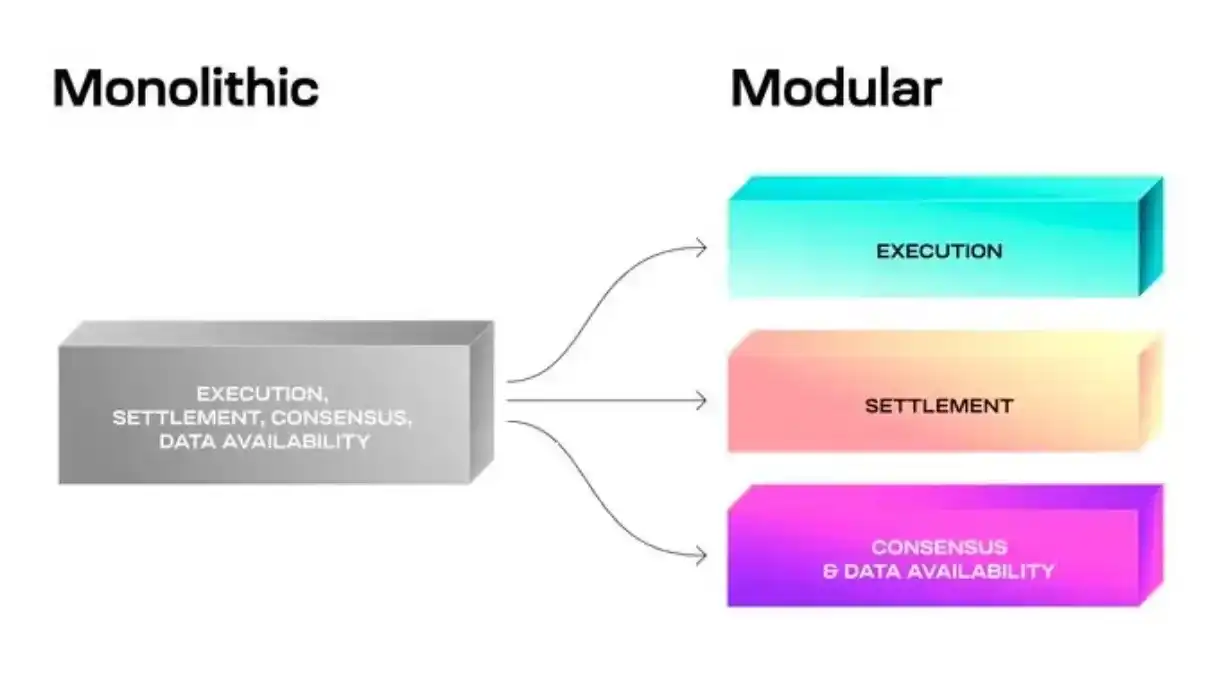
Like any engineering problem, the concept of a "perfect" blockchain only makes sense when there are clearly defined use cases. The existence of this framework allows for more specialized blockchain designs, where a blockchain built for high-throughput gaming will have vastly different requirements than one intended to be a global, decentralized ledger.
This thinking framework reminds me a lot of the principles of database design, especially the debate around SQL vs. noSQL.
Database Design
The existence of databases predates blockchain technology by several decades. The consensus in their design is that there is no perfect database. Like most engineering problems, everything comes down to trade-offs.
When building a scalable database framework, it is important to consider "what are the use cases"? Before making any decisions, I would ask some questions:
· In applications similar to Telegram or Slack, what is the approximate ratio of reading to writing? On Twitter, the amount of reading is several orders of magnitude higher than writing.
· In distributed systems, there are concepts of consistency and availability. In other words, this can be rephrased as: do we care more about inaccurate data or downtime of our application? Similarly, this depends on the situation. For fintech applications, consistency (accurate data) is more important.
· How important is stale data compared to fresh data? What is the relationship between this and the load of reading and writing? Does our database allow us to execute strategies for handling concurrent writes and reads? For example, when my wife withdraws cash from my bank while I swipe my debit card - how do we prevent the classic double payment problem?
· What is the reading mode like? Do you need flexibility in data access, or is it usually predefined? Are there many join operations between different datasets?
Even beyond technical considerations, it is important to understand the following points:
· How many engineers are familiar with this technology? How many engineers actually want to use this technology for construction?
· Is there a way to obtain proactive support if we want to fork the underlying code and make adjustments?
The Future of Ethereum
Now let's take a look at the whole issue. There is no such thing as a perfect blockchain. Excellent engineering designs are based on trade-offs, and there is no one-size-fits-all solution. So how did Ethereum become such a dominant platform? Why does Ethereum's price performance seem like it is a perfect blockchain? Finally, where will Ethereum go from here?
Ethereum, how did it become such a dominant platform?
Four years ago, Ethereum became the preferred platform for building smart contracts. Compared to other competitors, it had excellent development tools such as Hardhat and CryptoZombies. In addition, there was a dedicated user community, and the chain and tokens were "decentralized". At that time, centralized blockchains were more likely to be a fraudulent means. The asset ETH was also much cheaper, which meant that gas fees were also lower.


Welcome to join the official BlockBeats community:
Telegram Subscription Group: https://t.me/theblockbeats
Telegram Discussion Group: https://t.me/BlockBeats_App
Official Twitter Account: https://twitter.com/BlockBeatsAsia