Nvidia Halts Server Shipments to Four Southeast Asian Countries: Which Path Does the New US AI Chip Regulation Block?

TL;DR
· According to the Financial Times, Nvidia has asked partners including Dell and Super Micro Computer to suspend shipments of servers containing its chips to Malaysia, Singapore, Thailand and Indonesia, with some orders put on hold.
· The suspension follows the new export control rules that took effect on November 19 by the U.S. Department of Commerce, which extend licensing requirements to the four Southeast Asian countries and Brazil, and for the first time impose restrictions on overseas data centers providing remote computing power to restricted parties, though recipients with U.S. corporate backgrounds can obtain monthly reporting exemptions.
· Related tickers: Nvidia (NVDA), Dell Technologies (DELL), Super Micro Computer (SMCI)
According to a disclosure by the Financial Times on November 25, Nvidia has asked server manufacturing partners including Dell Technologies and Super Micro Computer to suspend shipments of AI servers equipped with its chips to Malaysia, Singapore, Thailand and Indonesia, with some buyer orders put on hold.
This abrupt halt in shipments follows the new export control rules that officially took effect on November 19 by the U.S. Department of Commerce's Bureau of Industry and Security. The new rules require licenses for exporting advanced AI chips to the aforementioned four countries and Brazil, with the core aim of closing the channel of renting computing power through overseas data centers.
As of now, Nvidia, Dell and Super Micro have not publicly commented, and the duration of the suspension remains unclear. However, people familiar with the matter said this is more of a temporary measure by the supply chain before figuring out the license approval process, rather than a complete abandonment of the Southeast Asian market.

New rules target overseas cloud leasing, revoking old tiered system in favor of precise licensing
Ordinary investors may easily view this control as a routine escalation of chip bans, but what the new rules truly rewrite is the regulatory boundary—previously the focus was mainly on preventing chips from being shipped directly into China, but now for the first time the gate has been extended to remote computing power leasing by overseas data centers.
The interim final rule submitted by the U.S. Department of Commerce on November 16 and published as effective on November 19 (a new rule that took effect without prior public comment) formally revokes the AI diffusion country tiers and model weight controls introduced in January last year, while imposing two more targeted restrictions.
The first targets transshipment and high-risk landing areas, adding Malaysia, Singapore, Thailand, Indonesia and Brazil to the licensing list; the four Southeast Asian countries are the first to come under pressure because the region has become a core hub for Chinese AI computing power going overseas, while Brazil is more of a preventive measure to close loopholes.
The second covers global data centers. As long as chip exporters know that overseas data centers will provide large-scale training and inference cluster computing power exceeding 12 million total processing performance (a regulatory metric measuring comprehensive chip computing power) to restricted parties such as China, they must also apply for a license in advance.

Non-US cloud providers hit, US cloud giants gain compliance exemptions
Less than a week after the new rules took effect, the computing power supply chain in Southeast Asia has rapidly begun to diverge. The first to be hit are local computing power leasing providers without US backgrounds. The Financial Times reported that banks have suspended about $500 million in loans to Singapore-based service provider Aolani, funds originally intended to support cooperation related to ByteDance.
Selling pressure has simultaneously emerged on the channel side. According to CNBC, after the new rules took effect, unusually large volumes of Nvidia GPUs were listed on the secondary market, including thousands of high-end B300 chips originally planned for delivery to data centers serving Chinese tenants, and channel premiums face revaluation.
But the Southeast Asian market is not uniformly frozen. The new rules explicitly stipulate that recipients headquartered in the US or with US parent company backgrounds need only report monthly to the Commerce Department to obtain license exemptions, meaning that data centers built by Microsoft, Google, and Amazon in Southeast Asia face relatively limited obstacles.
The resulting shift in the landscape is quite telling: local and Chinese-backed cloud providers that have invested heavily in building computing power subleasing operations in Southeast Asia face short-term pressure, while cloud giants with US exemption status may instead seize the opportunity to take on more compliant computing power demand.
Singapore's hundred-billion-dollar bill and why Nvidia immediately hit the brakes
What outsiders find puzzling is why Nvidia immediately halted shipments before the window ended, given that the new rules gave Southeast Asian cloud providers a 90-day window to apply for licenses. The key is that the new rules took effect on November 19, and once exporters know chips are flowing to restricted tenants, it constitutes a violation.
Before approval standards and customer penetration verification mechanisms are fully operational, combined with recent heightened scrutiny by US regulators and the market over Nvidia's overseas compliance, Nvidia's request for Dell and Supermicro to press pause is essentially a defensive stop-loss approach of erring on the side of strictness.
Nvidia's own multinational accounting also explains Singapore's sensitivity. Company accounts show that in 2025 Nvidia's Singapore subsidiary recorded $104 billion, up 72% year-over-year, but net profit on the books during the same period was only about $53 million, indicating it is essentially a multinational invoicing and settlement center rather than an end market.
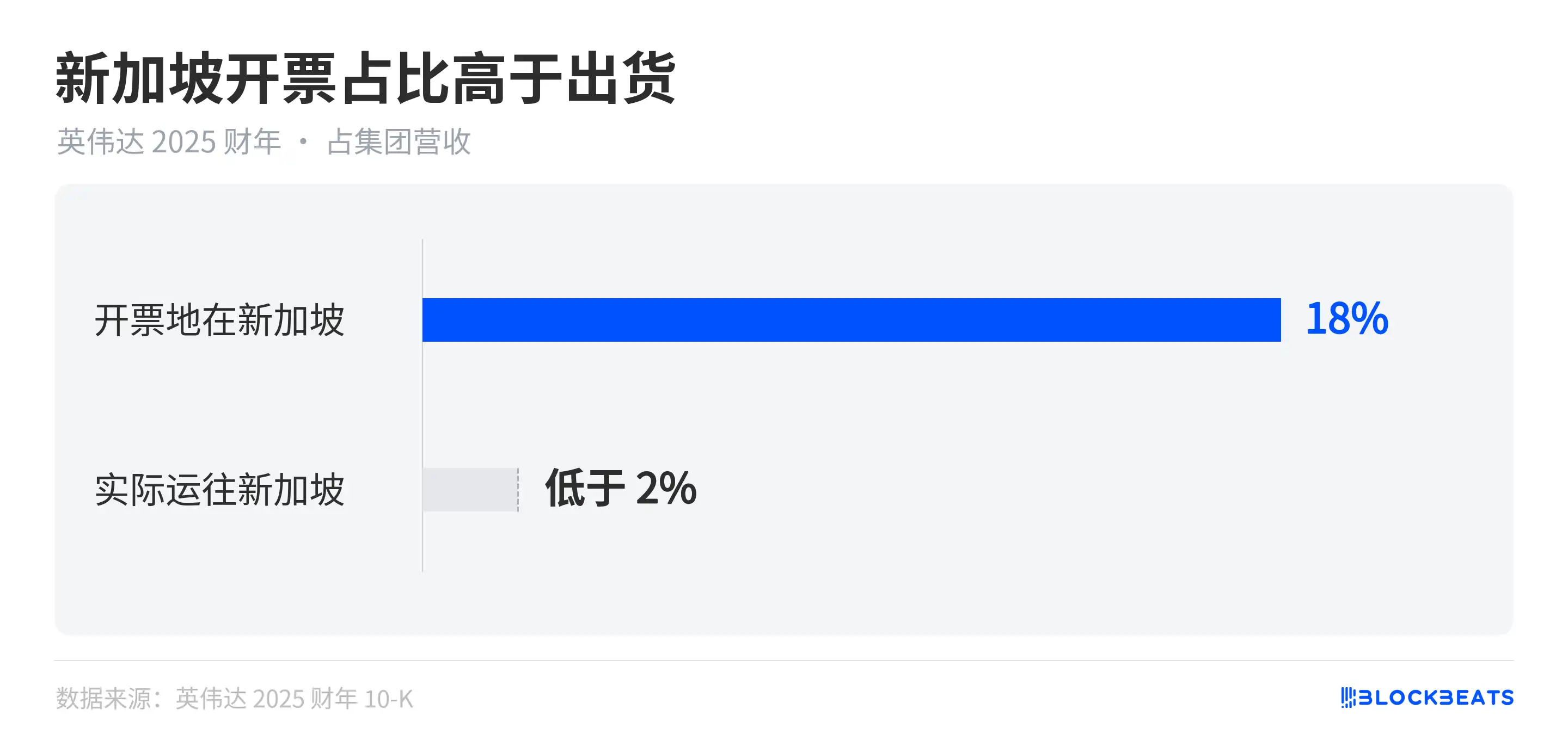
Even so, the massive regional flows still make Singapore and neighboring countries a focal point of Washington's scrutiny. Nvidia has previously changed its financial reporting regional revenue basis from "customer billing location" to "customer headquarters location" to reduce external misinterpretation.
Legal Boundaries of Bypassing Congress and the 90-Day Approval Yardstick
It is worth noting that this new rule itself still leaves room for procedural and legal maneuvering. The U.S. Congress has yet to formally legislate to grant the Commerce Department "remote cloud access" regulatory authority; the relevant bill has been stuck in the Senate since passing the House in January this year, and the Commerce Department is this time implementing it through a workaround based on existing end-use authorization.
At the same time, although the rule has taken effect, a 60-day public comment period remains, with the deadline around mid-January 2027. Chipmakers, cloud service providers, and the legal community are expected to concentrate pressure on the Commerce Department over enforcement boundaries and exemption details.

Whether Nvidia's latest suspension is merely a few weeks of compliance adjustment or will evolve into a long-term slowdown in Southeast Asia's computing power expansion ultimately depends on two concrete milestones: the leniency of license approvals within the 90-day window, and when Dell and Supermicro's shelved orders will resume delivery.
Welcome to join the official BlockBeats community:
Telegram Subscription Group: https://t.me/theblockbeats
Telegram Discussion Group: https://t.me/BlockBeats_App
Official Twitter Account: https://twitter.com/BlockBeatsAsia

 Related Articles