Figma's AI user base is growing, so why do profits need to be recalculated?

Design software company Figma has once again delivered earnings that beat revenue expectations. Reuters reported that third-quarter revenue reached $391.4 million, and the company simultaneously raised its full-year revenue and adjusted operating profit forecasts. Following the earnings release, the stock price initially fell in after-hours trading.
CEO Dylan Field is turning the design canvas into a workspace that can accommodate code and AI assistants. As customers use these tools, Figma has the opportunity to sell more seats and AI credits, while also bearing the cost of running models. The simultaneous upward revision of revenue and profit forecasts indicates that this business is growing. The change in gross margin raises another question: how much money is left from the new revenue?
Has growth slowed?
Figma's revenue has risen for multiple consecutive quarters. Looking at the most recent five quarters together, the latest quarter brought in over $100 million more than the same period last year. However, the growth rate has slightly declined from last quarter's peak.
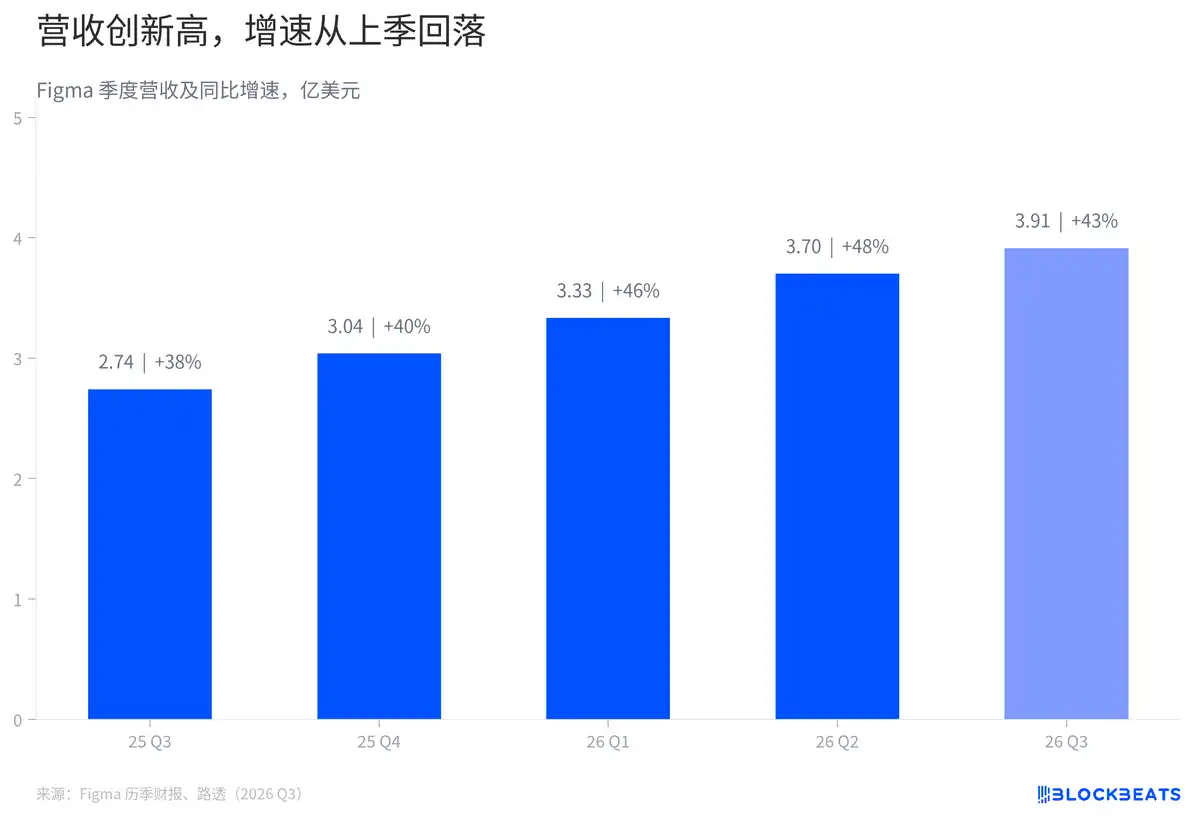
Year-over-year growth compares this quarter's revenue with the same quarter last year. The revenue base from the same period last year was already substantial, so even if this quarter added more revenue, the percentage could still be lower than last quarter. To determine whether growth has changed direction, one must look at customer expansion, seats, and usage in subsequent quarters.
This quarter's revenue also came in higher than the company's original forecast. Figma's third-quarter guidance upper limit given last quarter was $375 million, and actual revenue exceeded that figure by $16.4 million. That represents approximately 4.4% above the upper limit.
The company's revenue sources are becoming more complex. Previously, customers primarily paid for software seats; now, additional purchases of AI credits can also generate revenue. An enterprise adding designer seats versus existing employees calling models more frequently will both affect the bill. But the total revenue disclosed in earnings reports combines them, making it impossible to directly calculate how much growth each contributed.
Does 80% of customers using AI mean 80% of customers paying extra?
This ratio already appeared last quarter. Figma's second-quarter earnings showed that among paying customers with annual recurring revenue exceeding $10,000, more than 80% consumed AI credits weekly. Reuters reported that as of the end of October, this ratio remained above 80%.
The denominator of this metric is paying customers who meet a specific revenue threshold, and it describes whether a customer account has used credits within a week. Figma's seats themselves include credits, and customers can also purchase additional allowances according to the rules. Seeing only "consumed" does not reveal how many of these customers bought additional credits, nor how much each company consumed.
Figma CFO Praveer Melwani told Reuters that after the company adjusted its credit pricing, customers received more credits for the same spend, and utilization of separately purchased credits improved. This change may make users more willing to experiment, but it requires combining purchase amounts and invocation costs to determine how much profit a given credit revenue ultimately leaves behind.
Feature rollout and the timing of charging are not necessarily synchronized. Figma said on its second-quarter earnings call that some test features, including Agent and Code Layers, did not yet consume paid credits at the time. As the product continues to iterate, whether specific features begin to be charged requires checking against the latest rules. User growth from test features can generate product usage data, but may also incur service costs first.
Revenue is growing, so why is gross margin declining?
According to a MarketWatch report summary, Figma's third-quarter non-GAAP gross margin was 82%, down from 85% in the previous quarter. On this rounded basis, for every $100 of revenue received, about $82 remains after deducting adjusted cost of revenue, to cover research and development, sales, and other expenses.
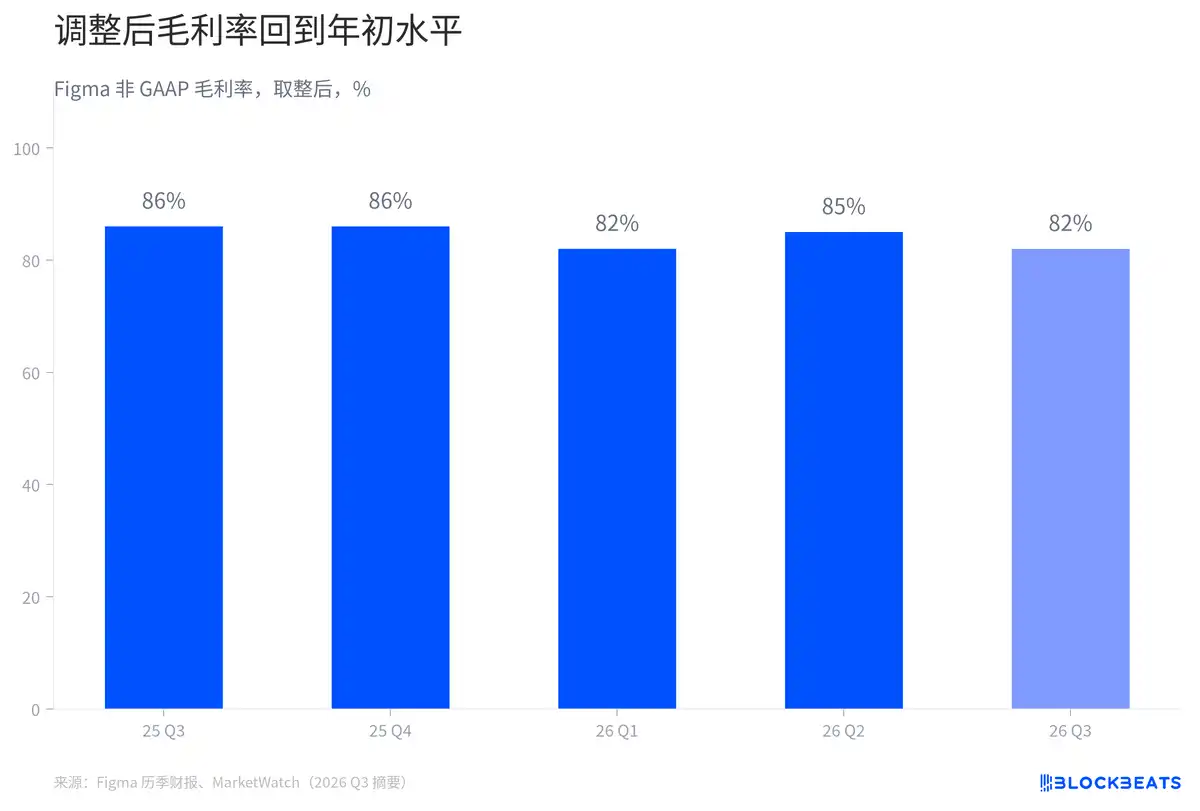
Gross margin is a ratio; gross profit is a dollar amount. When revenue grows fast enough, a lower gross margin can still correspond to a higher gross profit dollar amount. Figma's non-GAAP gross profit in the year-ago period was approximately $237 million. The precise gross profit for this quarter still needs to be verified against the original financial tables; the rounded gross margin cannot be used to back-calculate precise financial statement figures.
AI costs do not appear only in cost of revenue. Figma's second-quarter report mentioned that infrastructure, hosting, and AI costs related to free-tier users were among the factors driving growth in research and development expenses. The report also cited free-user-related costs in explaining changes in sales and marketing expenses. To assess company-wide AI investment, operating expenses must be read alongside.
The company is trying to change its cost structure. Melwani told Reuters that in the third quarter, the share of work handled by Figma's own models more than doubled, with the models used for more tasks in the product. The company did not disclose the specific amount saved as a result in that report.
Full-year outlook raised, how much change in the fourth quarter?
After revenue exceeded its original guidance, Figma raised the midpoint of its full-year revenue guidance from $1.465 billion to $1.498 billion. Of the upward revision, part was contributed by the already-occurred third-quarter beat, and the remaining portion can be inferred from the guidance midpoint.
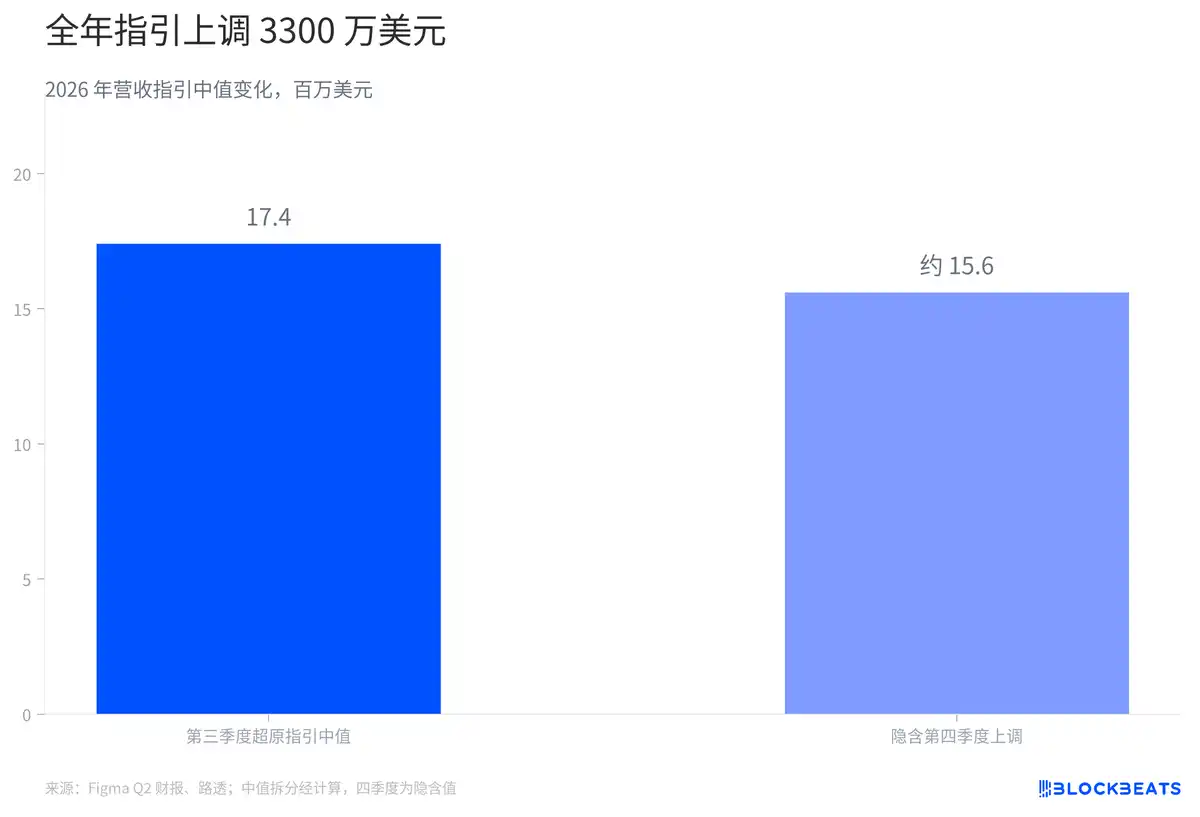
Based on the midpoint of the third-quarter guidance provided last quarter, the company collected $17.4 million more this quarter. The remaining approximately $15.6 million of the full-year midpoint raise corresponds to the inferred upward shift in the fourth-quarter midpoint. This figure is the implied difference calculated using the company's two full-year outlooks and quarterly data. It will not become actual revenue until the fourth quarter truly ends.
The company also simultaneously raised its full-year non-GAAP operating income outlook. The difference between the old and new guidance midpoints is $30.5 million, indicating that management, while raising revenue expectations, also raised expectations for full-year adjusted operating income. Operating income still deducts R&D, sales, and administrative expenses, and is at a different level from the gross margin shown in the chart.
Figma's credits enter customer workflows, and the quotas customers consume begin to affect the company's revenue and costs. In the next bill, it will still be necessary to see clearly how many additional credits were purchased and how much it cost to run these features.
Welcome to join the official BlockBeats community:
Telegram Subscription Group: https://t.me/theblockbeats
Telegram Discussion Group: https://t.me/BlockBeats_App
Official Twitter Account: https://twitter.com/BlockBeatsAsia

 Related Articles