Arm beats revenue expectations, but royalties decline from the previous quarter.

Arm announced its second fiscal quarter results for the period ending in September. Public earnings flash reports show the company's quarterly revenue was approximately $1.44 billion, above the $1.38 billion market expectation prior to the earnings release. Shares fell in after-hours trading. Breaking down revenue, within the same earnings report, licensing and royalties follow two different curves.
Where did this growth come from?
Putting this year's and last year's same-quarter revenue side by side, for every additional $100 Arm collected, approximately $84 came from "licensing and other." The increment in this revenue line was roughly five times the increment in royalties. The total revenue line adds the two together, yet omits the timing of when each enters the financial statements.
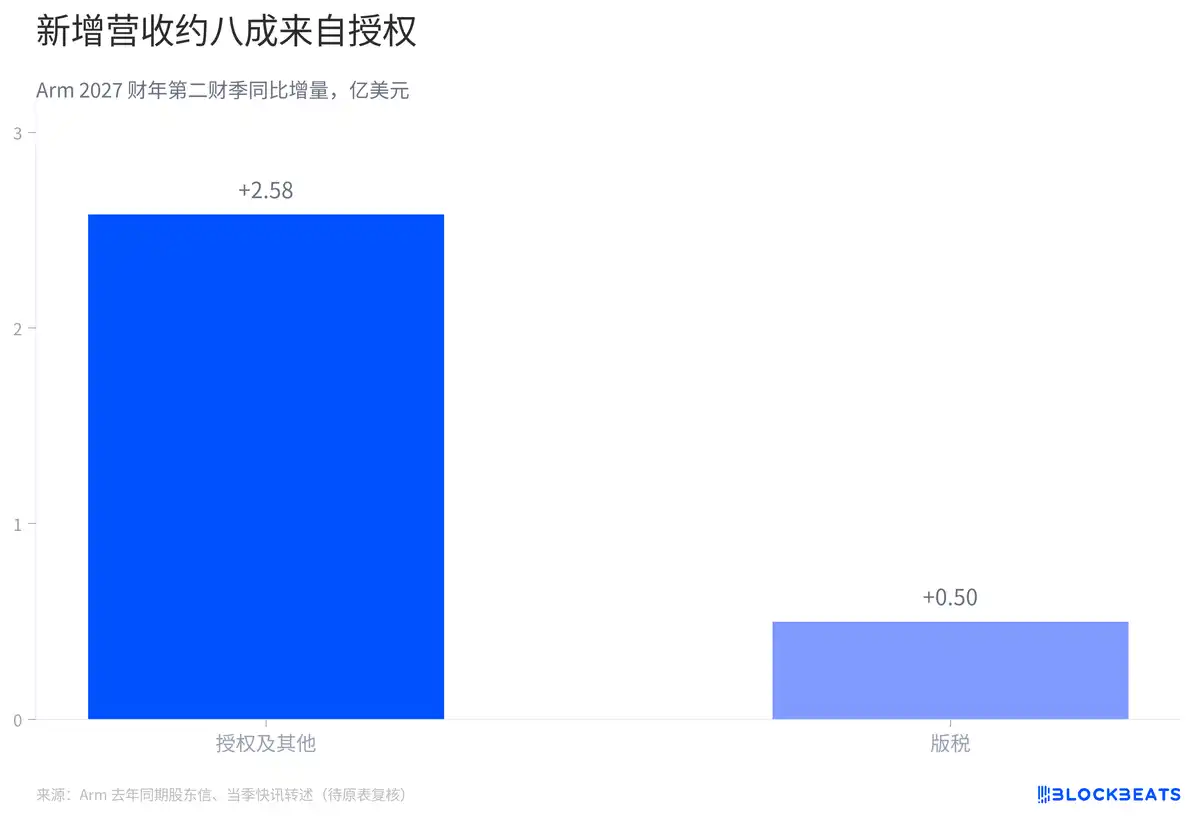
After chip companies obtain technology licenses from Arm, they typically still need to complete design, verification, and mass production. Licensing and other revenue is affected by the signing and performance cadence of large contracts. Only when chips incorporating these technologies ship can Arm collect royalties under the corresponding contract terms. A licensing revenue increase can appear in the financial statements several quarters earlier than the shipments it corresponds to. In its quarterly shareholder letters, Arm has also cited the timing and size of recognition of large contracts as reasons for fluctuations in this revenue line.
This time lag also determines what numbers should be used for comparison. The year-over-year breakdown answers where the additional money this year versus last year came from. The expectation gap answers how much revenue analysts had originally placed into this quarter. Total revenue has cross-verifiable market expectations, while the sample and sources for segment-level expectations remain to be confirmed. Using the same revenue classification to calculate year-over-year contribution here makes clear how large a portion of growth licensing carried.
There is another set of numbers that is easily overshadowed by "beat expectations." The adjusted earnings per share given in public flash reports was 52 cents, above the adjusted expectation prior to the earnings release. In the same period last year, Arm's net income disclosed under US GAAP was $238 million. Adjusted EPS and accounting net income each have their own comparison benchmarks — the former is used to compare against market forecasts on the same basis, while the latter must go back to the income statements of both periods to examine item by item how expenses and other gains changed.
Data center royalties doubled — so why did total royalties still decline?
If compared only with the same period last year, Arm's royalties are still growing. But extending the timeline, the latest quarter was down approximately $45 million from the prior quarter, and also below year-end levels last year. Placing these bars together makes it clear that "year-over-year growth" describes the position relative to the same period last year, while "sequential decline" describes the direction of the most recent quarter.
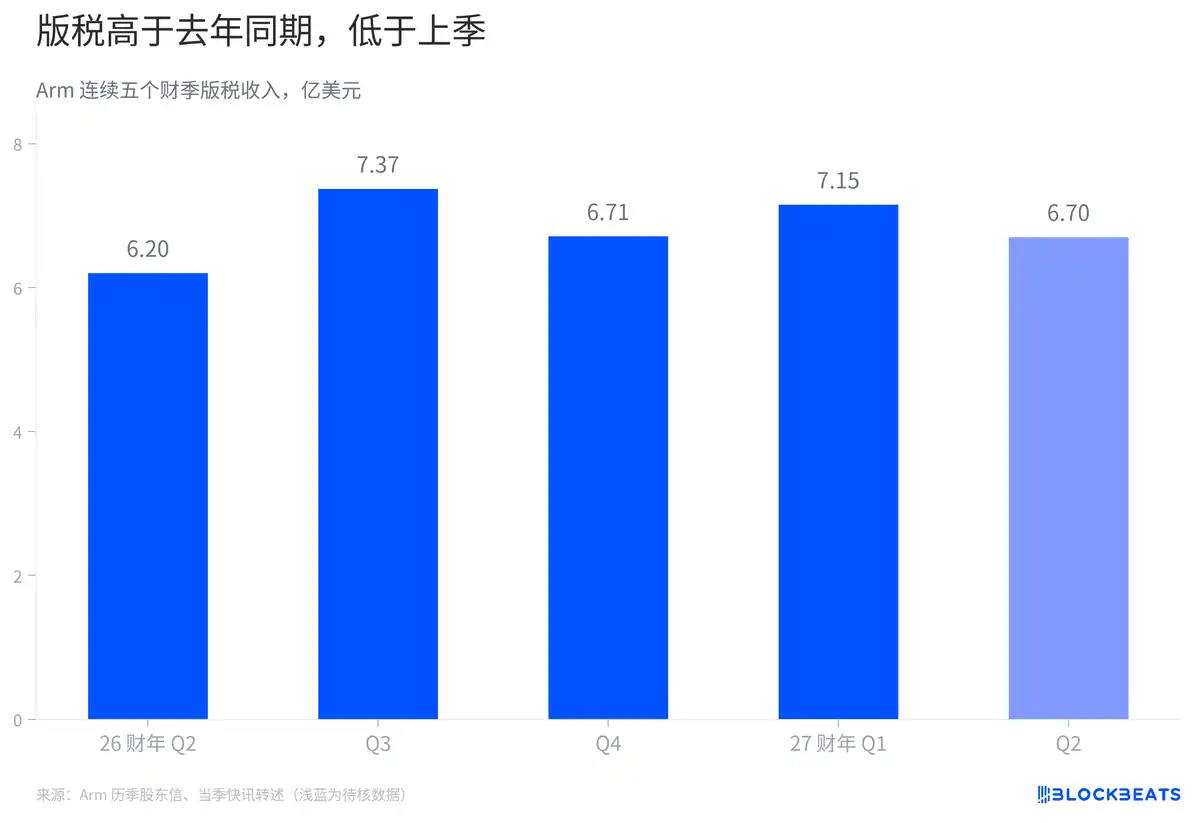
Data center royalties doubled year-over-year this quarter. That multiple is missing a number that would determine its weight—namely, the data center royalty amount from the same period last year. Splitting total royalties into data center and the rest of the business, total royalties this quarter grew only about $50 million year-over-year. If the data center segment alone added more than that, the rest of the business combined contracted year-over-year. If the data center segment added less, the rest of the business combined still has room for growth. Without the absolute figure, both scenarios could fall on the same total royalty curve.
Smartphones have a similar layer of distinction. Device shipments affect the number of chips incorporating Arm technology, while chips using newer architectures or compute subsystems may pay higher royalties. Arm previously noted on earnings calls that premium phones adopting higher-rate technology had supported smartphone business revenue during periods of device market weakness. To quantify the smartphone business impact this quarter, one needs to know both shipment volumes and per-chip royalty changes.
When do the CPUs cloud providers want to buy become Arm revenue?
In the past, even when cloud providers deployed custom Arm-based processors in their data centers, Arm typically only collected licensing fees and royalties under agreements. Now, Arm has designed its own data center-oriented AGI CPU and can also sell chips to customers. How much revenue the same cloud provider spending ultimately generates for Arm depends on whether the customer buys a license to design its own or buys Arm's finished product.
Arm gave an example in May of this year that illustrates supply constraints. Management saw customer demand exceeding $2 billion over the next two fiscal years while maintaining a $1 billion revenue outlook at the time. Translated to the buyer-seller ledger, customers wanted to buy at least twice what Arm projected it could sell at that time. Management noted on the same earnings call that the company was still securing supply chain capacity.
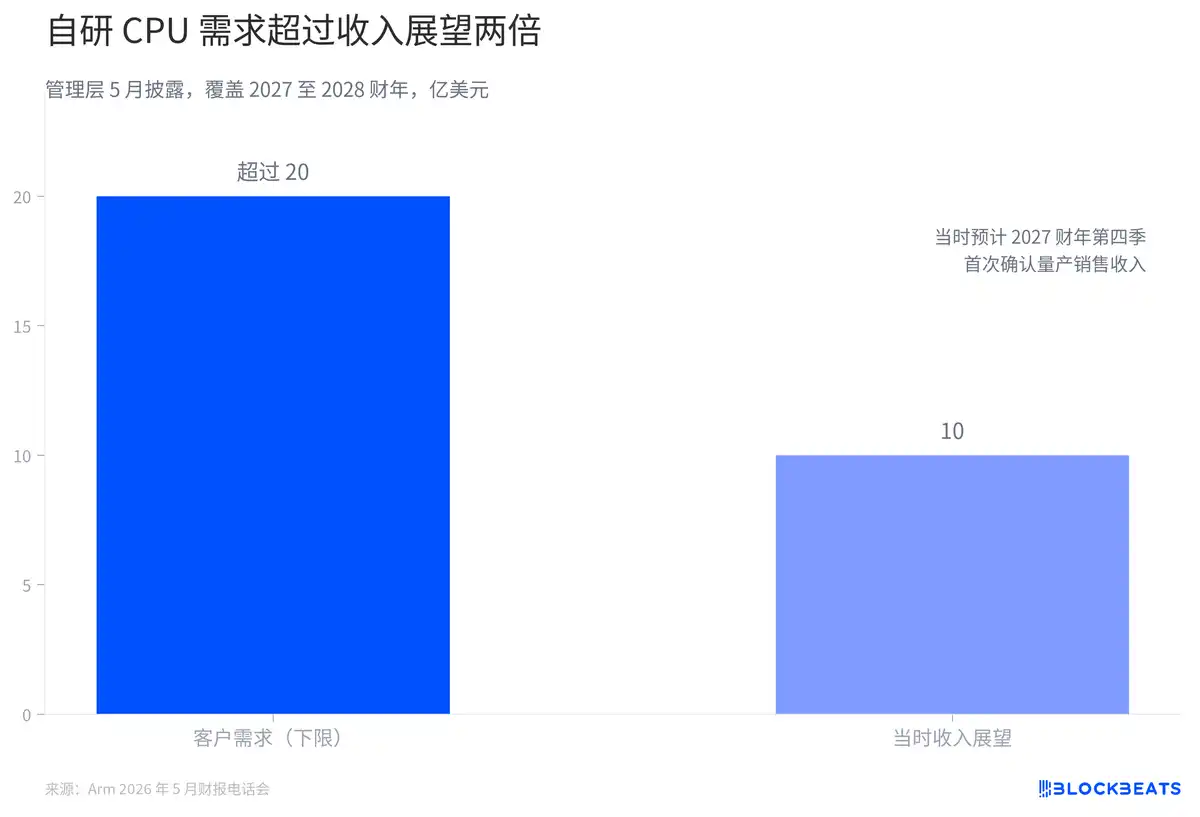
By July, management indicated greater confidence in exceeding the prior revenue outlook. When cross-referencing the financials, it's worth remembering a specific milestone the company previously provided. Per the May timeline, the first mass-production chip sales revenue was expected to appear only in the fourth quarter of fiscal 2027. Between buyers expressing purchase intent and Arm completing sales lie capacity, mass production, and delivery.
This also explains why, after reviewing this quarter's results, one should separately examine next quarter's guidance. The revenue guidance midpoint cited in public news flashes was $1.54 billion, against market expectations of approximately $1.53 billion—a difference of only about one percentage point. Beating expectations refers to the quarter already ended; guidance reflects how much revenue the company is now willing to project for the next quarter. Viewing both quarters together makes it clear why the market received two messages of differing magnitude on the same evening.
After this earnings report, the stock price fell in after-hours trading. After-hours quotes can show the direction of trading but cannot give the reason for each sell order. For Arm's data center business, there are two separately trackable revenue streams in the earnings report. One enters royalty revenue as customers' chips ship, and the other must wait until Arm's own chips are delivered to customers.
Welcome to join the official BlockBeats community:
Telegram Subscription Group: https://t.me/theblockbeats
Telegram Discussion Group: https://t.me/BlockBeats_App
Official Twitter Account: https://twitter.com/BlockBeatsAsia

 Related Articles