Palantir's US commercial business has surpassed government contracts for the first time.

Palantir has just delivered earnings with revenue nearly doubling year-over-year. What's more noteworthy than the growth rate is the shift in the ranking of the company's revenue in the U.S. market.
According to Palantir's third-quarter results released on November 2, the company's U.S. commercial business revenue exceeded its U.S. government business for the first time. This software company, which started with government clients and has long partnered with the public sector, now earns slightly more quarterly revenue from U.S. enterprises than from the U.S. government.
Total revenue reached $2.313 billion, up 96% year-over-year. That means for every $100 received in the same period last year, the company received about $196 this quarter. But where this new revenue came from is an answer that better explains the company's transformation than a single headline growth rate.
Where did the growth come from?
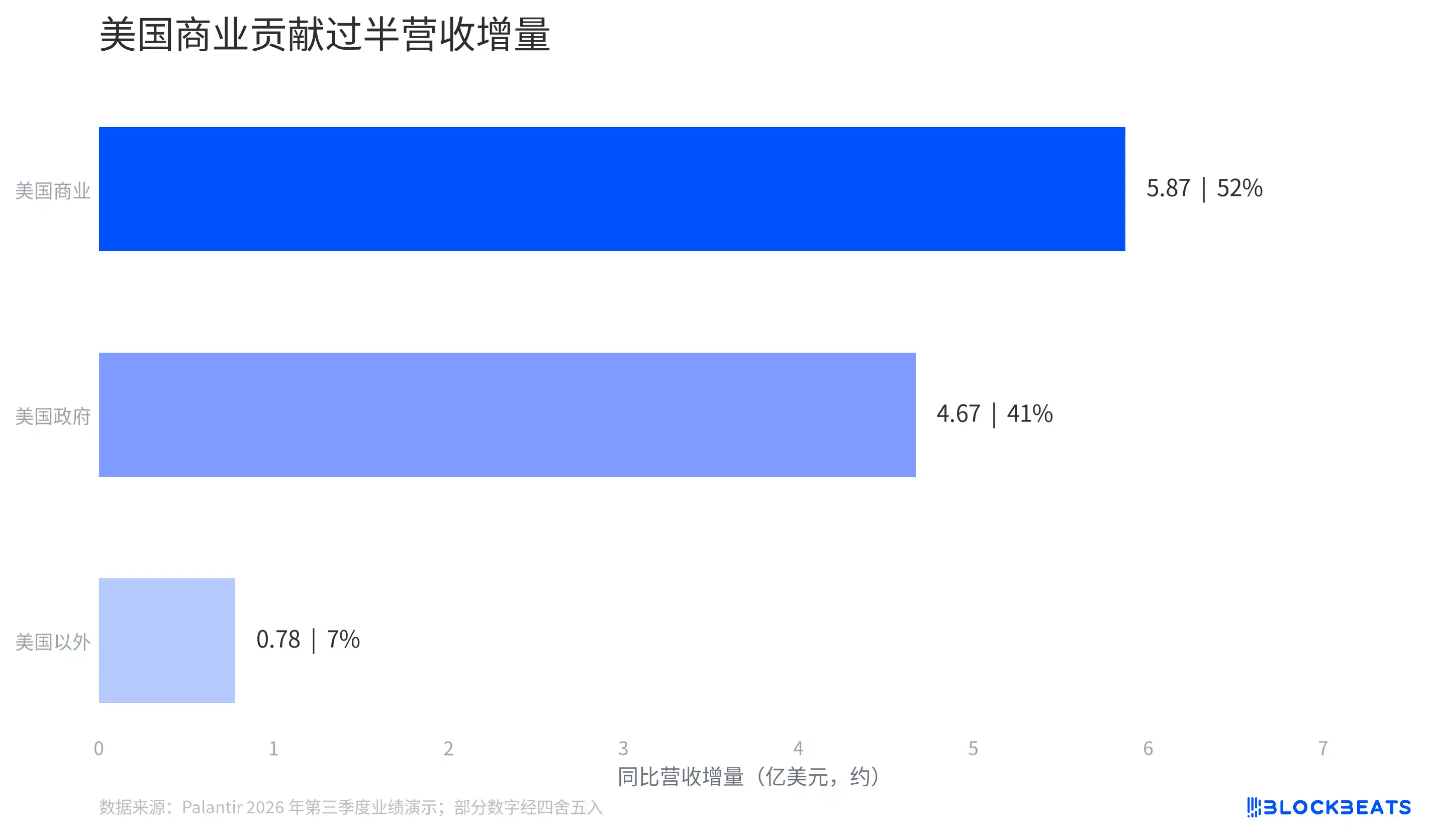
U.S. commercial contributed more than half of revenue increment
Based on calculations from Palantir's earnings presentation, the U.S. commercial business contributed about 52% of the third quarter's total year-over-year revenue increment. In other words, of every $100 in new revenue, about $52 came from U.S. commercial customers.
The U.S. government business also grew and contributed about 40% of the increment. Business outside the U.S. also added revenue, but its contribution to this round of growth was notably smaller. The overseas increment here is calculated by subtracting U.S. revenue from total revenue; the original segment figures were rounded, so the percentages are approximate.
This distinction affects how to interpret "nearly doubling." The company's overall growth rate is the result of multiple business segments stacking together. What truly widened the gap was faster growth in U.S. commercial revenue, not government business standing still.
Palantir's products help customers integrate data and apply analytical results to actual operations. In recent years, the company has pushed its artificial intelligence platform AIP to enterprise customers. The financial reports can show changes in commercial revenue, but these figures alone cannot accurately isolate AIP's contribution to the increment.
The weight of the U.S. market in the company's revenue has also increased accordingly. Based on calculations from the company's earnings materials, the U.S. business accounted for about three-quarters of total revenue in the same period last year, and this quarter that proportion has approached five-sixths. Both the commercial and government lines grew in the U.S., further increasing the geographic concentration of the company's overall revenue.
How did the commercial business catch up?
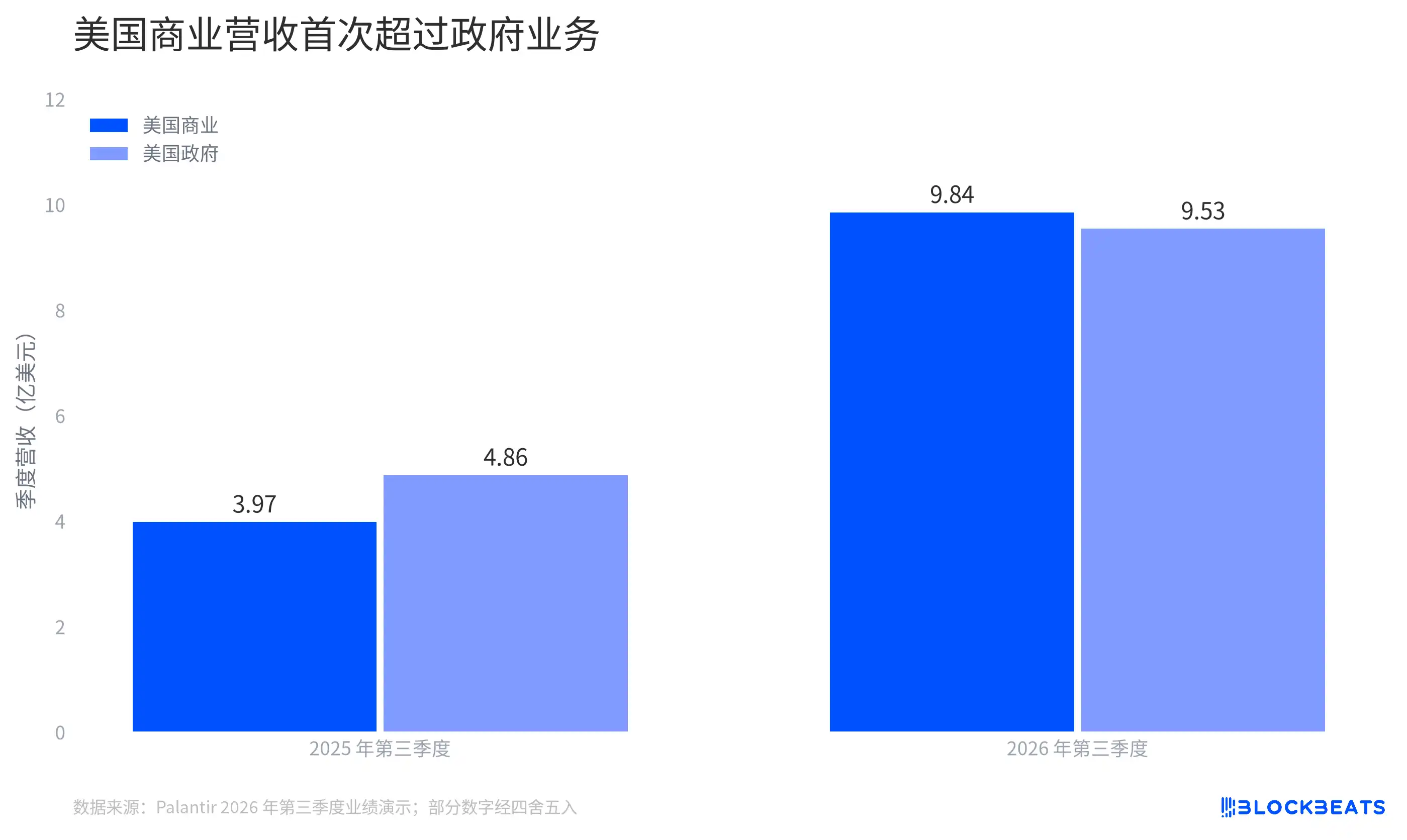
U.S. commercial revenue surpassed government business for the first time
A year ago, U.S. commercial business was still trailing government business by about $89 million. By the third quarter of this year, commercial business was ahead by about $31 million. The gap isn't large, but the direction has flipped.
The overtake happened as both sides grew rapidly. The company disclosed that U.S. commercial revenue grew 148% year-over-year, while U.S. government revenue grew 96% year-over-year. The former started from a smaller base, grew faster, and ultimately surpassed the latter this quarter.
This doesn't mean government business has become unimportant. U.S. government business revenue nearly doubled, and its incremental gain itself remains close to that of U.S. commercial business. Together, the two businesses constitute the bulk of U.S. revenue, and either one alone is enough to sway the company's overall performance.
Note also the boundaries of the comparison. What's being compared here is U.S. commercial versus U.S. government business, not global commercial versus global government business. The company also has commercial and government customers in other regions, and mixing numbers from different geographies would change the object of comparison.
The company's full-year revenue guidance was also raised alongside this earnings report. According to the earnings announcement, Palantir expects full-year revenue of between $8.530 billion and $8.534 billion, and expects U.S. commercial revenue to exceed $3.559 billion. This is management's forecast; unrealized revenue cannot be treated as confirmed revenue.
How many customers were added, and how much did existing customers spend?
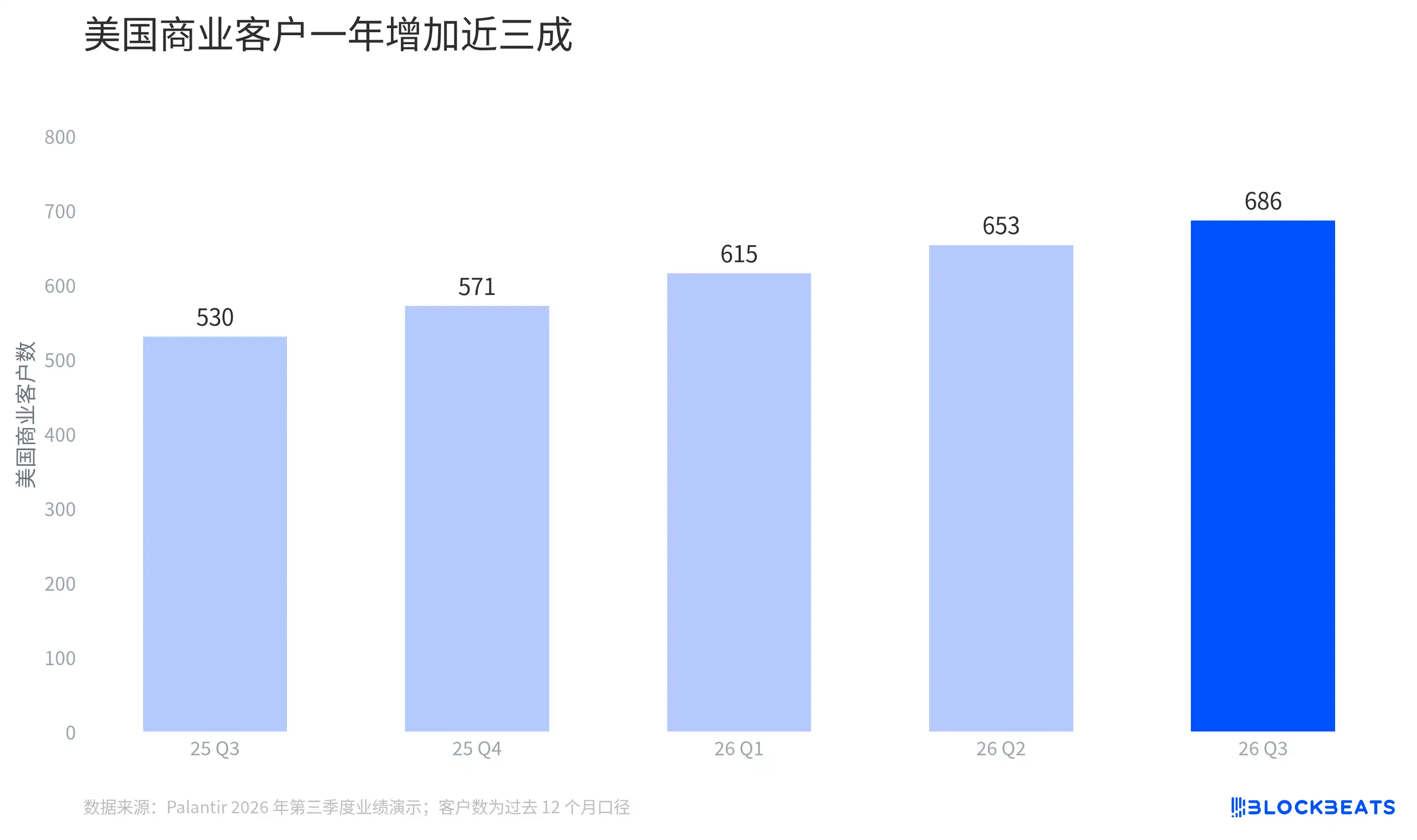
U.S. commercial customers up nearly 30% in a year
The customer list is getting longer. Palantir disclosed that as of the end of the third quarter, the company had 686 U.S. commercial customers over the trailing 12 months, up 29% from the same period last year. This metric counts organizations that have confirmed revenue over the past year, and is not equivalent to the number of newly signed customers in the quarter.
Customer count growth was lower than the same-quarter U.S. commercial revenue growth rate. This suggests revenue growth cannot simply be understood as the result of year-over-year customer count growth, but the two metrics cover different statistical periods, so they also cannot be directly divided to calculate per-customer spending growth.
Another figure offers a clue about expansion among existing customers. Palantir disclosed that the company's overall net dollar retention rate reached 165%. Under the company's methodology, revenue contributed by the same cohort of customers over the most recent 12 months equals 1.65 times that of the prior 12 months.
This metric covers the company's overall customer base, uses trailing annual revenue, and is not a quarterly retention rate specific to U.S. commercial business. It can show that revenue from the company's existing customer base is increasing, but it cannot directly prove how much of the U.S. commercial revenue increment came from existing customers versus new customers.
Large deals are also increasing revenue opportunities. The company said it closed 212 deals of at least $1 million in the third quarter, of which 64 reached at least $10 million. The latter are included in the former and cannot be added together.
Deal value also does not equate to quarterly revenue. According to the company's explanation, total transaction value includes contractual obligations and contract options that customers have not yet exercised. After a contract is signed, revenue still needs to be recognized in the corresponding periods under accounting rules.
Palantir's new milestone therefore has two simultaneously valid sides: U.S. enterprise customers brought in more quarterly revenue than the U.S. government for the first time, while the government business itself is still growing at a pace close to doubling.
Welcome to join the official BlockBeats community:
Telegram Subscription Group: https://t.me/theblockbeats
Telegram Discussion Group: https://t.me/BlockBeats_App
Official Twitter Account: https://twitter.com/BlockBeatsAsia

 Related Articles