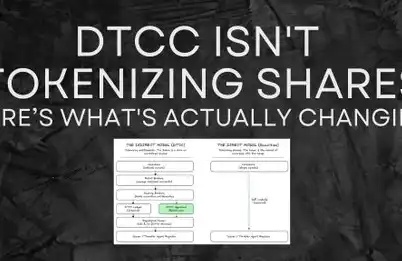
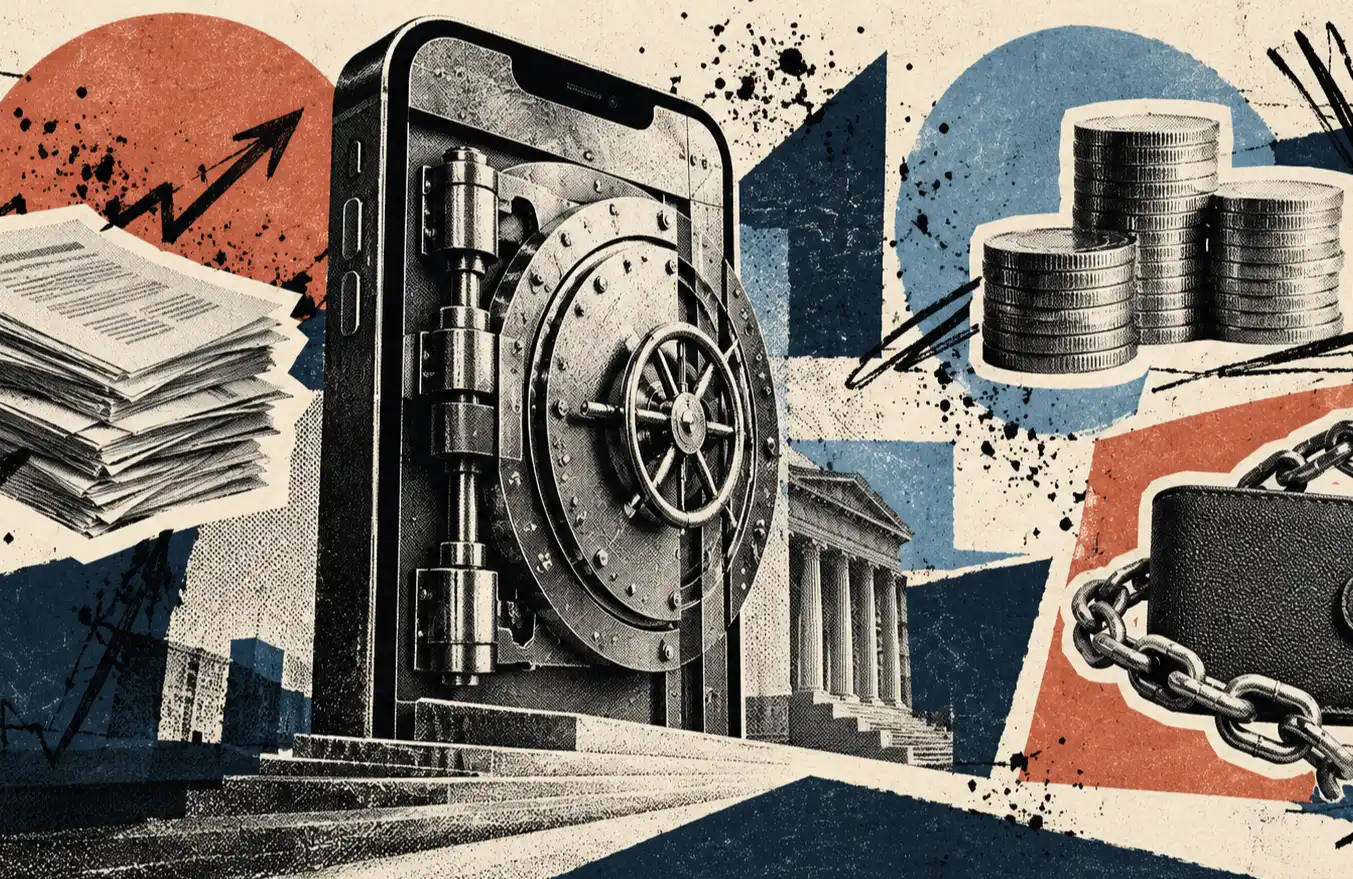
DTCC's newly launched tokenization service is not about putting US stocks on-chain.

TL;DR
· On October 28, DTC, a subsidiary of DTCC, launched its tokenization service, with 20 participating institutions signing access agreements.
· On-chain tokens are entitlement copies of already-custodied securities; the CUSIP and rights remain unchanged, and no new securities are issued.
· Related tickers: Canton (CC), JPMorgan, Citi, State Street.
On October 28, 2026, DTC, a subsidiary of DTCC (The Depository Trust & Clearing Corporation), announced the official launch of the DTCC Tokenization Service. Twenty DTC participants, including JPMorgan, Citi, State Street, Morgan Stanley, Bank of America, Barclays, and UBS, have signed access agreements, with onboarding to roll out subsequently.
After the news spread, "the $30 trillion U.S. stock market goes on-chain" became a headline that flooded screens. But what DTCC is actually doing is simply turning the official record on DTC's ledger of "who owns this already-custodied security" into a digital copy that can go on-chain and also be converted back to traditional form. The U.S. stock market itself has not been moved onto a public blockchain.
One relationship needs to be clarified first. The U.S. stocks investors see in their brokerage accounts are, legally, a securities entitlement recorded on DTC's ledger, not a stock certificate. DTC has created an on-chain mirror of the same entitlement, backed 1:1 by already-custodied securities, with the CUSIP (securities identification code), ownership, economic rights, and investor protections all preserved.
Two forms of the same stock
DTC has not issued any new securities. Its approach is to mint already-custodied positions into "tokenized entitlements" and deliver them to wallets registered by participants. The so-called "on-chain" here refers to entitlement records going on-chain, not the issuance of new securities.
The official boundaries are very specific. On the same chain, when both parties are registered wallets, tokens can be transferred peer-to-peer 24/7, with transfer being settlement, no longer waiting for T+1. However, conversions between traditional form and token form, as well as cross-chain transfers, still must go through DTC's conversion service, open on weekdays from 2:00 to 18:00 Eastern Time, with a target completion time of 15 minutes.
On the first day, more than 30 securities are convertible, covering selected Russell 1000 constituents, ETFs tracking major indices, and U.S. Treasuries. Two chains are supported on the first day: Canton and DTCC's own private Besu network. Additional networks are planned for 2027.
The $30 trillion figure comes from DTCC's own framing, referring to the total market value of the convertible securities in scope. It is the "tokenizable universe," not the amount already minted.
Who can use it, what can move, what can't
The service is not open to the public. Only DTC participants can connect directly, and tokens can only move between their registered wallets. It is a controlled inter-institutional pipeline, not open DeFi, and not a new trading app for retail investors.
The legal basis is a no-action letter the SEC's Division of Trading and Markets issued to DTC on December 11, 2025. Staff said they would not recommend enforcement action for three years if the arrangement proceeds as DTC described. This is a time-limited staff-level exemption, not an act of Congress, and not a permanent authorization.
SEC Commissioner Hester Peirce called it a gradual step toward moving markets on-chain, while cautioning that it is a pilot with operational limits.
Before launch, DTC completed small-scale production trades with more than 30 institutions on July 15 this year, covering collateral, lending, repo and equity delivery. But there is still a gap between signed agreements and running volume. On day one, DTCC did not disclose minted volume or transfer counts.
Canton's price didn't follow the "$30 trillion"
The crypto market read this as an exclusive catalyst for Canton. Market data shows CC traded around $0.10 around the launch, roughly flat over 24 hours, down about 11% over seven days, with no volume breakout matching a "$30 trillion on-chain" narrative.
The multi-chain design is one reason. DTCC Chief Digital Officer Nadine Chakar put it plainly: no single chain can carry the volume they need. On day one, Besu and Canton were side by side, Stellar is expected to connect in the first half of 2027, and Circle's Arc is also on the roadmap.
Another thread advanced the same day. According to The Wall Street Journal, JPMorgan, AMD, Coca-Cola and others joined the camp opposing third parties tokenizing their shares without authorization, with the list expanding to 33 companies.
Such third-party products only track the price, grant no voting rights, and issuers can demand delisting. DTCC is selling the same CUSIP with the same rights. The two kinds of "tokenized stocks" are fighting over the definition of the same term.
Citi's judgment sits on the latter side. Nadine Taysen, Citi's global head of tokenized securities and crypto, said the industry will move toward digital twins like DTCC's, and consumers must understand exactly what they are buying. Citi Research's mid-2026 base case projects tokenized assets reaching $5.5 trillion by 2030. That is an outlook for 2030, not validation of this launch.
The door is open, but scale hasn't arrived
To gauge the significance of this, what matters isn't the length of the list but whether there's volume. Twenty signings only show that major banks don't want to miss the official channel—it doesn't mean all twenty are running.
The absence list is equally telling. Industry media Ledger Insights noted that BNY Mellon, the largest U.S. custodian bank, and Goldman Sachs, which participated in the July pilot, are both not among the first batch of entrants.
A harder constraint comes from the settlement mechanism. In the traditional system, NSCC (National Securities Clearing Corporation) netting can compress actual settlement volume to about 2% of total trading volume. If the chain lacks both netting and on-chain cash, the efficiency narrative of 7×24 transfers is only half complete. Cross-chain and on-chain cash settlement are both currently on the 2027 roadmap.
Whether the three-year no-action letter can be converted to full status after it expires also remains unanswered. The door is indeed open, but what determines whether it's "opened a door" or "moved house" is the minting volume over the next few quarters, whether the collateral application chain can run, and when tokenized deposits or stablecoins will be connected.
Welcome to join the official BlockBeats community:
Telegram Subscription Group: https://t.me/theblockbeats
Telegram Discussion Group: https://t.me/BlockBeats_App
Official Twitter Account: https://twitter.com/BlockBeatsAsia
 Related Articles