Microsoft's earnings beat expectations, revenue accelerates, orders remain at high levels, maintaining positive cash flow.

Microsoft has delivered its first report card for the new fiscal year. Azure's growth accelerated again, but another curve in the earnings report has stalled: the commercial remaining performance obligation barely increased from the previous quarter.
These two things can happen at the same time. Cloud revenue records services already delivered, while the remaining performance obligation records revenue that customers have contracted for but Microsoft has not yet recognized. They point to different stages of the same business. Looking further upstream, there is also money that must be spent first, to purchase servers and expand data centers.
According to Microsoft's earnings report, revenue for the quarter ended September was $92.3 billion, up 19% year over year. The company grouped Azure, Microsoft 365 cloud services and others into a new "Agentic & Infrastructure" business segment. This new disclosure approach also makes the revenue structure of the cloud business clearer.
Where does the growth come from?
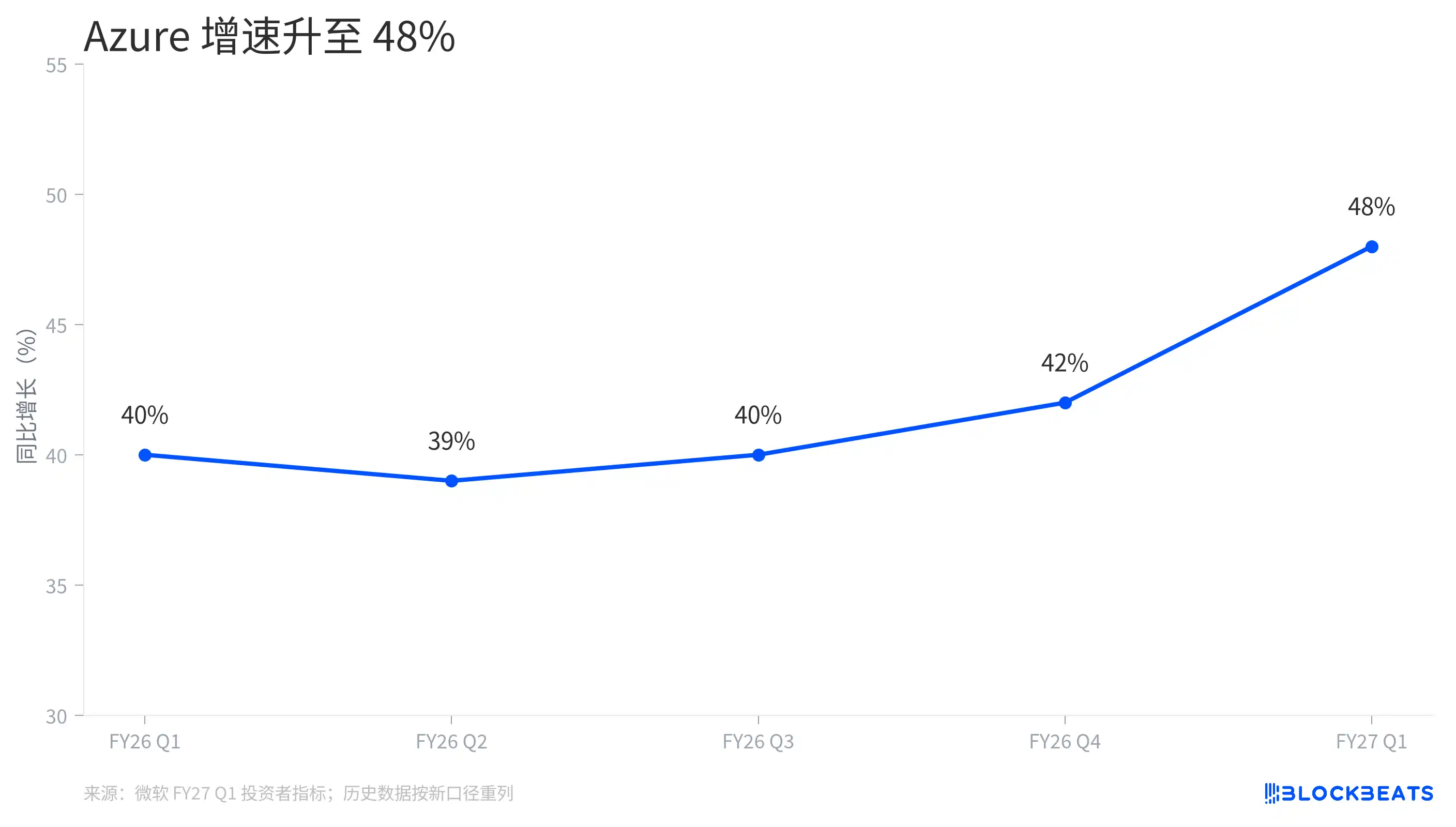
Azure growth rate
Azure is Microsoft's cloud platform, where customers can rent computing and storage resources and also use AI services. Microsoft's latest earnings report shows that Azure revenue for the quarter was $33.2 billion, an increase of about $10.8 billion from the same period last year. This single item's revenue increase accounted for about three-quarters of Microsoft's total revenue increment for the quarter. The calculation here uses the company's restated data under the new business segmentation.
This does not mean that all of this increment comes from AI. Microsoft's Azure metric includes cloud and AI consumption-based services as well as products such as virtual desktop, and the company did not separately disclose AI revenue in this earnings report. The growth shows that customers spent more on Azure, but it cannot directly tell us how much of that was used to train models or run AI applications.
Microsoft also restated historical growth metrics. The investor metrics table shows that, calculated under the new methodology, Azure's growth rate was 42% last quarter and rose to 48% this quarter. The "Azure and other cloud services" metric used when last quarter was reported showed growth of 43%. When looking at trends, one needs to use the same data set rather than directly stitching old and new methodologies together.
Where did the orders customers signed go?
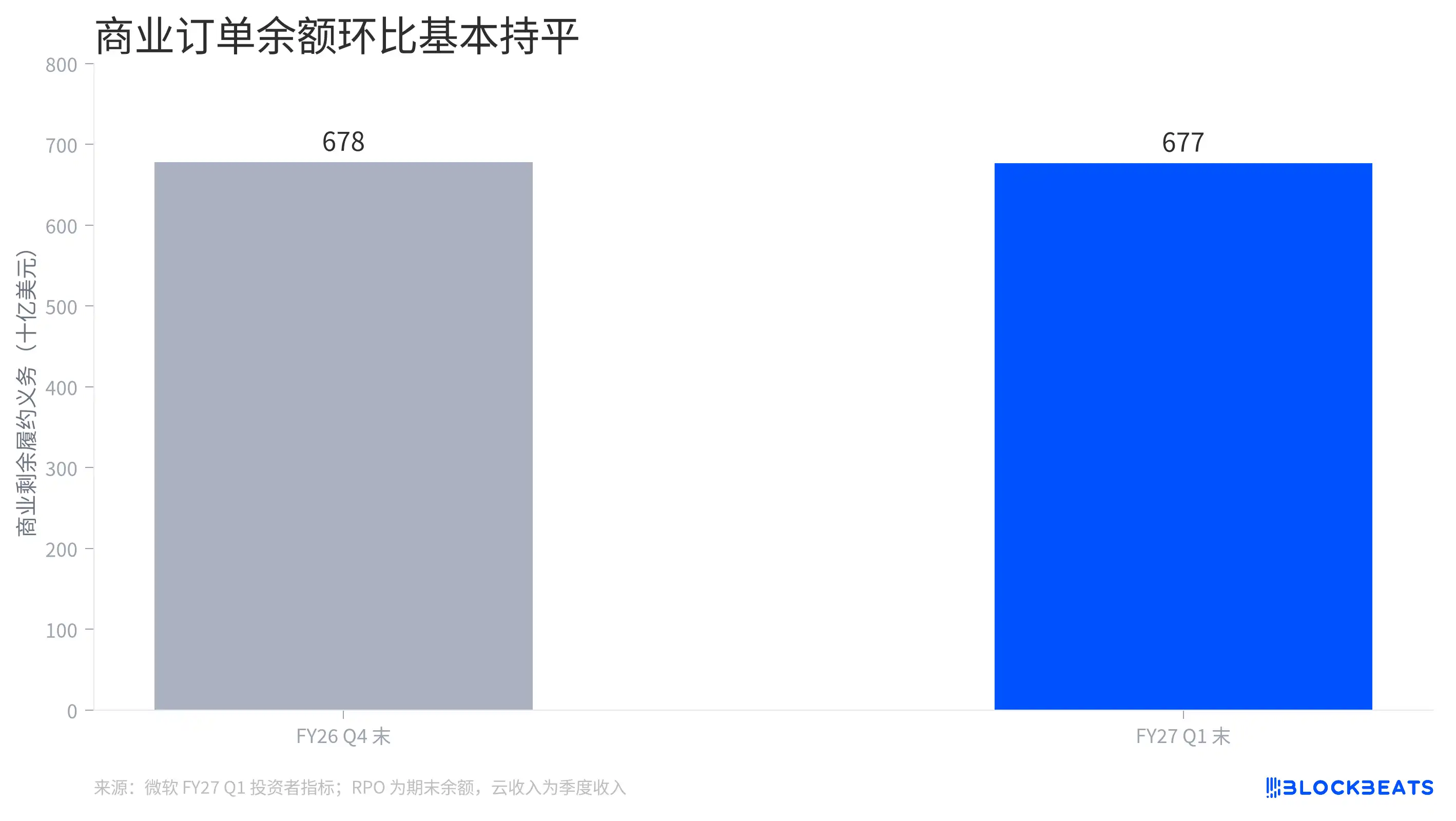
Commercial order balance
Commercial remaining performance obligation, or RPO, can be understood as commercial revenue that has been signed but not yet recognized. After a customer signs a long-term cloud contract, the contract amount does not all become revenue on the day of signing. Microsoft recognizes revenue as services are delivered, and the unrecognized portion remains in the order balance.
This balance is still 73% higher than a year ago, but it is nearly flat compared with the previous quarter. Over the same period, Microsoft Cloud revenue continued to grow. The two lines are not contradictory; the order balance is affected by new contracts, execution of existing contracts, and contract terms. A balance that is no longer increasing does not directly imply that demand has declined.
Another difference between the balance and revenue is timing. The former is a stock at a point in time and may span multiple quarters or even years. The latter is a flow recognized over an entire quarter. Dividing the order balance by quarterly revenue gives a multiple that can help convey scale, but it is not the average remaining term of customer contracts, nor is it cash Microsoft has already received.
How much of the money earned went back to the data centers?
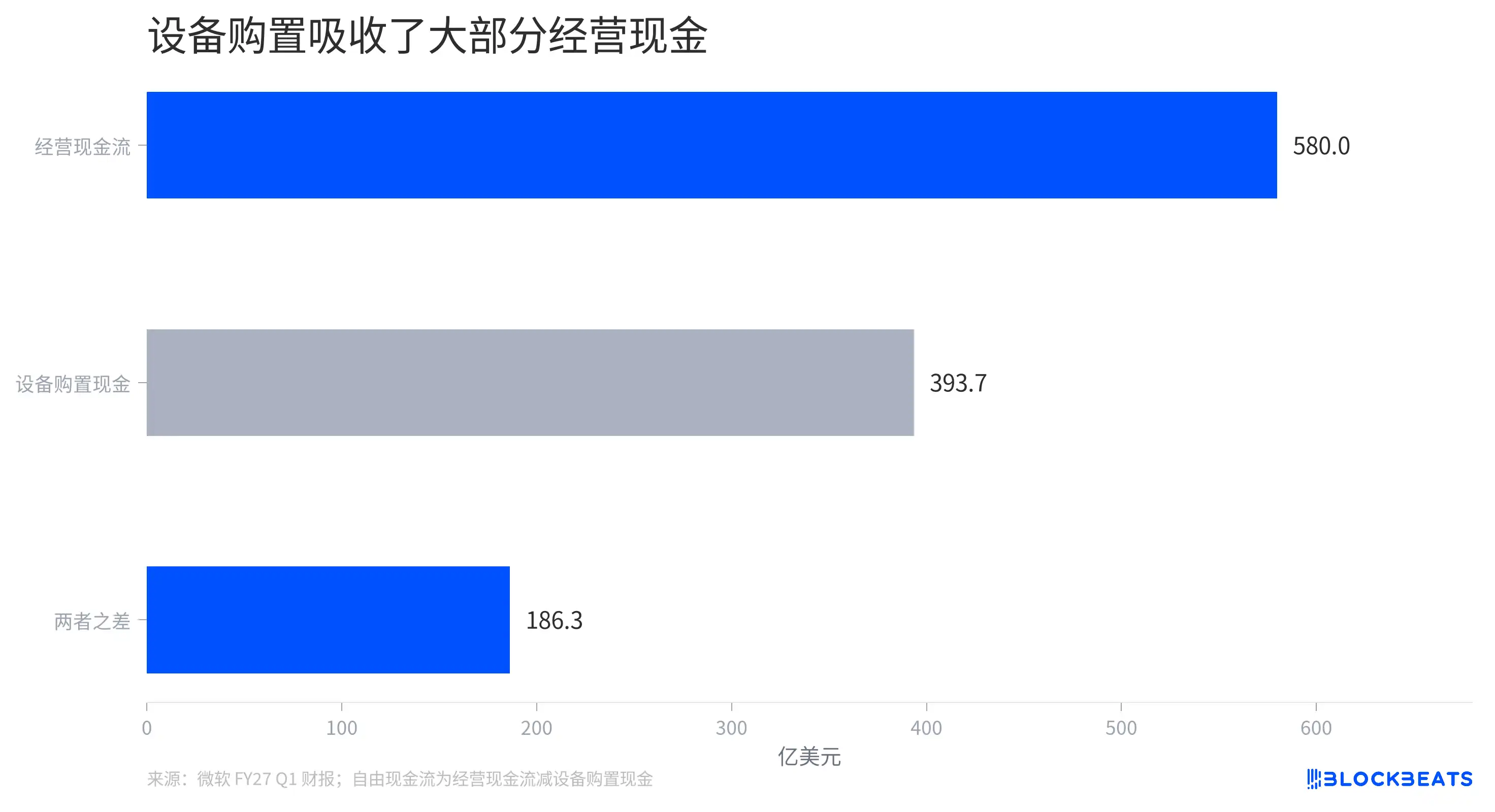
Operating cash flow and equipment purchases
Microsoft's income statement shows business growth, while its cash flow statement shows the pace of construction. According to the company's financial report, cash generated by operating activities in the quarter was $58 billion, and cash paid for equipment and property purchases was $39.4 billion. The difference between the two is about $18.6 billion, which is also consistent with the rounded figure for free cash flow disclosed by management in the earnings call transcript.
Put more intuitively, for every $100 of operating cash flow generated, about $68 was used for cash purchases of equipment and property in the quarter. This ratio covers Microsoft's overall business and cannot be directly treated as the standalone return on investment for Azure or AI. Operating cash flow is also affected by changes in working capital such as customer collections, payment timing, and taxes.
Capital expenditure also has a broader disclosure basis. The capital expenditure mentioned by management on the call includes items such as finance leases and cannot be directly deducted from operating cash flow. Equipment purchase expenditures in the cash flow statement record the cash actually paid. The two measure construction investment from different angles, so they cannot be conflated as the same expenditure.
Why Does Net Profit Appear to Grow Faster?
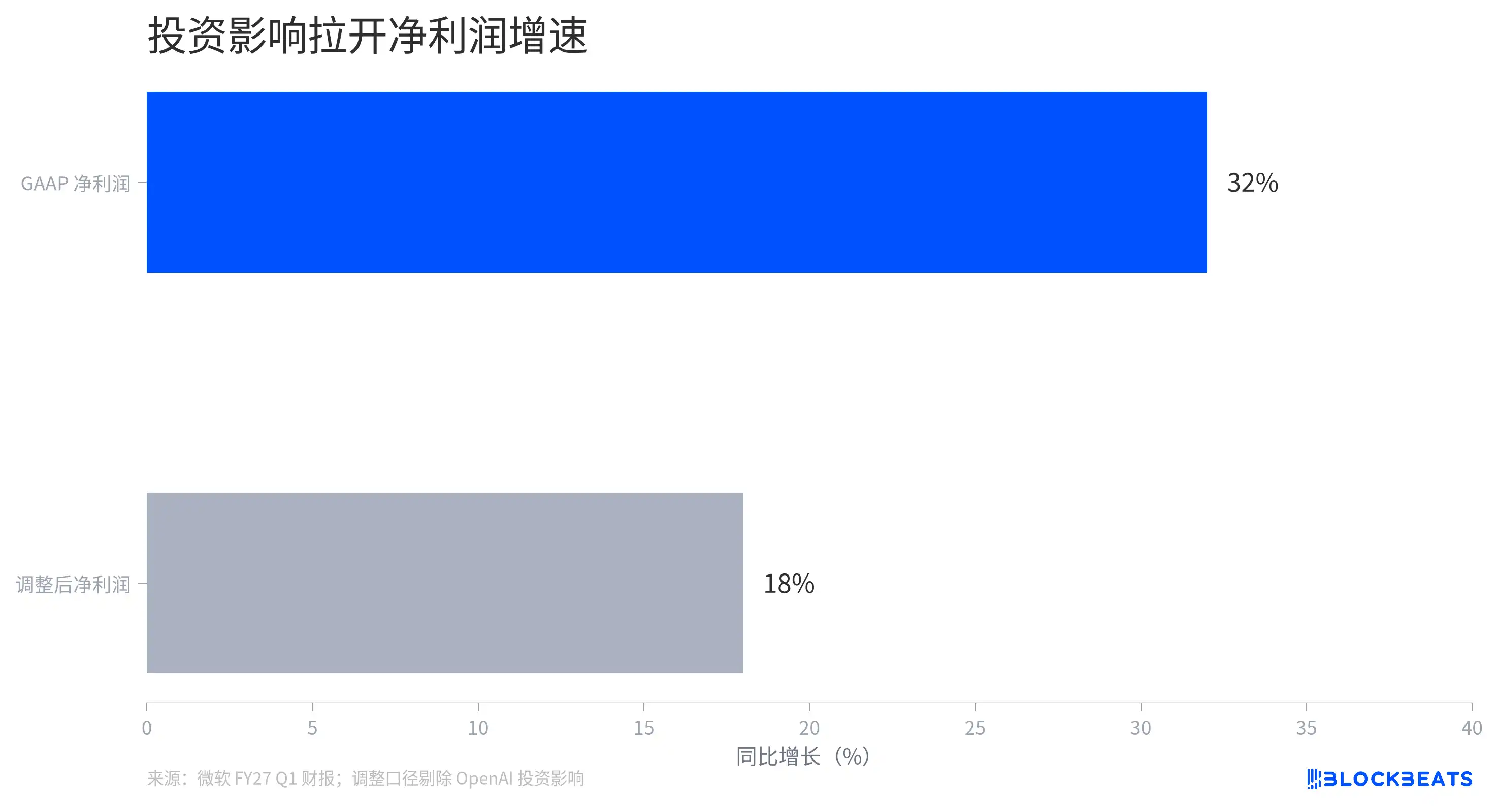
Two Net Profit Growth Rates
Microsoft's net profit for the quarter grew 32% year-over-year under US GAAP, and 18% after excluding the impact of its OpenAI investment. Same company, same quarter, a 14-percentage-point gap in growth rates.
The difference mainly comes from the comparison base. Microsoft's financial report shows that investment losses related to OpenAI in the same period last year depressed net profit at that time, while the investment impact this quarter was smaller. With last year's base pushed down, this year's GAAP year-over-year growth rate appears higher.
The adjusted figure can help readers observe the change after excluding this investment impact, but it remains a non-GAAP measure defined by the company and is not a comprehensive adjustment for all investments or one-time factors. Operating profit growth and cash flow changes still need to be examined separately.
This earnings report breaks Microsoft's cloud business into several different clocks: when contracts are signed, when services are delivered, when devices are paid for, and in which quarter investment gains and losses enter the income statement.
Welcome to join the official BlockBeats community:
Telegram Subscription Group: https://t.me/theblockbeats
Telegram Discussion Group: https://t.me/BlockBeats_App
Official Twitter Account: https://twitter.com/BlockBeatsAsia
 Related Articles