Why is Binance building a new chain?

Binance founder CZ quoted a tweet on X about BNB Chain's new L1, saying "Multiple chains, one coin."
This statement is the most straightforward positioning of this chain at present. The new chain does not issue its own token; gas fees, staking, and governance all continue to use BNB. No matter how many more chains BNB launches, there is only one account that ultimately collects the money.
In fact, this new chain was announced in the official technical roadmap on July 8. The official documentation positions this chain as "a vertically optimized general-purpose L1 designed for trading, payments, privacy, and AI."
Why build a new chain
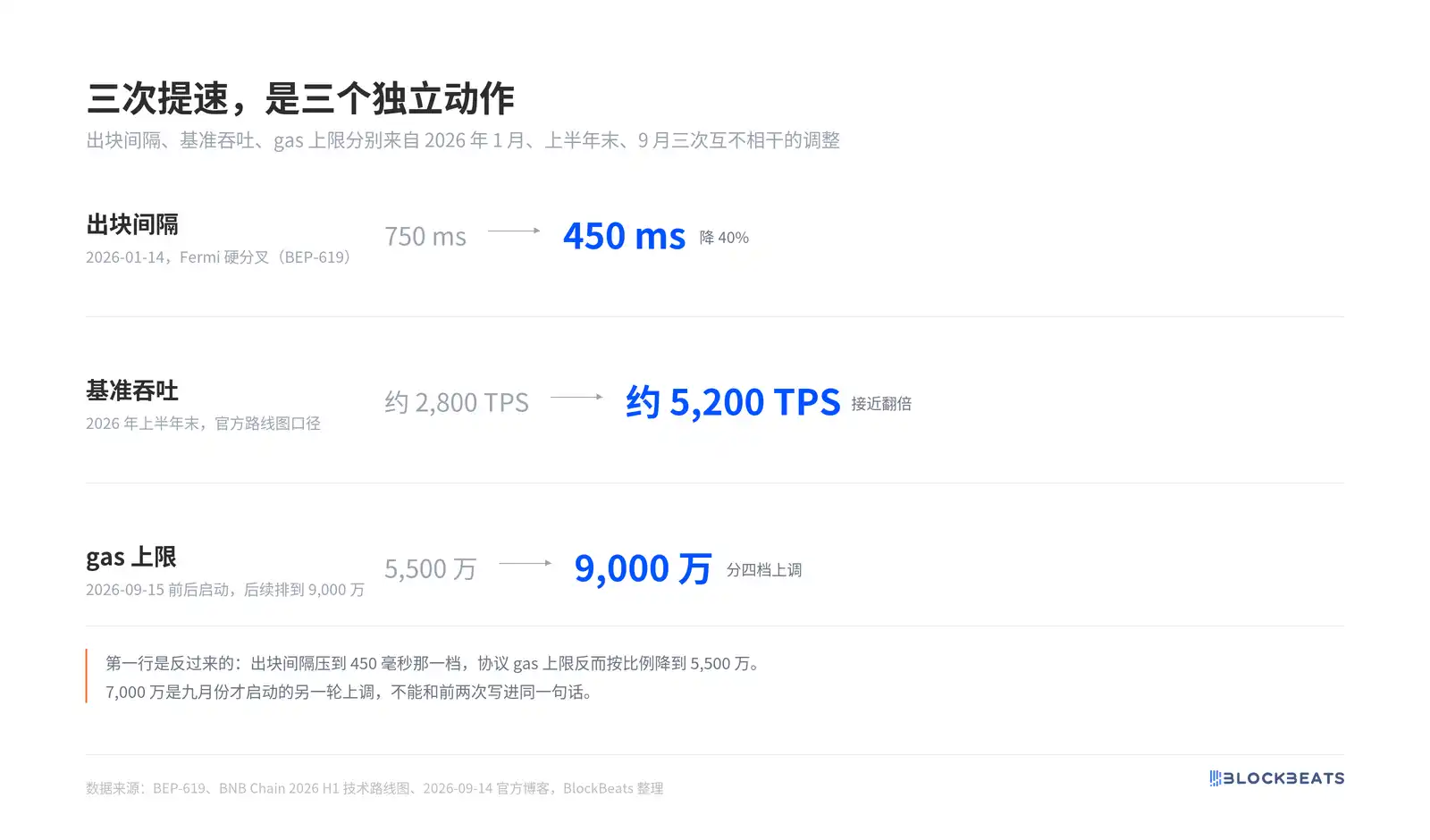
To understand why another chain must be built, one must first look at where BSC's current bottleneck lies. BSC compressed its block interval from 750 milliseconds to 450 milliseconds in January this year, and by the end of the first half, benchmark throughput rose from about 2,800 TPS to 5,200 TPS. Since September, the gas limit was raised again in a separate round, with the first-level target at 70 million.
The problem lies in the ordering rules. BSC's block space is sold by tip size, which no one cares about normally, but once Meme market activity picks up, speculative trading pushes tips to the sky, and transfers, withdrawals, merchant payments, and other time-sensitive transactions with low tips are directly squeezed out. A general-purpose chain has no way to distinguish "who is more urgent"; it only recognizes "who pays more."
The second layer of reasons lies in execution. In traditional chains, block producers must first run all transactions and compute the post-execution ledger state before publishing a block, and other validators must run it again before daring to vote. A block every 200 milliseconds means two rounds of full execution must be completed every 200 milliseconds, which is engineeringly unworkable.
The official documentation means that BSC can no longer accommodate certain workloads, so this time it is not about renovating it, but about drawing a new blueprint.
What truly made this decision urgent is a set of comparative figures. DefiLlama's reading on October 26, 2026, was $5.77 billion locked on BSC, with $166 million in annual fees. Hyperliquid had $2.37 billion locked, with $903 million in annual fees. Four-tenths of the money earned more than five times the toll revenue.
The gap is not in the number of users, but in whether that money is being traded frequently.
The new chain will separate ordering and execution, then rewrite the ledger
There is only one core action: separating "ordering" from "execution." Ordering determines who goes first and who goes after, while execution determines what the ledger looks like after the run completes. Traditional chains bind these two things tightly together; New L1 separates them—consensus only recognizes order, and execution catches up asynchronously, even if it lags several blocks behind.
This idea is not its invention. The documentation itself mentions two forerunners: Ethereum's EIP-7886 fixes execution lag at 1 block, and Monad fixes it at 3 blocks. New L1 makes the lag adaptive—compressed to 1 under low load, automatically extended under high load, with the upper limit set by governance configuration.
Once separated, block intervals can be compressed to 200 milliseconds, and pre-confirmations can be compressed to about 20 milliseconds. A so-called pre-confirmation is when the block producer uses a signature to tell you: I guarantee this order will be placed in this position. The documentation is very restrained, calling it best-effort—meaning they try their best but make no guarantee—and on revocation it will report aborted or superseded in the same subscription, and this is expected behavior, not a fault. What you get is a queue number, not a seat.
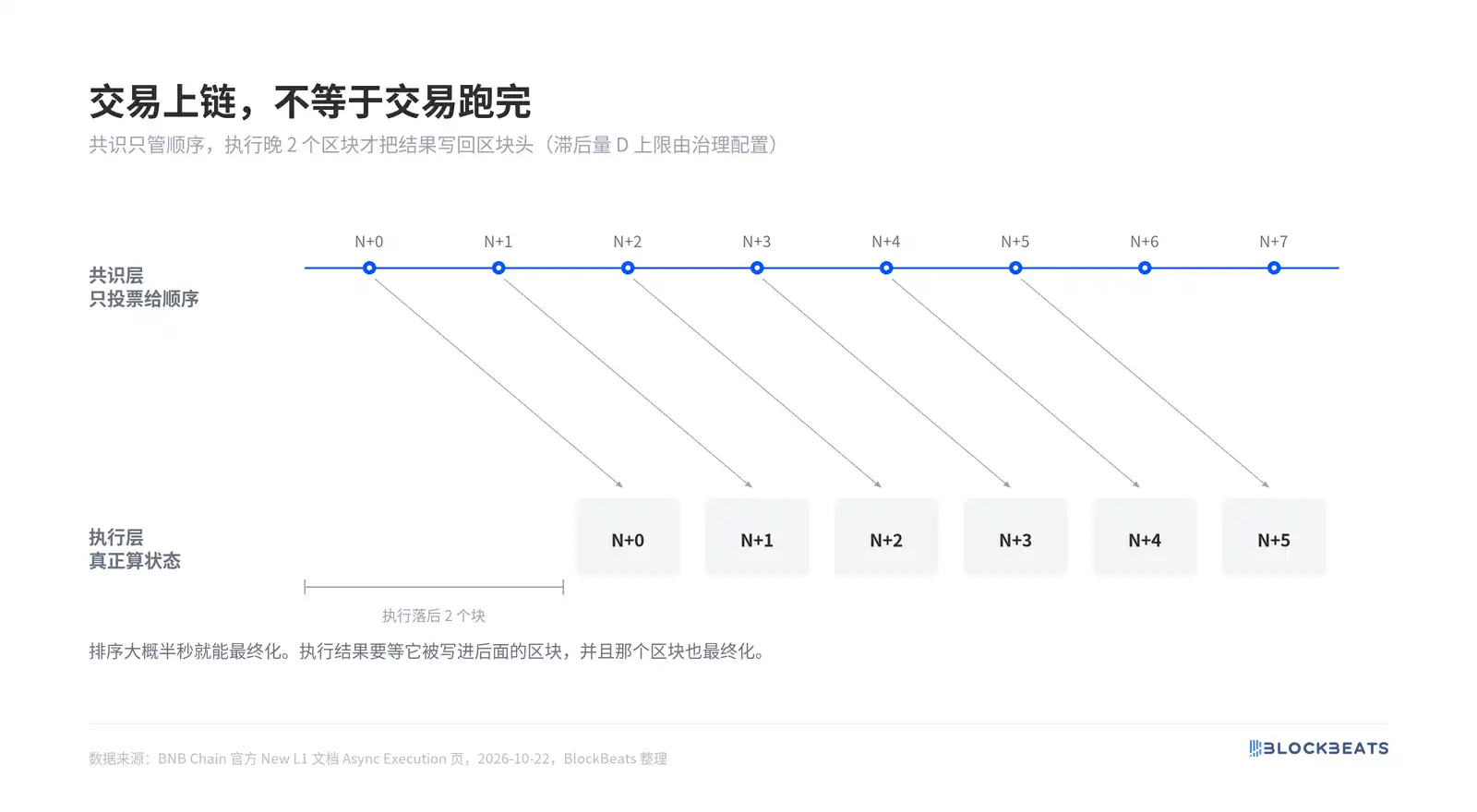
Actual final confirmation relies on another mechanism. Validators vote on blocks each round using BLS signatures—BLS is a signature scheme that can compress many signatures into one—and once two-thirds is reached, an aggregate signature is stamped into the next block header. Under normal circumstances, one block is justified and two blocks are finalized—200 milliseconds per slot, roughly half a second. There is a design detail here: validators vote on order, not execution results, so they do not need to wait for the EVM to finish running.
The ledger has also changed. New L1 no longer uses a Merkle tree—that structure organizes the ledger into a tree, with each layer hashing everything below into a bundle; the advantage is that an account's state can be proven from a single branch, but the disadvantage is that changing one account requires recomputing an entire path. The new chain switches to flat key-value storage plus an accumulator commitment—writes are cheap, at the cost that the eth_getProof interface is simply gone, and EIP-4844 and EIP-7702 are also unsupported.
The protocol layer also packs in three things that cannot be done on BSC. First, native account abstraction, transaction type 0x76—a single transaction can contain 1 to 64 calls, supporting passkey signatures, session keys, and third-party gas payment, with no bundler and no 4337-style entry contract. Second, Multi-Lane, which reserves a share of block gas for key transactions by contract address, so oracles and liquidations are not crowded out by ordinary transactions—it protects addresses, not use cases. Third, a native shielded pool—contract 0x5000 plus precompile 0x67 plus transaction type 0x77—where transfers within the pool hide amounts, assets, and both parties' addresses. The official team itself posted a warning on this part: the circuits have not been audited, and it uses an imported trusted setup rather than a ceremony they ran themselves—the exact words are do not try it with real funds.
The propagation method has also changed. Transactions no longer enter the public mempool; they are sent directly to the current and next block producers. This mitigates MEV attacks.
The Five Chains of the Binance Ecosystem
Looking at the timeline, BNB's chain-adding history is actually quite regular—each time it adds a chain, never issuing new assets. The four official chains have clear divisions of labor: one for general purposes, one for scaling, one for storage, and now one more for transactions. The fourth chain in the table is one that grew organically within the ecosystem.
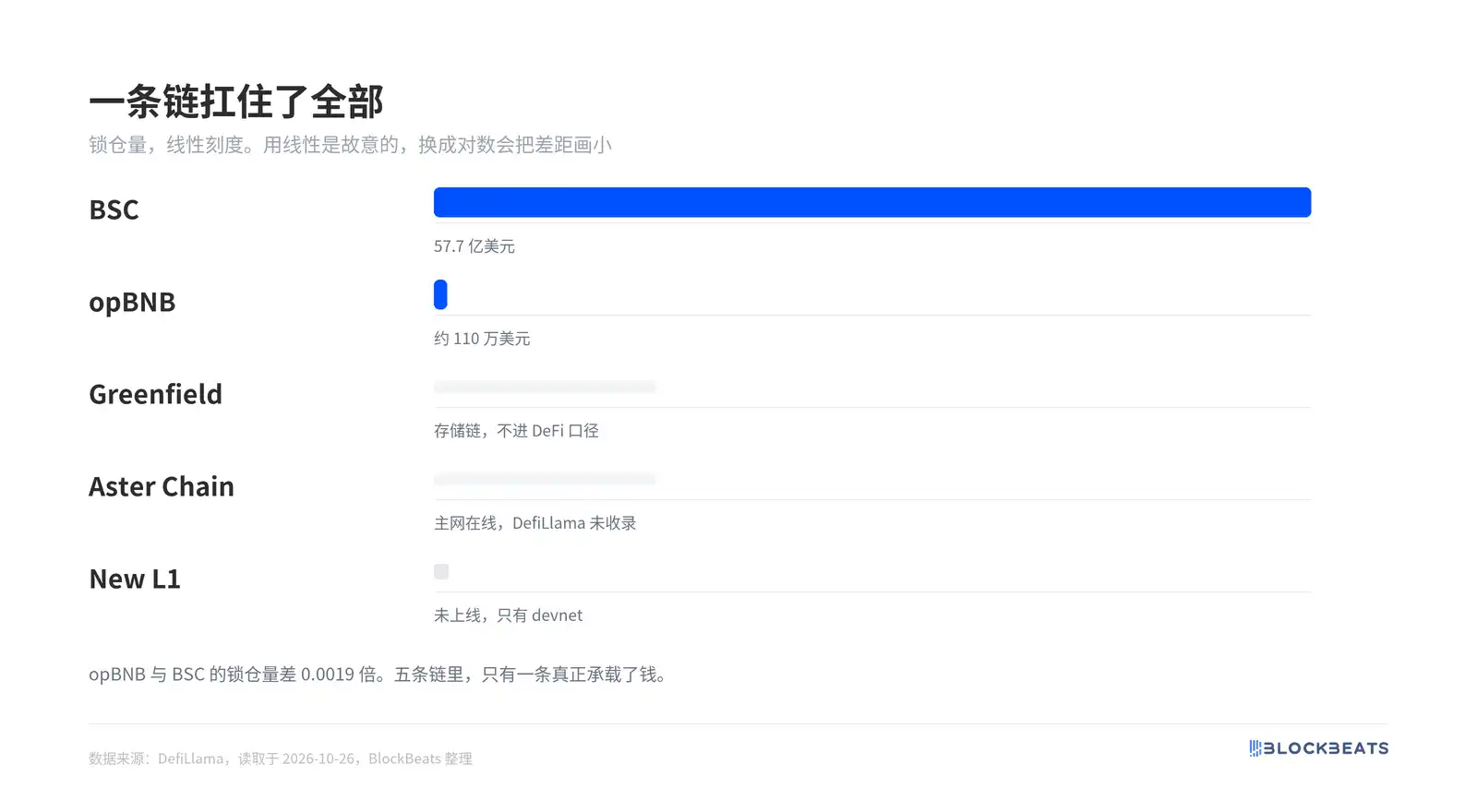
The first two supplementary chains did not end well. opBNB followed the OP Stack route, theoretically absorbing transactions overflowing from BSC. In three years it reached $1.1 million in TVL and $110,000 in annual fees—less than one-thousandth of BSC's. Greenfield handles storage, but so far it likewise has not grown a second growth curve.
Aster is a perpetual futures exchange native to BNB Chain. On March 17, 2026, it launched the first-phase mainnet of Aster Chain, a step the team calls Chain Genesis. It focuses on privacy for futures trading, using stealth addresses to hide trading history, and issues a credential called Viewer Pass that lets traders decide to whom they disclose. Official figures claim up to 100,000 TPS, 50-millisecond block times, and zero Gas fees for on-chain transactions.
It looks very much like what Binance's new chain is trying to do.
Aster Chain's on-chain Gas is zero, but 99% of the trading fees the platform collects daily are used for time-weighted buybacks of ASTER, which are then distributed to stakers. The official line is that staking yields track trading activity. But the money sits on ASTER's books and does not flow into BNB. This basically explains why BNB has to step in itself.
Potential Problems
The more chains there are, the more scenarios they can handle, and the greater the imaginative space for this discount ticket. That is the real meaning of "multiple chains, one coin"—the narrative can be maxed out.
But landing the narrative will not be so smooth. On October 23, galaio, the person behind the MEV solution, said on the forum that sub-blocks were not built into the protocol layer; they are merely a reputational commitment, and strict ordering cannot be guaranteed.
For example, at a restaurant, the host gives you a number and says it will be your turn soon. That is a promise, not a contract. The restaurant can make you wait forty minutes, or let a regular who arrived later go in first, and you have no recourse but to leave. A reservation is different: you pay a deposit, the seat is yours, and breach means compensation.
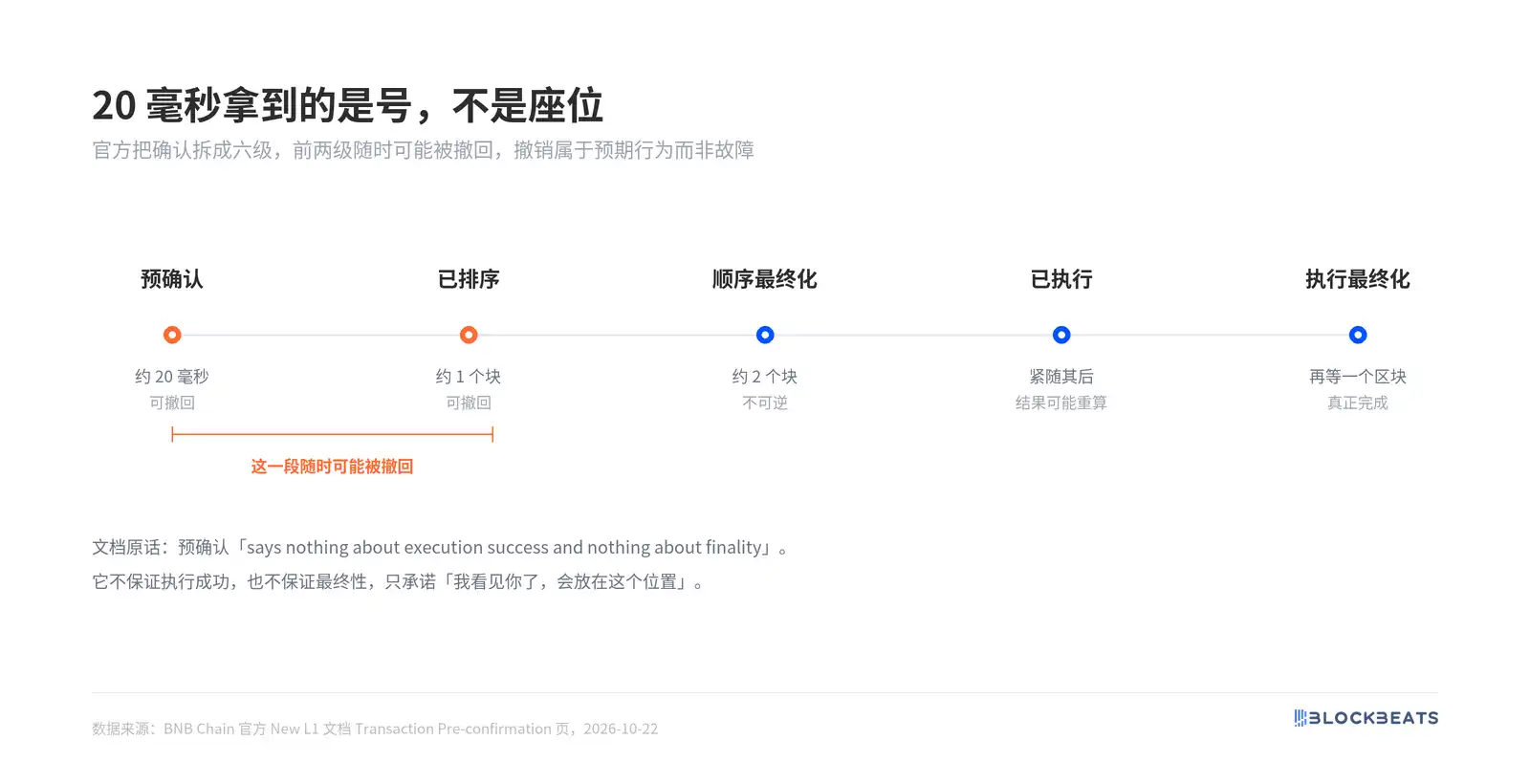
The 20-millisecond pre-confirmation of the new L1 chain is closer to the former. Anti-front-running, fast feedback, and predictable ordering—these three things are essential for market makers and professional trading teams, and at this moment they rely on the operator's reputation, not code enforcement. On October 26, 48ClubIan pushed this issue to its limit on the forum: if the protocol does not enforce ordering commitments, what exactly is gained by replacing permissionless block builder competition with enforced TEE ordering?
The answer will likely have to wait until next year's testnet launch.
Welcome to join the official BlockBeats community:
Telegram Subscription Group: https://t.me/theblockbeats
Telegram Discussion Group: https://t.me/BlockBeats_App
Official Twitter Account: https://twitter.com/BlockBeatsAsia
 Related Articles