Long-end US Treasuries are already raising rates on behalf of the Fed. What should the market be watching?

TL;DR
· On October 12, Cleveland Fed President Hammack said policy needs to remain restrictive and rates may need to rise further, based on strong demand and broad-based inflation pressures.
· The 10-year Treasury yield broke above 5.3% in the same period, the highest since 2002. The long end is pricing term premium and fiscal supply, not the rate path for the next few meetings.
· Related assets: Treasuries, mortgage-backed securities (MBS) funds, Russell 2000 small caps, U.S. housing-related sectors, and some emerging market currencies.
On October 12, Cleveland Fed President Beth Hammack said in a speech that monetary policy still needs to remain restrictive and rates may need to rise further to bring inflation back to 2% in a timely way.
She noted that in conversations with businesses, she saw strong demand, companies still having pricing power, and inflation pressures coming not only from energy. In the same week, the 10-year Treasury yield traded between 5.2% and 5.3%, briefly touching above 5.35% intraday, the highest since 2002.
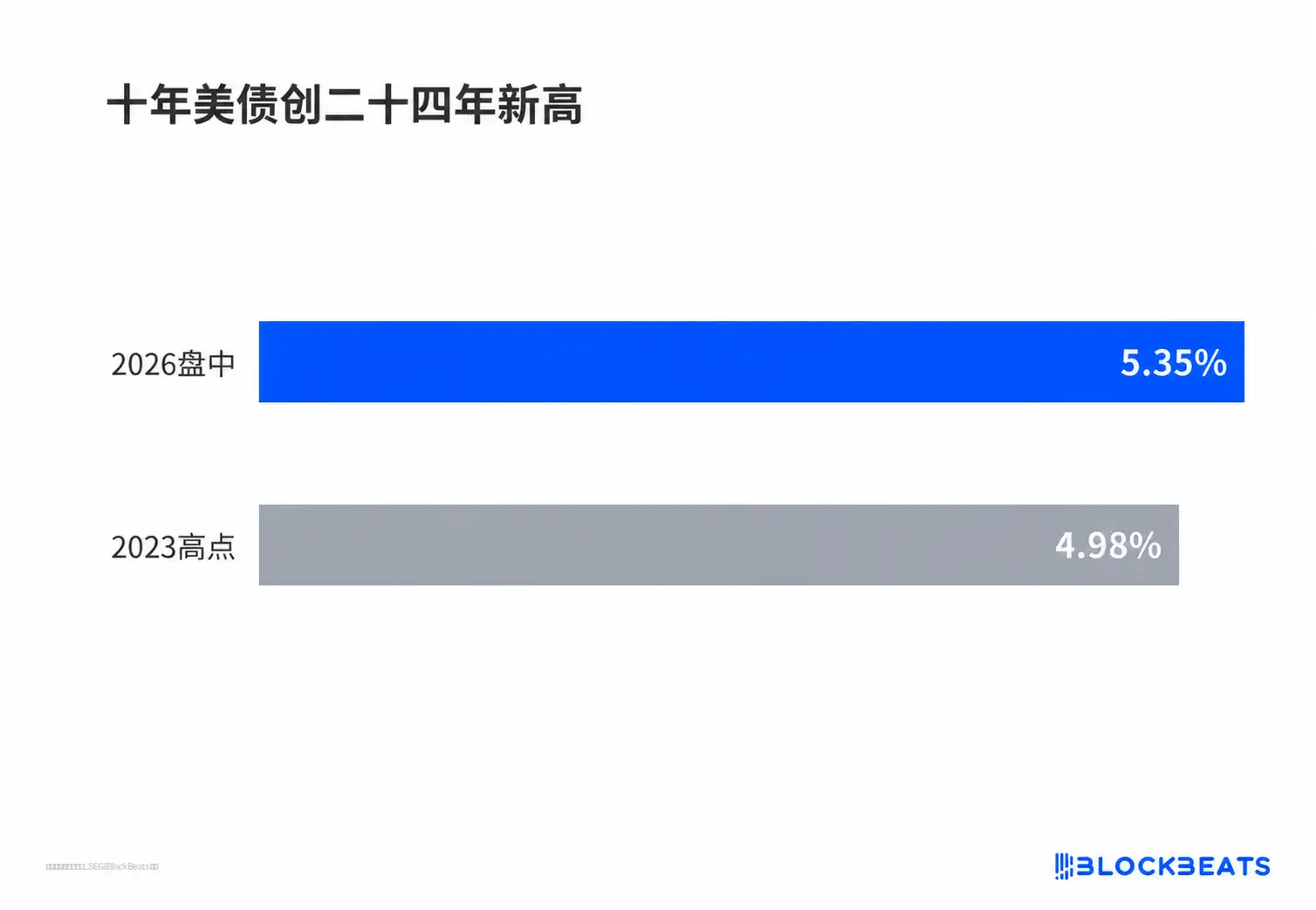
Ten-year Treasury hits 24-year high
On one side, the long end has already tightened financial conditions on behalf of the central bank; on the other, policymakers believe it is still far from enough. The point of divergence is that the short end and long end have decoupled, with short-end expectations moving lower while the long end moves higher.
The long end is rising on the wholesale price of money
For investors, the 10-year Treasury yield is the pricing benchmark for global assets. Mortgages, corporate bonds, and stocks all use it as a discount rate reference. When it rises, it means the wholesale cost of borrowing for the entire economy becomes more expensive.
This time it is not the short end that is moving. The 2-year yield is around 4.8%, the federal funds rate target range is 3.75% to 4%, and the 10-year is about 130 basis points above the policy rate.
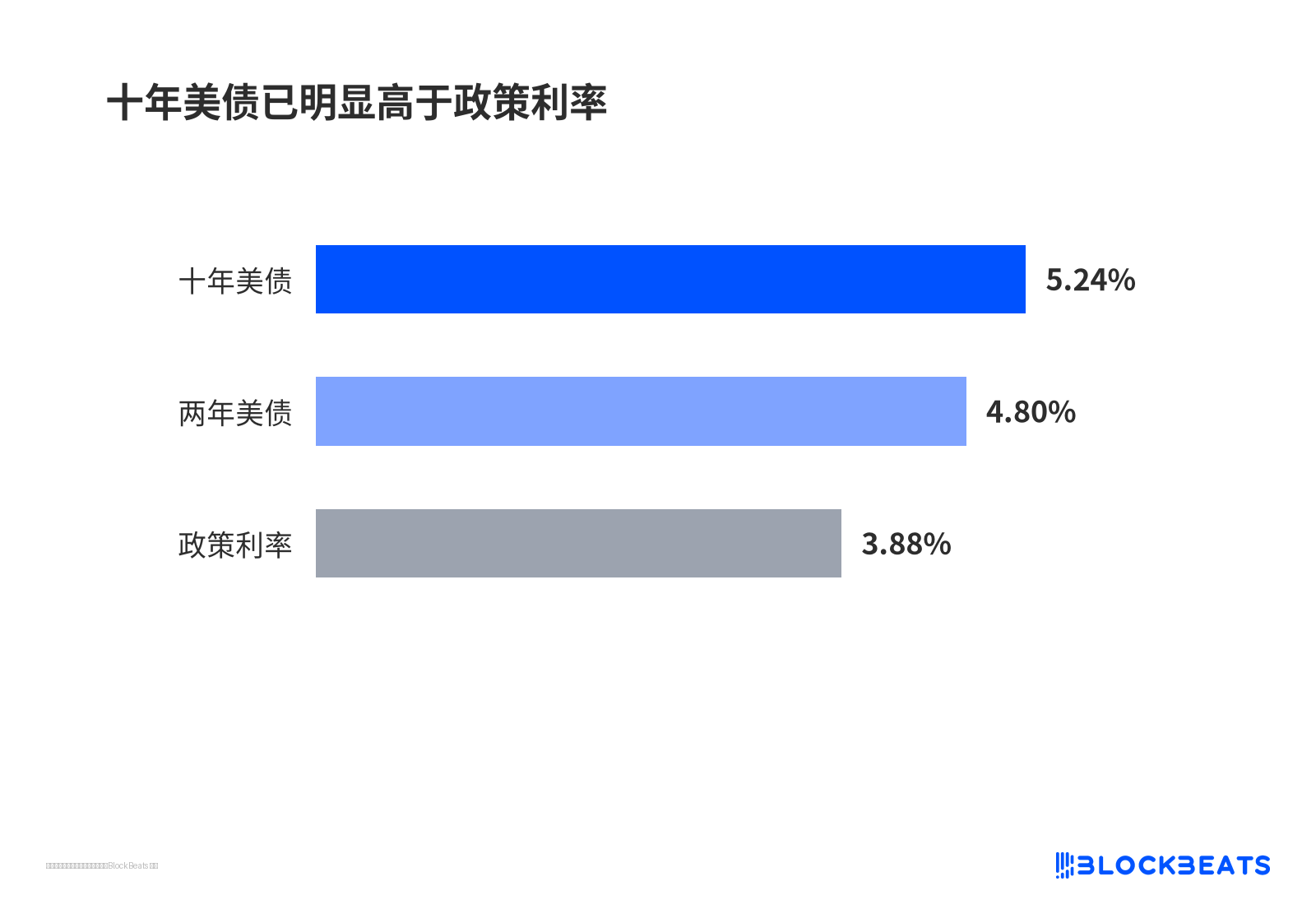
The 10-year Treasury is now clearly above the policy rate
The market is not pricing the next few meetings, but the price of money for more than the next decade.
At the same time, swap pricing for future rate hikes across major global economies has fallen notably since mid-September, and the market-implied probability of a U.S. rate hike in October has also dropped to a low level. Short-end expectations are falling while the long end is rising, indicating that what is pushing the long end higher is not the market's judgment on the policy path.
Term Premium Decouples the Long End from the Policy Path
First, an explanation of term premium. Lending money to the government for thirty years requires not only forecasting the path of future short-term rates but also charging an extra compensation for long-term uncertainty. When that compensation gets more expensive, long-bond prices fall even if the central bank stays put. This round, the 30-year term premium has risen to multi-year highs.
One driver is supply. The Treasury keeps issuing long bonds, and investors demand higher yields before they will take them down. Another is the competition for long-term capital—AI capex is competing with Treasuries for the same pool of money, with data center financing and corporate bond issuance both pushing up funding costs.
Some institutional investors say this selloff has already forced some hedge funds to stop out. There are also more aggressive views in the market that yields could approach 6% next year. The latter is an extreme scenario, not a consensus, but it shows the market is starting to price fiscal and long-term uncertainty.
Asset Managers Cutting Positions Amplified the Speed in Early October
The accelerated decline in early October was related to passive de-risking by asset managers. Asset managers often use futures to amplify long-bond positions. When yields rise rapidly, the same position loses faster, forcing them to cut, and cutting further pushes yields higher.
This is a trading-level amplifier, not the central bank dumping bonds. It explains the speed of the rise in early October, not the starting point of this trend. Whether the trend continues depends on whether long-bond supply can be steadily absorbed.
Mortgages, Small Caps, and Emerging Markets Are Already Paying the Bill
The transmission from long-end rates is already showing. The average 30-year fixed mortgage rate has risen to around 7.4%, back to highs not seen since late 2023.
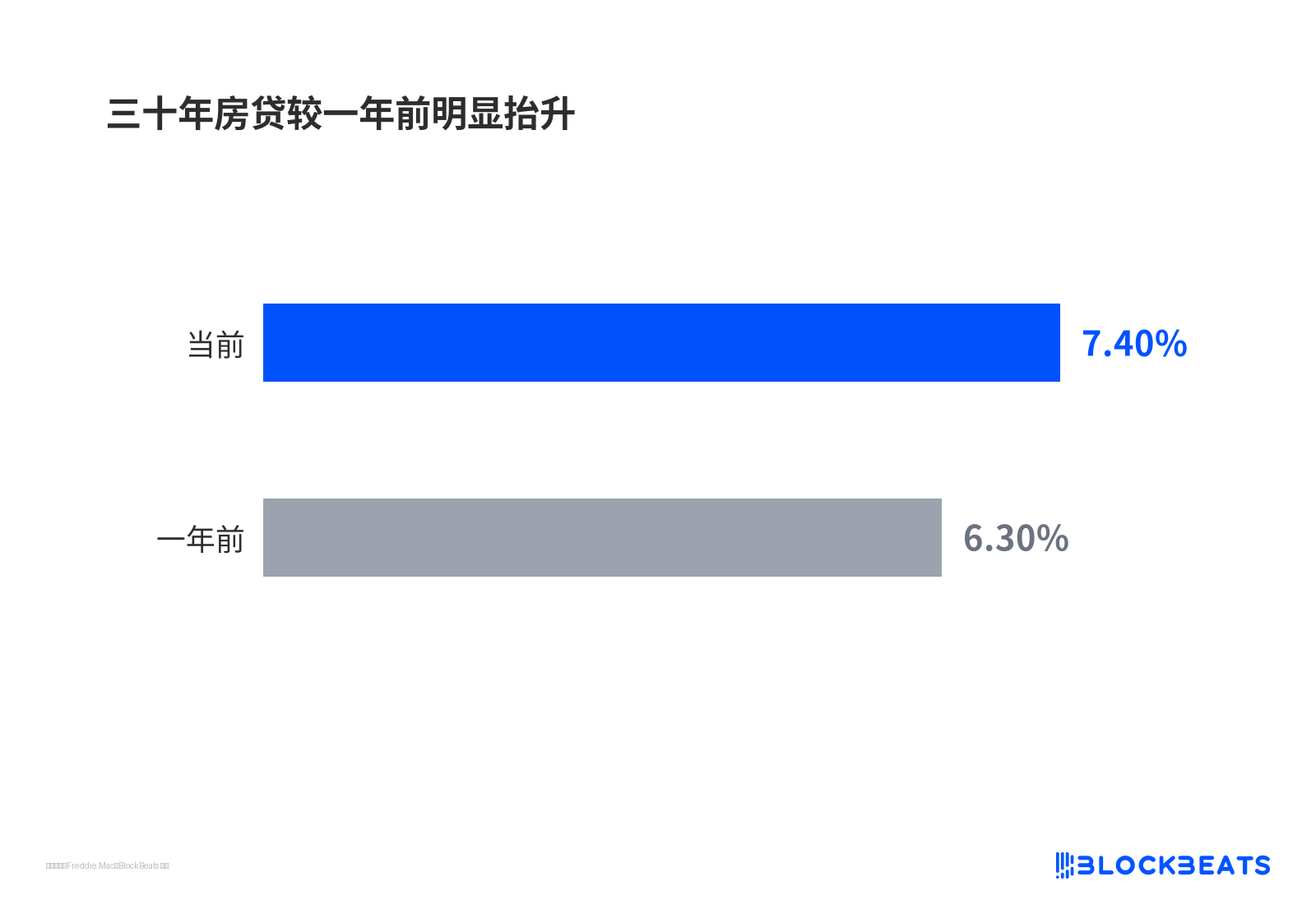
Thirty-year mortgages have risen notably from a year ago
Working backward from a monthly payment of no more than 30% of income, the income needed to buy a median-priced home is already well above median household income, and further rises in mortgage rates will only widen that gap.
Small caps are more sensitive to rates. The Russell 2000 has fallen for multiple consecutive weeks, down nearly 10% from its August high. Such companies have a high share of short-term and floating-rate debt, and refinancing costs will rise notably as the long end moves up.
Mortgage-backed securities are also under pressure, with related funds seeing persistent outflows in recent weeks, and September was one of the weaker months in recent years. An extreme spillover example appeared in frontier markets, where the Ugandan shilling briefly fell to its weakest in decades. It is an extreme spillover reading, not a template for a global crisis.
Inflation Data and Long-Bond Auctions Will Determine Whether 5.3% Is the New Anchor
Wednesday's CPI release is the next observation point. The market consensus expects headline inflation to rise to 3.6% to 3.7% on energy, with core inflation at about 2.4%. This is an expectation, not an outcome, and the October 27-28 policy meeting will provide another clue.
If core inflation continues to moderate and long-bond auction demand improves, the term premium may be compressed, and the long end could shift into high-level range trading. If corporate pricing power remains as strong as Hammack has seen in conversations with businesses, short-end rate-hike pricing will be revised higher again, and financial conditions will need to tighten another notch.
Whether the 5.3% 10-year yield is a cyclical high or the new anchor for pricing over the next two to three years depends on whether long-bond supply can be steadily absorbed and whether core inflation will reaccelerate. These two variables matter more than Hammack's comments alone.
Welcome to join the official BlockBeats community:
Telegram Subscription Group: https://t.me/theblockbeats
Telegram Discussion Group: https://t.me/BlockBeats_App
Official Twitter Account: https://twitter.com/BlockBeatsAsia