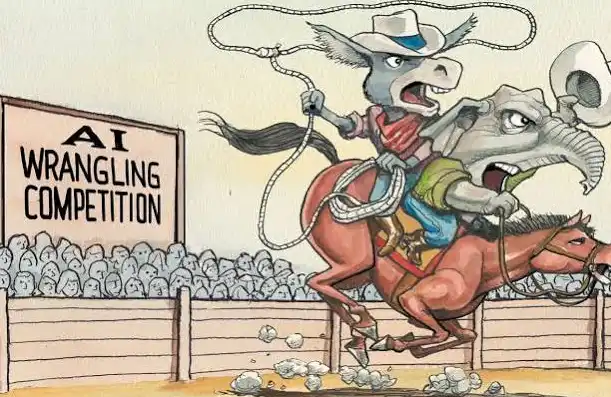
The long and short US Treasury yield curve approaches inversion, signaling a precursor to recession?

TL;DR
· On September 16, the Federal Reserve unanimously raised rates by 25 basis points, lifting the federal funds rate target range to 3.75%-4.00%, the first hike in three years. A week later, the 2-year vs. 10-year Treasury yield spread (2s10s) narrowed intraday to 17 basis points, the narrowest since early 2025, though it has not yet inverted.
· The debate is whether this flattening reflects the short end catching up to the policy path, or the bond market starting to reject the "strong economy" narrative. The 3-month vs. 10-year spread remains around 93 basis points, bank stocks have pulled back about 10%, and broad equities have yet to confirm recession pricing.
· Related instruments: 2-year vs. 10-year Treasury spread, KBW Bank Index, federal funds rate futures, high-valuation AI growth stocks.
On September 16, the Federal Reserve voted 12-0 to raise the federal funds rate target range by 25 basis points to 3.75%-4.00%. This was the first rate hike in three years and the first rate adjustment since Kevin Warsh took office as chairman in May of this year.
In the following week, the 2-year vs. 10-year Treasury yield spread (2s10s) narrowed intraday to 17 basis points, the narrowest since early 2025, just one step away from inversion. An inversion occurs when the 10-year yield falls below the 2-year yield, historically often seen as a recession precursor.
Debate followed. Whether this flattening reflects the short end catching up to the policy path, or the bond market starting to discount the claim that "the U.S. economy is strong." Zach Griffiths, head of macro strategy at CreditSights, believes the flattening will prompt the market to re-question the judgment that "the economy is very strong."
Gennadiy Goldberg, head of U.S. rates strategy at TD Securities, holds the opposite view, expecting limited room for further significant upside in the short end.
Bear Flattening: Short End Chases Policy, Long End Fixates on Growth
This round of flattening was driven by the short end leading gains, while the long end did not decline on recession fears. The 2-year yield was around 4.9% early this week, more closely aligned with the policy rate and future rate hike pricing.
The 10-year yield was around 5.2% over the same period, near its highest level since 2007, reflecting growth, inflation, term premium (the extra compensation demanded by duration-locking funds), and fiscal supply. Federal funds futures have priced in at least three 25-basis-point hikes over the next year, causing the short end to catch up rapidly.
The same flattening can carry different meanings. In August, the long end surged as the market questioned Warsh's anti-inflation credibility, producing a bear steepening of the curve. After the September rate hike landed, the short end took over the rally, turning the curve into a bear flattener.
A bear flattener corresponds to rate hikes and inflation repricing, while a bull flattener is when funds chase long bonds and bet on recession. This round belongs to the former.
Bond bears: Will inversion negate the "strong economy"?
What bears are wary of is the short end continuing to be pushed higher by rate hike expectations, rather than the specific spread reading on any given day. Once the short end accelerates upward, bank net interest margins, high-valuation growth stocks, and long-duration assets will feel the pressure first.
Griffiths put it more directly. He pointed out that this kind of flattening or inversion would call into question the view that the "economy is very strong," which is exactly what the bond market is currently pricing in.
Jamie Patton, co-head of global rates at TCW, believes that if inversion does occur, the signal is that the Fed has hiked too much and will need to cut rates more aggressively in the future, which is not healthy for the macro picture.
Ed Al-Hussainy, a portfolio manager at Columbia Threadneedle, went further. He publicly stated that he is positioning for 2-year versus 10-year and 5-year versus 30-year inversion trades, on the grounds that curve flattening and eventual inversion is the best indication that monetary policy is tightening.
The other side: Hikes already priced in, 3-month and 10-year still steep
The counterargument's key point is that the market has already priced in a large number of rate hikes, and the short end has limited room to continue rising significantly relative to the long end. Goldberg judges that 2s10s is more likely to steepen in the coming weeks rather than flatten further.
Warsh emphasized economic strengthening in the statement and press conference, saying financial conditions are hardly notably restrictive. The median of the Fed's Summary of Economic Projections (SEP) shows the policy rate at 4.1% by the end of both 2026 and 2027, with real GDP growth of 2.3% and 2.4% this year and next, and only a few officials viewing this hike as a one-off move.
Harder counter-evidence comes from the 3-month versus 10-year spread (3m10s). On September 25, that spread was about 93 basis points, and in mid-to-late September it held between 80 and 94 basis points, far from flattening, let alone inverting — and the Fed has also placed more weight on this indicator in recent years.
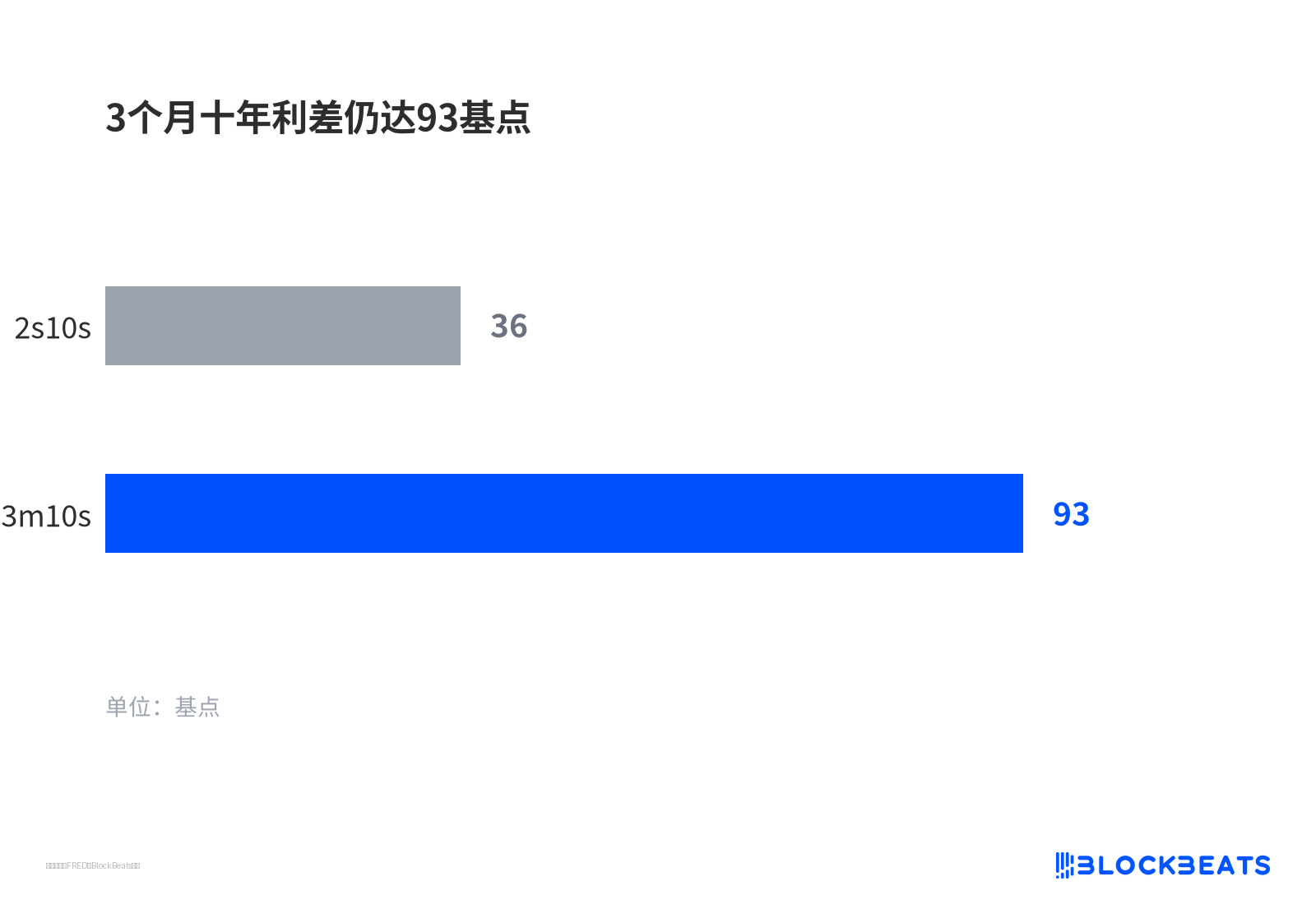
The 3-month/10-year spread still stands at 93 basis points
History also provides a reference. From 2022 to 2024, 2s10s saw the longest inversion in modern times, lasting about 25 to 27 months, and a recession did not materialize as most economists had expected.
Banks fall first, stock market hasn't confirmed narrative reversal
The most direct equity mapping of a flattening curve is banks. The KBW Bank Index has fallen more than 10% from its August high, entering a technical correction.
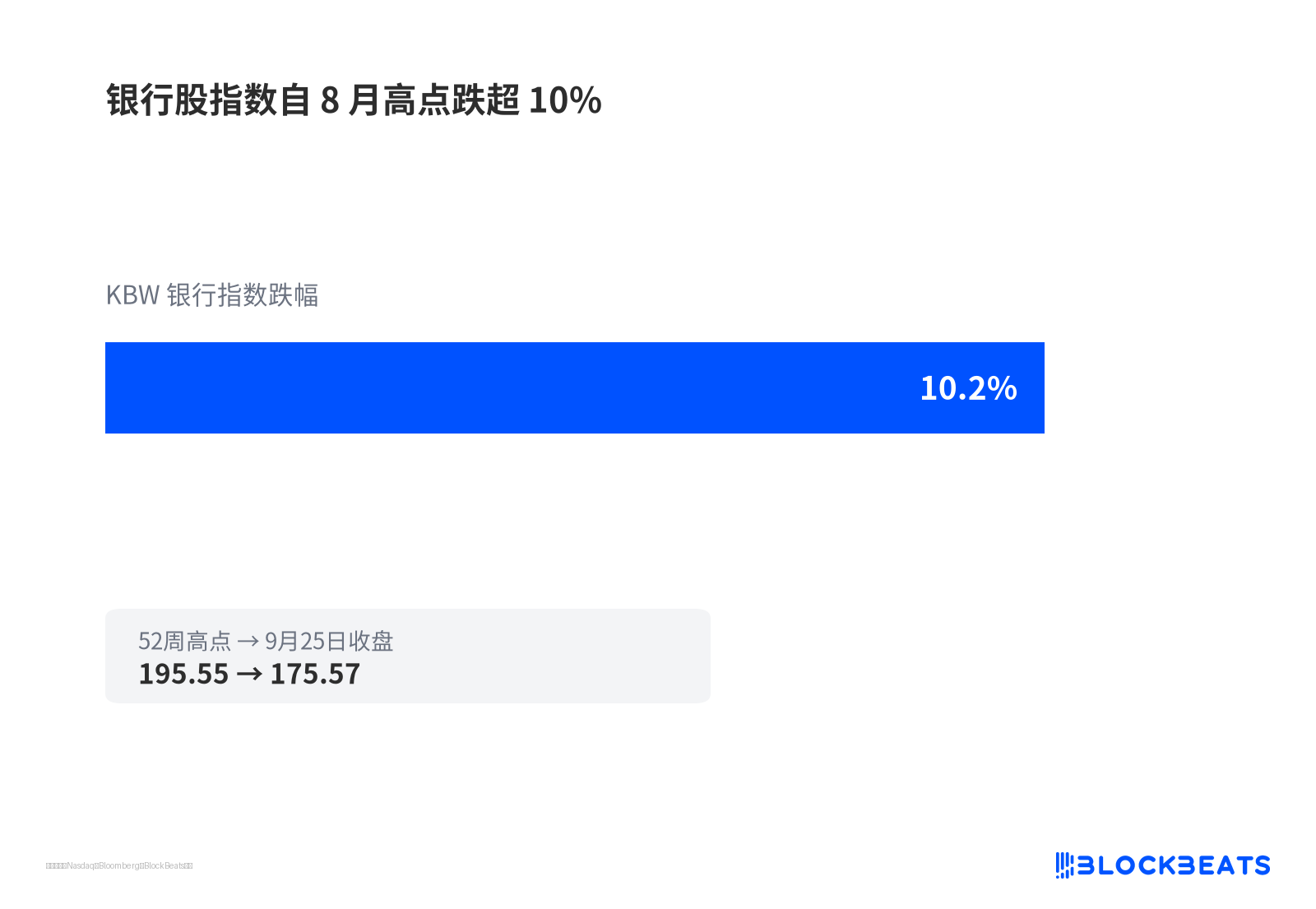
Bank index down over 10% from August high
Banks borrow short and lend long, and narrowing spreads erode net interest margins.
This decline cannot be simply attributed to a single spread; regulation, the credit cycle, and sector rotation are also at play. The broad stock market is giving the opposite signal — market gauges show the S&P 500 is still rising over the past week and near recent highs, with a forward P/E of about 19x, below 22x at the start of the year.
The 10-year real yield is about 2.82%, at its highest since 2008, and high rates have not yet broken earnings expectations.
At the global level, the scope needs to be narrowed. Some broader interpretations say this round of flattening will "reverse global curve normalization," but verifiable evidence is mainly concentrated in the U.S. The UK gilt 2-year and 10-year spread is still positive at about 18 basis points, and the German bund curve also maintains a normal slope.
Growth data will determine whether this is repricing or an alarm
Existing evidence can only support one judgment: inversion risk has risen to a level that needs to be priced, but it cannot yet be said that inversion has occurred, let alone that a recession signal has been confirmed.
Intraday extremes and closing levels need to be viewed separately. The Federal Reserve Economic Data (FRED) daily closing spread has recovered from about 20 basis points on September 21 to about 36 basis points on September 25.
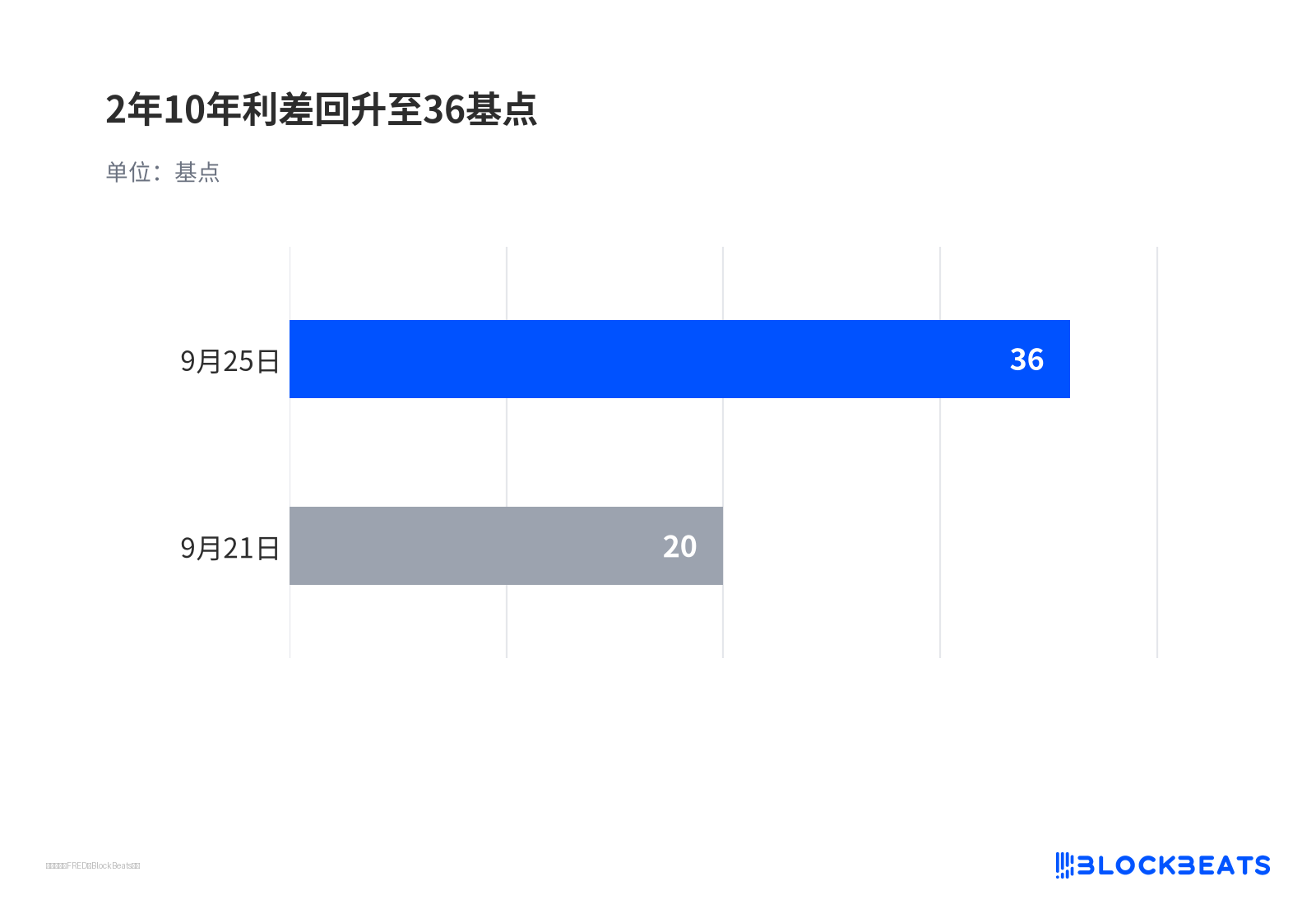
2-year 10-year spread rebounds to 36 basis points
17 basis points is more like a thermometer after crowded rate-hike expectations, rather than hard evidence of an economic stall.
What determines direction is still growth data. If October data or the next meeting continue to push up short-end pricing, while fourth-quarter growth, employment, or inflation show a clear turn, voices questioning the strong-economy narrative will quickly gain the upper hand.
Conversely, if 3m10s remains steep and earnings expectations hold steady, the curve may steepen again, and the current flattening would just be a repricing in a bear market. Bank net interest margins and the sensitivity of highly valued assets to the rate path are the most direct observation windows for the coming months.
Welcome to join the official BlockBeats community:
Telegram Subscription Group: https://t.me/theblockbeats
Telegram Discussion Group: https://t.me/BlockBeats_App
Official Twitter Account: https://twitter.com/BlockBeatsAsia