Quant Trader Takes on $40 Billion Kalshi Empire, Tearing Off the Fig Leaf of Trading Volume Fraud

A Comeback That Sparked Trouble
The day before yesterday, crypto KOL and head of Kalshi Crypto's market division, IcoBeast, posted an image on Twitter with the caption: "Folks, is 96.7% a lot?"
This figure came from an Artemis chart showing trading volume share in prediction markets. Kalshi occupied the vast majority, while Polymarket was squeezed at the top. Beni replied below, saying three-quarters of the volume is wash trading, so achieving that share is naturally easy.
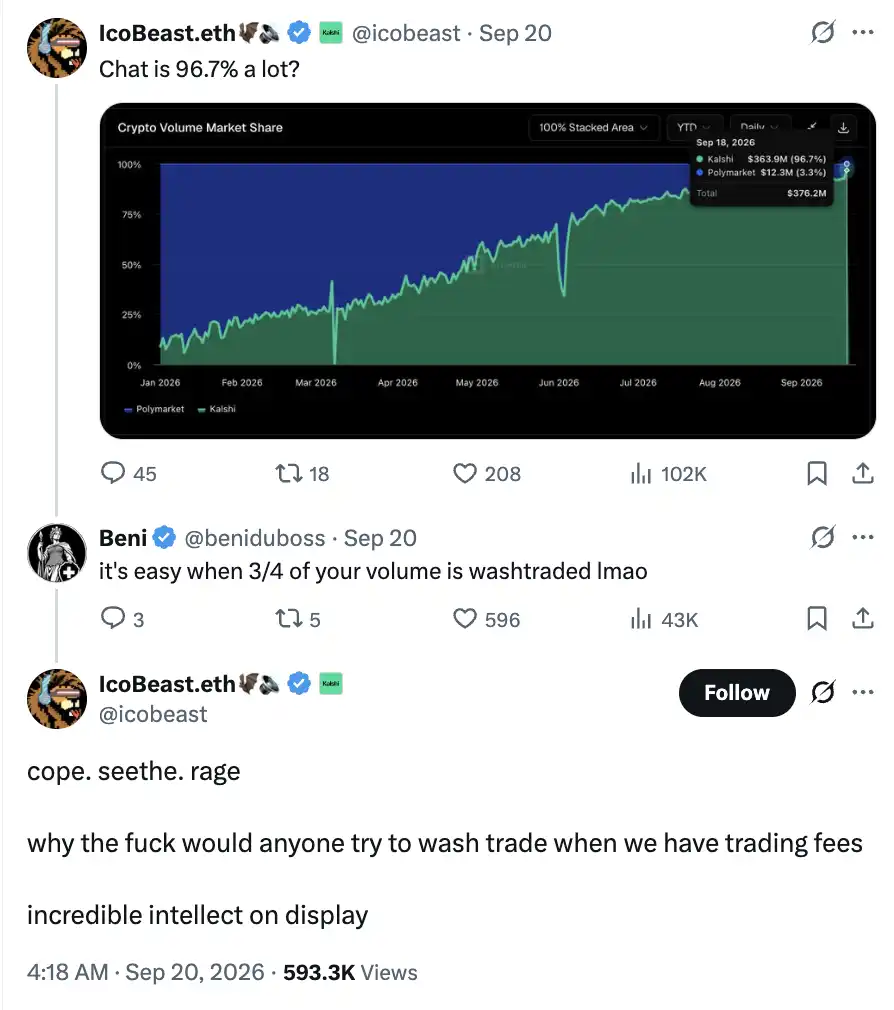
Next, IcoBeast fired back with a rebuttal that would be repeatedly quoted: "We charge trading fees, who the hell would still wash trade?" He didn't forget to mock the other's intelligence at the end.
Beni initially took him for a KOL paid to promote Kalshi and advised him to think it through and delete the tweet. IcoBeast retorted that he works at Kalshi, built the company's crypto market business from scratch over the past year, and knows these volumes are real. Then, he threw back the line "I'll give you a few minutes to think it over and delete the post" at Beni.
This might be the tweet IcoBeast regrets most in his career, because he angered someone he shouldn't have.
Beni then posted a long thread. The first rebuttal targeted the fees: In Kalshi's perpetual contract rebate program, eligible members are allowed to pay 0.3 basis points when taking orders and net receive 0.3 basis points when making orders. Assuming a trade with a notional amount of $1 million occurs between two members, the taker pays $30, the maker receives $30, and the total platform fee for both sides is zero.
Where did the "platform fees" IcoBeast mentioned go?
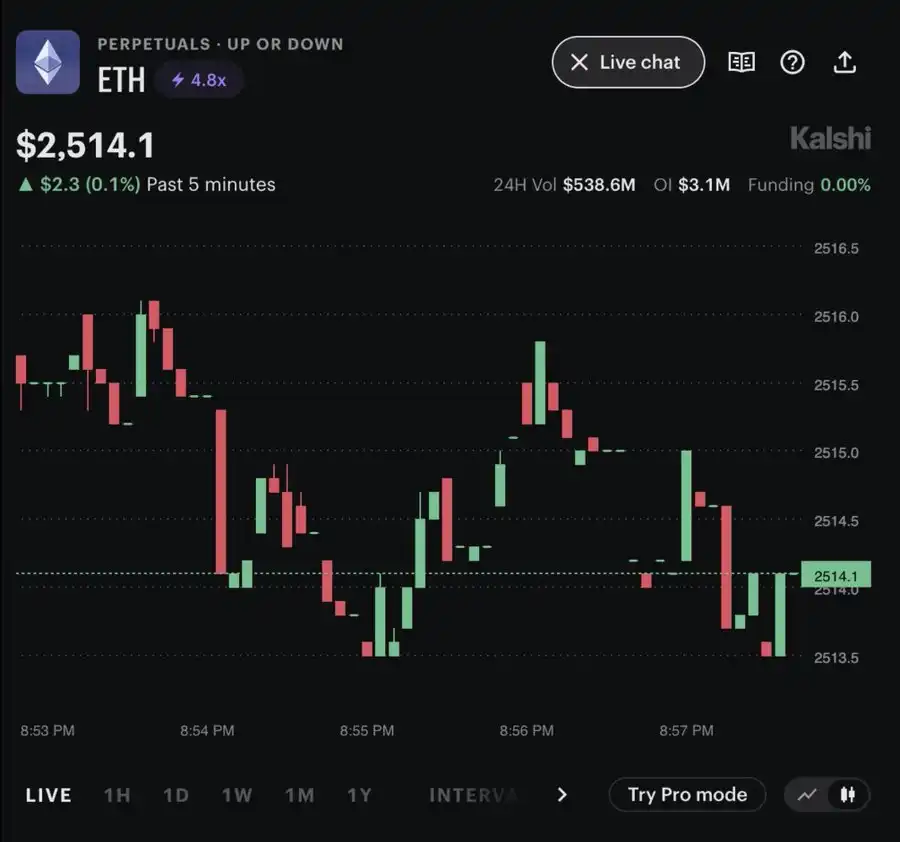
Subsequently, Beni posted the ETH perpetual contract page: 24-hour trading volume of $538.6 million, with open interest of only $3.1 million. The day's trading amount was about 174 times the existing positions. Then, he found recurring $5,500 orders and publicly accused these fixed-amount trades of manufacturing volume.
IcoBeast later added an important distinction: what he originally showed was prediction market share, while what Beni used to discuss rebates and positions was perpetual contracts. Prediction markets don't have the 0.3 basis point rebates Beni mentioned.
The issue is that IcoBeast's clarification only addressed the prediction market business and did not respond to the wash trading in the contract market. Beni seized on this point and continued his attack, leaving Kalshi with more and more to explain.
Genius Trader
Beni's sensitivity to orders and fees stems from his work experience.
In a podcast interview, Beni recalled that he first got into Bitcoin to play online poker. Later, his poker friends began making money by buying and selling cryptocurrencies, and he also entered the crypto market. After losing money trading contracts, he shifted to cross-exchange arbitrage and gradually studied order books and trading mechanisms.
In his early days trading on Cryptopia, he would monitor small-cap coin deposits on the exchange. When someone transferred coins in, a sell-off could follow; he would place buy orders in advance at lower prices and wait for the other party to smash through the thin order book. To capture such opportunities, he used block explorers and fed data from different websites into spreadsheets and alert systems.
Later, he and a capital partner ran a market-making bot in the Monero market on TradeOgre. The initial logic was simple: reference prices from other markets, add a spread sufficient to cover fees, and quote on both sides. As he gained experience, he would adjust his quoting range and margin based on large deposits. By his own account, this business at one point accounted for approximately 65% to 70% of the trading volume in that exchange's Monero market.
During Ethereum's "The Merge" upgrade, Beni simultaneously monitored 43 ETH contract markets and discovered that one contract platform's price briefly spiked about 2% roughly every 26 minutes before falling back. He and a friend traded around this pattern for about 18 hours until the opportunity disappeared.
This is the opponent IcoBeast has drawn: a master at finding market inefficiencies.
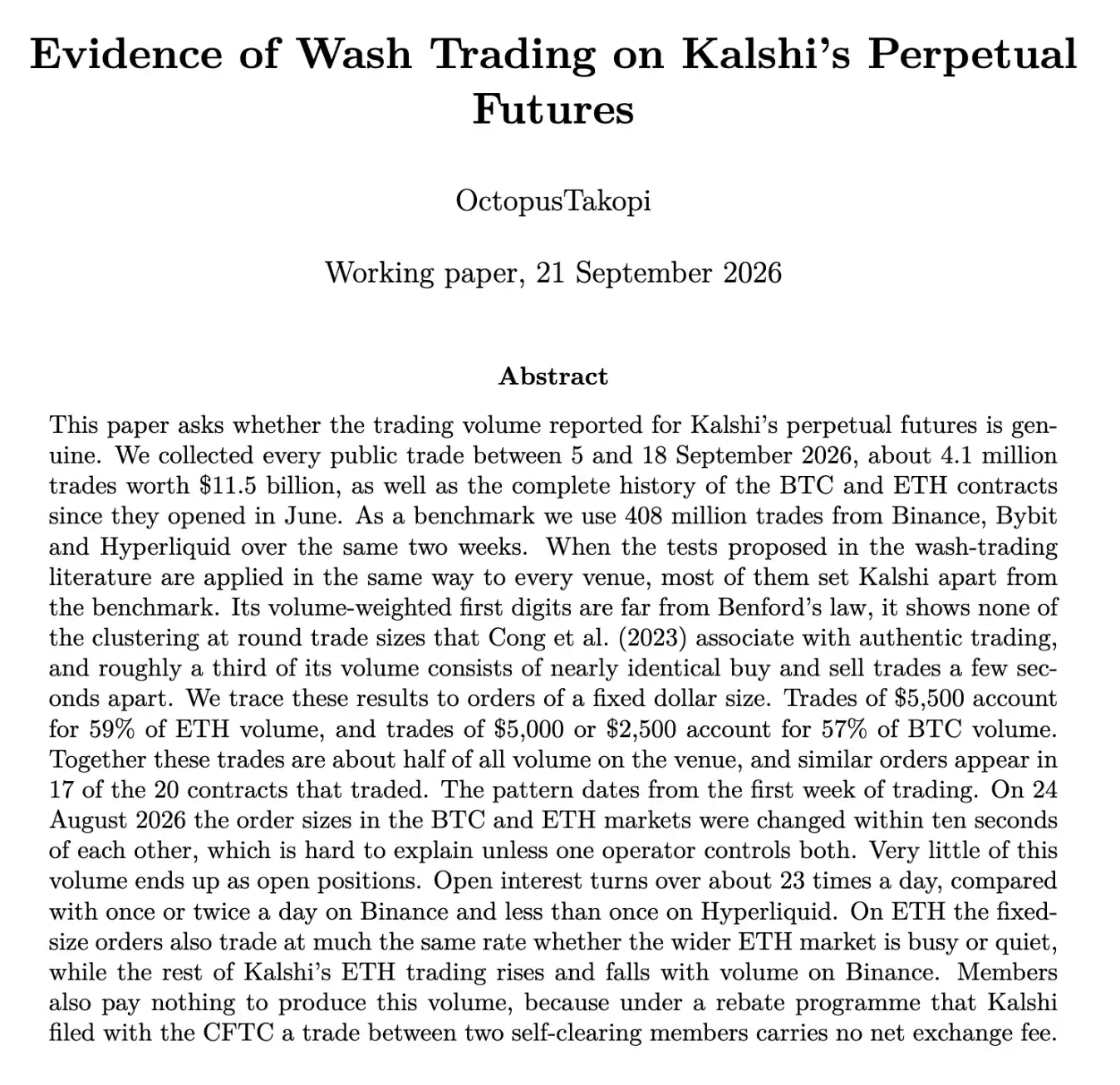
Beni's friend, another quantitative trader named Octopus, subsequently published a working paper that visualized the allegations against Kalshi item by item into charts.
Fixed Trading Volume
This research collected approximately 4.1 million public trades from Kalshi perpetual contracts between September 5 and 18, with a notional trading volume of approximately $11.486 billion, and used approximately 408 million trades from Binance, Bybit, and Hyperliquid during the same period as a comparison.
The most easily understood finding is that trading volume is unusually concentrated around a few dollar amounts.
Source: OctopusTakopi, Figure 3, Page 7. The horizontal axis is the size of a single trade, and the vertical axis is the proportion of total volume accounted for by the corresponding amount range.
In the ETH market, orders of about $5,500 contributed 59% of the volume. In the BTC market, orders of about $5,000 and $2,500 together contributed about 57% of the volume. These three fixed-size order types alone accounted for about 51% of the Kalshi sample volume. We knew it was wash trading, but we didn't know it had become this brazen.
Placing orders at fixed amounts is itself very common; market-making and arbitrage programs may both do this. The next question is why it can account for more than half of an entire market's volume, and why it changes simultaneously across different markets.
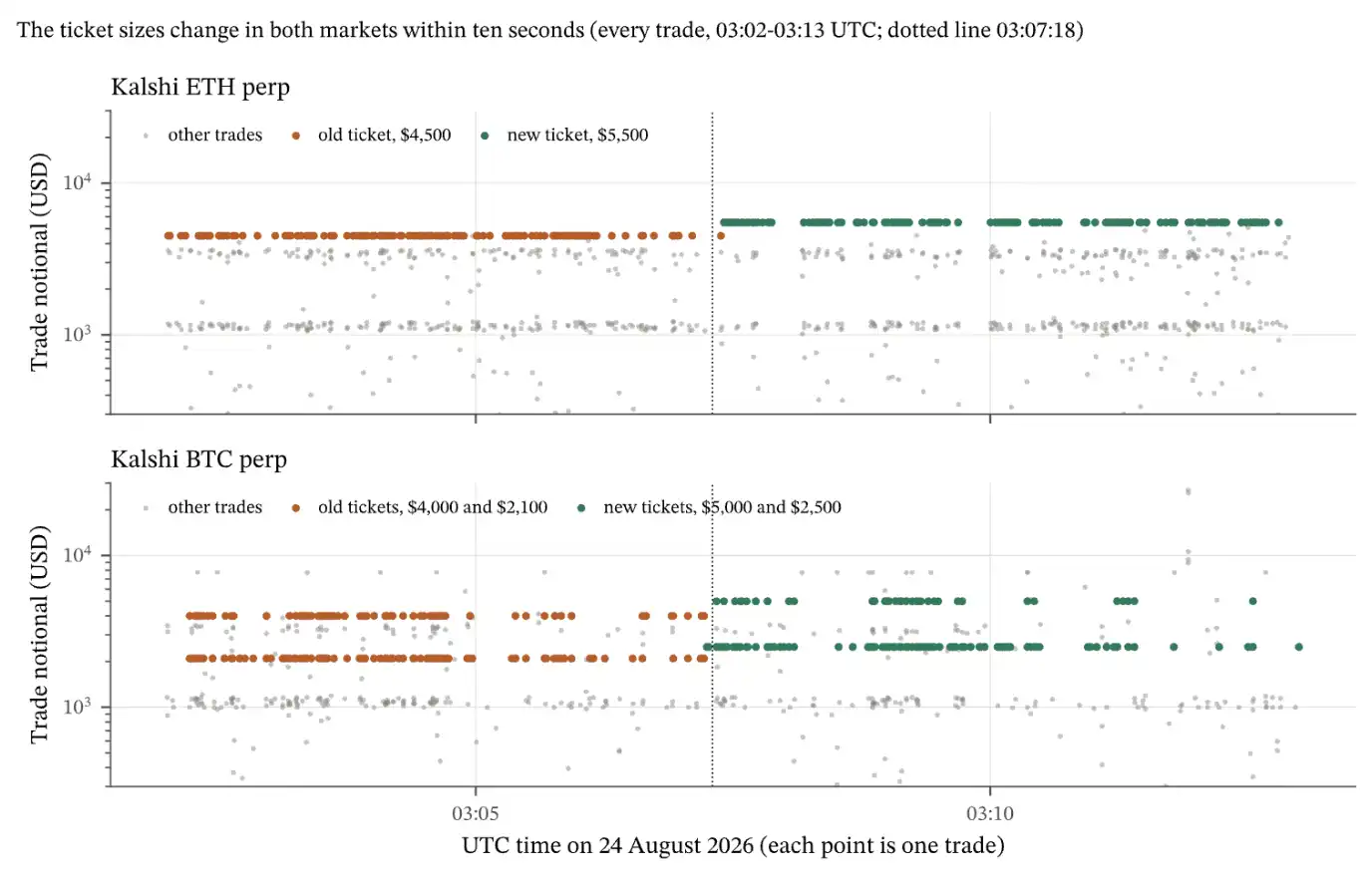
Source: Paper Figure 8, Page 12. Each dot is a trade; orange represents the old amount, green represents the new amount.
On August 24, ETH's fixed order amount changed from $4,500 to $5,500; BTC's two groups of amounts changed from $4,000 and $2,100 to $5,000 and $2,500. The two markets completed the switch within about ten seconds of each other. The orange horizontal lines on the chart end, and green horizontal lines immediately appear.
This looks very much like the same operator modified the parameters of a quoting program. A Kalshi team member thought that always sending $4,500 orders was a bit too fake, so they changed "4,500" in the code to "5,500." They did not even bother to change the program to use random numbers that would be harder to detect.
The time intervals left another set of traces.
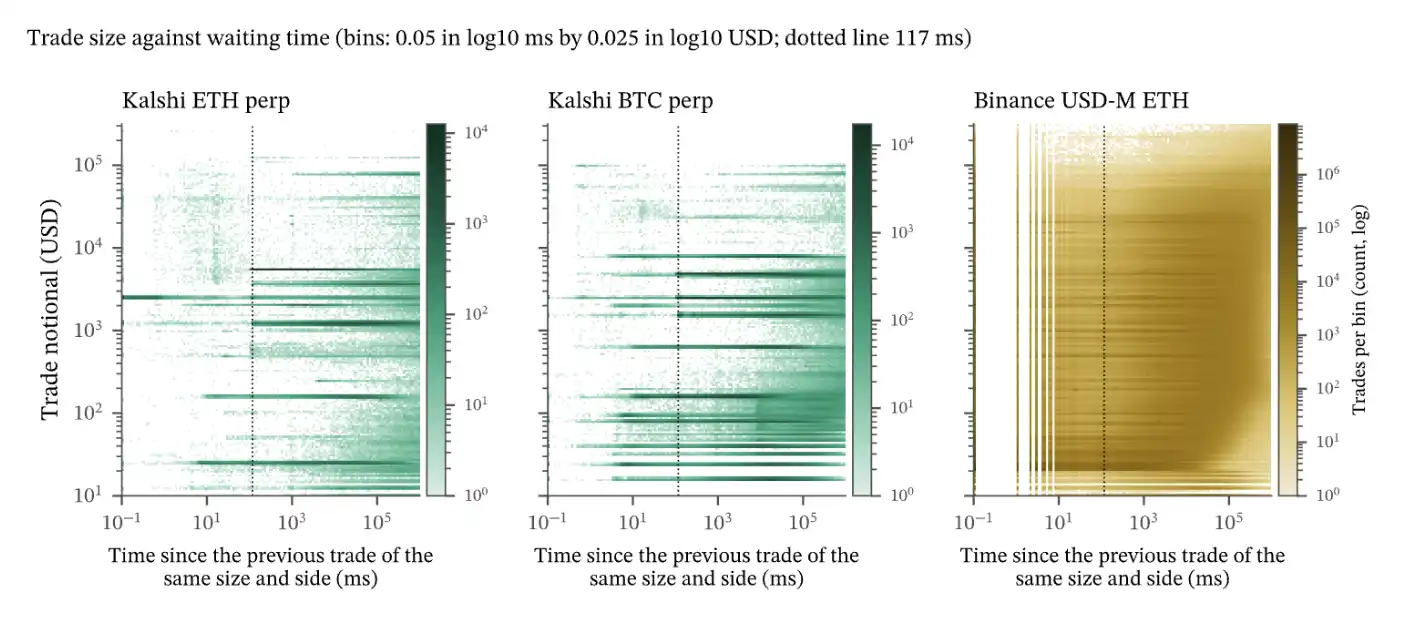
Source: Paper Figure 10, Page 14. The horizontal axis is the time since the previous trade of the same amount and same direction; the dashed line marks about 117 milliseconds.
Among these fixed order types, consecutive trades in the same direction almost never occur less than 117 milliseconds apart. The corresponding dark horizontal lines only begin to appear near the dashed line. Trades of other amounts, as well as the Binance control sample, do not have the same neat boundary.
The paper's explanation is that after a quote is taken, the program needs roughly this long to replenish the next quote. It describes the lower bound on the time formed by the order replenishment speed, and cannot be understood as the bot executing a trade precisely every 117 milliseconds. But when fixed amounts, synchronized parameter changes, and similar replenishment rhythms stack together, "a large number of independent clients all happening to trade this way" becomes very difficult to explain these phenomena.
The positions corresponding to trading volume are also unusually small.
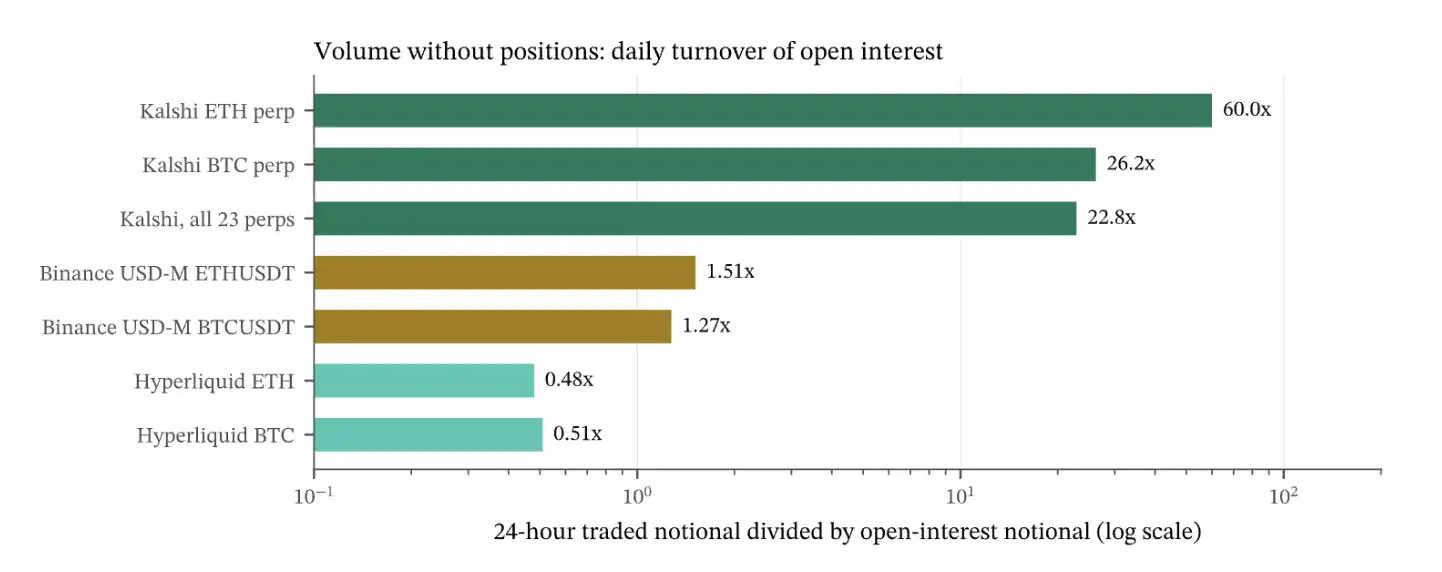
Source: Figure 12 of the paper, page 15. Kalshi and Hyperliquid use September 21 snapshots, Binance uses the median of daily values over two weeks; the horizontal axis is on a logarithmic scale
Kalshi's ETH daily trading volume is equivalent to 60 times its open interest, BTC is about 26 times, and all perpetuals are about 23 times. Binance's comparable values for BTC and ETH are about 1 to 2 times, and Hyperliquid is about 0.5 times. This echoes the 174 times previously captured by Beni.
Normally, a buy or sell of any amount will increase or decrease open interest, and only hedged operations of opening long/opening short with the same amount will keep open interest unchanged.
Therefore, among the 22 trades that occurred on Kalshi, the vast majority were simultaneous long/short hedging wash trading operations.
The paper also found that the ETH group of fixed-amount orders has a very weak connection with external market conditions. Its hourly trading volume has a correlation coefficient of only 0.19 with Binance's ETH hourly trading volume, while the correlation coefficient for Kalshi's other non-fixed-amount ETH trades is 0.72.
In other words, whether the market is busy or not has a significantly smaller impact on this group of orders. BTC's fixed orders did not show the same disconnect, so this point can only be applied to ETH.
These results together support one judgment: Kalshi's perpetual contract trading volume is highly dependent on a small number of mechanical trading flows.
The evidence is overwhelming, and it is now an indisputable fact that Kalshi is wash trading in its own contract market.
Have the dominoes been pushed over?
Phenomena such as the mismatch between trading volume and open interest have long been mentioned by people in the industry, but previously not enough people cared, so regulators did not have to bear pressure because of it. But perhaps this time is different.
Kalshi's political connections may invite more scrutiny as the controversy widens. If political opponents continue to pursue this line, the company will need to address questions about both its trading data and its political ties.
Beyond that, market makers may also follow suit and withdraw. Beni previously cited reports of Jump's equity partnership with Kalshi, questioning the incentive relationship between liquidity and platform valuation; once regulatory attention rises, Jump may reassess whether it is worth continuing to provide liquidity.
Even if a market maker believes its trades are fully compliant, responding to inquiries, reviewing strategies, and explaining business relationships all come at a cost. If those costs exceed the benefits of the partnership, scaling back or exiting becomes the best business choice.
The same problem arises on the funding side. When real trading volume and fees cannot support the original growth expectations, the next funding round may require longer due diligence, harsher terms, or even a lower valuation.
Everything comes full circle. High-valuation DeFi protocols collude with whales to pump TVL, PerpDEXs use clumsy tactics to wash trade volume, and when the tide goes out, everyone is swimming naked.
This time, can Kalshi get away with telling U.S. regulators, "It's just business"?
Welcome to join the official BlockBeats community:
Telegram Subscription Group: https://t.me/theblockbeats
Telegram Discussion Group: https://t.me/BlockBeats_App
Official Twitter Account: https://twitter.com/BlockBeatsAsia