Friday CPI Preview: Inflation Risks Are Shifting, Is the Fed Set to Raise Rates in September?
TL;DR
·A former Federal Reserve economist has shifted their policy stance from "holding rates steady" to "hiking rates," advocating for a 25-basis-point rate increase at the Fed's September meeting, with cumulative hikes potentially reaching 50 to 75 basis points by year-end.
·Current inflation data still supports staying on hold, but disinflation progress remains limited. Core PCE rose 0.2% month-over-month in July, translating to an annualized rate of roughly 3%, still far from the 2% target.
·Sahm believes the slowdown in inflation over the past three months may be influenced by seasonal factors and may not necessarily indicate a clear improvement in underlying inflation trends.
·If Middle East conflicts persistently push up gasoline and diesel prices, cost pressures could gradually spread from energy to transportation and other core goods and services.
·Trade frictions between the U.S. and Canada suggest that the tariff hike cycle may not necessarily be over, and goods inflation could come under renewed pressure.
·AI infrastructure investment could push up prices of key components like memory chips in the near term, with its inflationary nature differing from one-off energy or tariff shocks.
·The rate hike is not a complete reversal of Sahm's baseline inflation scenario, but rather a risk management move: using modest tightening to hedge against the possibility that inflation remains persistently above target over the next year.
Editor's Note: The challenge facing the Fed's September meeting is not just whether the latest CPI report runs hot or cold.
While recent inflation data has eased from earlier this year, the pace of decline remains slow. Meanwhile, Middle East tensions, trade frictions between the U.S. and Canada, and chip demand driven by AI infrastructure investment are creating new price pressures.
Economist Claudia Sahm, creator of the "Sahm Rule," has therefore shifted from her previous stance supporting holding rates steady. She argues that based on current data alone, the Fed can still barely afford to stay on the sidelines; however, monetary policy needs to address future risks, not just explain inflation that has already occurred. Persistently high energy prices could transmit to core inflation, a new round of tariffs could interrupt goods disinflation, and AI capital spending could form more sustained demand pressure.
She still views disinflation as the baseline scenario and acknowledges that the decision to hike or not is a near coin-flip call. But without confidence that PCE inflation will return to 2% on its own within the next year or two, she advocates for the Fed to implement a modest rate hike as "insurance."
The following is a translation of the original article:
Why Did I Shift from "Holding Rates Steady" to Supporting a Rate Hike?
Rate hike or hold? That's the question the Federal Reserve needs to answer at next week's meeting. What's certain is that divisions have already emerged among Fed officials, and such rifts are unlikely to be resolved by a single CPI report.
Recently, I adjusted my preferred policy stance from "holding rates steady" to "raising rates." The reason is that I can no longer be confident that PCE inflation will return to 2% over the next year or two without further rate increases from the Fed.
More importantly, upside risks to inflation have been mounting since July. In my view, the Fed could start with a 25-basis-point hike in September and accumulate 50 to 75 basis points in total by year-end to ensure inflation moves down in a timely and sustained manner.
This doesn't mean current inflation data has clearly deteriorated. On the contrary, recent figures have been slightly positive. What truly tilts the risk balance toward a hike is the prolonged unrest in the Middle East, the trade war between the U.S. and Canada, and chip shortages driven by AI infrastructure buildout.
If we look only at existing inflation data, the Fed could still choose to hold rates steady—but the justification is no longer compelling.
As of July, both headline and core PCE inflation have eased from their peaks earlier this year, which could be seen as evidence that disinflation is ongoing, but the improvement is limited. The 12-month inflation rate has declined slowly, and this week's PPI and CPI readings will serve as key inputs for August's PCE data. Markets broadly expect further cooling, yet the distance from the 2% target remains significant.
I am cautious about the positive signals from the recent three-month changes in inflation. Over the past few years, PCE inflation has shown a seasonal pattern: elevated early in the year, followed by a gradual decline. Core PCE rose 0.2% month-over-month in July, translating to an annualized rate of roughly 3%. That pace is slower than the first half of the year but still clearly above the 2% target.
Thus, recent data looks more like an absorption of the unusual spike seen earlier this year, reverting to the already-elevated pace of last year, rather than evidence of a substantive improvement in the underlying inflation trend.
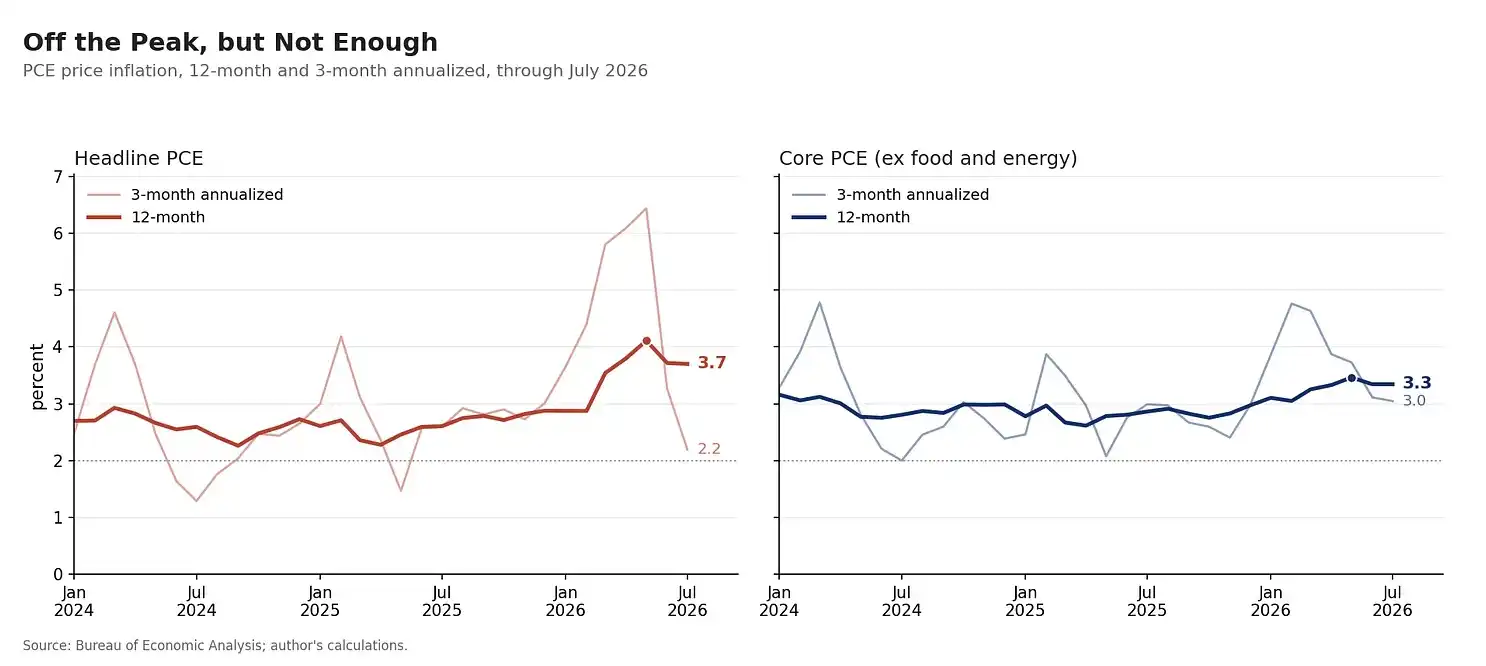
The seasonal pattern of core PCE inflation—high early in the year and lower mid-year—means the cooling signals from the recent three-month data may be overstated
Transitory Shocks Are Becoming More Persistent
Given that disinflation has made limited progress and the labor market remains solid, why has the Federal Reserve kept rates unchanged all along? And why did I support that decision until just a few weeks ago?
The key lies in the type of shocks driving inflation.
Last year, tariffs were raised sharply, pushing up goods prices. But once the higher import costs are fully reflected in final prices, the incremental inflationary impact of tariffs typically fades gradually. The same goes for disruptions to Middle East energy supplies: energy prices spike quickly, but once the conflict ends, prices may retreat, in turn pulling inflation down.
Such shocks tend to cause a one-off rise in price levels, not necessarily sustained inflation. If the Fed responds with rate hikes, it risks over-tightening demand to suppress price pressures that would naturally fade on their own.
Previous data broadly aligned with this assessment, but the risks ahead have shifted.
Risk One: Middle East Conflict Could Transmit Energy Inflation to Core Prices
A mere rise in energy prices is not enough to justify a Fed rate hike. But if energy prices stay elevated for an extended period and gradually feed through to non-energy goods and services, monetary policy may need to respond.
Historical experience shows that after energy prices rise, airfares typically increase quickly; other core prices react more modestly and slowly, with the pass-through effect potentially peaking a year or more later. A 10% rise in gasoline prices adds roughly 0.2 percentage points to core inflation over the following year.
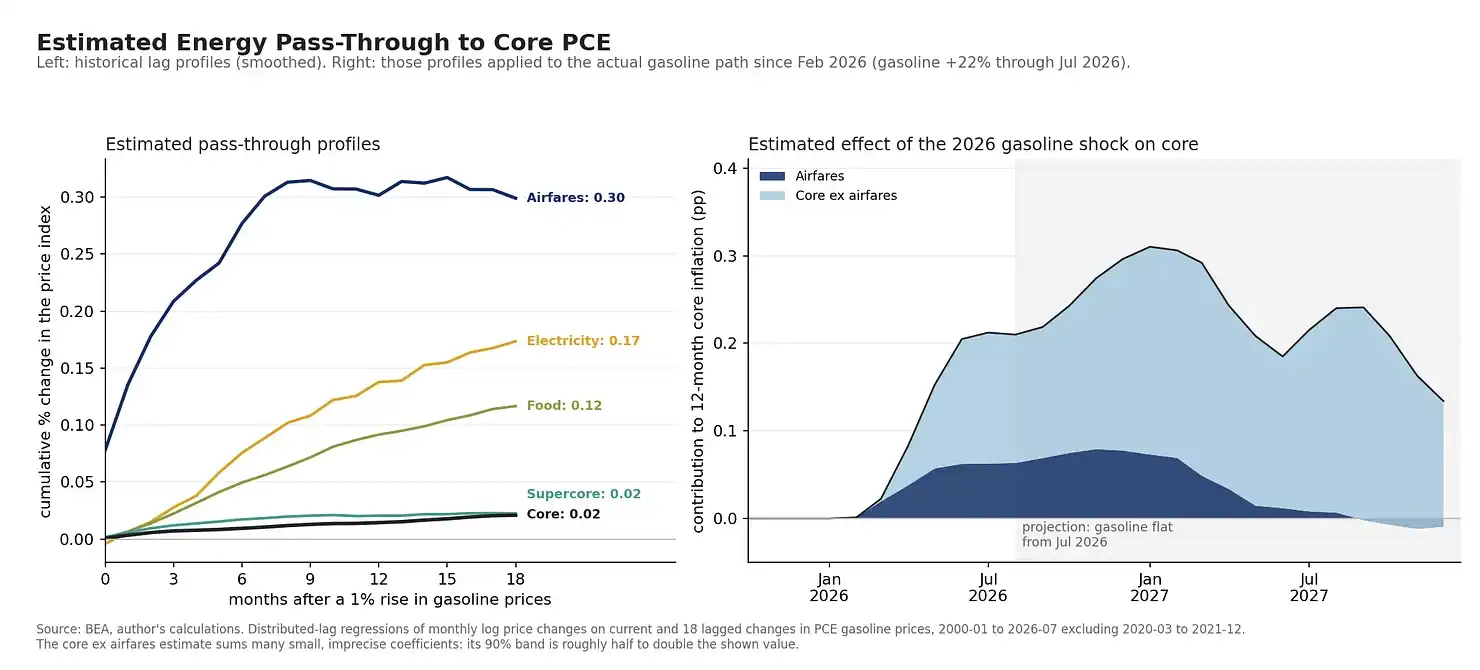
The pass-through of energy price increases to core inflation is slow, with the impact potentially peaking a year or more later
This impact may seem limited, but the longer energy prices stay elevated, the more pronounced the cumulative push on inflation becomes.
At the onset of the Middle East conflict, treating a swift resolution as the baseline scenario was reasonable, but that assumption is now increasingly hard to make. If gasoline prices hold at current levels, the impact on core inflation could extend into next year.
Diesel prices deserve particular attention. As a key cost in transportation and logistics systems, a diesel price surge affects a wide range of goods and services. The lack of progress in reopening the Strait of Hormuz means core inflation still faces further upside risks.
Risk Two: Tariff Hikes May Not Be Over Yet
The Fed's July meeting minutes show that most officials believe the inflationary impact of tariffs has largely peaked and will gradually fade going forward.
This trend is already reflected in the data. After tariffs took effect last year, the three-month annualized increase in core goods prices rose rapidly, peaked early this year, and then fell noticeably over the summer.
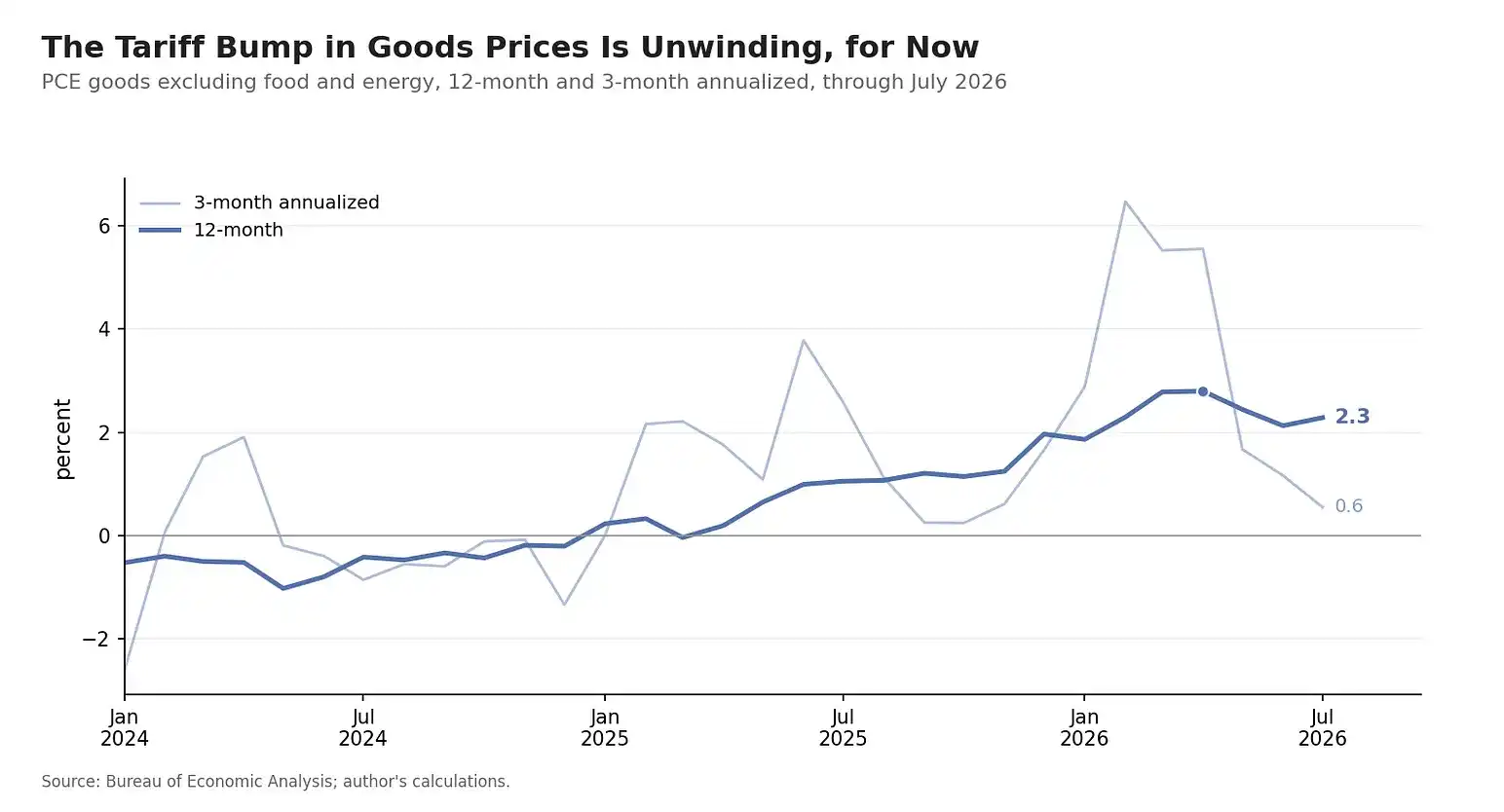
After tariffs were imposed, U.S. core goods inflation initially rose notably; although it has since eased, further cooling is premised on no additional tariff hikes
But continued goods disinflation hinges on the assumption that tariff rates will not rise further.
For now, the scale of Canadian imports affected by the additional 50% U.S. tariffs is relatively limited, but Canada's retaliatory measures against U.S. goods could prompt Washington to raise tariffs further. More importantly, this dispute shows that the U.S. government is still using tariffs as a bargaining tool.
As a result, the risk that tariffs could push inflation higher again has increased compared with the last Fed meeting.
Risk Three: AI Investment Could Also Fuel Inflation in the Near Term
AI infrastructure buildout is another inflation source that is easy to underestimate. Nvidia's latest earnings show AI demand remains robust, with major cloud providers expected to spend more than $1 trillion on capital expenditures next year.
Over a five- or ten-year horizon, AI could have a deflationary effect once productivity gains materialize. But over the next year—the timeframe monetary policy cares about most—the inflationary impact of AI investment is more likely to be upward.
Consumer and business investment price data already show memory chip prices rising. Related spending may account for a limited share of the overall economy, but it still adds to upside inflation risks.
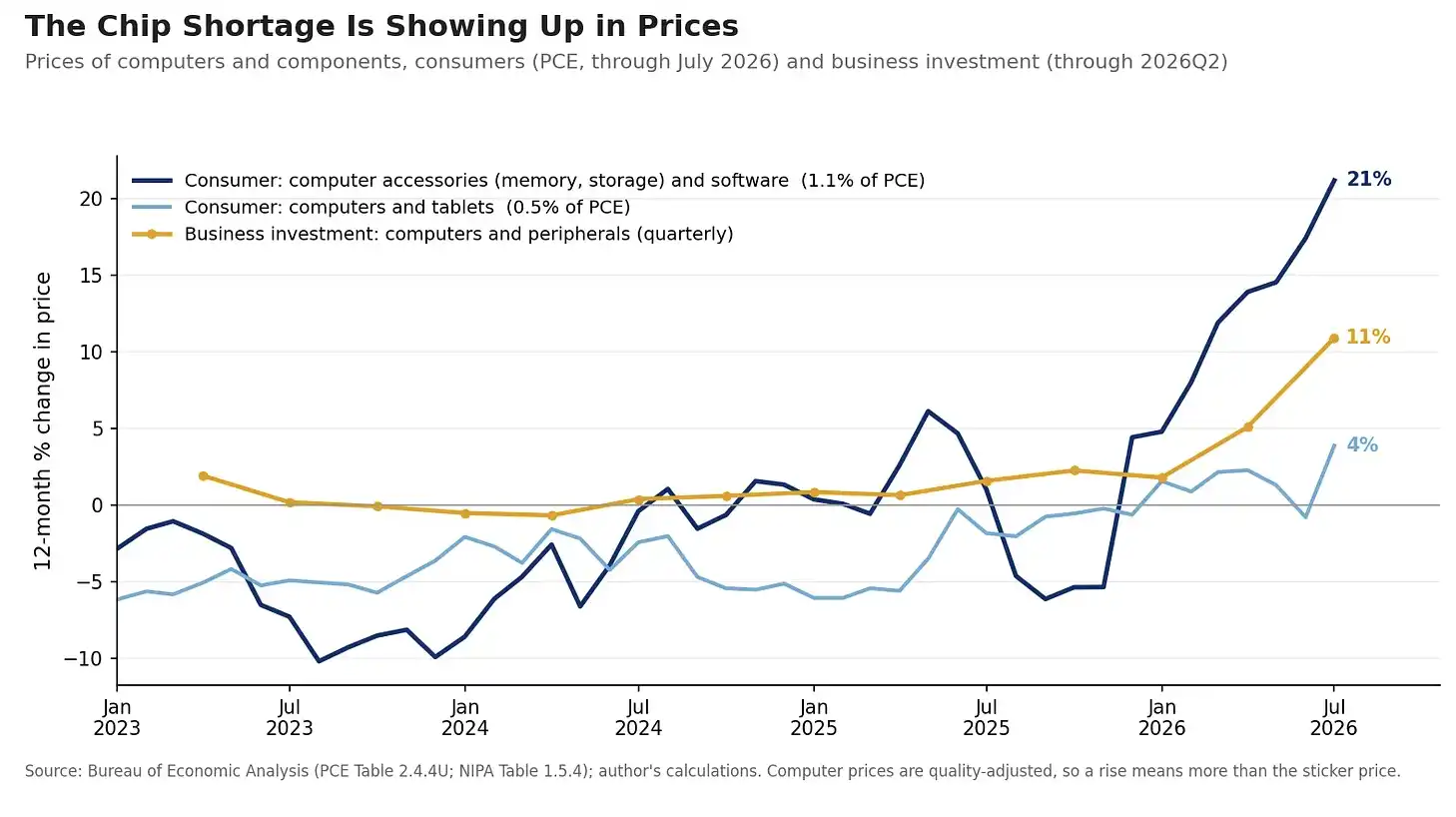
AI infrastructure investment is driving up demand for memory chips, with signs of price increases already emerging in related consumer and business investment spending
The price pressure from AI buildout is essentially a demand-driven factor. For energy and tariff shocks, the Fed can choose to look through them, as their impact may fade on its own; but the memory chip shortage stems from persistently expanding investment demand, and the same logic may not apply.
Rate Hikes Are an Insurance Policy Against Future Risks
All told, my baseline scenario remains one of inflation continuing to ease. However, the upside risks to inflation have become quite substantial, and they are spread across multiple areas, including energy, goods, transportation, and tech investment.
From a risk management perspective, the Federal Reserve has ample reason to tighten monetary policy further. Raising interest rates during a phase of disinflation may sound contradictory, but the policy objective is not merely to eventually bring inflation to 2%, but also to ensure that inflation declines sustainably in a sufficiently credible manner over the coming year.
A modest rate hike now is akin to purchasing insurance against rising inflation risks.
Of course, there is also a reasonable case for holding rates steady, especially when policymakers place greater weight on current data rather than forecasts and tail risks. If this week's inflation data show marked improvement, or if the aforementioned risks ease, I could shift back to supporting a pause. Monetary policy judgments inherently require continuous adjustment as new information emerges.
Since 2024, I have participated in the "Shadow Economic Forecast Summary" organized by Duke University. In March of this year, I still expected the Fed to cut rates within the year; by June, I shifted to supporting a hold; now, I believe the Fed may need to hike twice within the year, with a higher rate path in the years ahead.
This does not mean the Fed will definitely raise rates. For those officials who previously deemed a hold more appropriate, they would need to change their stance as I have in order to form a majority in favor of hiking. This remains a very close call.
Markets Need More Than Just a Decision
Whether the September meeting delivers a hike or a hold will be a difficult decision. Current inflation data are still sufficient to support the Fed's patience, but the inflation outlook has deteriorated due to accumulating upside risks. Based on this, I believe a modest increase in the federal funds rate is more appropriate.
Regardless of the Fed's final choice, markets need a clear explanation.
Uncertainty about the outcome ahead of the FOMC meeting is not frightening; what is truly unacceptable is if, after the press conference concludes, markets still do not understand why the Fed made that decision.
If a majority of officials still believe inflation will return to 2% soon, they need to articulate where that confidence comes from; if they no longer hold that conviction, then the Fed should act to re-establish credibility that inflation can return to target.
Welcome to join the official BlockBeats community:
Telegram Subscription Group: https://t.me/theblockbeats
Telegram Discussion Group: https://t.me/BlockBeats_App
Official Twitter Account: https://twitter.com/BlockBeatsAsia
 Related Articles